An SLA management system helps support teams deliver consistent service while meeting clearly defined expectations. By structuring SLA and service level management within a single management system, businesses gain better control over response and resolution commitments. Clear SLAs reduce confusion, align teams, and create measurable standards for daily operations.
With the right approach, teams improve efficiency by prioritizing requests, tracking deadlines, and avoiding missed commitments. SLA-driven workflows also support stronger accountability and transparency across support processes. As customer expectations continue to rise, organizations rely on structured SLA practices to protect service quality. Over time, an effective SLA management system directly contributes to stronger business performance by ensuring reliable support, faster responses, and a more predictable service experience for customers.
What Is An SLA Management System
An SLA management system is a structured approach to defining, monitoring, and enforcing a service level agreement between a company and its customers. A service level agreement SLA outlines the expected service levels, timelines, and quality standards for provided services. These agreements clearly document what customers can expect and what teams are responsible for delivering.
By formalizing the agreement, organizations set clear responsibilities across support and service teams. Service levels define response and resolution commitments, helping teams stay aligned with expectations. An SLA management system ensures these commitments remain visible and measurable, reducing misunderstandings and supporting consistent service delivery across all customer interactions.
Why SLA Management Is Needed For Support Teams
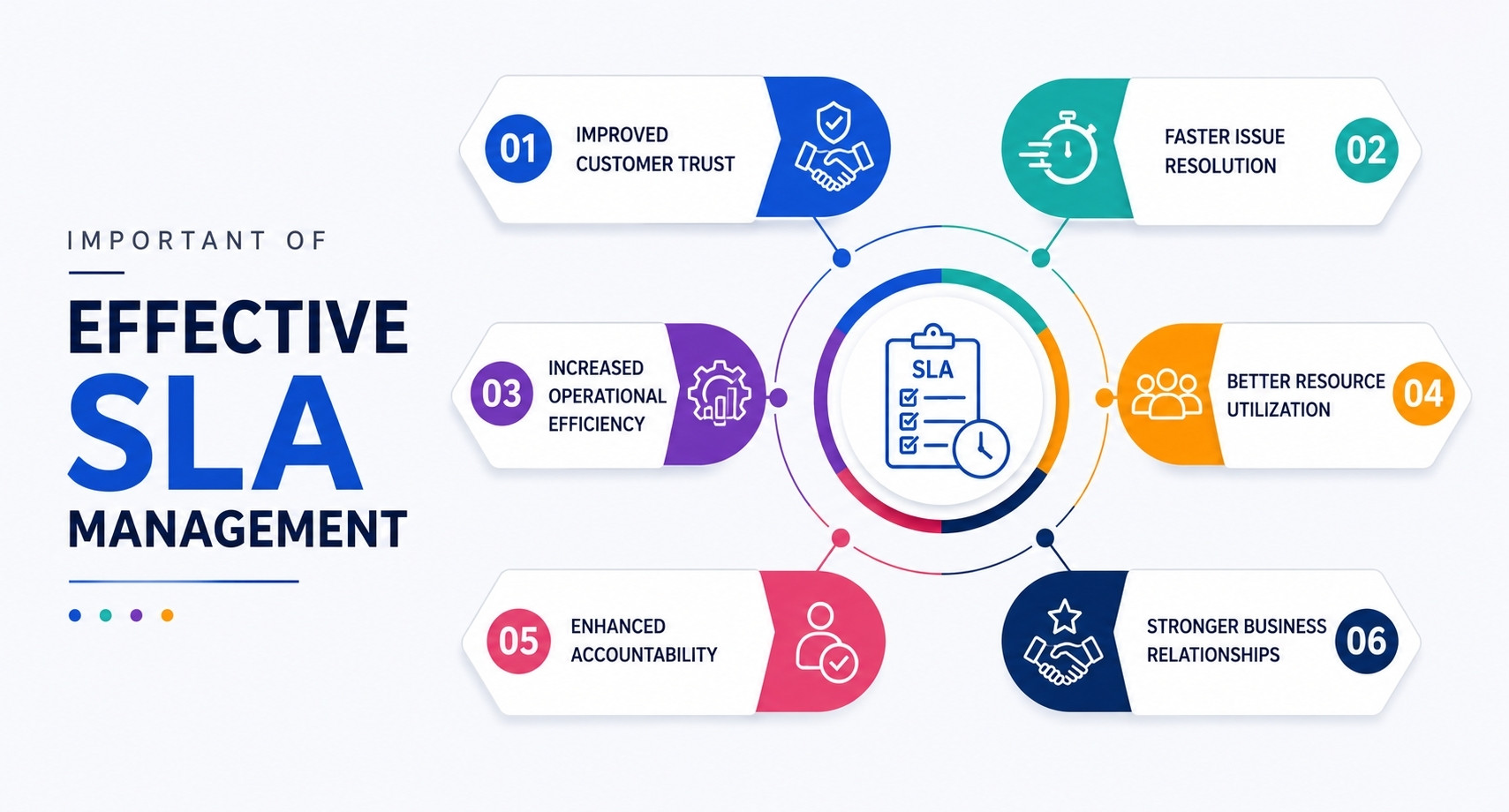
Clear service commitments help support teams stay aligned, responsive, and accountable. SLA management creates structure around expectations, priorities, and performance so teams can deliver reliable support at scale.
Meeting Customer Expectations Consistently
Customer expectations around response speed and service quality continue to rise across digital support channels. SLA management helps teams set clear timelines and service commitments so customers know what to expect from the beginning. Defined SLAs remove ambiguity around response and resolution time, which reduces frustration and follow-up inquiries. When expectations are documented and consistently met, trust builds naturally. Support teams can prioritize work based on urgency instead of guesswork, ensuring important requests receive timely attention. Over time, predictable service delivery strengthens customer relationships and creates confidence that support commitments will be honored across every interaction.
Improving Customer Satisfaction Through Accountability
Customer satisfaction improves when support delivery feels reliable and transparent. SLA support management introduces accountability by clearly defining targets and tracking progress against them. Teams can see approaching deadlines early and take corrective action before issues escalate. This proactive approach, combined with practices for reducing customer support response time with automation, prevents missed commitments and reduces negative experiences. Accountability also improves internal behavior, as agents and managers share responsibility for meeting agreed standards. Customers benefit from faster responses, fewer delays, and clearer communication. When service performance aligns with promises, satisfaction grows, and support interactions feel more professional and dependable.
Aligning Support Team And Internal Teams
Support teams often rely on internal teams such as engineering, billing, or operations to resolve complex issues. SLA management creates alignment by defining shared responsibilities, ticket escalation processes, and timeframes. Internal teams understand priorities clearly, which reduces back-and-forth communication and stalled tickets. Alignment improves collaboration because everyone works toward the same service goals. Support teams can manage expectations more confidently when internal dependencies are visible and measurable. This coordination reduces bottlenecks, speeds up resolution, and ensures customers receive consistent updates throughout the support process.
Supporting Business Needs With Measurable Benefits
SLA management supports broader business needs by turning service delivery into a measurable and predictable process. Clear SLAs help organizations control workload, allocate resources effectively, and maintain service quality as volume grows. Performance data highlights trends, recurring issues, and improvement opportunities, creating valuable benefits beyond daily support. Businesses gain visibility into service health and can make informed decisions based on real outcomes. As teams scale, SLA management protects consistency, improves efficiency, and ensures support operations contribute positively to long-term business goals.
Types Of SLAs Used In Service Management
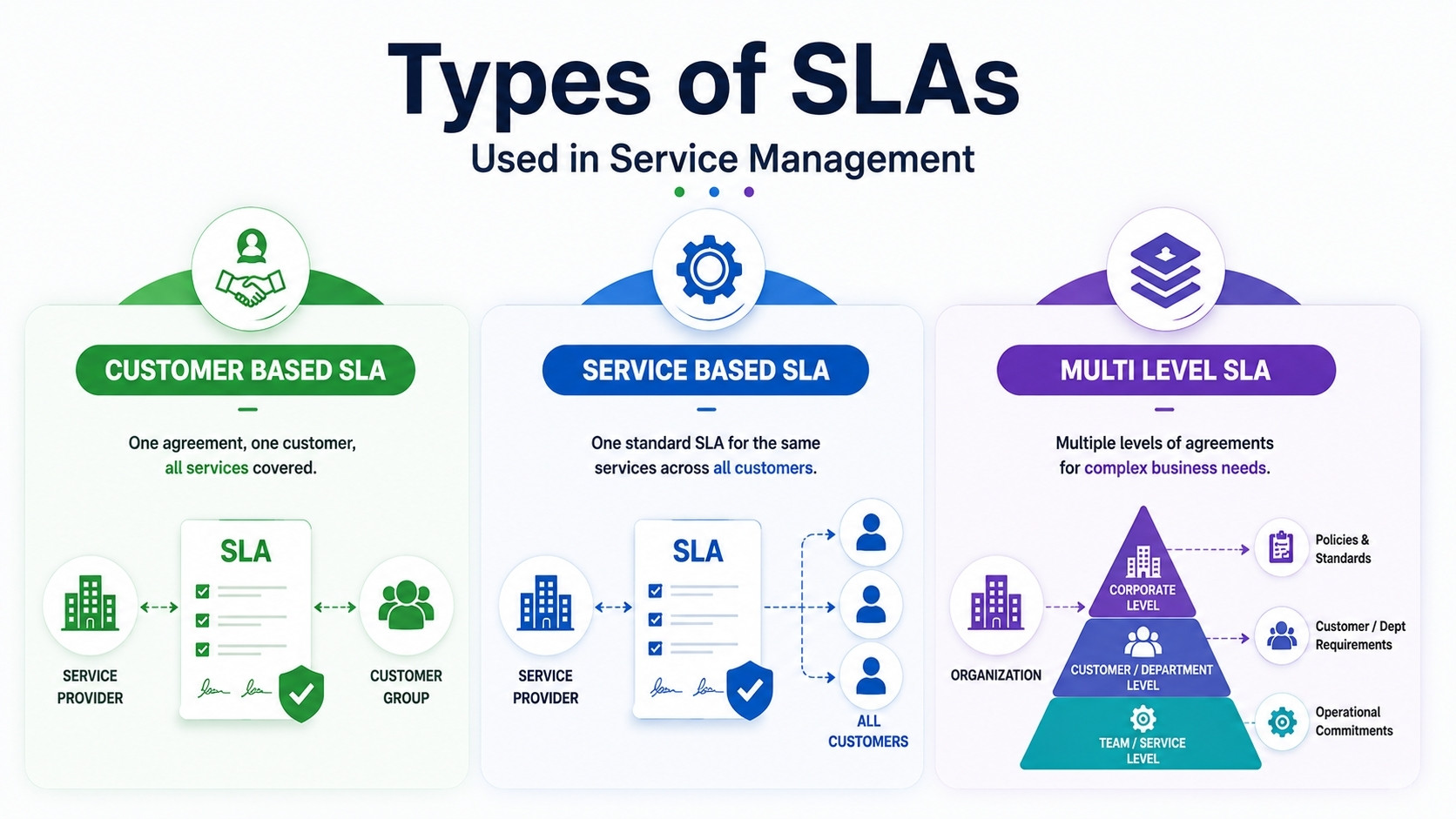
Service level agreements define responsibilities, response standards, and performance expectations between providers and clients. Different SLA types help organizations manage customer expectations, track service quality, and maintain consistent service management across multiple services and teams.
Customer Based SLA
A customer based sla focuses on one customer group and covers all the services offered to that client under a single service agreement. Companies often use this structure when one customer needs support, maintenance, hosting, and consulting from the same company.
This model helps manage customer expectations because every service expected by the client follows agreed upon metrics and expected levels. An it service provider can also simplify contractual obligations by keeping every requirement in one document instead of separate contracts.
Customer based agreements support sla monitoring through centralized reporting dashboards. Teams can monitor performance, track average time for responses, and analyze common sla metrics like resolution speed or abandonment rate. When ongoing issues appear, sla alerts help teams react quickly before service breaches affect business results.
Service Based SLA
A service based sla applies one standard agreement to every customer using the same services. Organizations usually create this model for cloud hosting, help desk support, or data center operations where the service provider delivers identical support standards to all clients.
This structure keeps all parties involved on the same page because service targets, security standards, and disaster recovery commitments remain consistent across every account. Extensive documentation also becomes easier since companies only maintain one service level sla for all users.
Service based agreements support proactive sla monitoring by using data collected from support systems and analytics tools. Businesses gain valuable insights into service performance, response time, and service delivery trends. Many companies also define service credits or financial penalties if the provider fails to meet expected levels.
Multi Level SLA
A multi level sla separates agreements into multiple levels to address complex business needs. Large enterprises commonly use this approach when different departments, locations, or customer segments require separate conditions.
For example, one level may define company-wide policies, while another customer level sla may apply to a specific customer group. Additional layers can cover technical teams, vendors, or department-specific services provided by the organization.
This setup helps align service expectations across multiple services without creating confusion. Teams can customize key features, service targets, and performance targets based on operational priorities. A multi level structure also helps organizations monitor performance more accurately because each layer measures different common sla metrics.
Businesses often use proactive sla monitoring tools to track service performance and identify risks before violations happen. Detailed reporting allows managers to detect desired behavior patterns, reduce ongoing issues, and improve service management efficiency. Because every service agreement includes clearly defined responsibilities, the service provider delivers more reliable support while maintaining compliance with contractual obligations.
Key SLA Metrics To Track In A Helpdesk
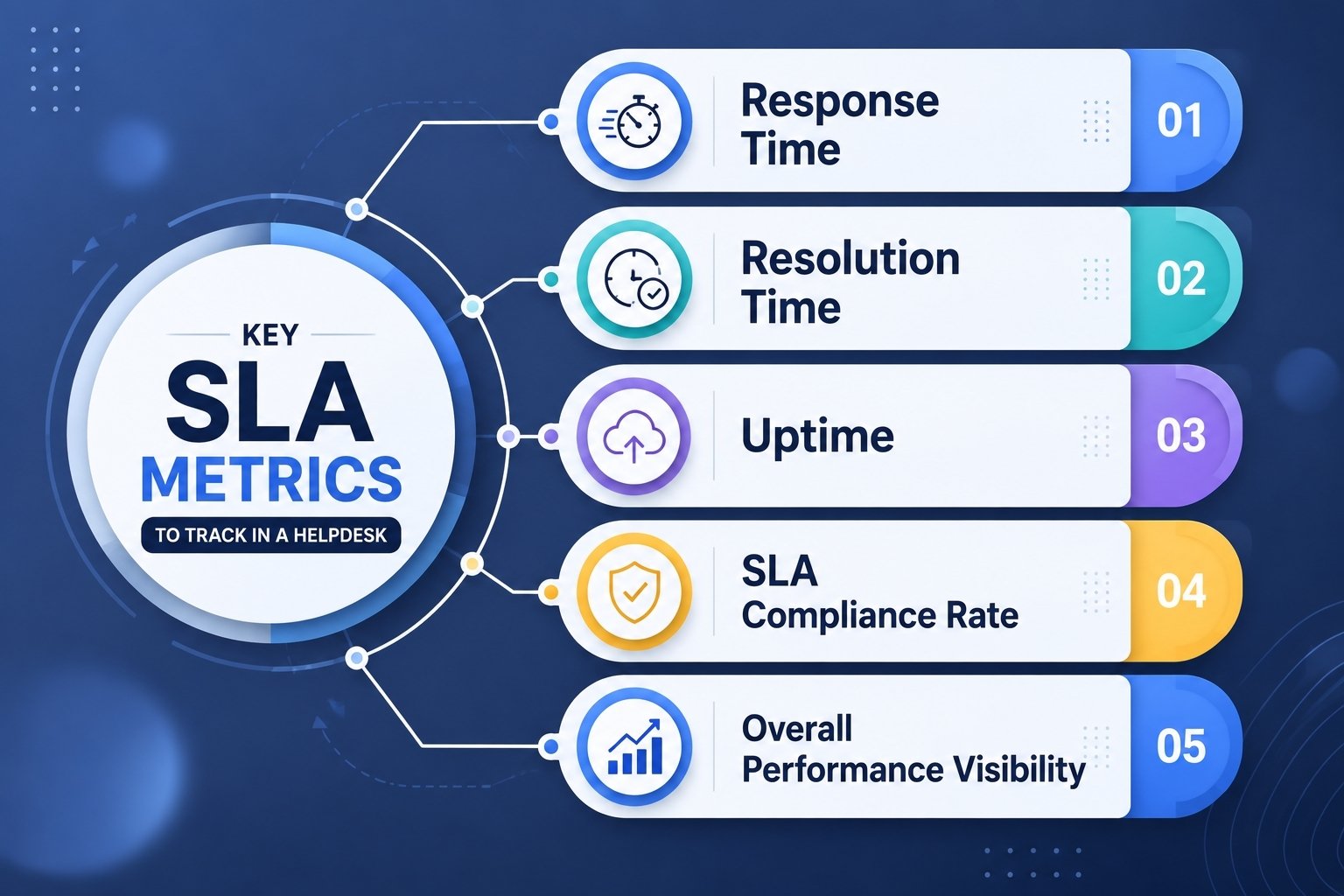
Tracking the right SLA metrics helps teams measure service quality, spot risks early, and improve consistency. A focused set of indicators turns daily support activity into clear, actionable performance insight, especially when teams follow a structured service level agreement helpdesk guide for support teams.
Response Time
Response time measures how quickly a support team replies after a request arrives. As one of the most visible sla metrics, it directly shapes first impressions and trust. Fast initial replies reassure customers that issues are acknowledged and being handled.
Monitoring response time as part of core key performance indicators helps teams prioritize incoming work and manage queues effectively. Consistent response standards reduce anxiety, limit follow-ups, and create predictable service experiences across channels.
Resolution Time
Resolution time tracks how long it takes to fully solve an issue from creation to closure. Strong performance metrics around resolution highlight whether teams can handle complexity efficiently without unnecessary delays, and focused strategies on cutting average resolution time fast help keep this metric under control as volumes grow.
Long resolution cycles often signal workflow gaps, dependency issues, or unclear ownership. Tracking this metric helps teams improve collaboration, refine escalation paths, and deliver faster outcomes without sacrificing quality.
Uptime
Uptime reflects service availability and reliability, especially for platforms where access disruptions affect many users at once. For support teams, uptime connects technical stability with customer experience and SLA compliance.
Tracking uptime alongside other key metrics helps teams understand how outages influence ticket volume and response pressure. High availability supports smoother operations and reduces reactive support spikes.
SLA Compliance Rate
SLA compliance rate shows how often agreed targets are met across tickets. As a summary view of SLA metrics, it reveals whether commitments align with real capacity and execution.
Low compliance highlights risk areas such as staffing gaps or unrealistic targets. High compliance builds credibility and demonstrates consistent service delivery.
Overall Performance Visibility
Combining key performance indicators into a single view improves performance understanding. Teams can compare response time, resolution time, uptime, and compliance together to identify trends.
Clear performance metrics support data-driven decisions. Managers spot bottlenecks early, balance workloads, and improve service outcomes through continuous refinement.
SLA Management System Best Practices
Effective SLA management depends on clarity, consistency, and adaptability. Following proven practices helps teams maintain service quality while adjusting to changing workloads and customer needs.
Define Agreed Upon Service Levels Clearly
Agreed upon service levels should be documented in simple and measurable terms. Clear definitions remove ambiguity around response and resolution expectations, ensuring both teams and customers share the same understanding. Well-defined service level objectives help teams prioritize work accurately and avoid misaligned expectations.
Clarity also supports accountability. When expectations are visible, teams can track progress confidently and respond before issues escalate.
Set Realistic Service Level Objectives
Service level objectives must align with real capacity and operational constraints. Setting achievable performance targets helps teams maintain consistency without creating unnecessary pressure. Unrealistic goals often lead to burnout or frequent SLA breaches.
Balanced targets encourage steady performance. Teams stay focused on delivering quality rather than racing against impossible deadlines.
Treat SLA Management As An Ongoing Process
SLA management works best as an ongoing process rather than a one-time setup. Regular reviews help teams adapt to changing demand, staffing, and customer behavior. Processes evolve as support environments grow more complex.
Continuous improvement ensures SLAs remain relevant. Teams refine targets based on data instead of assumptions.
Standardize Processes And Review Performance
Consistent processes help teams manage SLAs predictably across channels and teams. Standard workflows reduce confusion and improve response consistency.
Performance reviews highlight gaps and opportunities. Regular analysis helps teams adjust targets, workflows, and resources to maintain reliable service delivery.
Common SLA Challenges In Customer Support
Managing SLAs consistently becomes more difficult as support volume, customer expectations, and system dependencies increase. Without strong processes and visibility, even well-defined SLAs can fail under real-world pressure.
SLA Violations And Missed Commitments
SLA violations occur when response or resolution timelines are not met. These missed commitments often result from sudden ticket spikes, poor prioritization, or a lack of real-time visibility into deadlines. When agents are unaware of approaching SLA limits, issues escalate silently until a violation happens.
Frequent violations damage trust and create frustration for customers who rely on timely support. Internally, they signal gaps in workload distribution, staffing, or escalation processes. Over time, repeated violations reduce confidence in the SLA framework itself, making it harder for teams to treat SLAs as meaningful performance standards rather than theoretical goals.
SLA Breaches And Non Compliance
SLA breaches and non-compliance usually point to structural problems rather than individual mistakes. Unclear ownership, unrealistic targets, or poor coordination between teams make it difficult to meet commitments consistently. When internal dependencies are not aligned with SLA timelines, delays become unavoidable.
Non-compliance also affects accountability. Teams lose clarity around priorities when SLAs are frequently missed, which leads to inconsistent handling of requests. Without clear enforcement and tracking, SLAs stop guiding behavior and become disconnected from daily operations.
Recurring Issues And Service Outages
Recurring issues place continuous strain on support teams and directly impact SLA performance. Repeated problems generate similar tickets, increasing workload without adding new value. When these issues are not addressed at the root level, they consume time that could be used for meeting SLA targets.
Service outages intensify the challenge by triggering sudden surges in requests. During outages, support teams face overwhelming volume, making it difficult to respond within agreed timelines. Without proactive monitoring and clear SLA tracking software, SLAs are quickly breached as teams shift into reactive mode.
Risk Of Potential Penalties
Potential penalties are one of the most serious consequences of poor SLA management. Many SLAs include financial or contractual penalties tied to performance failures. As explained in depth in resources on what SLAs are and why they matter for service success, repeated breaches expose organizations to direct revenue loss and legal risk.
Beyond financial impact, penalties affect brand reputation and customer confidence. Clients may question reliability and reconsider long-term partnerships. Effective SLA management reduces this risk by identifying early warning signs, allowing teams to act before failures turn into costly outcomes.
EasyDesk SLA Management Features
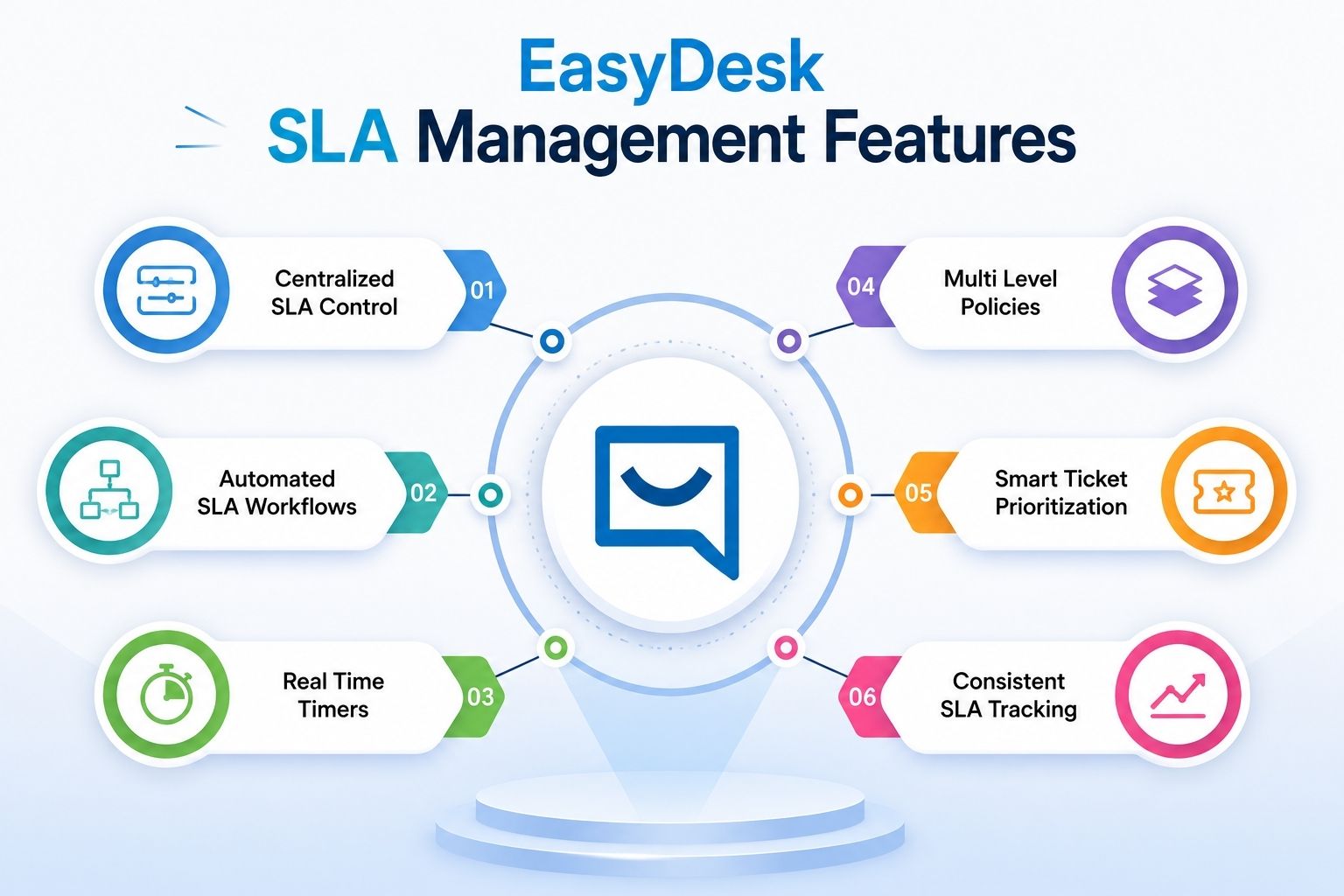
EasyDesk provides built-in SLA capabilities designed to help support teams define expectations, track timelines, and stay consistent with service commitments. These SLA management features for support teams are integrated directly into the helpdesk workflow, allowing teams to manage SLAs without relying on external tools or manual tracking.
Centralized SLA Management And Configuration
EasyDesk functions as practical SLA management software that allows teams to define and control SLAs from a single place. Support teams can configure sla software rules based on ticket priority, category, or support requirements. This setup ensures that SLAs are automatically applied when tickets are created.
Using built-in sla tools, teams can manage slas without manual intervention. Clear configuration reduces errors and keeps service commitments aligned with internal processes and customer expectations.
SLA Workflows With Real-Time Timers
EasyDesk uses structured sla workflows to guide how tickets move through different stages. SLA rules remain active throughout the ticket lifecycle, ensuring deadlines are respected at every step.
SLA timers provide real-time visibility into response and resolution deadlines. Agents can clearly see how much time remains, which helps them prioritize work and avoid unnecessary delays. Timers work alongside automated ticket management software capabilities to reduce guesswork and support consistent service delivery.
Support For Multiple And Multi-Level SLA Policies
EasyDesk supports multiple sla policies to handle different service scenarios. Teams can apply different SLAs based on ticket prioritization in customer support such as urgency, issue type, or service priority, allowing flexible handling of varied support needs.
With multi level sla support, teams can define layered targets such as first response time and resolution time under a single policy. This structure ensures more precise control over service commitments across complex support environments.
Consistent SLA Control And Management
EasyDesk helps teams manage slas by keeping SLA rules active and visible throughout ticket handling. SLA status updates automatically as tickets progress, helping teams stay aware of approaching risks.
Consistent SLA tracking supports accountability and operational clarity. Teams can focus on resolving issues instead of manually monitoring deadlines, improving overall support efficiency and reliability.
Together, these features make EasyDesk a dependable SLA management system for teams that need clear structure, visibility, and control without unnecessary complexity. Beyond SLAs, the EasyDesk customer support platform and its secure, transparent customer support approach enable smarter helpdesk setups for smoother support](https://easydesk.app/blog/it-helpdesk-solutions-to-streamline-your-support-system), giving teams a unified foundation for reliable service.
SLA Reporting, Performance Analytics, Automation, And Integrations
Clear visibility and automation turn SLA tracking into a measurable and actionable process. Combined reporting, analytics, and integrations help teams monitor commitments, respond faster, and continuously improve service delivery.
Centralized SLA Data Visibility
SLA data provides the foundation for understanding how well service commitments are met. Centralized access to SLA information allows teams to view timelines, ticket progress, and compliance status in one place. This visibility helps managers identify trends without switching between tools or spreadsheets.
Accurate data improves decision-making. Teams gain confidence when performance insights reflect real activity rather than assumptions or delayed reports.
Performance Reporting And Key Metrics
Structured reporting transforms raw activity into meaningful insights. SLA reports highlight key metrics such as response time compliance, resolution efficiency, and breach frequency. These reports help teams evaluate performance objectively.
Clear metrics support accountability. Managers can compare results across periods, teams, or priorities to understand where improvements are needed.
SLA Performance And Availability Monitoring
Continuous monitoring keeps SLA performance visible throughout the ticket lifecycle. Real-time tracking, supported by automated workflow software for smarter support, helps teams detect risks early instead of reacting after deadlines pass.
Availability tracking connects service reliability with support demand. When availability drops, teams can correlate spikes in tickets and adjust resources accordingly.
Automated Alerts And Management Tools
Automated alerts notify teams when SLA deadlines approach or risk being missed. These alerts reduce reliance on manual checks and help agents prioritize urgent work.
Built-in management tools ensure SLAs remain active and enforced across workflows. Automation improves consistency and reduces human error in deadline tracking.
Cloud Integrations And Workflow Efficiency
Cloud-based integration allows SLA systems to connect smoothly with other management tools. Integrated monitoring tools ensure SLA tracking works alongside helpdesk ticketing software, communication, and reporting workflows.
Easy integration helps teams create efficient processes without disruption. Unified systems reduce silos and support scalable SLA management across growing support environments.
By combining reporting, automation, and integrations, SLA management becomes proactive rather than reactive. Teams gain visibility, control, and confidence in their ability to meet service commitments consistently, especially when they manage support tickets efficiently using EasyDesk.
How EasyDesk Helps With SLA Management
EasyDesk helps service providers manage SLA commitments by bringing structure and visibility to service delivery across all support operations. It centralizes service requests within a single ticket creation and management service desk, making it easier to apply SLA rules consistently across specific services.
Support teams can define SLAs based on business hours and time zones, ensuring fair and accurate tracking for customers in different regions. EasyDesk supports organizations with unique needs, including remote support teams that need to stay aligned and on track, by aligning SLA rules with available resources and internal workflows.
By keeping SLA status visible at every stage, EasyDesk helps each provider maintain accountability and control. This structured approach supports better management, improves service reliability, and ensures every SLA aligns with company and business expectations, as seen when SLA tracking software improves response time and in real-world results where EasyDesk improved response time for a growing team.
FAQs
What Is An SLA In Customer Support?
An SLA, or service level agreement, defines the expected response and resolution timelines between a business and its customers. It sets clear expectations around service quality, responsibilities, and performance standards. SLAs help support teams stay accountable while giving customers confidence in how their requests will be handled.
Why Is An SLA Management System Important?
An SLA management system helps teams track deadlines, prioritize tickets, and avoid missed commitments. Without a structured system, SLAs become difficult to enforce consistently. Proper management improves efficiency, reduces escalations, and supports predictable service delivery as support volume grows.
What Happens When An SLA Is Breached?
When an SLA is breached, the agreed response or resolution time is missed. This can lead to customer dissatisfaction, internal escalations, or contractual penalties. Repeated breaches often indicate workflow gaps, unrealistic targets, or resource constraints that need attention.
How Do SLAs Improve Customer Satisfaction?
SLAs improve customer satisfaction by setting clear expectations and ensuring timely responses. Customers feel more confident when they know when to expect updates or resolutions. Consistent SLA compliance builds trust and reduces frustration caused by uncertainty or delays.
Can Different SLAs Be Applied To Different Customers Or Services?
Yes, many support teams use multiple or multi-level SLAs to handle different priorities, customers, or services. This flexibility allows businesses to tailor commitments based on urgency, service type, or customer agreements without treating all requests the same.
How Does EasyDesk Support SLA Management?
EasyDesk helps teams manage SLAs by applying rules directly to service requests within the service desk. It supports tracking across business hours and time zones, helping organizations meet commitments consistently. Clear visibility and structured workflows help teams stay aligned with SLA goals and customer expectations.