Support teams face a digital flood with nearly 600 tickets pouring in each day that need immediate attention. Customer support teams struggle to deliver quick and effective service under this massive load.
Most customers (81%) would rather solve issues on their own before they ask for help. They expect quick responses once they reach out for support. The data shows 67% of customers will give up if they wait too long. Smart self-service options and automation tools present the perfect chance to cut down support tickets.
Companies that implement the right solutions see remarkable results. One company's help center improvements led to 26% fewer ticket submissions in just five months. A well-laid-out self-service portal reduces ticket numbers and makes customers happier.
In this article, will show you proven ways to reduce support tickets. Your team will handle less work, and customers will get faster solutions.
Why Businesses Need To Reduce Support Tickets
The flood of support requests isn't a temporary bump in the road; it's now a defining business challenge. Support ticket volume has shot up 30% in the last three years. Each ticket costs businesses between $15-$50 to resolve. Support queues keep getting longer, and businesses need budget-friendly answers that last.
Customer Expectations Are Rising
Today's customers just need more from support teams than ever before. The numbers tell the story, 91% of customers believe companies should put more emphasis on customer service than they used to. This gap keeps widening, and 55% of customers look for better service levels each year.
Time has become crucial. Almost half of customers (46%) want answers within four hours. Even more telling, 85% expect replies within six hours after they reach out. It also turns out that 12% of impatient customers want answers in just 15 minutes.
The price of missing these targets hits hard. About 52% of customers will walk away from a business that's too slow to respond. The data shows that 71% of consumers rate quick responses as their top priority for good service. The message couldn't be clearer: customers want quick fixes, and they'll switch brands to get them.
Support Teams Need To Focus On Complex Issues
Ticket overload creates a real headache for teams trying to handle both simple and complex issues. Support agents buried under simple questions don't have enough time or energy to tackle the complicated problems that need human expertise.
The numbers back this up: teams hit with surprise ticket spikes don't deal very well with keeping service quality consistent. Studies show companies that can predict support ticket volume cut staffing costs by up to 15% while keeping service levels high.
Unsolved problems create repeat tickets, which pile extra work on support teams. This endless loop of repeated questions slows down response times and drops service quality.
Here's a key insight: 40% of customers who submit tickets already tried to find answers themselves. This suggests big gaps in knowledge bases or accessible design, problems that teams could fix to free up resources.
Reducing Tickets Improves Brand Loyalty
Great support builds stronger customer loyalty than most businesses realize. Almost 40% of consumers will drop a company after one bad experience. Generation X customers are even quicker to leave, 43% will walk away.
Companies that cut unnecessary tickets through self-service and automation create experiences that keep customers coming back. Businesses with solid customer education programs see 40% fewer support tickets. These educated customers are 75% more likely to stick around as loyal users.
Self-service options do more than save money; they make customers happier. Quick answers without waiting for support help customers feel in control rather than ignored. This boosts satisfaction since 77% of customers say quick responses are the best service a company can provide.
Online community platforms are a great way to get fewer support tickets. Companies using them cut support costs by 32.9% year after year. This creates a positive cycle of better service, happier customers, and stronger loyalty.
What Causes A High Volume Of Support Tickets
Support tickets tell a story. They reveal deeper problems in your product and support structure. After analyzing thousands of support interactions, I found that ticket floods follow patterns we can prevent. The quickest way to build a better support system starts with understanding these root causes. This helps both your team and customers.
Lack Of Clear Product Documentation
Poor documentation silently kills support team productivity. Customers reach out for help when they can't find clear instructions or troubleshooting guides. The numbers paint a grim picture - each SaaS support interaction costs $10. Monthly support costs hit $5000 just to handle 500 issues.
These costs pile up over time. Here's what happens when documentation stays incomplete:
- Support agents answer the same questions over and over
- Knowledge gets stuck with specific team members who become bottlenecks
- Work stops when the core team is unavailable
- Bug fixes take longer because no one documented the reasoning
Research shows that 40% of customers try self-service options before submitting tickets. This tells us that better documentation could prevent many support requests.
Support costs grow faster than team size. Unlike marketing expenses that companies track closely, support costs hide across departments. The total damage stays invisible. Companies waste money on preventable tickets without seeing the full picture.
No Real-Time Help Inside The App
Users need answers right away - not hours after submitting a ticket. They get stuck and frustrated without proper guidance in your application.
Tooltips and in-app help can cut support volume by a lot. Research shows companies that add effective in-app features see 20-40% fewer tickets. A social proof company added widgets to their app and cut support tickets in half.
Smart companies prevent tickets through proactive updates about known issues and chatbots for common questions. This approach typically reduces volume by 15-25% while keeping customers happy.
In stark comparison to this, new users generate many tickets because they don't understand the systems. A smooth onboarding process with video tutorials gives users confidence to use tools without asking for help. Live chat can guide users before they think about submitting a ticket.
Delayed Responses And Escalations
Slow responses create a chain reaction that multiplies your tickets. Customers don't wait quietly - they reach out through other channels, creating duplicate tickets. About 40% of millennials wait just 60 minutes before trying another channel.
Poor ticket routing causes major problems. Tickets get stuck between departments because of wrong categorization. This leads to delays and multiple transfers. Expert teams get swamped with issues when escalation rules aren't clear.
Customer expectations have changed. Nearly half want answers within 4 hours. Then 70% of consumers warn others after bad service experiences. About 27% say slow, ineffective support frustrates them most.
These problems cost more than customer goodwill. Agents waste 30% of their day switching between tools. Systems that don't talk to each other slow down resolution times by 26%. This creates backlogs that clog up the entire support process.
How Self-Service Helps Reduce Support Tickets
Self-service isn't about avoiding customers, it's about enabling them to help themselves. My experience shows that giving customers tools to solve their own problems doesn't just save money. It makes them happier too. Research backs this up: 91% of customers will use an online knowledge base that meets their needs. My years of working with support teams prove that the right self-service options can transform your entire support operation.
Build A Searchable Knowledge Base
A well-laid-out knowledge base forms the core of good self-service support. This goes beyond putting information online; you need a reliable, searchable hub that customers can easily use. The results speak for themselves: one eCommerce brand saw their ticket volume drop 38% in just a month after adding their FAQ widget.
A knowledge base works best when it's detailed and easy to use. Your homepage should include:
- A prominent search bar at the top
- Logically categorized articles below
- Content hierarchy from broad topics to specific questions
- Short paragraphs with visual elements like screenshots and videos
The numbers make sense, companies save 30-40% on support costs with a good knowledge base. This works because 61% of customers would rather fix simple problems on their own instead of calling support.
Your knowledge base content should target your most common support issues. This helps you reach customers with answers right when they need them. Melissa Burch from Zendesk puts it well, they say "interception" rather than "deflection" because it's about enabling customers, not avoiding them.
Use Embedded Help Centers
Embedded help centers take things further by putting help right inside your application. Users don't have to leave your product to get help, they get guidance exactly where they need it.
The benefits are clear, users get quick answers without breaking their workflow automation. This acts as your "24/7 automated support team," giving in-app help at the right time while reducing support tickets.
Embedded help shines because it shows relevant articles based on where users are in your application. These systems can predict what help someone might need before they ask by looking at URL parameters and user context.
AI-powered widgets that pull articles from your knowledge base can make a big difference. They answer common questions quickly, so your support team can handle more complex issues. Smart systems can even suggest helpful content when customers start writing a support ticket, often solving problems before submission.
Enable Community Forums For Peer Help
Community forums create a support ecosystem where customers help each other. Peer support lightens your support team's load while building stronger customer relationships through engagement.
Forums let users connect in three ways: with support teams, with other customers facing similar issues, and through past solutions. This approach works well because people trust advice from others who've faced the same problems.
The business impact is huge. Companies using online communities to reduce support tickets cut their support costs by nearly 33% year over year. Forums also lead to fewer calls to live agents.
Forums excel at handling common issues that would create multiple tickets otherwise. Users share solutions and workarounds, creating a knowledge base that grows with your product.
Forums work best when they're well-organized with clear categories, good moderation, and links to your knowledge base. This creates a complete self-service system that cuts support tickets and keeps customers happy.
How Automation Helps Reduce Support Tickets At Scale
Customer support teams are entering a new era with automation. Support teams have revolutionized their operations by implementing smart systems that handle routine tasks automatically. A newer study, published in, shows that 71% of organizations are either reviewing or testing AI for their IT service management. This change goes beyond just technology - it creates space for support agents to focus on problems that need human expertise.
AI To Reduce Support Tickets With Instant Answers
Smart AI solutions cut down ticket numbers by solving issues before they reach your support team. These systems do more than just redirect customers - they solve problems on their own. The results speak for themselves: top AI chatbots can resolve up to 65% of conversations from start to finish.
These systems work so well because they combine:
- Natural language understanding to learn what customers need
- Quick access to your knowledge base and company policies
- The capability to perform real actions like password resets or order checks
- Self-improvement through usage information
The numbers tell an impressive story. Clients using one AI solution provider report an 80% drop in support tickets, which lets support teams tackle only the complex issues. Unlike old support methods, AI guides users through complete workflows until they find a solution.
AI's capabilities go beyond basic questions. Modern systems connect with external platforms like payment gateways, CRMs, and delivery APIs. This means they can process refunds, check inventory, or cancel orders. Such deep integration helps resolve even moderately complex issues without human help.
Automated Workflows For Ticket Assignment
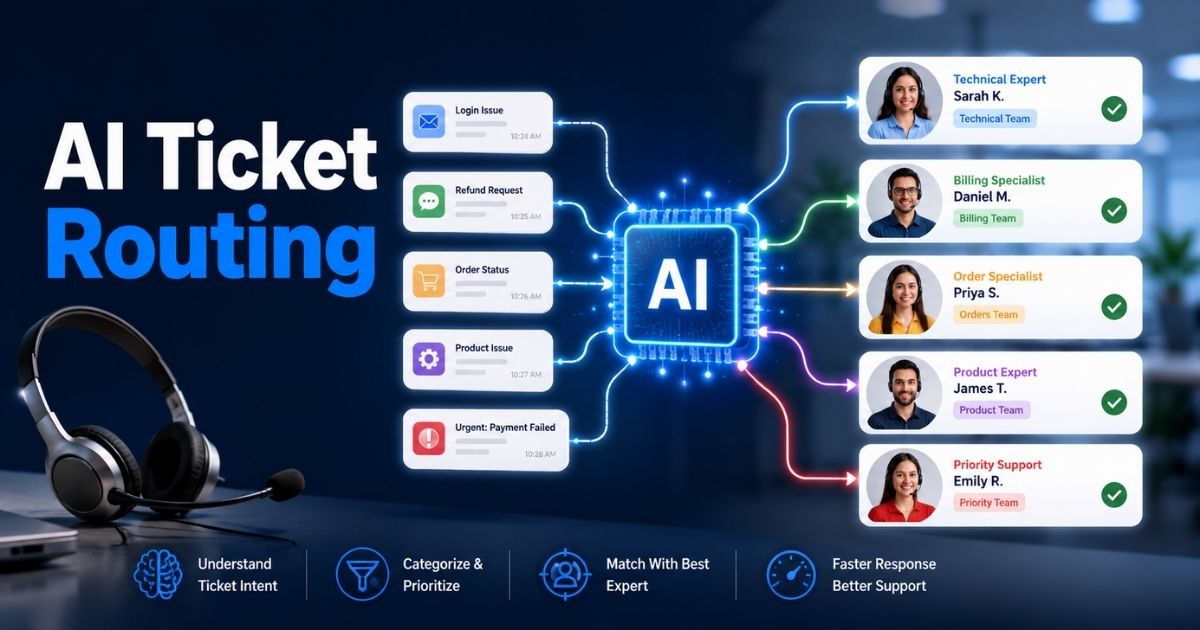
Some tickets will always need human attention. Smart ticket routing systems become crucial here as they direct questions to the right person right away. These systems use preset rules or AI to review tickets based on category, priority, channel, or customer status.
The results show clear benefits - faster routing, fewer mistakes, and balanced workloads. Different team structures benefit from various assignment methods:
- Round-robin assignment shares tickets one by one in sequence for balanced workloads
- Load-based assignment checks current agent workloads and sends new tickets to less busy staff
- Skill-based routing matches tickets with specialists based on language, customer tier, or technical complexity
Agents who exceed their ticket limit become temporarily unavailable for new assignments until they clear their backlog. This approach maintains service quality while protecting team members from overwork.
Use Of Monitoring Tools To Prevent Issues
Stopping problems before they start is the quickest way to reduce support tickets. Smart monitoring platforms can spot potential issues before customers notice them. These systems can fix problems automatically or alert technical teams when patterns emerge.
AI monitors network performance and adjusts configurations automatically to prevent outages. This proactive approach means fewer incident-related tickets. The system gets smarter over time by learning from past data to improve its predictions.
The system analyzes ticket patterns to determine which issues need immediate attention versus those that can wait. Critical problems never get buried in the queue thanks to this smart prioritization.
The financial benefits are clear - RingCentral's data shows AI reduces after-call work by 35%, saving about 5.8 minutes per call. These tools not only lower ticket volume but also speed up resolution times for remaining tickets.
Note that automation exists to enhance human capabilities, not replace them. When AI handles routine questions, support teams can focus on complex issues, creative solutions, and building customer relationships. The end result brings fewer tickets, satisfied customers, and a more eco-friendly support operation.
Why Proactive Support Helps Reduce Support Tickets
A change from reactive to proactive support reshapes the entire support scene. Teams can transform their workload by fixing issues before customers notice them. Proactive support creates an experience where customers feel you anticipate their needs. This method spots friction points and fixes them quietly behind the scenes. The numbers tell the story: proactive communication can cut ticket volume by 20-30% during incident periods. Here's how you can use this strategy to reduce support tickets.
Trigger Help Based On User Behavior
Real-time customer actions serve as signals to provide timely assistance. This system responds to specific user actions within your application and offers relevant guidance at the right moment.
The system works like this: when users take (or fail to take) certain actions, like having trouble with navigation or missing key features, they automatically receive contextual help. To cite an instance, if someone spends too much time on a step or keeps making the same mistake, smart suggestions can guide them to helpful resources.
You'll need these elements to implement behavior-based triggers:
- A map of your customer's trip to spot critical touchpoints
- Clear behavioral triggers that activate help
- Custom messages that match what users are doing
- Smart timing rules that maximize engagement
When combined with segmentation, your help reaches the right people, not just anyone who meets the conditions. This strategy works because it connects directly to your customer's actions.
Send In-App Notifications For Updates
In-app notifications help keep customers informed and reduce support tickets. These messages alert users about system changes, scheduled maintenance, or newly found bugs before they flood your inbox with questions.
Success depends on proper implementation. In-app messages react to user actions within the app. They can substantially reduce ticket volume by answering potential questions right away. During an outage, an in-app banner that explains the situation stops customers from submitting multiple tickets about the same problem.
In-app notifications bring several advantages:
- They build trust by being transparent about issues
- Users get help exactly when they need it
- You collect useful feedback to make things better
- New features get noticed through timely announcements
Studies show that relevant messages help users find more features and benefits, which boosts product adoption and creates loyal customers. Start by creating message templates for common situations (outages, maintenance) so you can respond quickly when needed.
Use Surveys To Detect Friction Early
Your customers' feedback helps spot problems before they turn into support tickets. Surveys provide a reliable way to find and fix friction points before they escalate.
Strategic survey placement throughout the customer's experience yields the best results. You can quickly add in-app microsurveys to your application. Simple feedback tools like NPS surveys or CSAT scores give you quick insights into possible issues.
Support issues always show warning signs. Regular feedback helps you spot patterns that show where customers struggle. This creates ongoing improvements. Survey response analysis helps make your product and help messages better over time.
Proactive support creates better results: fewer tickets give your team more time to handle complex issues and make strategic improvements. The largest longitudinal study shows that this change from reactive to proactive support helps companies find root causes and fix issues across their digital systems. This not only reduces current tickets but also prevents future problems.
How Better Onboarding Helps Reduce Support Tickets
Your product's first few minutes can turn users into loyal customers or support ticket generators. Good onboarding acts as a shield against overwhelming support requests. Companies often face high ticket volumes because they throw users into complex interfaces without proper guidance. Smart onboarding doesn't just teach - it stops common questions from becoming support tickets. This lets your support team handle truly complex issues.
Guide Users With Interactive Tutorials
Interactive tutorials cut down support tickets by showing users how to use key features step by step. These hands-on walkthroughs help users learn by doing, unlike static documentation. Users see exactly how features work as they try them.
A company that added interactive walkthroughs cut their face-to-face training from hundreds of hours monthly to just four hours. Their customer success team could focus on high-touch support. Another team built an interactive guide for adding funders to prospect lists. Users with this guide showed 100% higher activation rates than those without it.
Interactive walkthroughs shine when they:
- Break complex tasks into manageable steps
- Celebrate small wins to keep users going
- Stop common mistakes that create tickets
Use Tooltips To Explain Features
Tooltips give quick help right inside your app where users need it most. These subtle helpers explain features as users explore your interface. They clear up confusion before it becomes a support ticket.
A social proof app saw amazing results - their embeddable help widgets cut support tickets by 50%. Tooltips work best when they target common sticking points and appear as users hover over new elements.
Good tooltips stay brief, relevant, and simple. They shouldn't interrupt users but should add understanding as people use your product. Well-designed tooltips act like a round-the-clock automated support team.
Segment Users For Personalized Help
Generic onboarding often creates confused users and more support tickets. User segmentation helps create custom experiences based on roles, needs, or skill levels.
Segmentation delivers the right help to the right people. Welcome surveys gather data about customer roles and use cases. This helps create targeted help content that matches specific needs. Users find what they need faster without reaching out to support.
Smart segmentation looks at user data (name, email, signup date), company details (plan, industry, size), location, and behavior patterns. This targeted approach gives each user exactly what they need - no more, no less. The result is fewer tickets from confused users.
Proven Strategies To Reduce Support Tickets
Your team needs to polish internal processes after adding self-service options and automation. The right operational approach will reduce your support load quickly. My experience managing support teams shows these proven methods work well without big investments or complex tech.
Combine Multiple Tickets From Same User
Your ticket volume drops when you merge related tickets from the same customer. This creates a smoother support experience. Multiple questions about similar issues from one customer should not have several agents working on them at once. This method strikes a chord when you want to streamline communication and cut down repetition.
The merging process needs clear rules to work best:
- Merge only tickets about the same topic or from the same account
- Think over enabling ticket CCs to keep everyone in the loop after merging
- Add tag indicators (like "closed_by_merge") so agents spot merged tickets fast
Note that merging cannot be undone. Review your choices well before finishing to avoid sharing private information between different customers by mistake.
Route Tickets To The Right Agent
Your resolution times improve when tickets reach the agents who can handle them best. Auto-assignment based on skills and who's available makes a big difference. Different team structures need different routing methods. Round-robin gives out tickets one by one, while load-based routing sends new tickets to agents with lighter workloads.
Skill-based routing sends tickets straight to subject experts. This helps customers get the right answers faster. The process looks simple but needs proper limits. Agents should stop getting new tickets when they hit their capacity until they clear some existing ones.
Use Analytics To Improve Help Content
Support data shows patterns you can use to make better documentation. Topics that create lots of tickets tell you where to focus new content. Page views and time spent on help articles show what content works for your users.
Localize Help Articles For Better Reach
Your self-service options become available to everyone when you create support content in multiple languages. Good localization does more than translate - it fits content to local culture and priorities. Better understanding leads to more people using self-service options.
How Easydesk Helps Reduce Support Tickets Efficiently
Need a practical way to reduce support tickets without overloading agents? Easydesk helps teams shift from reactive support to proactive resolution. A centralized knowledge system, AI-driven deflection, and real-time insights work together to stop repetitive questions before tickets appear.
Easydesk provides a single source of truth for customer help content. Teams organize FAQs, guides, and ready-made responses in one place. Customers find accurate answers faster, while agents reply consistently with minimal effort across every support channel.
AI-powered chat suggests relevant articles before ticket submission and deflects common issues automatically. Built-in analytics highlight content gaps and usage trends. In-app help widgets deliver contextual guidance inside the product, which reduces confusion and prevents unnecessary support requests. You can enjoy these features at a suitable price.
FAQs
How Long Does It Take To Reduce Support Tickets After New Tools Launch?
Most teams notice early results within two to four weeks. Clear self-service content and basic automation usually reduce repetitive tickets first, while greater improvements appear over time.
Which Metrics Show Progress When Teams Reduce Support Tickets?
Ticket volume per user, first response time, and self-service success rate show the clearest impact. Tracking repeat tickets also reveals whether root problems get resolved.
Can Small Teams Reduce Support Tickets Without Extra Staff?
Yes, small teams often see faster gains because processes change quickly. The right tools replace manual work and allow agents to focus on high-impact issues instead of routine questions.
What Role Does Product Updates Play In Reducing Support Tickets?
Clear update communication prevents confusion and repeated questions. Release notes, in-app messages, and update summaries stop customers from submitting avoidable tickets.
How Security And Access Control Affect Support Ticket Volume?
Strong access control reduces account-related issues like permission errors and login confusion. Clear role settings help users avoid mistakes that usually trigger support requests.
Does Multilingual Support Help Reduce Support Tickets?
Yes, localized help content improves understanding and self-service adoption. Customers find answers faster when help articles match their language and regional context.
How Teams Scale Support While Reducing Ticket Volume?
Scalable platforms like Easydesk combine analytics, knowledge management, and automation. This approach reduces ticket growth even as customer bases expand.