A service level agreement helpdesk framework creates a structured foundation for reliable customer support. It defines how a service provider delivers service, manages support tickets, and meets agreed service levels across the service desk or IT service desk. Clear agreements help align service expectations with actual service delivery and reduce confusion for both internal teams and end users.
A well-defined service level agreement SLA outlines response time, resolution time, service availability, and escalation rules. These commitments help support teams provide timely responses, maintain accountability, and measure performance using clear performance metrics. When SLAs remain realistic and transparent, organizations build customer trust, improve customer satisfaction, and maintain consistent service performance across different customer segments.
What Is A Service Level Agreement Helpdesk
A service level agreement helpdesk define how a service provider delivers customer support through a service desk or IT service desk. It sets clear service levels for response time, resolution time, service availability, and operating hours, ensuring customers understand what level of service to expect. By documenting service expectations, the agreement aligns customers, internal teams, and all the stakeholders around consistent service delivery and measurable outcomes.
A service level agreement SLA explains how support tickets and each support request move through internal processes. It includes response SLA, resolution SLA, escalation rules, wait time thresholds, and performance metrics used to measure performance. Many organizations apply customer-based SLA or service-based SLA models to reflect different customer segments, customer types, and business offers, including free users, high-value customers, and enterprise customers.
Unlike general support policies, a level agreement creates accountability. Customer service SLAs define SLA metrics, key performance indicators, SLA compliance requirements, and service credits in case of SLA violation. This structure helps support teams meet SLAs, manage SLA monitoring effectively, and maintain customer trust while delivering excellent customer service to every end user.
Why Service Level Agreements Are Important In Helpdesk Software
Service level agreements define how helpdesk software supports consistent service delivery across customer support operations. Clear SLA management improves accountability, aligns internal teams, and ensures service expectations remain realistic for every customer type and service desk environment.
Customer Satisfaction And Trust
A strong service level agreement helpdesk system structure plays a direct role in customer satisfaction and customer trust. When response time, resolution time, and service availability remain predictable, customers feel confident about the service provided. Clear service levels reduce uncertainty around wait time, operating hours, and escalation rules.
Enterprise customers and high-value customers depend on reliable customer service SLAs to support daily operations. Timely responses and consistent resolution SLA commitments lead to satisfied customers and a positive customer experience across different customer segments.
Clear Service Expectations
SLAs clearly communicate service expectations between customers and the support team. Defining response SLA, business hours, and normal business hours coverage prevents confusion during a support request.
A service level agreement SLA explains what level of service applies to each customer type. This clarity helps customers plan around service availability and understand how the service desk delivers support.
Team Accountability
SLAs establish responsibility across support teams and internal teams. SLA rules define ticket ownership, escalation path, and how escalation rules apply across multiple tiers.
Clear accountability improves collaboration between it teams and the service desk. When all the stakeholders understand their role, internal processes remain efficient and service performance improves.
Service Performance Tracking
Helpdesk SLAs enable teams to measure performance using SLA metrics and key performance indicators. First response, resolution time, and overall SLA compliance reveal how well the service provider meets commitments.
Ongoing SLA monitoring helps identify issues before SLA breaches occur. Measuring SLAs consistently supports continuous improvement in service delivery and customer support quality.
Risk Reduction
SLA breaches and repeated SLA violations damage customer trust and brand reputation. Missed commitments often lead to service credits disputes and lost enterprise customers.
Clear SLA management reduces these risks by defining realistic service levels and escalation rules. Well-structured SLAs help support teams meet SLAs and maintain reliable service performance.
Internal And External Alignment
External SLAs depend on strong internal SLA agreements. Internal teams must support the service levels promised to customers, especially in multi-level SLA or multilevel SLA models.
Alignment between internal processes and customer-facing SLAs ensures consistent service delivery. This alignment helps the service desk provide support without delays across customer segments.
Scalable Support Operations
SLA based workflows support growth across customer support operations. SLAs help manage increasing support tickets from free users, individual customer groups, and enterprise customers.
Structured service levels across multiple tiers allow support teams to maintain excellent customer service. This structure ensures consistent service performance as demand and service complexity increase.
Core Components Of A Service Level Agreement Helpdesk
A service level agreement helpdesk work effectively only when its core components remain clearly defined and measurable. These components guide service delivery, align internal teams, and ensure consistent service performance across customer segments, service desk workflows, and multi-tier support environments.
Response Time Commitments
Response time commitments define how quickly a support team acknowledges a support request after submission. A clear response SLA helps manage customer expectations and reduces frustration during the initial wait time. First response targets often vary by customer type, priority level, and service levels, ensuring high-value customers and enterprise customers receive timely attention.
Clear response time definitions help customer support teams plan workloads during business hours and normal business hours. When response commitments remain realistic and transparent, SLA compliance improves, and customer trust strengthens. Consistent first response performance also supports accurate SLA monitoring and reliable service delivery across all support tickets.
Resolution Time Targets
Resolution time targets define how long a service provider takes to fully resolve an issue. A resolution SLA ensures accountability and sets clear expectations for issue closure across different customer segments and service desk scenarios. Resolution time commitments often differ for service-based SLA and customer-based SLA models.
Accurate resolution targets help support teams balance quality and speed without compromising service performance. Clear timelines reduce SLA breaches and improve customer satisfaction. Resolution SLAs also help internal teams coordinate internal processes and escalation paths efficiently across multiple tiers of support.
Service Availability Hours
Service availability defines when customer support remains accessible. Clear operating hours, business hours, and normal business hours help customers understand when the service desk provides support. This clarity prevents misunderstandings and reduces unnecessary SLA violation incidents.
Defined service availability supports better workload planning for it teams and internal teams. Customers gain confidence in the service provided when coverage hours align with their service expectations. Well-documented availability terms also improve SLA management and help maintain consistent service levels across regions and customer types.
Escalation Rules
Escalation rules outline how support requests move when response SLA or resolution SLA thresholds face risk. A structured escalation path ensures urgent issues reach the appropriate stakeholders involved without delay. Multi-level SLA and multilevel SLA frameworks support smooth escalation across multiple tiers.
Clear escalation rules protect service performance during critical incidents. Defined ownership prevents confusion within support teams and ensures faster resolution for enterprise customers and high-value customers. Strong escalation processes also reduce repeated SLA breaches and improve overall SLA compliance.
Performance Metrics
Performance metrics define how organizations measure performance against agreed service levels. Common SLA metrics include first response time, resolution time, wait time, and overall SLA compliance. These indicators provide insight into service performance and customer experience.
Tracking key performance indicators allows teams to identify gaps and improve service delivery. Regular SLA monitoring ensures service expectations remain aligned with actual outcomes. Accurate metrics also support transparent reporting for stakeholders and help maintain trust with customers.
SLA Scope And Coverage
SLA scope defines which services, customer segments, and support requests fall under the level agreement. Clear scope definitions prevent confusion around free users, individual customer agreements, and enterprise contracts. This clarity protects both customers and the service provider.
Well-defined scope ensures internal SLA agreements support external SLAs effectively. Support teams understand responsibilities, service levels, and exclusions clearly. Proper scope definition strengthens SLA based workflows and supports consistent SLA customer support across all service desk operations.
SLA Metrics Helpdesk Teams Must Track
SLA metrics help helpdesk teams maintain visibility into service performance and SLA compliance. These measurements support consistent service delivery, align internal teams, and allow organizations to measure performance against defined service levels across customer segments and service desk operations.
First Response Time
First response time shows how quickly a service desk acknowledges a support request after submission. A strong response SLA reduces wait time and reassures customers that support remains available. Clear first response targets help manage customer expectations and improve customer satisfaction, especially during normal business hours.
Consistent first response performance supports SLA compliance and builds customer trust. For enterprise customers and high-value customers, fast acknowledgment often matters as much as final resolution. Tracking this metric helps support teams balance workload across operating hours and multiple tiers.
Resolution Time
Resolution time measures how long a support team takes to fully resolve a support ticket. A clear resolution SLA sets accountability for service delivery and reflects overall service performance. This metric often varies based on customer type, priority level, and service-based SLA definitions.
Shorter resolution times indicate efficient internal processes and effective collaboration between it teams and internal teams. Tracking this metric helps identify delays, reduce SLA breaches, and maintain consistent service levels across customer segments.
SLA Breach Rate
SLA breach rate tracks how often response SLA or resolution SLA commitments fail. Frequent SLA violation issues indicate gaps in capacity planning or unclear SLA rules. This metric helps organizations identify risk areas within customer support operations.
Monitoring breach rates supports proactive SLA management. Early identification allows teams to adjust service levels, escalation rules, or internal processes before customer trust erodes or service credits disputes arise.
Ticket Backlog Volume
Ticket backlog measures the number of unresolved support tickets within the service desk. A growing backlog signals workload imbalance and risks to SLA compliance. High backlog volumes often increase wait time and negatively affect customer experience.
Tracking backlog trends helps support teams allocate resources more effectively. This metric also highlights whether service availability and operating hours match customer demand across customer segments.
Customer Satisfaction Scores
Customer satisfaction scores connect SLA performance with real customer experience. High satisfaction often reflects timely responses, effective resolution time, and consistent service delivery.
This metric helps validate whether service expectations align with the actual service provided. Support teams can use feedback to refine customer service SLAs and improve overall service performance.
Escalation Frequency
Escalation frequency tracks how often support requests move up the escalation path. Frequent escalations may indicate unclear escalation rules or unrealistic SLA targets.
Monitoring this metric helps teams evaluate multi-level SLA and multilevel SLA structures. Proper escalation management ensures critical issues reach the right stakeholders involved without unnecessary delays.
Overall SLA Compliance
Overall SLA compliance measures how consistently service levels meet defined targets. This metric combines response time, resolution time, and service availability into a single performance view.
High SLA compliance demonstrates reliable service delivery and strong internal alignment. Tracking this metric supports long-term improvements in customer support quality and customer trust.
Best Practices For Creating Effective Helpdesk SLAs
Effective helpdesk SLAs support reliable service delivery without overloading internal teams. Well-structured service level agreements align customer expectations with operational capacity, protect service performance, and help customer support teams deliver consistent service levels across different customer segments.
Realistic SLA Targets
SLA targets must reflect the actual service provided by the support team. Response time and resolution time commitments should consider operating hours, service availability, and normal business hours. Unrealistic targets increase SLA violation risk and negatively affect customer trust.
Realistic service levels allow support teams to meet SLAs consistently. When targets align with internal processes and workload capacity, customer satisfaction improves and service performance remains stable across all customer types.
Team Capacity Alignment
SLAs should match the size, skills, and structure of the support team. Multiple tiers, specialized it teams, and internal teams influence achievable response SLA and resolution SLA commitments.
Internal SLA alignment ensures internal teams support external SLAs effectively. This coordination helps reduce SLA breaches and improve service delivery for enterprise customers and high-value customers.
Clear Customer Segmentation
Customer segments require different service levels. Customer-based SLA models define service expectations for individual customer groups, while service-based SLA structures focus on the service delivered.
Clear segmentation helps prioritize support tickets correctly. High-value customers and enterprise customers receive appropriate attention without compromising service quality for other customer types.
Defined Escalation Rules
Escalation rules guide how support requests move across multiple tiers when SLA thresholds are met. A clear escalation path ensures urgent issues reach the right stakeholders involved.
Well-defined escalation rules reduce wait time and improve resolution time. This structure helps support teams manage complex cases without confusion or unnecessary delays.
Consistent SLA Monitoring
Ongoing SLA monitoring helps teams measure performance using SLA metrics and key performance indicators. Regular review of service performance identifies risks before SLA breaches occur.
Consistent monitoring supports data-driven SLA management. Teams can adjust service levels and internal processes based on real service delivery outcomes.
Regular SLA Reviews
SLAs require periodic review as customer expectations and business offers change. Regular evaluation helps ensure service levels remain relevant across customer segments.
Review cycles help organizations refine response time, resolution SLA, and service availability. This practice supports continuous improvement and long-term SLA compliance.
Clear Stakeholder Communication
Clear communication ensures all stakeholders understand SLA terms and responsibilities. Transparency helps align service expectations between customers, support teams, and internal teams.
Well-communicated SLAs reduce misunderstandings and strengthen customer trust. This clarity supports excellent customer service and consistent service delivery.
How Helpdesk Software Improves SLA Management
Helpdesk software plays a critical role in SLA management by structuring service delivery and simplifying SLA monitoring at scale. The right platform supports consistent service levels, improves internal processes, and helps support teams meet SLAs across diverse customer segments.
Centralized Ticket Control
Centralized ticket visibility gives the service desk a complete view of all support tickets across customers. Support teams can track response time, resolution time, and current service levels from a single workspace.
This visibility helps reduce wait time and prevents missed support requests. Clear oversight allows customer support teams to prioritize low-priority tickets, urgent cases, and enterprise customers without losing SLA compliance.
Automated SLA Tracking
Built-in SLA tracking automates response SLA and resolution SLA measurement. Helpdesk software monitors operating hours, business hours, and normal business hours automatically to ensure accurate SLA calculations.
Automated SLA monitoring reduces manual effort and human error. Teams gain confidence that SLA metrics reflect real service performance and align with customer service SLAs.
Real-Time Alerts
Real-time alerts notify support teams when SLA thresholds approach risk. Early warnings allow teams to act before SLA breaches occur and protect customer trust.
Alerts support proactive SLA management and help maintain consistent service delivery. Escalation rules activate automatically, ensuring the right stakeholders involved receive timely notifications.
Clear Performance Dashboards
Performance dashboards present SLA metrics and key performance indicators in a visual format. Managers and it teams can review overall SLA compliance and service performance quickly.
Dashboards support transparency and accountability across internal teams. Clear data helps identify trends, resource gaps, and improvement opportunities.
Escalation Workflow Support
Helpdesk software enforces escalation rules and escalation paths consistently. Multi-level SLA and multilevel SLA structures ensure complex issues reach appropriate multiple tiers.
Structured escalation improves resolution time and reduces confusion. Support teams handle critical issues efficiently without relying on manual coordination.
Consistent Reporting
Standardized reports provide insight into SLA metrics, SLA compliance, and service performance over time. Reports help organizations measure performance across customer segments and customer type.
Consistent reporting supports informed decisions and SLA optimization. Teams refine service levels and internal processes based on reliable data.
Scalable SLA Management
Helpdesk software supports SLA based workflows as customer demand grows. Platforms adapt to new customer segments, free users, and enterprise customers without compromising service delivery.
Scalable SLA management ensures that excellent customer service remains consistent. Support teams maintain service quality even as ticket volume and complexity increase. That’s why you need to choose the right SLA management software.
How To Choose The Right Helpdesk Software For SLA Management
Choosing the right helpdesk software ensures reliable SLA management and consistent service delivery across customer support operations. The right platform supports SLA compliance, aligns internal teams, and helps service providers meet service expectations for different customer segments and service levels.
SLA Feature Coverage
Helpdesk software must support flexible SLA rules that reflect real service levels. Key features include response SLA, resolution SLA, multi-level SLA support, and clear escalation rules. These capabilities allow service providers to manage different customer types and multiple tiers effectively.
Strong SLA feature coverage supports accurate SLA monitoring and measuring SLAs consistently. This foundation helps customer support teams meet SLAs and reduce SLA breaches across service desk operations.
Scalability And Growth Support
Scalable service desk platforms adapt as support teams grow and customer demand increases. Software should handle rising support tickets from free users, individual customer groups, and enterprise customers without performance decline.
Scalability ensures service delivery remains consistent during business growth. Support teams maintain service performance and customer satisfaction even as ticket volume and service complexity expand.
Reporting And Analytics
Robust reporting tools help teams track SLA metrics and key performance indicators. Detailed insights into response time, resolution time, and SLA compliance support better decision-making.
Clear analytics enable service providers to measure performance accurately. Data-driven insights help refine SLA management strategies and improve overall service performance.
Ease Of Configuration
Easy configuration allows teams to define service levels without complex setup. Support teams benefit from intuitive workflows that reflect internal processes and business offers.
Simple configuration reduces errors and accelerates SLA adoption. Teams spend more time providing support and less time managing system complexity.
Security And Reliability
Strong security protects customer data and ensures trust across customer segments. Reliable platforms maintain consistent service availability and minimize downtime risks.
Security and reliability directly affect customer experience. Stable systems support uninterrupted service delivery and protect service provider credibility.
Internal Team Alignment
Helpdesk software should support internal SLA agreements between internal teams and the service desk. Alignment ensures internal processes support external SLAs effectively.
Clear internal alignment reduces delays and SLA violation risks. Teams collaborate smoothly and maintain consistent service levels across departments.
Long-Term Flexibility
Long-term flexibility ensures the platform adapts to changing service expectations. Software should support new service models, customer-based SLA, and service-based SLA structures.
Flexible platforms protect long-term investment. Support teams continue delivering excellent customer service as business needs evolve.
Common SLA Mistakes Helpdesk Teams Should Avoid
Even well-defined service level agreement helpdesk frameworks can fail without disciplined execution. Common mistakes weaken SLA management, increase SLA breaches, and damage customer trust. Avoiding these gaps helps support teams maintain SLA compliance, protect service performance, and deliver consistent service levels across customer segments.
Unrealistic Response Time Promises
Unrealistic response time commitments create immediate risk for SLA compliance. When response SLA targets ignore actual team capacity, operating hours, and service availability, wait time increases and customer satisfaction declines. Customers quickly lose trust when first response expectations remain unmet.
Service providers must base response time targets on real internal processes and available it teams. Aligning response SLAs with business hours and normal business hours ensures achievable service levels. Realistic commitments help support teams meet SLAs consistently and protect long-term customer experience.
Undefined Business Hours Coverage
Unclear business hours and holiday coverage cause frequent SLA violation issues. When operating hours and service availability remain vague, customer expectations drift away from actual service delivery.
Clear definitions help end users understand when the service desk provides support and when response time and resolution time apply. Accurate coverage terms protect customer support teams from unfair SLA breaches and improve transparency across all customer segments.
Weak Escalation Ownership
Missing escalation rules create confusion during critical support requests. Without a defined escalation path, tickets move between internal teams without accountability, increasing resolution time and harming service performance.
Multi-level SLA and multilevel SLA frameworks assign responsibility across multiple tiers. Clear escalation ownership ensures the right stakeholders involved receive timely alerts, protecting high-value customers and enterprise customers from prolonged service disruptions.
Single SLA For All Customers
Applying one overall SLA to every customer type ignores business reality. Free users, individual customer plans, and enterprise customers require different service levels and service expectations.
Customer-based SLA and service-based SLA models allow service providers to align service delivery with business offers. Proper segmentation helps support teams prioritize support tickets effectively and deliver excellent customer service without overextending resources.
Limited SLA Monitoring
SLAs lose value without consistent SLA monitoring. Teams that fail to measure performance miss early warning signs of SLA breaches and declining service performance.
Tracking SLA metrics and key performance indicators enables proactive SLA management. Measuring SLAs regularly helps support teams meet SLAs, refine internal processes, and maintain strong customer trust over time.
Poor Internal SLA Alignment
External SLAs fail when internal SLA agreements lack alignment. Internal teams must support the service levels promised to customers, or service delivery breaks down.
Strong internal SLA alignment ensures internal processes reinforce customer service SLAs. This coordination reduces delays, supports SLA compliance, and improves overall service performance across the service desk.
Lack Of Stakeholder Awareness
SLAs often fail when all the stakeholders lack a clear understanding of responsibilities. Ambiguity around roles weakens accountability and increases SLA breaches.
Clear communication ensures support teams, IT teams, and service providers understand SLA rules and service expectations. Shared awareness strengthens SLA based workflows and supports a consistent customer experience.
Avoiding these mistakes strengthens help desk SLA programs, improves customer satisfaction, and helps organizations scale customer support without sacrificing service quality.
How EasyDesk Supports Service Level Agreement Helpdesk Success
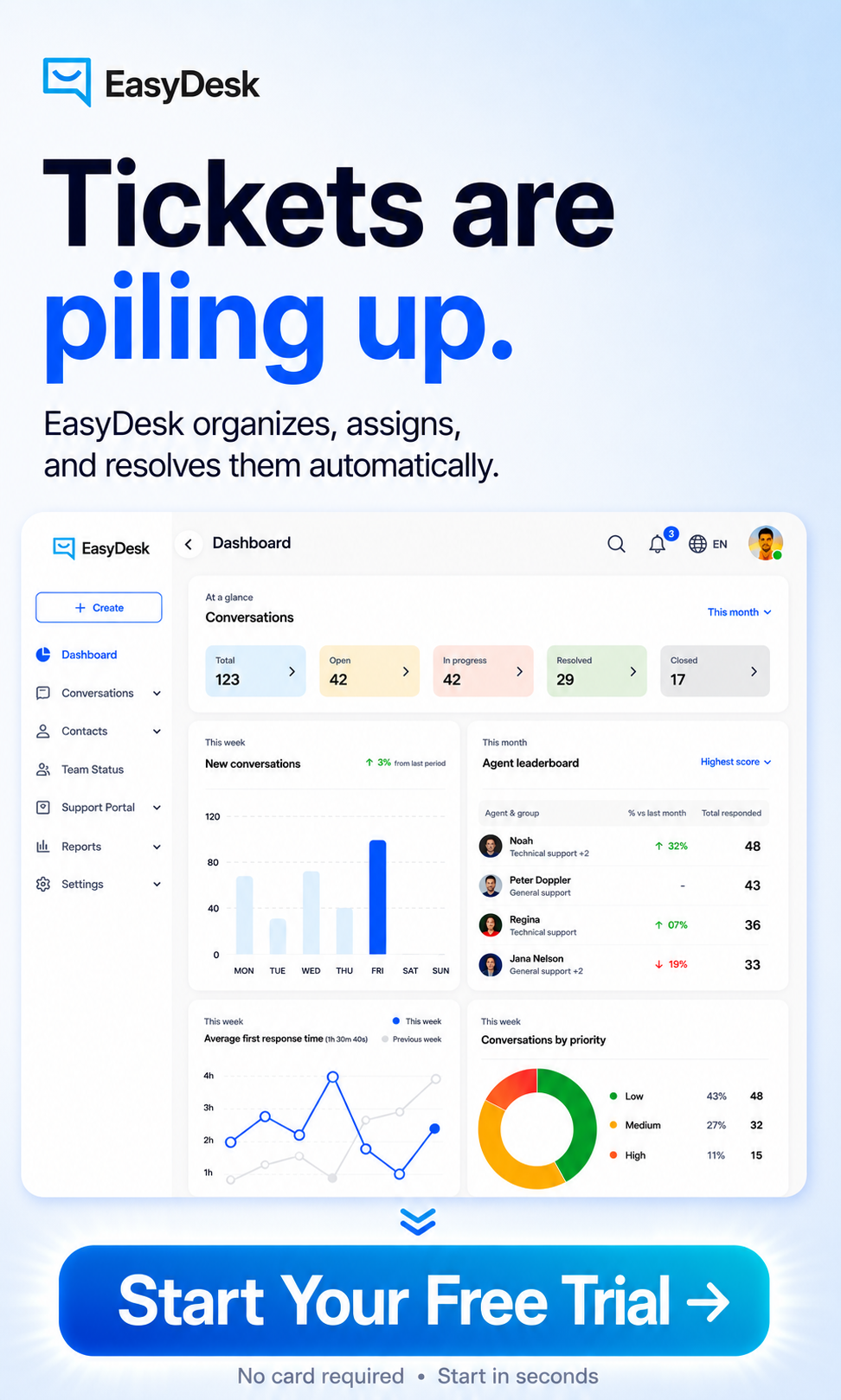
EasyDesk strengthens service level agreement helpdesk execution by giving customer support teams clear control over service levels, priorities, and SLA compliance. The platform supports structured SLA management across the service desk, helping service providers meet customer expectations while maintaining consistent service delivery for different customer segments and service types.
EasyDesk allows teams to configure SLA rules that reflect real business needs. Support teams can define response SLA and resolution SLA based on customer type, customer-based SLA models, or service-based SLA requirements. This flexibility helps manage high-value customers, enterprise customers, and free users without compromising overall service performance. Clear priority policies ensure support tickets follow the correct escalation path during business hours and normal business hours. They have many features at a suitable price.
Automated alerts and escalation workflows help teams prevent SLA breaches before they occur. Real-time dashboards provide visibility into SLA metrics, SLA compliance, and service performance for all the stakeholders involved. This transparency improves accountability, supports timely responses, and builds long-term customer trust through reliable customer support.
FAQs
What Factors Influence SLA Response Time?
Response time depends on customer type, ticket priority, business hours, and operating hours. High-value customers and enterprise customers usually receive faster first response commitments within defined service levels.
How Do Internal SLAs Support External SLAs?
Internal SLA agreements align internal teams with customer-facing SLAs. This alignment ensures consistent service delivery and prevents delays caused by internal process gaps.
What Happens During An SLA Breach?
An SLA breach triggers escalation rules and defined escalation paths. Depending on the level of agreement terms, corrective actions or service credits may apply.
Can SLAs Differ For Free Users And Paid Customers?
Yes, SLAs often vary by customer segments. Free users usually receive basic service levels, while paid customers receive priority response and resolution commitments.
How Often Should SLAs Be Reviewed?
SLAs should be reviewed regularly based on service performance, customer expectations, and business growth. Ongoing reviews help maintain SLA compliance over time.
Do SLAs Apply To All Support Requests?
SLAs apply to defined support requests only. Exclusions often exist for unsupported issues, third-party dependencies, or services outside the agreed scope.
How Does SLA Compliance Improve Customer Experience?
Consistent SLA compliance builds customer trust and improves customer experience. Reliable response and resolution times support excellent customer service outcomes.