Support teams often struggle to manage feature requests effectively when ideas arrive from multiple channels and lack a unified system. Without clear workflows, feedback and feature requests remain scattered, which makes it difficult to track priorities or evaluate all the feature requests properly. A dedicated feature request tool helps teams create a structured pipeline, improve collaboration, and support effective feature request management across departments.
Modern help desks also enable teams to collect user feedback, add feature requests, and monitor feature improvements without relying on emails or spreadsheets. Many platforms offer a free sign-up option that allows startups to test automation instead of prioritizing manually. Features such as notifying users updated, applying various criteria, sharing a public board, visualizing product flow, and allowing customers to upvote ideas help organizations build a transparent and customer-driven request management system.
What Is Feature Request Management
Feature request management is the end-to-end process of capturing, organizing, prioritizing, and closing the loop on customer-submitted feature requests. It covers feedback from support tickets, in-app widgets, live chat, email, social media, sales notes, and customer interviews.
For SaaS businesses, this process shapes the product roadmap, pricing tiers, and retention strategy. A single feature request is just data. Feature request management is the system that transforms scattered data into actionable decisions.
Consider a simple example: A customer submits a request for SAML SSO on your Enterprise plan. That request enters your feature request tracking system, gets categorized under “Security,” receives votes from similar requests, moves through internal review, and eventually appears on your public roadmap with a target quarter.
The goal is to align product development with what users genuinely need while filtering out noise that doesn’t serve your business strategy.
Why Support Teams Need A Structured Request Management Process
Support teams sit at the intersection of customer needs and product capabilities. They hear firsthand what users struggle with, what features would solve real problems, and what gaps exist in the current product. Yet without a structured request management process, this valuable insight often gets lost in ticket queues or scattered across spreadsheets.
Research shows that companies opening their development process to customer input get inundated with feedback requests. The challenge isn’t receiving feature requests. It’s receiving too many to address manually. Decision paralysis sets in. High-impact suggestions get buried under low-priority noise.
A structured process transforms this chaos into clarity. It ensures that customer requests flow through defined channels, receive consistent evaluation, and reach the right teams at the right time.
Improve Visibility Into Customer Needs
When support agents handle tickets without a tagging system, patterns become invisible. You might receive fifteen separate requests for dark mode from different customers without realizing they represent a significant demand.
A feature request tracking tool changes this dynamic. Each request gets logged with customer context: their plan tier, account value, and specific use case. Product managers can then see which features matter most to existing users versus trial accounts. This visibility helps teams understand users pain points at scale rather than through anecdotal evidence.
Reduce Chaos In Ticket Handling
Generic email forms and fragmented communication channels create duplicate requests that waste everyone’s time. Support agents spend hours answering the same questions about requested features. Product teams lose track of what’s been promised to whom.
Centralized request tracking eliminates this confusion. When a customer asks about a particular feature, agents can instantly check if an existing request covers it. They can add the customer’s vote to that request rather than creating another entry. This approach keeps the backlog clean and ensures relevant requests receive proper attention.
Align Support And Product Teams
The collaboration model for feature request management involves three key groups. Customer-facing teams act as “the ears and mouth,” gathering requests and closing the loop with customers. The product team serves as “the head,” analyzing requests and prioritizing based on impact and strategy. Engineering functions as “the hands,” assessing feasibility and building solutions.
This collaboration fails when teams work in silos. Support agents mark tickets as “feature request” but nobody reviews them. Product managers prioritize based on internal assumptions rather than customer data. Engineering builds features that don’t match what users originally requested.
A structured process creates shared definitions, clear ownership, and documented outcomes that keep all teams aligned.
Prioritize Requests Based On Impact
Not all feature requests are created equal. A request from fifteen enterprise customers worth $120,000 in annual revenue carries different weight than cosmetic UI changes requested by eighty free trial users.
Effective prioritization considers multiple factors: the number of requesting accounts, revenue impacted, churn risk, implementation effort, and strategic fit. Voting alone doesn’t capture this complexity. A feature upvote system helps, but product managers must layer business context on top of raw vote counts.
Strengthen Customer Trust And Satisfaction
Customers who submit feature requests expect acknowledgment. They want to know their input matters, even if their specific suggestion won’t be built immediately. When companies go silent, customers feel ignored. They question whether providing feedback is worth their time.
Closing the loop builds trust. A simple status update that says “Under review” or “Planned for Q3” shows respect for the customer’s contribution. When teams publish roadmaps and keep customers updated about progress, customer satisfaction increases measurably.
How Feature Requests Flow Through A Support Ticket System
Understanding the typical workflow helps teams design better processes. Feature requests move through several stages before becoming shipped functionality. Each stage involves different teams and different decisions.
The entire feedback process works best when all stakeholders understand their role and have visibility into request status. Here’s how new feature requests typically flow through a support ticket system.
Request Submission And Ticket Creation
Customers submit feature requests through various platforms: support email, live chat, in-app forms, or social media channels. Each submission creates a ticket or entry in the support system.
At this stage, agents need enough information to understand the request. A well-designed feature request form captures the problem statement, desired outcome, urgency level, and customer context. This structured data makes later stages more efficient.
The best systems avoid generic email forms that capture vague suggestions. Instead, they guide customers to provide actionable details about what they need and why.
Categorization And Priority Assignment
Once submitted, requests need organization. Support agents or automation tools categorize requests based on the nature of the feature (new functionality, improvement, integration), potential impact on user experience, and implementation complexity.
Tags add important context: customer segment (SMB vs. Enterprise), plan tier (Free, Pro, Business), and region. This tagging lets product teams filter and analyze requests by customer type.
Automated systems can automatically classify incoming requests based on keywords or previous patterns. This saves time and ensures consistent categorization across the team.
Internal Review And Product Team Collaboration
Categorized requests move to internal review. Product managers assess each request against company strategy, technical feasibility, and resource availability. They consider whether the feature aligns with product vision or represents a tangential distraction.
This stage often involves weekly triage meetings where support, product, and engineering discuss the top requests. These cross-functional sessions ensure that customer context informs technical decisions and that engineering constraints inform customer communication.
Key stakeholders review similar requests together, looking for patterns. If multiple customers request variations of the same capability, the team might design a broader solution that addresses several needs at once.
Status Tracking And Customer Communication
As requests progress, their status changes. A typical flow includes: “Under review,” “Planned,” “In progress,” “Released,” and “Won’t do.”
Each status change triggers communication to affected customers. Support teams send updates explaining where the request stands. For planned features, teams share realistic timelines. For declined requests, teams provide brief, respectful explanations.
A public roadmap makes this communication scalable. Customers can see what’s planned without submitting support tickets asking for updates. This transparency reduces repetitive inquiries and builds confidence in your product development process.
Implementation Feedback And Closure
When a requested feature ships, the feedback loop closes. Customers who requested the feature receive notification that their suggestion influenced the product. Release notes link back to original requests, showing that customer input drives development.
Post-implementation, teams gather user feedback to assess effectiveness. Did the feature solve the problem customers described? Are there adjustments needed? This feedback informs future iterations and helps teams refine their understanding of what customers value most.
Key Features To Look For In A Feature Request Management System
Choosing the right feature request software depends on your team’s size, workflow complexity, and integration needs. However, certain capabilities matter universally. The best systems reduce manual work while maintaining the flexibility to adapt as your processes mature.
Teams managing multiple products need tools that scale without requiring separate implementations for each product line. Look for platforms that let you manage feature requests in one centralized location while maintaining distinct backlogs where needed.
Centralized Request Collection Dashboard
A feature request management system should gather requests in one place regardless of where they originate. Whether customers use email, chat, social media, or in-app forms, all requests should flow into a single dashboard.
This centralization eliminates the scattered spreadsheets and lost notes that plague growing teams. When agents need to check if a feature has been requested before, they search one database rather than multiple systems.
The dashboard should display request details alongside customer information. Knowing who requested a feature, what plan they’re on, and their account history helps teams prioritize based on business impact rather than volume alone.
Automated Tagging And Categorization Tools
Manual categorization doesn’t scale. As request volume grows, teams need automation that consistently applies tags based on content, customer segment, and request type.
Advanced workflows can route feature ideas to appropriate team members automatically. Security-related requests go to the security team. Integration requests reach the partnerships team. This routing ensures that relevant requests reach people with context to evaluate them properly.
Automation also helps identify duplicate requests. When a new submission matches an existing request, the system can merge them or prompt the agent to link them, keeping the backlog clean.
Workflow Automation And Status Tracking
Status tracking should be automatic whenever possible. When a developer moves a feature into development, affected customers should receive updates without manual intervention.
Look for systems that support custom workflows matching your development process. Some teams use simple three-stage flows. Others need complex approval chains involving multiple departments. The system should adapt to your process rather than forcing you into a rigid structure.
SLA tracking for feature request responses matters too. Even though feature development itself doesn’t follow traditional SLA timelines, initial acknowledgment and status updates should.
Reporting And Analytics Capabilities
Data drives better decisions. Your feature request tracking system should provide insights into request volume trends, popular request categories, customer segments submitting the most feedback, and time from submission to resolution.
These metrics help teams identify patterns. If integration requests spike after a competitor launches a new partnership, that’s actionable intelligence. If enterprise customers consistently request security features while SMB customers want usability improvements, that informs roadmap planning.
Analytics also measure process health. Tracking “time from decision request” reveals bottlenecks. Monitoring “requests per feature shipped” shows how efficiently teams convert feedback into shipped functionality.
Seamless Integration With Product Tools
Feature request management doesn’t exist in isolation. Requests need to flow into product management tools, development tracking systems, and CRM platforms.
Integration ensures that product managers see customer context when evaluating requests. It lets support agents check roadmap status without switching applications. It enables sales teams to reference planned features during customer conversations.
Look for native integrations with tools your team already uses. API access matters for custom workflows. The goal is reducing friction between systems so that the entire feedback process feels seamless.
Best Practices For Managing Feature Requests Efficiently
Having the right tools matters, but process matters equally. Teams with sophisticated software still struggle when they lack clear evaluation criteria, consistent communication habits, and collaborative workflows.
These practices help teams move from reactive firefighting to proactive planning. They work for early-stage startups using lightweight processes and growth-stage companies running formal prioritization frameworks.
Define Clear Request Evaluation Criteria
Every team needs documented criteria for evaluating requests. Without shared standards, prioritization becomes arbitrary. Different team members apply different logic, creating inconsistent outcomes.
Start with 4-6 factors: customer impact, revenue potential, strategic alignment, implementation effort, urgency, and competitive positioning. Weight these factors based on your company’s current priorities. A company focused on reducing churn might weight existing user requests higher than new customer acquisition features.
Document these criteria and review them quarterly. As company strategy shifts, evaluation weights should shift accordingly.
Maintain Transparent Communication With Customers
Set expectations early. When customers submit feedback requests, acknowledge receipt promptly. Let them know that you read every request but cannot build all of them.
Create message templates that sound human rather than robotic. A simple acknowledgment might read: “Thanks for sharing this idea. We’ve added it to our backlog and will review it during our next planning cycle. We’ll update you if this moves forward.”
When declining requests, provide brief explanations. “We’ve decided not to pursue this currently because it conflicts with our focus on enterprise security features” respects the customer’s time while being honest about priorities.
Use Data To Prioritize High Impact Requests
Gut feelings lead to biased decisions. The loudest customer or the most recent request often gets attention regardless of actual importance.
Data grounds prioritization in reality. How many customers requested this feature? What’s their combined account value? Have any churned customers mentioned this gap in exit surveys? Does this feature address commonly submitted support tickets?
Combine quantitative data with qualitative judgment. Numbers reveal demand. Product vision determines whether demand aligns with where you’re taking the product.
Establish Cross Team Collaboration Workflows
Feature request management requires input from support, sales, product, and engineering. Each team brings different context. Support understands customer frustration. Sales knows competitive positioning. Product sees strategic direction. Engineering assesses feasibility.
Monthly review meetings bring these perspectives together. The format might involve reviewing the top 20 requested items from the previous quarter and deciding priorities for the upcoming quarter.
Document decisions and share them internally. When everyone knows why certain features were prioritized or deprioritized, alignment improves across the organization.
Review And Update Request Status Regularly
Stale backlogs frustrate everyone. Requests sitting in “Under review” for eighteen months signal a broken process. Customers lose faith. Team members stop checking the system.
Schedule regular backlog reviews. Weekly triage handles incoming requests. Monthly prioritization ranks the top candidates. Quarterly cleanup archives or closes outdated requests that no longer make sense.
When closing old requests, communicate respectfully. A note like “We’re closing this request as our product direction has shifted. If this remains important to you, please let us know” maintains transparency.
Common Challenges Support Teams Face And How To Solve Them
Even well-designed processes encounter friction. Volume spikes, conflicting demands, communication gaps, and resource constraints create ongoing challenges. Recognizing these patterns helps teams build resilience into their workflows.
The solutions below address challenges that appear consistently across SaaS support teams managing product feature requests.
Handle High Volume Of Duplicate Requests
Duplicate requests inflate backlog size and distort priority signals. If a feature receives fifty entries when thirty of them are duplicates, it appears more demanded than it is.
Solve this by implementing merge functionality in your tracking system. When agents identify similar requests, they link them to a single parent entry. Customer votes consolidate, and communication goes to everyone who submitted related ideas.
Search functionality helps agents check for existing requests before creating new entries. Prompting customers during submission to review existing requests reduces duplicates at the source.
Balance Customer Expectations And Product Limits
Customers expect quick implementation. They don’t understand that their suggestion competes with hundreds of other users’ requests and limited engineering capacity.
Manage expectations through transparent communication. Public roadmaps show what’s planned without committing to exact dates. Status updates explain where requests stand. Educational content helps customers understand how prioritization works.
When saying no, frame decisions positively. Explain what you are building rather than just what you won’t build. Connect your roadmap to customer value so declined requesters still feel the product serves them.
Prevent Miscommunication Between Teams
Support agents capture requests without understanding technical implications. Product managers prioritize without knowing customer context. Engineers build solutions that don’t match original request intent.
Solve this through structured handoffs and shared documentation. Request entries should include customer quotes, use case descriptions, and business context. Product specs should reference original requests. Implementation reviews should include support team input.
Regular cross-functional meetings create ongoing alignment. When teams review requests together, misunderstandings surface early rather than after development completes.
Manage Resource Constraints Effectively
Every team has more feature ideas than capacity to build them. This constraint never disappears. It simply requires ongoing management.
Prioritization frameworks help teams make hard choices consistently. When evaluating requests, teams ask: “Given our current resources, what delivers most value to customers and the business?”
Batching related requests improves efficiency. Building a flexible permissions system might address five separate feature requests simultaneously. Identifying these opportunities requires seeing the backlog holistically rather than evaluating requests individually.
Track Long Term Request Progress Clearly
Some requests take quarters or years to address. During that time, customers want updates. Team members change. Context gets lost.
Maintain persistent records attached to each request. Document every status change, every relevant conversation, and every decision. When a new product manager reviews the backlog, they understand why certain requests were deprioritized or why timelines shifted.
Periodic updates to long-waiting customers show respect. A quarterly note saying “This remains on our radar, but other priorities have taken precedence” maintains the relationship even when progress stalls.
How EasyDesk Improves Feature Request Management Workflow
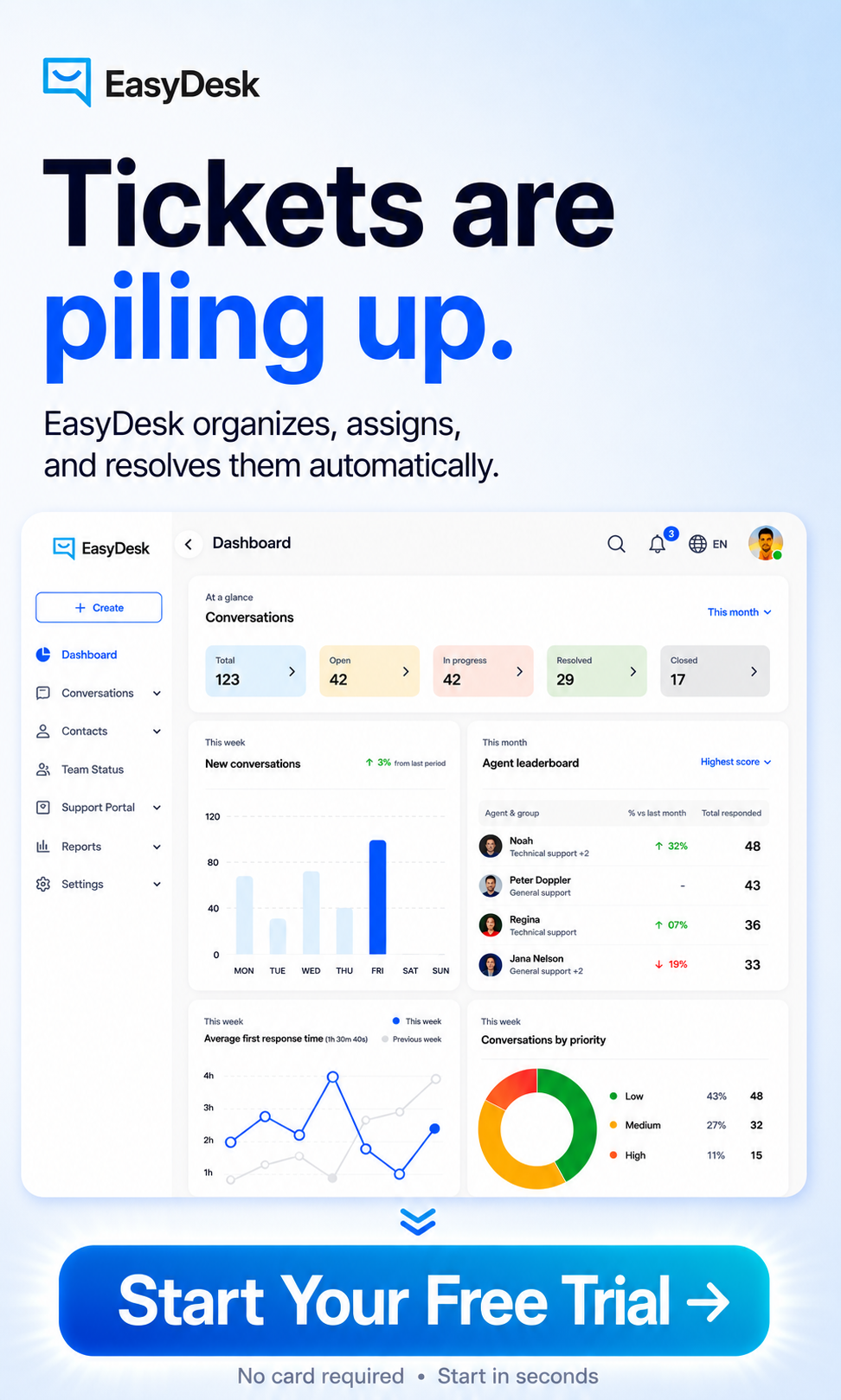
EasyDesk brings all essential customer support tools together with feedback tracking and public roadmap capabilities. Support tickets, live chat, and social media messages flow into one centralized hub where agents can tag conversations as feature requests and link them to customer accounts.
Automation rules route tagged requests to dedicated product feedback queues. SLA management ensures timely acknowledgment even when development decisions take longer. The knowledge base and changelog features help close the loop by connecting shipped features to original requests.
Teams can collect feature requests across channels, organize feature requests with consistent tagging, and prioritize feature requests using customer context and vote data. The 14-day free trial lets small teams test structured request management without lengthy setup.
FAQs
What Makes Feature Request Management Different From Bug Tracking?
Bug tracking addresses broken functionality that needs immediate fixing. Feature request management handles suggestions for new capabilities or improvements to existing ones. Bugs represent deviations from expected behavior. Feature requests represent aspirations for future behavior.
The workflows differ accordingly. Bugs typically follow severity-based prioritization with quick resolution timelines. Feature requests undergo strategic evaluation against product vision and resource availability. Both processes may use similar tools, but the evaluation criteria and customer communication patterns vary significantly.
How Do Support Teams Prioritize Feature Requests Fairly?
Fair prioritization balances multiple factors: customer impact, revenue potential, implementation effort, strategic fit, and urgency. Relying solely on vote counts lets high-volume customer segments dominate over smaller but higher-value accounts.
Document your evaluation criteria and apply them consistently. Consider weighting enterprise customer requests differently than free tier feedback. Review criteria quarterly to ensure they match current business priorities. Transparent criteria also help explain decisions to customers whose requests weren’t selected.
What Tools Help Automate Feature Request Workflows?
Modern feature request software like EasyDesk, Canny, and similar platforms offer automation for tagging, routing, duplicate detection, and status notifications. These tools reduce manual work while maintaining visibility across teams.
Look for platforms that integrate with your existing support and product tools. Native connections to helpdesks, CRMs, and development trackers ensure that feature request data flows where it’s needed without manual copying between systems.
How Often Should Teams Review Pending Feature Requests?
Weekly triage handles new incoming requests, ensuring nothing sits unacknowledged for long. Monthly prioritization sessions evaluate top candidates for upcoming development cycles. Quarterly reviews address the broader backlog, closing outdated requests and adjusting long-term priorities.
This rhythm prevents backlog bloat while ensuring strategic alignment. Teams that review less frequently often find their backlogs become unusable, filled with stale requests that no longer reflect current customer needs or product direction.
Why Do Customers Value Transparent Feature Request Updates?
Customers invest time when they provide product feedback. They describe problems, suggest solutions, and share context about their workflows. When companies respond with silence, that investment feels wasted. Future feedback slows.
Transparent updates respect customer contributions. Even a simple status change notification shows that someone reviewed the request. Public roadmaps let customers see where their suggestions fit without submitting repetitive support tickets. This transparency builds loyalty and encourages ongoing engagement with the product feedback process.