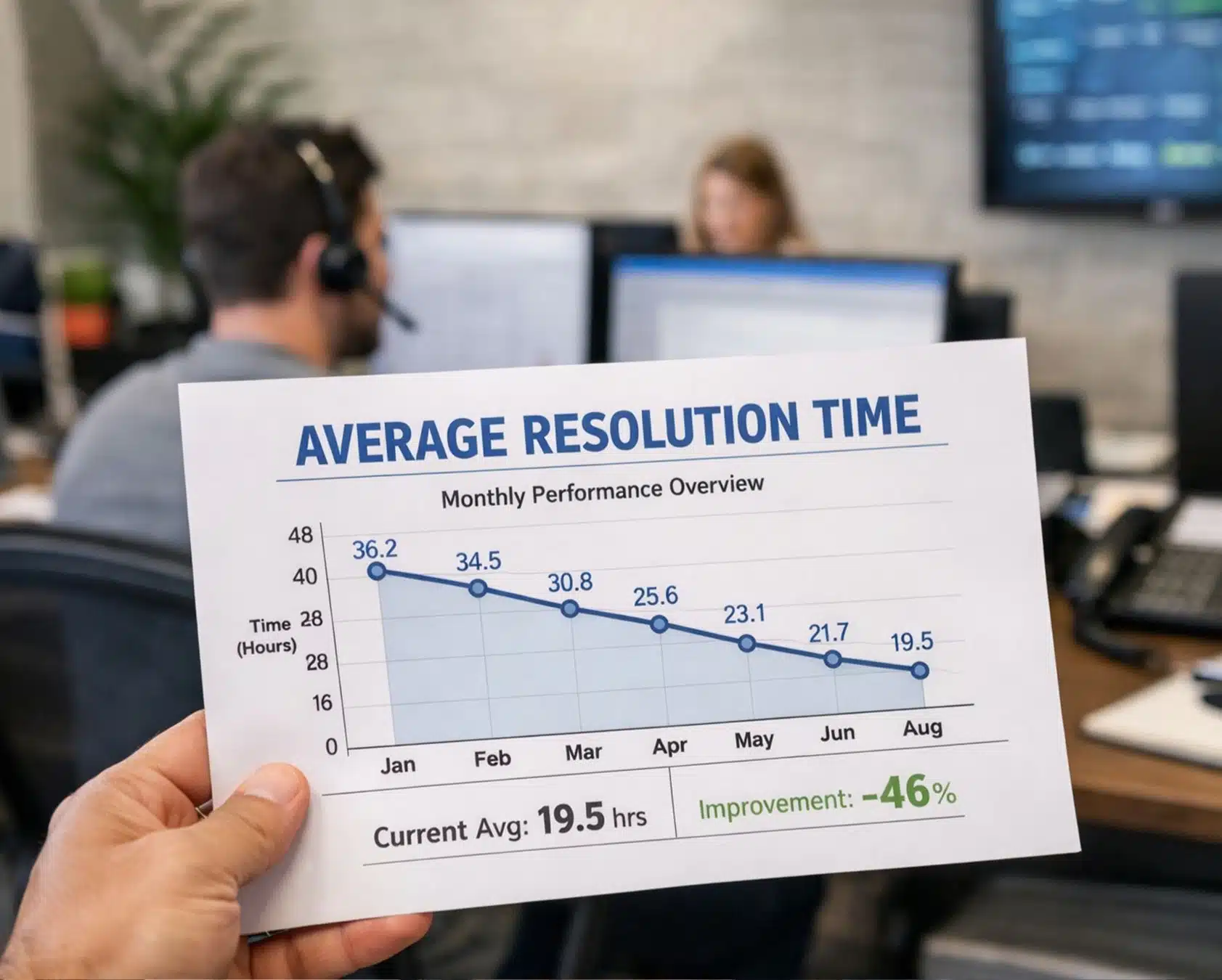
Average resolution time stands as a critical metric for every customer support operation. Average resolution time shows how long a support team needs to fully resolve customer issues from the first customer interaction to full resolution. Businesses calculate average resolution time to understand response time, ticket management efficiency, and overall customer service quality. Average ticket resolution time also reflects how well customer support agents meet customer expectations across different customer inquiries and incoming requests.
Customer service teams rely on measuring resolution time to gain a complete picture of support operations. The average resolution time formula helps identify bottlenecks, skill gaps, and inefficient processes that slow issue resolution. A tiered support system, clear internal processes, and established procedures support faster resolution time for complex issues and high ticket volumes.
In this article, we will explore valuable insights from customer feedback, team feedback, and industry benchmarks help improve processes, boost the team’s efficiency, and deliver high-quality support that leads to higher customer satisfaction.
What Is Average Resolution Time
Average resolution time refers to the average time a support team takes to fully resolve customer issues from the first customer interaction to final issue resolution. Average resolution time measures how efficiently customer support agents handle support tickets within a defined time frame. Customer service teams calculate average resolution time to understand customer service quality, meet customer expectations, and track overall customer satisfaction across customer interactions.
Teams calculate average resolution time using the average resolution time formula by dividing total resolution time by the total number of resolved tickets. Measuring resolution time offers valuable information about support processes, ticket management, and internal processes. Average ticket resolution time also helps identify bottlenecks, skill gaps, and areas where additional training or better communication skills improve the team’s efficiency.
A lower average resolution time improves customer experience, reduces dissatisfied customers, and increases customer retention. Self-service options, knowledge bases, automation tools, and a tiered support system support faster issue resolution. High-quality support depends on efficient processes, the right team, and continuous improvement across customer service operations.
Average Resolution Time Vs First Response Time
Average resolution time and first response time measure different stages of customer support performance. Both metrics shape customer satisfaction, customer experience, and support team efficiency. Understanding the difference helps customer service teams improve support processes and deliver high-quality support consistently.
| Aspect | Average Resolution Time | First Response Time |
|---|---|---|
| Definition | Average time required to fully resolve customer issues | Average time taken to send the first reply after a customer inquiry |
| Focus Area | Complete issue resolution and ticket closure | Initial acknowledgment and response speed |
| Time Frame | From ticket creation to full resolution | From ticket creation to first reply |
| Impact On Customers | Strongly affects overall customer satisfaction and retention | Shapes first impression and perceived responsiveness |
| Key Use Case | Measuring the resolution process efficiency and the team’s performance | Managing response time expectations |
| Optimization Methods | Training programs, automation tools, and a tiered support system | Ticket routing, alerts, staffing levels |
| Common Metric Name | Average ticket resolution time | First reply or response time |
| Business Insight | Reveals bottlenecks, skill gaps, and internal process issues | Highlights availability and workload balance |
Both metrics together provide a complete picture of customer support operations and help teams reduce average resolution time while maintaining fast response time.
Common Causes Of High Average Resolution Time
High average resolution time often signals deeper issues within support operations and internal processes. Customer service management systems face delays when systems, skills, or workflows fail to support efficient issue resolution. Identifying root causes helps teams reduce average resolution time and improve overall customer satisfaction.
Poor Ticket Prioritization
Poor ticket prioritization increases average resolution time across customer interactions. Support tickets often arrive with different urgency levels, yet many ticketing systems treat incoming requests equally. Critical customer issues then wait alongside low-impact inquiries, which delays full resolution and frustrates customers.
Customer support agents need clear rules for ticket management. Without priority tagging and escalation paths, the resolution process slows down. A structured approach allows support teams to resolve customer issues faster and meet customer expectations. Effective prioritization also improves the team’s efficiency and ensures that tickets solved align with business impact.
Skill Gaps Within Support Teams
Skill gaps among support agents directly affect resolution time. Customer issues that require technical or product knowledge take longer when agents lack proper expertise. Inexperienced agents may rely on repeated handoffs, which increases total resolution time.
Customer service teams benefit from thorough training programs and additional training sessions. Strong communication skills and problem-solving ability help agents deliver effective solutions faster. Identifying skill gaps through measuring resolution time and team feedback allows managers to strengthen the right team capabilities and improve average ticket resolution time.
Inefficient Support Processes
Inefficient support processes create unnecessary delays in issue resolution. Unclear internal processes, manual steps, and poor coordination slow down support operations. Customer inquiries may pass through multiple teams without clear ownership, which increases average time per ticket.
Established procedures and a defined resolution process reduce confusion. Customer service teams that improve processes remove friction points and reduce rework. Streamlined workflows help support agents resolve tickets within the expected time frame and maintain high-quality support across customer interactions.
Limited Self-Service Options
Lack of customer self-service increases ticket volume and raises average resolution time. Customers often submit support tickets for simple issues that internal knowledge bases or self-service options could solve instantly. Support teams then spend time on repetitive tasks instead of complex issues.
Self-service portals, FAQs, and automation tools reduce incoming requests and the total number of tickets. Customers receive quick answers, while support agents focus on higher-value issue resolution. Strong self-service also improves customer experience and supports higher customer satisfaction.
Weak Use Of Support Data
Poor use of support data prevents teams from identifying bottlenecks. Without tracking average resolution time, average ticket resolution time, and related customer support metrics, teams lack a complete picture of performance. Decisions then rely on assumptions rather than valuable insights.
Customer service teams that analyze resolved tickets can identify trends and recurring customer issues. Data-driven reviews reveal inefficient process steps and improvement opportunities. Using metrics alongside customer feedback management supports better ticket management, faster issue resolution, and stronger overall customer satisfaction.
Proven Ways To Reduce Average Resolution Time Faster
Average resolution time reflects how quickly customer service teams resolve customer issues from first contact to full resolution. Reducing average resolution time improves customer satisfaction, strengthens customer experience, and helps support teams deliver efficient, high-quality support at scale.
1. Strengthen Agent Skills And Product Knowledge
Well-trained support agents resolve customer issues faster and with greater accuracy. Thorough training programs improve communication skills, product feedback management, and decision-making across customer interactions. Regular additional training closes skill gaps and supports confident handling of complex issues without unnecessary escalation.
Strong product knowledge reduces total resolution time and improves customer service quality across support tickets. Skilled customer support agents follow the resolution process more effectively, deliver accurate solutions, and maintain higher customer satisfaction throughout the support journey.
2. Use Automation Tools And Smart Ticket Routing
Automation tools reduce average resolution time by removing manual steps from ticket management. Smart ticket routing assigns incoming requests to the right team based on issue type, urgency, and customer needs. Automated workflows shorten average time per ticket and improve response time consistency.
Efficient routing improves the team’s efficiency and prevents unnecessary handoffs. Customer service teams that rely on automation resolve tickets faster and maintain better control over support operations and workload distribution.
3. Expand Customer Self Service And Knowledge Bases
Customer self-service options reduce ticket volume and speed up issue resolution. Knowledge bases, FAQs, and self-service portals allow customers to solve common problems without contacting support agents. Fewer incoming requests help customer service teams focus on complex customer issues.
Strong self-service improves customer experience and supports higher customer satisfaction. Customers gain instant answers, while support agents spend more time on high-impact issue resolution.
4. Improve Support Processes And Internal Workflows
Clear internal processes help customer service teams resolve tickets within a defined time frame. Established procedures reduce confusion and improve coordination during the resolution process. Streamlined workflows remove delays and support efficient process execution across support operations.
Improved workflows reduce average ticket resolution time and increase overall customer service quality. Consistent processes also strengthen the team’s efficiency and performance across customer interactions.
5. Track Performance And Apply Data Insights
Tracking average resolution time provides valuable information about the team’s performance and support operations. Regular reviews help identify bottlenecks, trends, and improvement areas within ticket management and the resolution process.
Customer feedback and team feedback guide process optimization and training priorities. Data-driven actions reduce average resolution time, improve customer satisfaction, and support high-quality support outcomes consistently.
Common Mistakes Teams Make While Tracking Average Resolution Time
Average resolution time delivers valuable insights only when teams track and interpret the metric correctly. Many customer service teams misread data, overlook context, or rely on incomplete measurements. Avoiding common tracking mistakes helps improve support operations, accuracy, and decision-making.
Relying On A Single Metric
Many teams treat average resolution time as a standalone indicator. This approach creates an incomplete view of customer support performance. Resolution time alone cannot explain why delays occur or how customers perceive the resolution process.
Customer service teams should review average resolution alongside other metrics such as customer effort, ticket backlog, and escalation rates. A balanced view highlights workload distribution, issue complexity, and support agent effectiveness. Combining metrics offers better clarity on customer experience and helps teams avoid misguided process changes.
Ignoring Issue Complexity
Not all support tickets require the same effort or expertise. Teams that ignore issue complexity risk unfair performance evaluations and misleading averages. Simple customer inquiries resolve faster, while complex issues demand deeper investigation and coordination.
Segmenting tickets by type, priority, or complexity provides more accurate insights. Customer service teams gain a better understanding of average resolution time across different scenarios. This approach helps set realistic benchmarks, allocate resources properly, and support agents working on advanced customer needs.
Using Incomplete Data Sets
Incomplete data leads to inaccurate average resolution calculations. Teams sometimes exclude reopened tickets, escalated cases, or partially resolved issues. Such gaps distort total resolution time and hide recurring problems.
Accurate tracking requires inclusion of all resolved tickets within the ticketing system. Complete data supports reliable analysis and trend identification. Customer service teams gain stronger visibility into issue patterns, workload challenges, and long-term process effectiveness through consistent data collection.
Overlooking Customer Perspective
Focusing only on internal metrics ignores how customers experience resolution time. Customers measure success based on clarity, accuracy, and perceived effort, not just speed. A quick resolution without proper communication may still result in dissatisfaction.
Customer feedback adds critical context to average resolution time. Surveys, reviews, and follow-up responses reveal whether solutions meet customer needs. Integrating customer perspective ensures support teams balance speed with quality and maintain strong customer satisfaction.
Failing To Update Benchmarks
Static benchmarks reduce the value of average resolution tracking. Customer expectations evolve, and support operations change with new tools or processes. Outdated benchmarks no longer reflect realistic performance standards.
Customer service teams should review benchmarks regularly and compare results with industry benchmarks. Updated targets encourage continuous improvement and adaptability. Dynamic benchmarks also motivate teams and align performance goals with current business growth and customer demand.
Lack Of Team Accountability
Tracking average resolution time without accountability limits improvement. When ownership remains unclear, teams fail to act on insights. Support agents may not understand how individual actions affect overall resolution performance.
Clear responsibility improves results. Team leaders should share performance data, provide guidance, and encourage collaboration. Transparent reporting builds accountability and supports skill development. Accountability transforms resolution metrics into actionable improvement tools.
Misinterpreting Automation Impact
Automation tools influence resolution time, but misinterpretation creates false conclusions. Teams may credit speed gains to agents while automation handles repetitive steps. Others may blame tools for delays without reviewing configuration issues.
Accurate analysis separates automated actions from human involvement. Customer service teams gain clearer insight into process efficiency and tool effectiveness. Proper interpretation helps optimize automation, refine workflows, and support consistent issue resolution outcomes.
Why Average Resolution Time Is Important For Customer Satisfaction
Average resolution time directly shapes how customers judge support quality and reliability. Faster resolution time builds trust, meets customer expectations, and protects customer experience. Customer service teams that control average resolution time deliver consistent support outcomes and avoid dissatisfied customers across customer interactions.
Customer Trust And Confidence
Average resolution time plays a decisive role in customer trust. Customers expect customer service teams to resolve customer issues within a reasonable time frame. Long resolution time signals weak support operations and poor internal processes, which damages confidence. Faster issue resolution proves that the support team values customer needs and respects customer time.
Customer support agents who close tickets efficiently create positive customer interactions. Average ticket resolution time also affects how customers perceive the brand after each support ticket. When customers see tickets solved without delays, overall customer satisfaction rises. Trust grows when customers feel confident that future customer inquiries will receive high-quality support without repeated follow-ups or unnecessary escalation.
Customer Experience Quality
Customer experience depends heavily on average resolution time. Slow resolution process interrupts workflows and increases frustration. Customers want effective solutions, not prolonged communication loops. A lower average resolution time supports smoother customer interactions and reduces friction across support tickets.
Customer service teams that track average resolution time gain valuable insights into support processes and ticket management. Measuring resolution time helps identify bottlenecks and inefficient process steps. Teams that improve processes deliver faster full resolution and maintain consistent customer service quality. Better experience leads to stronger customer retention and long-term loyalty, especially when complex issues receive timely and accurate resolution.
Support Team Efficiency
Average resolution time reflects the team’s efficiency and operational maturity. Efficient support agents resolve tickets faster by following established procedures and clear internal processes. A well-structured ticketing system allows customer support agents to prioritize incoming requests and reduce total resolution time.
Customer service teams that calculate average resolution time can identify skill gaps and training needs. Thorough training programs improve communication skills, issue resolution accuracy, and decision speed. When customer support operations run efficiently, teams handle higher ticket volumes without quality loss. Faster average time per ticket also improves the team’s performance metrics and workload balance.
Customer Retention Impact
Average resolution time strongly influences customer retention. Customers who wait too long for issue resolution often become dissatisfied customers and may switch to competitors. Faster resolution time reduces frustration and strengthens emotional loyalty to the brand.
Customer service teams that reduce average resolution time show commitment to customer needs. A timely resolution process creates positive memories during problem situations. Customers remember how fast issues were resolved more than the issue itself. High-quality support encourages repeat usage, long-term relationships, and positive customer feedback. Strong retention directly supports revenue stability and brand credibility.
Operational Visibility And Control
Average resolution time offers a complete picture of support operations. Measuring resolution time allows teams to identify trends across resolved tickets and customer inquiries. The average resolution time formula highlights inefficiencies within internal processes and ticket management workflows.
Customer service teams use this critical metric to improve processes and allocate the right team resources. Data-driven insights help identify opportunities for automation tools, tiered support system adjustments, and better workload distribution. Clear visibility across average ticket resolution time supports smarter decisions and consistent service outcomes.
Alignment With Customer Expectations
Customer expectations continue to rise across multiple digital channels. Customers expect a fast response time and a timely full resolution. Average resolution time helps customer service teams align service delivery with modern customer needs.
Customer self-service options, knowledge bases, and CRM system integration reduce pressure on support agents and shorten resolution time. When customers receive quick answers through self-service, support teams focus on complex issues more effectively. Aligning the resolution process with expectations improves overall customer satisfaction and positions the brand as reliable and customer-focused.
How EasyDesk Helps Teams Control Average Resolution Time
EasyDesk helps customer service teams control average resolution time through structured workflows, smart visibility, and performance-focused tools. Centralized ticket management, SLA tracking, and real-time dashboards give support managers a clear view of the total number of tickets, resolved tickets, and total resolution time across support operations. These features support accurate measuring resolution time and reveal valuable information about support capacity and workload balance.
EasyDesk strengthens resolution consistency with customizable workflows, automated assignments, and CRM system integration. Teams identify trends, detect delays, and pinpoint root causes across customer interactions. Built-in reporting supports average resolution time art analysis, uncovers improvement opportunities, and aligns support processes with industry benchmarks. You can enjoy these features at a suitable price.
EasyDesk also empowers teams with internal notes, shared context, and knowledge bases that support full resolution. These tools help support agents deliver effective solutions faster, improve processes continuously, and maintain high-quality support that protects customer retention and long-term customer experience.
FAQs
Can Average Resolution Time Differ By Support Channel?
Yes, average resolution time often varies by support channel. Live chat, email, and phone support follow different resolution processes and response time expectations. Tracking channel-level data helps customer service teams optimize support operations and improve customer experience.
Does Average Resolution Time Affect Customer Loyalty?
Yes, average resolution time has a direct impact on customer loyalty. Faster issue resolution reduces frustration and builds trust. Customers who receive timely full resolution show higher customer retention and stronger long-term engagement.
Should Teams Track Average Resolution Time Daily Or Monthly?
Customer service teams should review average resolution time across multiple time frames. Daily tracking helps spot urgent bottlenecks, while monthly analysis reveals trends. Both views support better decision-making and process improvement.
Can A High Average Resolution Time Indicate Product Issues?
Yes, a consistently high average resolution time may signal product-related problems. Repeated customer issues increase total resolution time and ticket volume. Identifying these patterns helps teams share insights with product teams and improve overall customer satisfaction.
Does Average Resolution Time Apply To Internal Support Teams?
Yes, average resolution time applies to internal support teams such as IT or HR. Measuring resolution time improves internal processes, team efficiency, and employee experience. Faster internal issue resolution supports smoother business operations.
How Does Ticket Reopening Impact Average Resolution Time?
Ticket reopening increases total resolution time and affects average ticket resolution time. Reopened tickets often highlight incomplete resolution or unclear communication. Tracking reopened cases helps improve resolution quality and support processes.
Is Average Resolution Time More Important Than Response Time?
No, average resolution time and response time serve different purposes. Response time shapes first impressions, while average resolution time reflects full issue resolution quality. Customer service teams need both metrics for a complete performance picture.