Your customers care deeply about response time - more than you might think. Research shows that 53% of customers would abandon a business simply because they waited too long for email or message responses. Most of us know the frustration of waiting endlessly for a reply.
Customer service response time measures the gap between a customer's initial contact and an agent's first reply. Each communication channel sets different expectations. Customers expect email responses within 24 hours, social media replies within an hour [-3], and phone calls should take no more than three minutes. The reality paints a troubling picture. Companies take an average of 12 hours to respond to emails, and 62% never reply to customer service emails at all.
This article covers everything about first response time and ways to make it better. You'll learn about standards for various support channels, why delays happen, and practical ways to speed up your team's responses.
What Is First Response Time
First response time (FRT) measures how quickly a customer service team responds after a customer submits a customer inquiry. The clock starts from the customer’s initial inquiry and stops when a human agent sends the first response. Automated responses, predefined responses, or instant replies do not count, since FRT focuses on personalized responses from a customer service agent. A fast first response time creates a positive first impression and sets clear customer expectations across different support channels, such as customer service emails, messaging channels, phone support, or live chat.
Average first response time helps teams evaluate customer support performance during business hours. Teams calculate FRT by tracking response times divided by ticket volume and excluding automated responses for accuracy. Support software, automation tools, and intelligent routing help support agents handle high-volume customer queries faster. A direct correlation exists between quick responses, customer satisfaction, and customer experience, which keeps customer success and service quality on the right track.
Why First Response Time Is Important
First response time plays a direct role in customer satisfaction, customer retention, and long-term revenue. The speed at which a customer service team responds to a customer’s initial inquiry shapes trust, loyalty, and overall customer experience across support channels.
Impact On Customer Satisfaction
First response time strongly influences customer satisfaction because customers expect quick acknowledgment after a customer submits a request. A fast first response shows respect for the customer’s time and reassures them that a customer service agent is actively handling the issue. Even when full resolution takes longer, quick responses reduce anxiety and improve perceived service quality.
Average first response time also affects how customers judge customer support performance. When a support team responds within expected business hours, customers feel valued and wait patiently for resolved tickets. Slow response times, on the other hand, create frustration and damage customer expectations, especially across high-volume support channels like customer service emails and messaging platforms.
Effect On First Impression
First response time sets the tone for every customer interaction. A quick first response creates a positive first impression and signals professionalism, operational efficiency, and strong internal processes. Customers often associate response speed with the overall reliability of a business.
A delayed response can have the opposite effect. Customers may assume poor service quality, lack of organization, or insufficient support agents. Since first impressions influence long-term perception, first response time FRT becomes a key metric for maintaining a consistent customer experience across different support channels and preferred channels.
Role In Brand Trust
Response speed directly impacts how much customers trust a brand. When a support team responds quickly, customers believe the company values transparency and accountability. Trust grows when response times stay consistent and predictable.
Slow first reply time raises doubts about service quality and competence. Customers often question whether their issues will reach a human agent or remain unresolved. Maintaining a strong average response time builds credibility and positions the brand as dependable, especially during urgent customer issues or complex issues that require careful handling.
Connection To Customer Loyalty
Customer loyalty depends heavily on response speed. Quick responses encourage customers to stay, return, and engage more frequently. When customers receive timely replies, they develop confidence in the customer service team and feel comfortable reaching out again.
Slow response times increase churn risk. Customers facing delays often switch to competitors that instantly respond or offer immediate answers through automation tools, knowledge base access, or self-service options. First response time becomes a deciding factor that separates loyal customers from those who leave after repeated delays.
Impact On Revenue And Growth
First response time has a direct correlation with revenue. Faster responses increase the chance of resolving customer queries before frustration escalates. Businesses that respond first often win new customers, especially in competitive markets where consumers expect instant responses.
Response time also affects customer lifetime value. Customers who receive quick, personalized responses tend to spend more and stay longer. Improving average first response time supports customer success, increases resolved tickets, and strengthens long-term growth without adding more agents unnecessarily.
Influence Across Support Channels
Different support channels come with different expectations, but first response time remains critical across all of them. Customers expect faster replies on live chat ticketing systems and messaging channels than on email or phone support, yet consistency matters everywhere.
Support teams that track FRT by channel can identify patterns, manage ticket volume better, and allocate resources efficiently. Using intelligent routing, automation tools, and AI platforms helps teams meet industry benchmarks while maintaining high service quality across every customer interaction.
Importance Of Operational Efficiency
First response time reflects how efficiently a support team operates. Faster response times indicate well-structured workflows, proper staffing, and effective use of support software. Teams that track FRT can calculate average response time accurately and spot operational gaps.
Poor FRT often signals high-volume issues, lack of prioritization, or outdated processes. Improving first response time improves the team’s performance, reduces resolution time, and helps customer support stay on the right track even during peak demand periods.
How First Response Time Impacts Customer Retention
Response speed isn't just about efficiency; it determines whether customers stay or leave. Customer patience and loyalty start ticking away the moment they reach out with concerns.
FRT As A Predictor Of Churn
First response time is one of the most reliable signs that customers might leave. Data shows that high FRT leads to lower customer satisfaction scores and more customers jumping ship. This makes perfect sense; customers start looking elsewhere when they feel ignored.
The numbers tell a compelling story. Service problems like slow first response time make customers four times more likely to switch to competitors than price or product issues. This fact alone should make FRT optimization a top priority for any business focused on keeping its customers.
First response time helps executives gauge service quality, brand perception, and how smoothly operations run. Your customer retention metrics deserve careful attention, especially FRT data patterns. A low median response time with a high 90th percentile suggests some customers face unacceptable delays, often the first step before losing them for good.
Customer Expectations Around Response Time
Today's customers have specific expectations about business response times across support channels:
- Email inquiries: Nearly half (46%) of customers expect companies to respond faster than 4 hours
- Urgent queries: 12% expect a response within 15 minutes or less
- Overall support: 90% of customers rate an "immediate" response as important when they have a support question
These expectations keep rising. Customers now say their customer service feels "somewhat" or "much" slower than just a year ago. This gap between customer expectations and business delivery creates a dangerous weak spot in retention.
Trust and customer loyalty go hand in hand, with 88% of customers rating it most important, especially during economic uncertainty. Quick responses build trust by showing competence and respect for customers' time. Delays create frustration and doubt; even brief ones can damage your brand's professional image.
Examples Of Retention Loss Due To Delays
Slow response times hurt businesses in several measurable ways:
Brands that respond slowly on social media lose future sales to competitors, according to 73% of consumers. This direct link between slow responses and lost business proves why a better first response time is crucial for keeping customers.
The situation gets worse, 62% of companies never respond to customer service emails. Customers who experience this neglect get a clear message: their business doesn't matter. Most of these customers leave the brand after just 2-3 support attempts.
Money talks in this situation. Insurance companies with quick claims processing keep customers at rates that are a big deal, as it means that slower competitors. These companies know that quick service responses keep customers coming back.
Customers have clear limits on patience. Support teams have about eight minutes before most customers (54%) end their phone calls. After missing the response window, 28% of customers simply abandon the product or service.
Getting new customers costs nowhere near as much as keeping existing ones. This makes preventing customer loss through better first response time one of the smartest investments your support team can make.
Ideal First Response Time Benchmarks By Support Channel
Different support channels create varying customer expectations for response speeds. You can set realistic targets and allocate resources better by understanding these expectations.
Email Support Benchmarks
Email gives support teams the most flexibility with response times. Customer patience has limits, though. A detailed analysis of 300 data points from more than 150 sources showed clear tiers of email response performance.
Most customers (94%) want email responses within 24 hours. In spite of that, almost half (48%) expect replies within 6 hours. About 15% of customers want responses within just 60 minutes.
Industry benchmarks classify email response times into three categories:
- Good: 12 hours or less
- Better: 4 hours or less
- Best: 1 hour or less
Reality often disappoints these expectations. The average email response time sits at 12 hours across industries. The logistics sector performs slightly better with a 12-hour average, while retail businesses typically take 17 hours to respond.
Live Chat Response Expectations
Live chat has become the most time-sensitive channel. An overwhelming 96% of customers expect responses within five minutes after starting a chat. Among these, 80% want answers within just two minutes, and almost half (49%) will leave your website if they don't see someone typing within one minute.
Industry standards for live chat first response time have become increasingly demanding:
- Good: Under 1 minute
- Better: Under 40 seconds
- Best: Instantly or under 10 seconds
Slow chat responses carry high risks. Studies show 82% of customers abandon a chat after waiting more than 12 minutes. Each minute of delay costs roughly 10% in lost conversions.
Response expectations vary by industry. E-commerce and retail customers want the fastest replies (12-30 seconds). Healthcare follows at (20-45 seconds), then travel and hospitality (10-25 seconds), SaaS (15-45 seconds), and financial services (30-60 seconds).
Social Media Response Standards
Social media has become a crucial customer service channel with unique timing demands. The social media equation is simple: "Small Error + Slow Response Time = Colossal PR Disaster".
Industry benchmarks recommend social media responses within:
- Good: 5 hours or less
- Better: 2 hours or less
- Best: 1 hour or less [151]
Some experts suggest an even stricter timeline, 60 minutes or less, as the standard measure. This urgency comes from social media's public nature, where delays can turn into viral customer service failures quickly.
About 83% of Twitter users and 71% of Facebook users want responses the same day. Brands that fail to respond quickly on social platforms risk losing customers, as 73% say they'll buy from competitors next time.
Phone Support Timeframes
Customers expect immediate human contact on phone support. After dialing customer support, 90% of customers will wait up to 5 minutes to reach a live agent. Within this group, 60% expect waits under two minutes, and 29% tolerate only one-minute queue times.
Phone support response times typically fall into these categories:
- Good: Within 3 minutes
- Acceptable: 3-5 minutes
- Poor: Beyond 5 minutes
Phone support has strict customer patience limits. Support teams have roughly eight minutes before most customers (54%) hang up. This short window highlights the importance of efficient queue management and proper staffing during peak hours.
First response time standards should shape your service level agreements (SLAs) and resource distribution across channels. Your support strategy can meet customer expectations by understanding these timing requirements.
Common Causes Of Poor First Response Time
Every slow response time has specific problems you can identify and fix. Your customer service team needs to understand these roadblocks to develop working solutions.
Lack Of Agent Availability
Your first response time suffers when you don't have enough agents available. The ideal scenario would give customers someone ready to help right away. Reality shows limited staff forces customers to wait.
Agents who take calls back-to-back with no breaks will burn out. Customer support already faces high employee turnover rates. Handling queries without breaks between interactions makes this problem worse.
Limited staff creates problems throughout your support operations. This affects several key metrics:
- Average time in queue
- Speed of answer
- Call abandonment rates
- Customer satisfaction scores
Staff schedules often don't match customer demand. Poor scheduling leads to too many agents during slow periods and too few during rush hours. This creates unnecessary downtime and delayed responses.
Inefficient Ticket Routing
Your first response time increases because of delays from manual ticket routing. Support desk staff spend too much time sorting tickets to find the right team. This process wastes time and leads to mistakes.
Messy workflows without clear paths for moving tickets up the chain slow down response times. Agents waste valuable time managing shared email accounts and assigning tickets by hand. This leads to longer resolution times and lower customer support productivity.
Poor ticket distribution methods make things worse. Simple round-robin distribution ignores how busy agents are and what they're good at. This creates uneven workloads and slower solutions. Without limits on tickets per agent, some team members get swamped while others sit idle.
The most alarming fact shows 62% of companies never answer customer service emails. Ignored messages create more problems as customers try multi-channel helpdesk software. This generates duplicate tickets for the same issue.
Overreliance On Manual Processes
Teams that rely too heavily on manual customer service create bottlenecks, especially during busy times. Response times get longer because teams can't handle incoming questions efficiently without automation.
These inefficiencies come at a high cost. Agents spend about 30% of their day switching between different tools. This constant switching leaves less time to help customers.
Manual processes create information silos that slow down first responses. Support teams struggle to find customer details quickly when information lives in different systems. Agents waste minutes searching for information instead of helping customers.
Busy periods make these problems worse. Manually managed systems strain under increased ticket volume. This creates a growing gap between what customers expect and actual response times.
Inadequate Training Or Resources
Poor agent training slows down response times. Well-trained agents solve more tickets faster and need less help from others. This keeps queues moving and improves first response time. Agents with poor training struggle with even simple questions.
Poor training shows up in several ways that slow down responses:
- Confusion about the correct procedures
- Limited product knowledge
- Trouble finding relevant information
- Too much time asking colleagues for help
Many training programs only cover products and services, not customer interaction skills. This leaves agents unprepared for real-life support situations. They hesitate before responding, which adds delays.
Training directly connects to response time. Customer service becomes less effective when training stops. Agents lose confidence without ongoing education. They take longer to create responses, which hurts your first response time metrics.
How To Improve First Response Time For Your Support Team
Your support team's response speed needs strategic techniques and processes to improve. These key areas will help you reduce first response time and make customers happier.
Set Clear SLA Targets
Service Level Agreements (SLAs) define clear standards for customer support response times. Written agreements help your team stay accountable and responsive by providing performance standards. Here's what you need for SLAs:
- Specific FRT goals for each channel (chat, email, social media)
- Realistic targets based on your current performance data
- Clear expectations for your support team
Good SLAs create consistency among agents and help managers spot the need for extra resources or process changes. Companies with dedicated SLAs solve tickets 35% faster and get better customer satisfaction scores.
Use Response Templates
Pre-written, customizable answers for common customer issues help agents respond faster without compromising quality. Templates work as starting points that agents can tailor to each situation, unlike automated responses.
"The agent should always control and edit and give a little bit of human touch to templates," advises Andrei Kamarouski, Pythia CEO and Zendesk expert. This mix of speed and personal touch lets your team cut response times while staying human.
Train Agents On Prioritization
Customer queries need different levels of attention - some are urgent, others can wait. Your agents need to learn ticket triage techniques to handle critical issues first.
Good prioritization needs:
- Email tags by type (technical issue, billing question, feature request)
- Priority levels based on urgency, effect, or customer type
- Specific agents for different channels
Teams using automated ticket triage solve issues 21% faster and get better customer satisfaction scores.
Monitor Performance With Dashboards
Your team needs real-time performance data to keep improving. Dashboards should show key FRT metrics, response rates, and agent status.
These dashboards need to:
- Display average response times by channel
- Alert when response times go over set limits
- Turn raw data into useful information
Quick access to this data lets you adjust staffing, workload, and support processes right away.
Track Time To First Response Regularly
Regular measurement creates accountability and shows trends. Weekly reviews of your FRT performance help spot patterns and fix bottlenecks early.
Your data analysis should:
- Find patterns in delayed responses (time of day, ticket types)
- Check performance across channels and agents
- Study SLA breaches and create prevention plans
Regular reviews give you visibility into key performance indicators that help manage SLAs effectively.
These strategies will help build a support operation that meets customer expectations consistently. Each interaction builds trust and loyalty.
Role Of Automation In Reducing First Response Time
Automation tools have transformed how support teams handle customer questions and cut response times on all channels. Teams can scale their customer support team operations with the right technology while keeping the personal touch customers expect.
Using Chatbots For Original Contact
Chatbots act as the front line of customer support and provide quick answers to common questions. These AI-powered assistants work 24/7 to give customers instant responses, no matter what time they reach out. Research shows 90% of consumers think an "immediate" response matters when they have a customer service question. Chatbots handle basic questions about order status, shipping times, or password resets so human agents can tackle more complex issues. One insurance company's chatbot now manages about 4,000 conversations each month and substantially reduces ticket volume.
Automated Ticket Assignment
Quick ticket routing to the right agent is vital to maintain optimal first response time. Automated assignment systems use predefined rules to route tickets and eliminate manual distribution bottlenecks. Common approaches include:
- Round-robin: Distributes tickets in sequence for balanced agent workloads
- Workload-based: Sends new tickets to agents with the least open requests
- Skill-based: Routes tickets by categories, keywords, or customer details
These systems can slash first response times from hours to seconds. One case study showed a drop from 15 minutes to just 23 seconds.
AI-Powered Response Suggestions
AI helps agents create faster, more accurate responses. These systems analyze incoming messages and suggest contextual replies based on your knowledge base. Agents can review, personalize, and send these suggestions with minimal editing to reduce response time. Companies that use AI-suggested responses see up to a 74% drop in first response time. This happens because agents don't need to search for information or write responses from scratch.
Benefits Of Workflow Automation
Workflow automation makes the entire support process smooth by removing obstacles throughout the customer's trip. Automated systems handle intake, triage, and routing quickly and ensure consistent processing during busy periods. This integrated approach cuts first response time while maintaining quality - a balance that keeps customers happy. On top of that, it frees agents from repetitive tasks so they can focus on complex customer issues that need human expertise.
How EasyDesk Helps Teams Achieve Faster First Response Time
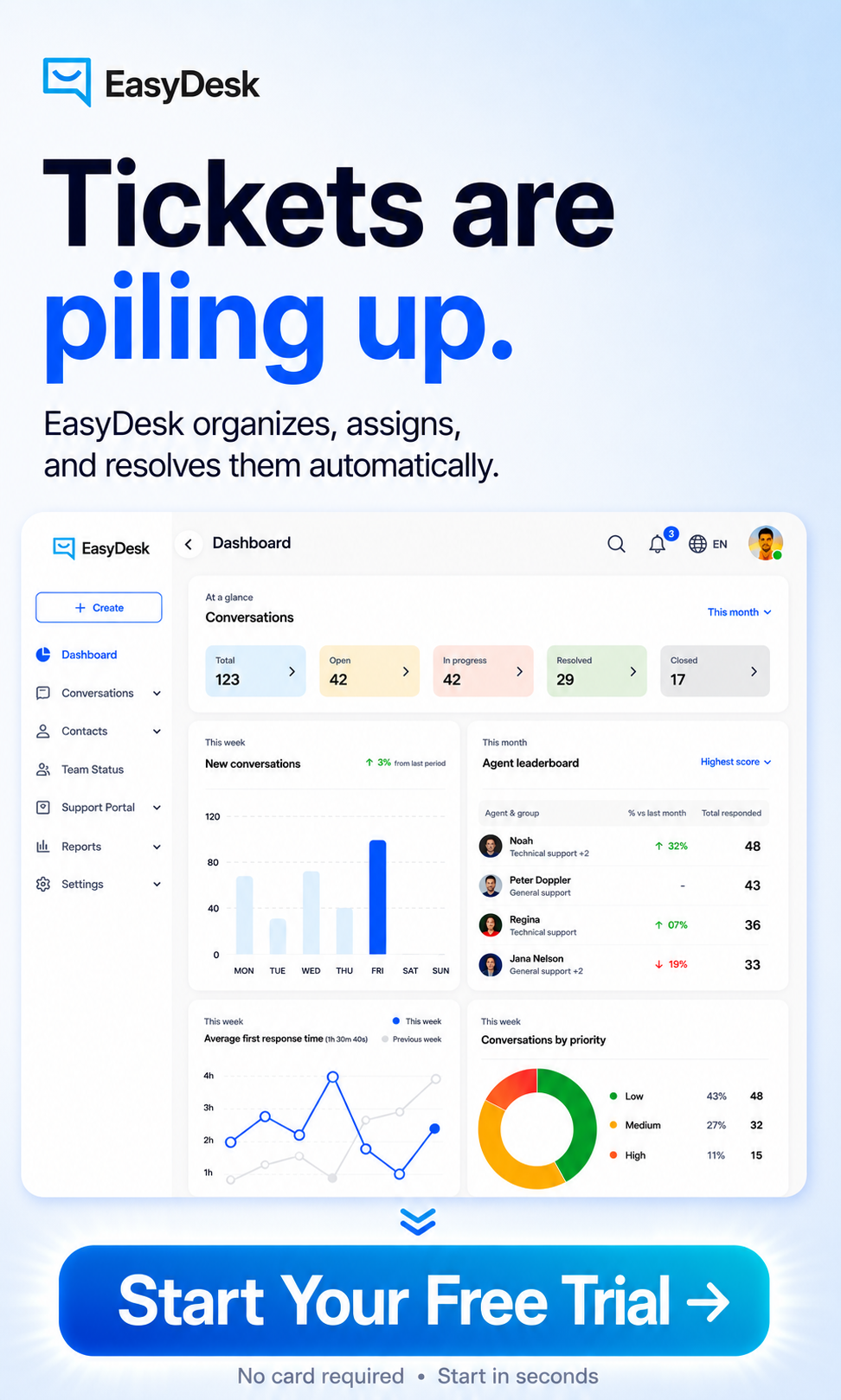
EasyDesk helps customer support teams improve first response time by combining automation, visibility, and smart workflows inside one support software. EasyDesk has several features that are helpful for your customer support teams. When a customer submits a request, the platform ensures the support team responds faster across different support channels without manual delays. Built-in SLA tracking, intelligent routing, and real-time alerts help teams meet FRT expectations during business hours, even with high ticket volume.
Automation tools assign customer queries to the right support agents instantly and exclude automated responses from first response time FRT tracking. Custom dashboards help teams calculate average response time, track FRT trends, and identify patterns across customer interactions. With unified inbox access, personalized responses, and better operational efficiency, EasyDesk helps teams deliver quick responses, improve service quality, and create a positive first impression that supports customer success and retention. You can enjoy EasyDesk at a suitable price.
FAQs
Does First Response Time Include Automated Replies?
No. First response time excludes automated responses, predefined responses, and instant replies. FRT counts only the first personalized response sent by a human agent after a customer’s initial inquiry.
Can First Response Time Affect Customer Expectations?
Yes. Fast first response time sets clear customer expectations and reassures customers that a support team responds quickly. Slow reply time often causes frustration and lowers perceived service quality.
Is Average First Response Time Better Than Average Response Time?
No. Average first response time focuses only on the first reply, while average response time covers all replies during customer interactions. FRT better reflects the first impression and early customer satisfaction.
Should First Response Time Be Measured Outside Business Hours?
No. Teams usually calculate first response time during business hours unless 24/7 support exists. This approach shows accurate customer support performance and avoids misleading response times.
Does First Response Time Influence The Number Of Resolved Tickets?
First response time impacts how quickly tickets move forward. Faster first replies reduce backlog, improve operational efficiency, and help support agents resolve more tickets within SLA limits.
Can Self-Service Options Reduce First Response Time Pressure?
Yes. A strong knowledge base software, and self-service tools give customers immediate answers. This lowers ticket volume and allows support teams to focus on complex customer issues that need a human agent.
Why Do Different Support Channels Have Different FRT Expectations?
Customer expectations vary by preferred channel. Messaging channels and live chat demand instant responses, while customer service emails allow longer response times. Tracking customer response by channel helps teams stay on the right track.