Canned responses in customer support can revolutionize how businesses handle customer questions. Support teams face mounting pressure as 90% of customers expect immediate responses to service emails. The challenge grows with 75% of online customers who need help within five minutes.
Businesses grow revenue 41% faster and retain 51% more customers when they focus on customer satisfaction. Canned responses serve as pre-written, reusable message templates that answer common customer questions quickly. Support teams use these templates to stay consistent and respond faster while scaling their customer communication effectively. The right approach to canned responses can improve your customer service strategy by a lot, especially since bot-chats achieve 87.58% satisfaction rates. Let's explore canned responses, their benefits to your support team, and the best ways to create templates that make customers happy while saving time.
What Are Canned Responses In Customer Support?
Canned responses in customer support means pre written responses that help customer service teams quickly respond to common customer inquiries. These canned responses allow customer support agents to deliver accurate answers with a faster response time across live chat and multiple channels.
Customer service canned responses work as canned response templates that support teams use to greet customers, handle customer messages, and address frequently asked questions during business hours or business days. Support agents can personalize canned responses with a customer name, relevant details, or hello customer name to improve customer communication and overall customer satisfaction. Live chat canned responses and chat canned responses help customer service reps save time, maintain consistent responses, and quickly respond to customer complaints, technical support issues, or feature request messages.
Effective canned responses support a strong customer service strategy, improve customer experience, boost customer satisfaction, protect company policies, and strengthen the company’s reputation while still offering further assistance, self-service options, knowledge base links, video tutorials, or a closing canned response when needed.
How Canned Responses Improve Support Team Efficiency
Canned responses in customer support tools help support teams manage high volumes of customer inquiries without losing speed or accuracy. Pre-written responses give customer support agents a reliable way to deliver consistent answers, reduce response time, and protect customer experience as demand grows.
Faster Replies For Common Questions
Support teams receive repeated customer messages about pricing, access, refunds, or setup steps every day. Canned responses allow customer service agents to reply instantly instead of writing the same explanation multiple times. This approach helps customer support agents meet modern expectations for immediate response, especially on live chat and canned responses.
Quick replies reduce first response time and improve overall customer satisfaction. Customers feel valued when they receive accurate answers within seconds. Customer service reps can select canned response templates, add a customer name, and send a polished reply across multiple channels. This speed improves customer communication and strengthens trust in the support team.
Better Focus On Complex Issues
Canned responses help customer service teams handle simple requests efficiently, which leaves more time for complex issues. Technical support cases, feature request discussions, or sensitive customer complaints need human judgment and deeper attention. Pre-written replies reduce distraction from repetitive questions.
Customer support agents can focus on meaningful customer interactions that require analysis and empathy. Support agents feel less pressure during peak business hours because basic questions no longer slow them down. This balance improves productivity and reduces burnout. A customer support team that focuses on value-driven work delivers higher customer satisfaction and stronger long-term outcomes.
Consistent Answers Across Teams
Consistency matters in customer service strategy. Canned responses ensure that customer service responses stay aligned with company policies, tone, and approved messaging. Every customer receives the same accurate answers, regardless of which support agent handles the conversation.
Consistent responses protect the company’s reputation and reduce confusion. Customer service reps avoid sharing outdated or conflicting information. Live chat canned responses and customer service canned responses help standardize replies across email, chat, and social platforms. This clarity builds trust and improves customer experience at every touchpoint.
Quick Onboarding For New Agents
New customer service agents often struggle with confidence during the early days. Canned response templates act as a built-in guide that supports faster onboarding. New hires learn approved language, product details, and customer communication standards while responding to real customer inquiries.
Pre-written messages reduce mistakes and help new support agents deliver accurate answers from day one. Customer service teams spend less time correcting replies and more time refining quality. This approach supports efficient training and allows the support team to scale without slowing down service quality.
Higher Productivity During Peak Hours
Busy periods create pressure on customer support operations. Canned responses help customer service teams handle higher volumes without delays. Support agents can reply to customer messages quickly, even during traffic spikes or limited business hours.
Shorter response time improves customer satisfaction and reduces frustration. Customer service reps manage more conversations without sacrificing quality. Automated canned responses and chat canned responses also support better resource allocation. Teams stay responsive, calm, and organized during demanding periods.
Better Use Of Self Service Resources
Canned responses support smarter customer communication by guiding users to self-service options. Support agents can share knowledge base links, video tutorials, tracking link details, or relevant department contacts through pre-written replies.
Customers receive clear next steps without waiting for long explanations. This method encourages self-resolution while keeping customer interactions helpful and personal. Customer service agents still offer further assistance when needed. This balance helps address frequently asked questions and improves overall customer satisfaction.
Stronger Metrics And Business Results
Effective canned responses improve measurable support performance. Faster replies improve response time, while consistent answers raise customer satisfaction scores. Customer feedback often reflects appreciation for clarity and speed.
Customer service teams that use canned responses see better outcomes across CSAT, resolution speed, and retention. Support teams delight customers by combining quick replies with personalization. This structure supports growth, protects brand trust, and helps customer support scale without sacrificing quality.
Key Benefits Of Canned Responses For Customer Support Teams
Canned responses from customer support tools give support teams a structured way to deliver fast, accurate, and consistent customer service responses. Pre-written responses help customer support agents improve efficiency, protect brand voice, and raise customer satisfaction across live chat and other channels.
Consistent Tone And Messaging
Canned responses help customer service teams maintain consistent responses across every customer interaction. Pre-approved canned response templates ensure that customer communication follows the same tone, language, and company policies, regardless of which support agent replies. This consistency strengthens trust and improves customer experience.
Customer service agents avoid conflicting answers when handling customer inquiries such as pricing, refunds, or account changes. New customer service reps also benefit by matching the communication style of experienced team members. Consistent answers reduce confusion, protect the company’s reputation, and support a reliable customer service strategy.
Faster First Response Time
Response time plays a critical role in customer satisfaction. Canned responses allow customer support agents to quickly respond to common questions without writing long replies. Live chat canned responses and chat canned responses help support teams deliver immediate responses during business hours.
Customer messages receive accurate answers within seconds. Faster first response time improves overall customer satisfaction and encourages positive customer feedback. Customer service teams that use canned responses consistently meet expectations and reduce frustration, especially when customers expect instant support on live chat.
Better Scalability During Peak Volume
High ticket volume can overwhelm even experienced customer service teams. Canned responses give support teams the ability to handle more customer inquiries without sacrificing quality. Pre-written replies allow customer service agents to manage high demand during product launches, outages, or busy business days. Better ticket prioritization can easily help you to achieve better scalability.
Support teams maintain consistent answers while addressing multiple conversations at once. Customer service reps avoid burnout and keep conversations moving smoothly. This scalability supports growth and helps customer support teams maintain service standards as demand increases.
Stronger Quality Assurance
Canned responses support quality assurance by providing approved and reviewed customer service responses. Support teams control messaging accuracy and ensure that customer communication aligns with company policies. This process reduces the risk of outdated or incorrect information.
Customer service agents avoid common errors such as typos or unclear explanations. Pre-written messages maintain clarity and professionalism across multiple channels. Regular updates to canned response templates keep content relevant and ensure accurate answers for customer inquiries.
Improved Agent Productivity
Customer support agents spend less time typing repetitive replies when they use canned responses. This time savings allows support agents to focus on complex issues, customer complaints, or technical support cases that require deeper attention.
Customer service reps manage more conversations with less effort. Better productivity leads to higher job satisfaction and reduced stress. Support teams deliver faster resolutions while maintaining a high standard of customer experience across all touchpoints.
Easier Training For New Agents
Canned responses support faster onboarding for new customer service agents. Pre-written responses act as a practical learning resource that helps new hires understand product details, customer communication standards, and company tone.
New support agents reply with confidence while learning. Customer service teams reduce training time and minimize errors. This structure ensures that every customer interaction meets quality standards from the first day, even during early training stages.
Higher Customer Satisfaction And Trust
Customers value clear and timely responses. Canned responses help customer service teams improve customer satisfaction by delivering consistent, accurate, and quick replies. Customers feel heard and respected when support teams respond without delay.
Positive customer interactions lead to better customer feedback and stronger loyalty. Support teams that use effective canned responses delight customers while maintaining efficiency. This balance supports long-term retention and higher overall customer satisfaction.
Common Use Cases Of Canned Responses In Daily Support Operations
Customer support teams deal with many repeated situations where ready-made responses are a great way to save time. Here are the most common scenarios where templates help deliver quality service quickly.
Acknowledging receipt of a ticket
The first response to customers sets the tone. Customers need to know right away that someone has seen their request. A quick acknowledgment shows them their issue matters, and help is on the way.
Good ticket responses should include the ticket number, when to expect a reply, and self-help options. For example: "Hello [CUSTOMER NAME], Thank you for sending your request. Your ticket tracking number is [TICKET NUMBER]. Our team is working on resolving your issue, and you will receive an email notification as soon as it is resolved".
Messages outside business hours need clear expectations: "Our team is currently away and will start working on resolving your issue shortly. Please note our business hours: [YOUR BUSINESS HOURS]".
Providing step-by-step instructions
Customers often ask about common technical issues that have simple fixes. Support teams can save time with ready-made responses that list step-by-step solutions to frequent problems.
Product help works best with clear instructions: "I'm happy to help. Follow these instructions to get started: [instructions]". It also helps to share resource links: "I would be happy to help you use the product! Visit this link to get started [link]".
Requesting more information
Customer messages sometimes miss vital details needed to solve their problem. Templates help agents get the right information without going back and forth multiple times.
A direct request works best: "Could you please provide more details about the issue you're experiencing? I'd like to help". Technical issues need specific details: "I understand you're facing issues with (issue). Can you describe what troubleshooting steps you've taken so far?"
Apologizing for errors
Every company makes mistakes. The way support teams handle them shapes customer trust. Well-written apology templates help keep responses professional.
Good apology responses own up to mistakes directly: "We apologize for the mistake on our end. We're taking steps to correct it immediately". Being open builds trust: "Thank you for bringing this to our attention. We're sorry for any inconvenience this has caused. Our solution is to [solution]".
Escalating issues to higher support tiers
Some problems need expert help. When complex issues come up, templates make it easy to move them up while keeping customers in the loop.
A good escalation message says: "I understand the urgency of this matter. I'm escalating your case to our senior support team. They will contact you within [Time Frame]". This shows the customer you take their issue seriously and lets them know what happens next.
These common support situations show how templates speed up responses while keeping messages personal and consistent. Support teams can work faster and maintain quality across all customer conversations by using templates for these situations.
Best Practices For Creating Effective Canned Responses
Effective canned responses customer support teams rely on require clear structure, human tone, and strong relevance. Well planned pre written responses help customer support agents deliver accurate answers, improve response time, and maintain a positive customer experience across live chat and multiple channels.
Use Clear And Simple Language
Canned responses work best when customer service responses stay easy to read and direct. Short sentences and clear wording help customers understand solutions without confusion. Customer support agents avoid follow-up questions when pre-written replies explain steps in a simple way.
Customer service teams should remove unnecessary technical terms unless the message targets technical support users. Simple language improves customer communication and speeds up resolution. Clear customer service canned responses also help new agents reply with confidence and accuracy across customer interactions.
Add Personalization Placeholders
Personalization helps canned responses feel human. Placeholders such as customer name, ticket number, or product reference allow customer service agents to tailor replies quickly. A greeting like hello, the customer's name, makes customer messages feel acknowledged and valued.
Customer support agents can personalize canned responses without slowing down response time. This balance improves customer experience and overall customer satisfaction. Live chat canned responses feel more natural when personal details replace generic text. It can be easily done by an automated ticket management software.
Match Brand Voice And Tone
Canned response templates must reflect the company name and brand personality. Friendly brands should avoid overly formal language, while professional services should maintain clarity and respect. Consistent tone across customer service responses builds trust.
Customer service teams should define tone rules as part of their customer service strategy. Support agents then deliver consistent answers that align with customer expectations. This approach protects the company’s reputation and strengthens customer communication.
Focus On Common Customer Questions
Effective canned responses address frequently asked questions and recurring customer inquiries. Support teams should review customer messages to identify patterns across live chat, email, and social channels. Templates should target these high-volume issues first.
Customer service agents save time when they use canned responses for billing, access issues, or basic feature guidance. This focus helps address customer complaints faster and improves response time during busy business hours.
Review And Update Regularly
Canned responses need regular review to stay accurate. Product updates, policy changes, or pricing adjustments can quickly make pre-written replies outdated. Customer service teams should schedule reviews to keep content aligned with company policies.
Accurate answers reduce confusion and improve customer satisfaction. Support teams that maintain updated canned responses deliver consistent responses and avoid unnecessary escalations. Regular updates also support quality assurance goals.
Test Based On Customer Feedback
Customer feedback provides valuable insight into how canned responses perform. Support teams should track follow-up questions, customer satisfaction scores, and resolution rates. These signals show which customer service canned responses need refinement.
Customer support agents can test small wording changes to see what improves clarity. This practice helps delight customers and strengthen customer experience. Feedback-driven improvements support higher customer satisfaction over time.
Balance Speed With Human Touch
Speed matters, but empathy matters more. Effective canned responses combine fast replies with supportive language. Customer service agents should adjust their tone when handling customer complaints or sensitive issues.
Support agents can add a short personal sentence before a closing canned response. This approach offers further assistance while keeping replies efficient. The result supports trust, clarity, and long-term customer relationships.
How Canned Responses Enhance Customer Experience And Satisfaction
Canned responses that customer support teams use play a direct role in shaping customer experience and overall customer satisfaction. Pre-written responses help customer support agents deliver fast, accurate, and consistent customer service responses across live chat, email, and other channels.
Immediate Replies Improve Customer Experience
Customers expect quick answers when they reach out for help. Canned responses allow customer service agents to provide an immediate response to common customer inquiries. Live chat canned responses reduce wait time and help customers feel acknowledged within seconds.
Fast replies improve response time and lower frustration. Customer messages receive accurate answers without delays, which builds confidence in the support team. When customer support agents respond quickly, customers feel valued and respected, which leads to higher customer satisfaction and positive customer feedback.
Consistent Answers Build Trust
Trust grows when customer communication stays reliable. Canned response templates ensure consistent responses across all customer interactions. Customer service teams avoid sharing conflicting information, even when multiple customer service reps handle similar questions.
Consistent answers protect company policies and reinforce brand credibility. Customers feel more confident when they receive the same clear information every time. This reliability strengthens long-term relationships and improves overall customer satisfaction.
Personalized Messages Feel Human
Personalized canned responses improve customer experience without slowing down support teams. Customer support agents can personalize canned responses by adding the customer's name, order details, or relevant context. Simple touches, such as hello customer name, make conversations feel genuine.
Customers appreciate recognition and care during support conversations. Personalization helps customer service responses feel natural instead of scripted. This balance between speed and empathy helps delight customers and strengthens customer interactions.
Proactive Help Through Resources
Effective canned responses guide customers beyond basic answers. Support agents can share knowledge base links, video tutorials, tracking link details, or self-service options directly within pre-written replies. Customers receive relevant details without searching elsewhere.
This proactive approach empowers customers to solve related issues independently. Customer experience improves when support teams anticipate follow-up needs. Helpful resources show commitment to quality assistance and encourage customer trust.
Reduced Frustration During High Volume
Busy periods often increase wait times and frustration. Canned responses help customer service teams stay responsive during high message volume. Support agents manage more conversations while maintaining accurate answers.
Customers receive timely replies even during peak business hours. Shorter queues and faster resolution improve customer satisfaction. Reliable support during busy periods strengthens the company’s reputation and reassures valued customers.
Clear Communication For Complex Issues
Complex issues require clarity and structure. Canned responses help customer support agents explain technical support steps in a clear and organized way. Pre-written replies reduce confusion and guide customers through solutions.
Support agents can adjust responses with relevant details for each case. Clear communication reduces repeated questions and speeds up resolution. Customers feel confident when instructions are easy to follow.
Positive Impact On Long Term Loyalty
Customer experience shapes loyalty. Canned responses support higher customer satisfaction by combining speed, consistency, and clarity. Customers remember positive support experiences and return with confidence.
Strong customer interactions encourage referrals and repeat business. Customer support teams that use effective canned responses create lasting impressions. This approach strengthens trust and supports long-term business growth.
Canned Responses Vs Manual Replies: Key Differences
The basic difference between canned responses and manual replies boils down to balancing efficiency with personalization. Your team's productivity and customer satisfaction will substantially improve if you know the right time and way to use each approach.
Speed and efficiency comparison
Creating manual responses takes much longer than using canned responses, which let agents answer common questions almost instantly. The efficiency difference makes a real impact; companies that use email templates see their average case handling time drop by up to 40%. This time-saving advantage becomes valuable during busy periods. Teams can handle more tickets without adding staff, and queue times decrease naturally.
Canned responses help support teams answer repetitive questions with a few clicks while keeping their tone and content consistent. The boost in efficiency is substantial; these pre-written templates give agents more time to tackle complex problems that require human judgment and critical thinking.
Risk of errors and inconsistencies
Customer service faces a major challenge in keeping information consistent across channels and agents. Canned responses solve this problem by giving customers similar information no matter who handles their case.
Manual responses have higher error rates, including grammar mistakes and typos, especially when agents rush. Pre-written templates minimize these problems and ensure professional, accurate responses every time. Quality assurance becomes even more valuable since these templates undergo thorough checking before use. This process ensures customers receive only factually correct information.
When to use each approach
Canned responses work best for:
- Frequently asked questions about sales, support, billing or technical issues
- Simple questions with straightforward answers
- Original acknowledgments and greetings
Manual responses remain essential for:
- Complex issues that require personalized attention
- Emotional customer experiences that need empathy
- Unique situations not covered by existing templates
A balanced strategy works best, using canned responses as foundations that agents can personalize. This approach keeps efficiency high while avoiding the robotic feel that customers dislike.
How To Personalize Canned Responses Without Losing Speed
The real magic of canned responses comes from making them feel unique to each customer. Template messages become meaningful interactions that build customer satisfaction with the right personal touch. Many support teams find it hard to balance personalization with efficiency. Several techniques can help you work quickly while creating individual-specific experiences.
Use dynamic fields like name and issue type
Dynamic fields (or placeholders) automatically insert customer-specific information into your templates. These small bits of code pull data from customer profiles or tickets and place it directly into your response. To cite an instance, using {{ticket.requester.firstname}} in your greeting creates an instant "Hi John" instead of a generic "Hello there".
Dynamic fields can include ticket IDs, agent names, ticket subjects, and current status updates. Your response feels more personal just by adding these fields, without extra typing time. Most support platforms give you easy access to these fields through dropdown menus or insert buttons.
Add empathy and context manually
Automation handles simple personalization, but authentic human touches truly distinguish excellent support. Take a moment to add situation-specific context after inserting your template. Statements like "I completely understand how frustrating this must be" help calm upset customers and make interactions more human.
You should acknowledge what happened and how it affected the customer. Show you're not dismissing their concerns by confirming their experience. This takes a few extra seconds, but the effect on customer satisfaction makes it worth the time.
Segment templates by customer type or issue
Different customers have varying needs. Specialized templates for distinct customer segments improve personalization while keeping things efficient. You might organize your canned responses into folders by topics like "Billing," "Technical Issues," or "Shipping".
Setting permissions determines which teams can access specific templates. Specialized API troubleshooting responses might only need to be available to your Tier 2 support group. This organization helps agents find exactly what they need quickly while keeping interfaces clean.
Note that personalization doesn't mean starting from scratch with every interaction. Smart template design and strategic customization create the perfect balance between efficiency and personal connection.
Mistakes To Avoid When Using Canned Responses In Customer Support
Canned responses customer support teams rely on can improve efficiency, but poor execution can damage customer experience. Common mistakes often reduce customer satisfaction, weaken trust, and create frustration when pre-written responses feel careless or irrelevant.
Overuse Without Personal Touch
Canned responses lose value when customer support agents send them without adjustment. Customers notice copy-paste replies that ignore their specific situation. Live chat canned responses that lack personalization make customer interactions feel robotic and dismissive.
Customer service agents should personalize canned responses with a customer's name or relevant details. Small edits show attention and care. Support teams that balance speed with empathy improve customer experience and protect overall customer satisfaction.
Outdated Or Incorrect Content
Outdated canned responses cause confusion and harm customer communication. Customer service teams sometimes forget to update templates after policy changes, pricing updates, or feature releases. Incorrect information leads to repeat customer inquiries and unnecessary frustration.
Regular reviews help customer support teams maintain accurate answers. Updated canned response templates reduce errors and protect the company’s reputation. Accurate customer service responses build trust and reduce follow-up questions.
Poor Match To Customer Issues
Canned responses fail when they do not address the real problem. Customer support agents should understand customer messages before selecting a template. Generic replies frustrate customers who expect relevant solutions.
Customer service teams should use canned responses as a starting point, not a final answer. Support agents must adjust content to match customer complaints, technical support cases, or feature request details. Proper alignment improves response time and resolution quality.
Ignored Emotional Context
Tone matters in customer support. Canned responses that ignore emotional cues feel cold and unhelpful. Customers who express frustration expect empathy, not neutral or scripted replies.
Customer service agents should acknowledge emotions before offering solutions. A short empathetic sentence improves customer experience. Support teams that respect emotional context build stronger customer trust and improve overall customer satisfaction.
Excessive Automation Use
Automated canned responses can speed up replies, but too much automation harms customer interactions. Customers feel ignored when automated replies replace meaningful engagement. Chat canned responses should support agents, not replace them.
Customer support teams should combine workflow automation with human review. Support agents add value by adjusting tone and content. This balance helps delight customers while maintaining efficiency.
Lack Of Team Guidelines
Canned responses without clear usage guidelines create inconsistency. Customer service reps may misuse templates or apply the wrong tone. Inconsistent responses weaken customer communication and brand voice.
Support teams should define when to use canned responses and how to personalize them. Clear rules help customer service agents deliver consistent answers and maintain quality across multiple channels.
No Feedback Or Improvement Process
Customer feedback often highlights issues with canned responses. Support teams that ignore feedback miss chances to improve. Repeated follow-up questions signal unclear or ineffective templates.
Customer support teams should review feedback and performance metrics regularly. Refinement based on real customer interactions improves effectiveness. Continuous improvement supports higher customer satisfaction and long-term success.
How EasyDesk Helps Teams Manage Canned Responses
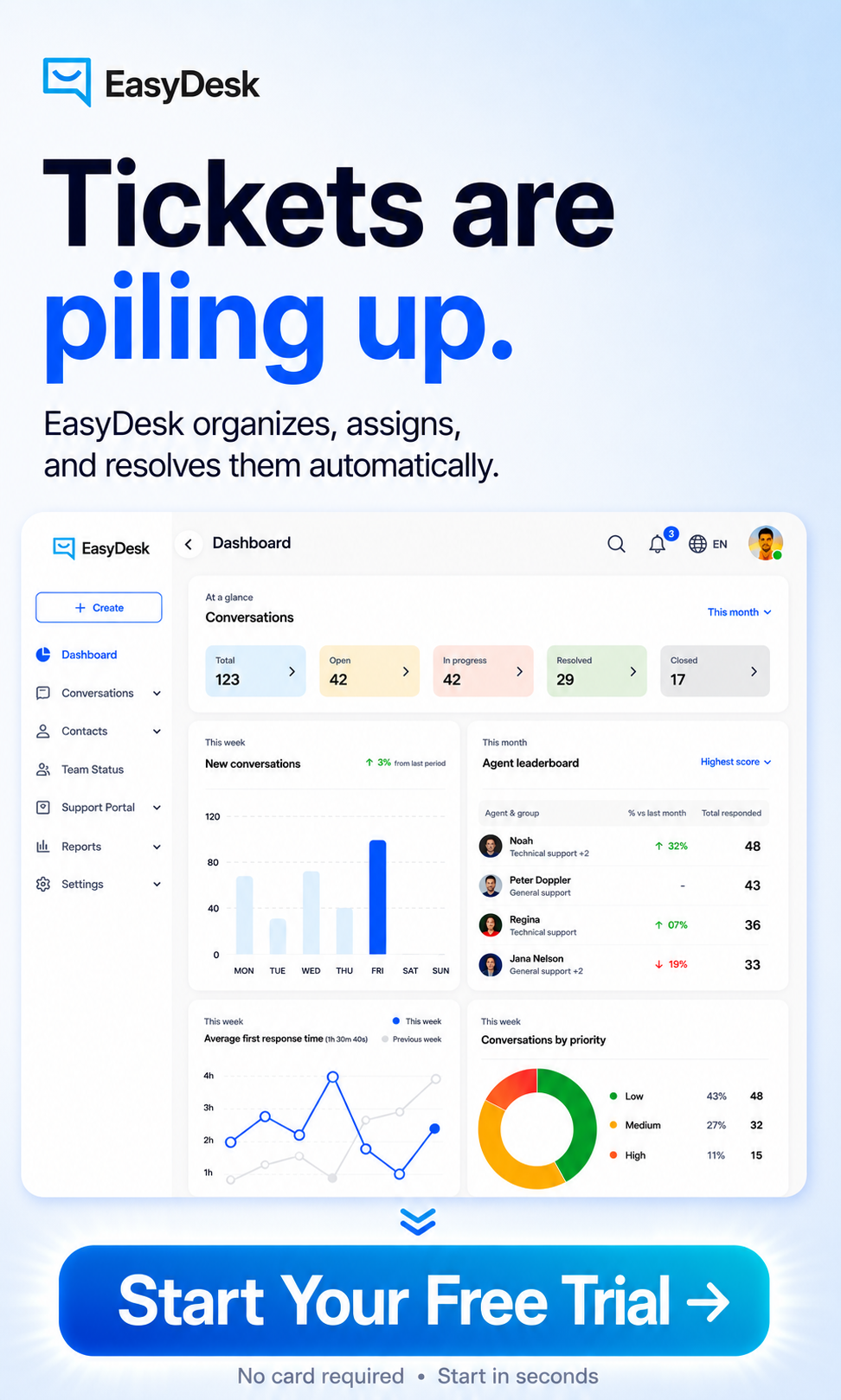
EasyDesk helps customer support teams manage canned responses and customer support workflows through a centralized and flexible cloud-based ticketing system. A shared library of canned response templates allows customer support agents to quickly respond to customer inquiries across live chat, email, and multiple channels. Support agents access pre-written responses with full customer context, which improves response time, ensures consistent answers, and strengthens customer communication. Customer service reps can personalize canned responses with the customer's name and relevant details while maintaining approved tone and company policies. These are the key features of this platform.
EasyDesk also supports collaboration and performance tracking. Customer service teams share customer service canned responses across departments while allowing edits for specific customer interactions. Built-in analytics help teams identify effective canned responses, improve customer satisfaction, and refine customer service strategy based on real customer feedback. Integration with knowledge base resources, video tutorials, and self-service options helps customer support agents deliver accurate answers, reduce follow-up questions, and create a smoother customer experience that drives higher overall customer satisfaction.
FAQ
How Do Canned Responses Improve Response Time?
Canned responses reduce response time by allowing customer service agents to reply instantly. Support teams avoid repetitive typing and deliver immediate responses during business hours and peak periods.
Can Canned Responses Feel Personal To Customers?
Yes, support agents can personalize canned responses with the customer's name and relevant details. This approach keeps customer interactions natural while maintaining speed and accuracy.
Are Canned Responses Effective For Live Chat Support?
Live chat canned responses work well for frequent questions and simple issues. Customer support agents manage multiple conversations without reducing customer experience quality.
What Common Mistakes Should Teams Avoid With Canned Responses?
Teams should avoid outdated templates, robotic tone, and poor alignment with customer messages. Regular reviews and personalization help maintain customer satisfaction.
How Do Canned Responses Help Improve Customer Satisfaction?
Fast replies, consistent answers, and clear communication improve overall customer satisfaction. Customers feel valued when support teams respond quickly and accurately.
Should Canned Responses Replace Human Support?
No, canned responses should support customer service agents, not replace them. Human judgment remains essential for complex issues and sensitive customer interactions.