The Best cloud help desk software is designed to manage customer inquiries and support requests efficiently, improving customer satisfaction and meeting customer expectations. These platforms centralize communication, automate routine tasks, empower users to self-solve, and provide insights into performance, streamlining support operations. An all-in-one desk system integrates multiple features such as AI tools, communication channels, and analytics into a single, unified platform for customer support, allowing organizations to manage multiple online channels like social media, live chat, and email through a single platform, which enhances response efficiency and customer satisfaction. Cloud help desk software integrates seamlessly with IT systems to automate workflows, proactively detect issues, and enhance overall IT service management, enabling a proactive approach to issue resolution.
Advanced capabilities, such as AI-driven support automation and the ability to streamline workflows, set modern cloud help desk software apart by reducing repetitive tasks, increasing speed of issue resolution, and improving overall productivity.
Why Use Cloud Help Desk Software?
Cloud-based help desk software gives businesses a flexible and scalable way to manage customer support. Teams can access the system from anywhere. It improves efficiency, reduces costs, and ensures consistent support across multiple support channels without complex infrastructure.
Access From Anywhere
Cloud help desk software allows support teams to work from any location. A stable internet connection is enough. This flexibility helps businesses manage support operations without relying on office-based systems.
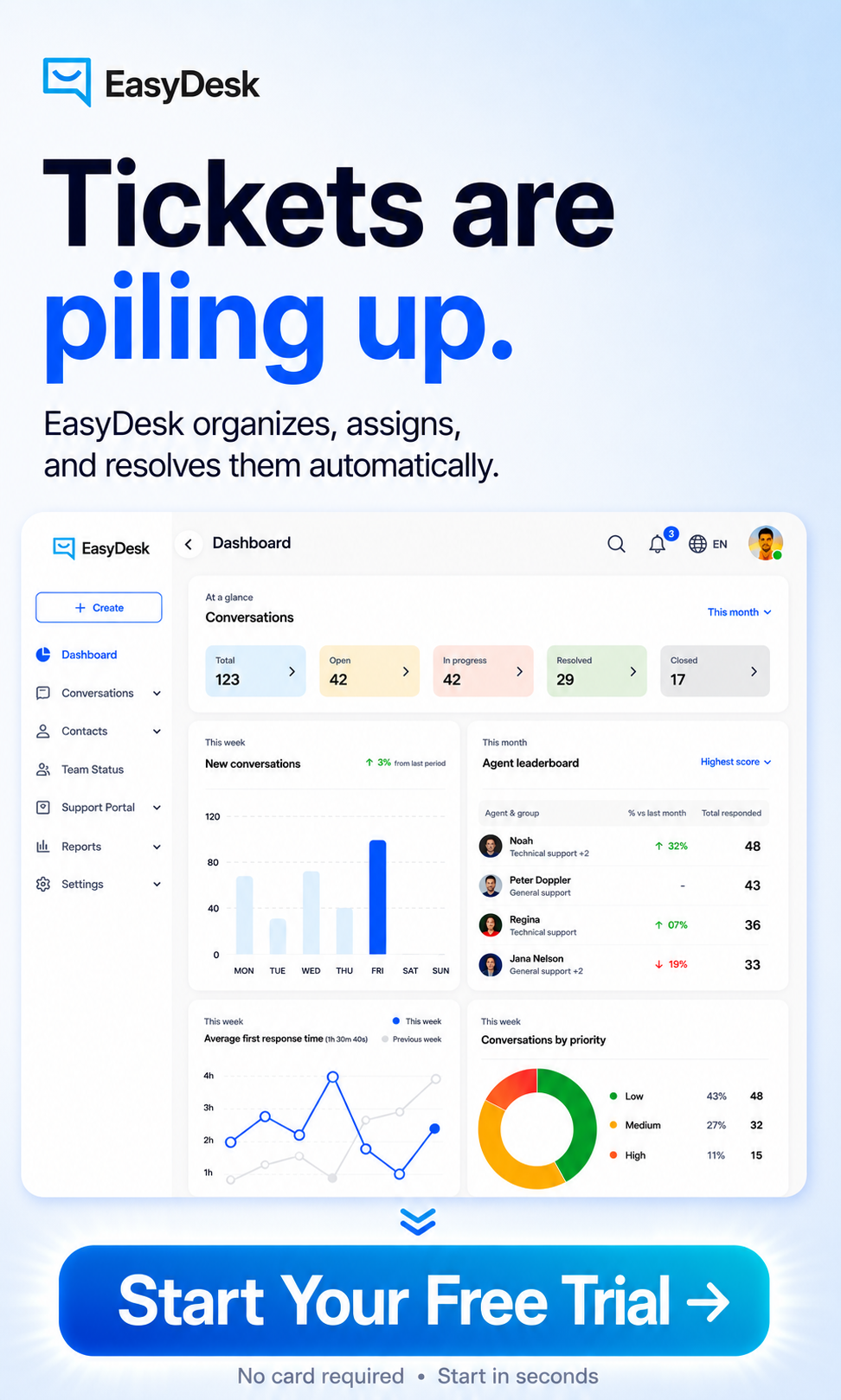
Customer support teams can access customer data, customer history, and support tickets in real time. This improves response quality and speed. Platforms like EasyDesk provide seamless access across devices. Reports show that over 70% of global teams now rely on cloud-based desk platforms for remote collaboration and service management.
Lower Setup And Maintenance Cost
Traditional service desk systems require servers and ongoing maintenance. Cloud desk solutions remove that burden. Businesses avoid high upfront costs and reduce dependency on IT teams.
Most help desk tools offer a free plan or free tier. Some even provide completely free options for small teams. Platforms like EasyDesk include basic features with monthly billing. Studies show that cloud adoption can reduce IT operational costs by up to 30%, especially for growing support operations.
Automation And AI Capabilities
Cloud help desk software includes strong automation features. Routine support tasks no longer require manual effort. Automated ticket routing and ticket assignment ensure faster response times.
AI tools and AI features improve customer interactions. They analyze customer inquiries and suggest relevant answers. A built-in knowledge base and internal knowledge base reduce ticket volume. Research indicates that AI-driven support can resolve up to 60% of repetitive tasks without human input. This allows support teams to focus on complex issues and improve team performance.
Easy Integration With Tools
Cloud desk software integrates easily with your entire tech stack. Businesses can connect CRM systems, marketing tools, and communication platforms without difficulty. This creates a unified customer service platform.
Tools like Help Scout and EasyDesk support deep integration with multiple channels such as web chat, live chat, phone support, and voice support. Seamless integration improves customer context and ensures consistent support across all support channels. Teams can manage tickets and track requests without switching between tools.
Scalable And Future Ready
Business growth demands flexible systems. Cloud help desk software scales with your needs. You can start small and upgrade as ticket volume increases. Many desk software options support unlimited users and advanced features.
Enterprise platforms like EasyDesk offer customizable workflows, audit logs, and asset management. This supports full-service lifecycle management. Reports show that 65% of businesses choose cloud help desks for long-term scalability. A robust platform ensures proactive support, better team collaboration, and improved customer satisfaction without a steep learning curve.
Key Features Of A Cloud Help Desk Software
Cloud help desk software combines automation, AI, and multi-channel support into one robust platform. Businesses use it to manage tickets, improve customer satisfaction, and streamline support operations while keeping customer data organized across the entire tech stack.
Omnichannel Ticket Management
A modern ticketing system collects support requests from multiple channels like email, web chat, live chat, and phone support. Everything stays in one place. Teams can manage tickets without confusion.
EasyDesk highlights ticket creation and management as a core feature. It allows teams to capture customer inquiries and maintain a structured workflow. shows that centralized ticket tracking improves collaboration and ensures no support tickets get missed. Reports suggest that companies using unified ticket management improve response efficiency by up to 35%.
Automation And AI Features
Automation features reduce repetitive tasks and improve speed. Workflow automation handles ticket routing, ticket assignment, and prioritization based on predefined rules. This ensures timely responses without manual effort.
EasyDesk also includes AI tools like Eden AI, which acts as a smart support assistant. It helps answer queries instantly and supports agents with context-aware suggestions. highlights that AI-driven assistance improves resolution accuracy. Studies show AI-powered help desk software can reduce workload by up to 50% in routine support operations.
Built In Knowledge Base
A built in knowledge base allows customers to find answers without contacting support teams. It includes guides, FAQs, and canned responses. This improves customer satisfaction and reduces ticket volume.
EasyDesk offers canned responses and a knowledge base to speed up replies. shows that agents can reuse answers and reduce response time. Research indicates that 67% of customers prefer self-service before reaching out. An internal knowledge base also helps agents access customer history and deliver consistent support.
Multi Channel Support And Live Chat
Cloud help desk software supports multiple channels to ensure consistent support. Customers can connect through email, live chat, social media, and voice support. This improves accessibility and engagement.
EasyDesk provides multi-channel support, live chat, and social media integration. shows that businesses can manage all customer interactions from one dashboard. This approach improves customer context and reduces delays. Reports show that companies offering support across multiple channels see up to 89% higher customer retention rates.
Workflow, SLA, And Feedback Management
Advanced features like SLA management, feedback tracking, and customizable workflows improve service management. These features help support teams maintain service quality and meet deadlines.
EasyDesk includes SLA (Service Level Agreement) management, feedback management, roadmap, and changelog tools. shows how teams can prioritize tasks, track feedback, and keep users informed. Businesses using SLA tracking report a 28% improvement in response compliance. This creates a proactive support system and boosts overall team performance.
Benefits of Cloud Help Desk Software
Cloud help desk software brings real benefits that make customer support easier and more effective for your team.
- Reduces repetitive tasks through automation, freeing up agents for more complex issues.
- Empowers customers with self-service options, leading to faster resolutions and fewer support tickets.
- Ensures faster responses by routing tickets to the right people immediately, eliminating delays and confusion.
- Provides real-time insights into support activity, helping you make informed decisions and spot problems early and balance human agents workload.
- Integrates seamlessly with existing tools, keeping workflows smooth and organized.
Cloud help desk software helps provide consistent support experiences and reduces the team's workload by automating routine tasks.
Cloud help desk software delivers reduced costs, increased efficiency, and improved customer satisfaction, making it an essential tool for modern support teams.
Help desk automation improves customer satisfaction by providing faster updates and proactive email notifications.
Transitioning to the next level of support, let’s explore how cloud-based ticketing systems further enhance these benefits.
Cloud-Based Ticketing System
Omnichannel Support
A cloud-based ticketing system allows for easy management of support requests from multiple channels, including social media and email, by consolidating all interactions through a single platform. Being available to customers via online channels, especially key social media channels, is critical for efficient customer service. Cloud-based systems provide real-time insights into ticket data and customer history to inform support decisions.
Scalability and Security
Cloud solutions easily scale with business needs, allowing quick addition or removal of users and features without infrastructure limitations. Reputable cloud providers invest in security measures and offer reliable data backup and disaster recovery solutions. Using cloud-based help desk software typically involves a predictable subscription fee, reducing upfront costs. Automated updates and maintenance are handled by the vendor, ensuring systems stay up-to-date with the latest features and security protocols.
Distinguishing Cloud from On-Premises Systems
Unlike traditional on-premises systems, cloud help desk software offers cost reduction, increased efficiency, and improved customer satisfaction. Built-in reporting and analytics tools provide data-driven insights into key metrics, allowing for continuous improvement of service quality.
Service Desk Automation
Service desk automation is a key feature of cloud-based ticketing systems, enabling efficient routing and resolution of support tickets while automation helps streamline workflows by reducing repetitive tasks and increasing productivity.
Workflow automation can automatically route tickets to the appropriate team or agent, allowing you to manage tickets more efficiently and reducing delays to ensure faster response times.
Automation also reduces the need for manual intervention in ticket handling, automating common tasks such as notifying customers about their issue being heard, streamlining workflows, and minimizing human error.
Next, we explore how AI-powered service adds another layer of efficiency to your support operations.
Help Desk Software for Customer Support
Unified Customer Interaction
- Centralized platform: Manage all customer interactions, including support requests and feedback, through a single platform, allowing you to handle multiple online channels efficiently in one place.
- Social media integration: Monitor and respond to customers where they are most active for timely and efficient support.
Efficiency and Personalization
- Ticket management and canned responses: Reduce manual effort and improve response times by using automation to provide consistent support experiences.
- Automated email replies and self-service resources: Lower ticket volume and empower customers.
- Real-time insights: Enable informed decisions and improved customer satisfaction via CSAT score.
The goal of desk software is to provide a high-quality, seamless experience for customers and improve overall customer satisfaction and relationships.
AI Assistant
An AI assistant in your cloud help desk software changes everything about how you handle customer questions. Support automation powered by AI assistants streamlines customer support by automating routine tasks and support workflows, allowing your team to focus on more complex issues. It understands what your customers are asking, gives them helpful answers right away, and makes sure their questions reach the right person on your team, all without you having to lift a finger. This means less manual work for your team, faster help for your customers, and support that actually feels personal and relevant. The AI assistant also spots patterns in your customer conversations, giving you clear insights to make your support even better and smoother. With smart AI working alongside your team, you can deliver excellent service, lighten your team’s load, and keep your customers happy—every single time.
Increase Efficiency
Making customer support better isn’t just about speed. It’s about meeting what your customers really need. They want quick answers. They want smooth experiences. And they want to solve things themselves when they can. That’s where smart support software steps in to help.
Cloud-based ticketing systems bring everything together. Your team can handle emails, social media messages, and chat requests all in one place. No more switching between different tools. No more losing track of customer questions. Smart routing sends each ticket to the right person automatically. This cuts down waiting times and makes sure nothing gets missed. AI takes this even further. It looks at your ticket data, spots urgent issues first, and even helps with personal responses using smart language tools. This means less repetitive work for your team. They can focus on the tricky problems that really need human care.
Self-service tools work wonders for everyone. A good knowledge base helps customers find answers right away. They don’t have to wait for replies. Your team gets fewer tickets to handle. Everyone wins. Real-time data shows you what’s happening as it happens. You can spot patterns, see problems coming, and fix things before they get worse.
Tracking the right numbers tells you what’s working. Look at how fast you solve problems. Count how many tickets come in. Listen to what customers say. This gives you real information to make better choices. When you smooth out your workflows and use smart tools, cloud help desk software helps streamline workflows for better efficiency, making your support system your strongest ally in keeping customers happy.
Today’s world moves fast. Better customer support means happier customers and stronger relationships. It keeps you ahead of others trying to win the same customers. Smart solutions, helpful automation, and self-service options don’t just solve problems faster. They create experiences that make both new and longtime customers feel valued and supported.
Customer Experiences
Customer experiences are critical to the success of any business, and help desk software can play a key role in improving customer satisfaction. Adopting new technologies, such as AI and data integration, enables businesses to enhance customer experiences and meet evolving expectations. Efficient customer service not only improves satisfaction but also enhances brand professionalism and provides a competitive edge. Faster responses, 24/7 availability, and consistent support build trust and improve customer satisfaction.
Key features of help desk software, such as automated responses and self-service tools, can help to improve customer experiences and reduce frustration. Providing personalized support and quick answers to customer inquiries can also help to improve customer satisfaction and loyalty.
The goal of help desk software is to provide a positive and seamless experience for customers.
Implementing Cloud Help Desk Software
Getting your cloud help desk software up and running successfully starts with being proactive and really understanding what your business needs. Follow these steps for a smooth implementation:
- Assess your requirements: Identify your team's needs, current pain points, and desired outcomes.
- Choose the right software: Select a platform that's user-friendly, scalable, and integrates with your existing systems.
- Plan customization and integration: Determine how much you'll need to tailor the software and ensure compatibility with your workflows.
- Train your team: Make sure your vendor offers solid support and training to help everyone get comfortable with the new system.
- Leverage analytics: Use real-time insights and analytics to monitor performance and drive continuous improvement.
When you plan thoughtfully and get the right people involved from the start, you'll unlock the full potential of your help desk software and create a smooth, efficient experience that works beautifully for both your customers and your support team.
Measuring Efficiency with Cloud Help Desk Software
To make sure your cloud help desk software is actually working for you, you need to keep an eye on a few simple things:
- Track resolution times: Monitor how quickly you solve problems.
- Monitor ticket volume: Keep count of how many support requests come in.
- Gather customer feedback: Listen to what customers are saying about your service.
This isn't about collecting data for data's sake—it's about spotting where things can get better and making your support team's life easier. Modern help desk tools give you real-time insights that show you what's happening right now, so you can fix issues before they become bigger problems. When you measure these things regularly, you stay ahead of issues instead of always playing catch-up. Your team gets better at helping customers, and your customers feel genuinely supported. It's about building a help desk that actually helps—both your team and the people they serve.
Top Cloud Help Desk Software Solution
- Top cloud help desk software solution include EasyDesk
- The solution provides a scalable and flexible platform for IT teams to manage support requests and customer feedback.
- Key features of these solutions include ticket management, canned responses, automated email replies, and self-service knowledgebase portal to reduce repetitive tasks.
- The use of these solutions can help to improve efficiency, reduce costs, and enhance customer satisfaction.
Best Practices for Cloud Help Desk Software
Getting the best from your cloud help desk doesn't have to be complicated—just follow these simple strategies that really make a difference:
- Offer strong self-service options: Provide a clear knowledge base and easy-to-find answers so customers can solve problems on their own.
- Automate routine tasks: Let automation handle ticket routing and repetitive work, so your team can focus on complex issues.
- Leverage AI features: Use AI to remember and deliver personalized, caring support.
Put these three approaches together, and you'll have a help desk that works smoothly, feels welcoming to your customers, and always delivers the support they need without the stress.
Common Challenges with Cloud Help Desk Software
Cloud help desk software brings great benefits, but it comes with real challenges too:
- Integration difficulties: Getting new software to work smoothly with your current systems can be tricky.
- Overwhelming ticket volume: When support requests pile up, things can get overwhelming fast, especially without smart automation.
- Maintaining service quality: Keeping your service quality consistently high while meeting commitments is tough, especially across multiple channels.
- Resource constraints: Smaller teams may struggle to deliver a great experience to every customer.
Understanding these hurdles is your first step toward building a help desk that really works for you and your customers.
Overcoming Challenges with Cloud Help Desk Software
The secret to tackling these challenges is getting ahead of problems before they happen, and that's where smart help desk tools really shine:
- Automate routine support tasks: Use tools that handle repetitive work and spot issues early.
- Simplify your system: Choose a cloud-based platform that understands customer needs and reduces manual effort.
- Train your team: Ensure everyone knows how to use the tools properly for smoother operations.
- Gather customer feedback: Use insights from customers to identify what's working and what needs improvement.
When you put these pieces together, your customers will be happier, your team will feel more confident, and your whole support operation will just work better.
Future of Cloud Help Desk Software
The future of cloud help desk software looks promising. AI-powered chatbots and virtual assistants are getting better at helping you, providing 24/7 support. They'll even give you personalized suggestions that actually make sense for your situation. Everything will work together smoothly, with business apps connecting seamlessly to create one unified system that grows with you. As smart technology becomes more common, your support team won't get bogged down in routine tasks, freeing them for the important work that moves your business forward. These improvements will help you make customers truly happy, adapt quickly to change, and stay ahead of the competition without the stress.
Conclusion
In conclusion, cloud help desk software makes a real difference for any business that wants happier customers and smoother support. It simply works better. By following smart practices, like giving customers ways to help themselves and using automation to handle routine tasks; you can solve common support headaches and deliver the kind of service that actually matters. Staying up to date with new features, like AI tools that predict problems before they happen, keeps your help desk working at its best for your customers. Whether you're handling support tickets, fixing issues, or giving each customer the personal attention they deserve, cloud help desk software gives you what you need to build strong relationships and grow your business. With the right approach, your help desk can deliver excellent service, keep customers happy, and help your business succeed. Cloud help desk software delivers reduced costs, increased efficiency, and improved customer satisfaction, making it an essential tool for modern support teams.