Changelog software has become essential for SaaS companies that want to keep customers informed without confusion. A well-organized change log gives users a clear place to see every new update, from feature releases to bug fixes and improvements. Instead of searching through documentation or scattered blog posts, customers can quickly access a single file that explains what changed and why it matters.
A powerful changelog tool also helps product teams collect user feedback directly from update posts. Many modern solutions come with built-in options that allow customers to react, comment, or request features. Clear communication through changelogs strengthens trust, improves user engagement, and ensures customers always stay aware of product progress and ongoing improvements.
What Is Changelog Software
Changelog software is a dedicated tool or module that collects, formats, and publishes every meaningful change in a product, ordered by date or version number. Unlike scattered commit messages or occasional blog posts, these tools create a structured record that anyone can access and understand.
Good changelog tools let teams tag changes using categories like new features, improvements, bug fixes, or internal updates. Each entry includes a release date, author information, and links to related documentation or videos. This makes it easy for customers to scan the latest changes and find what matters to them.
Here is how changelog software differs from similar formats:
Format | Purpose | Audience | Update Frequency |
|---|---|---|---|
Changelog Software | Continuous record of all changes | Customers, support, product teams | Every release |
Release Notes | High-level summary of major updates | Marketing, customers | Major versions only |
Product Blog | Storytelling about notable changes | Prospects, users | Occasional |
GitHub Releases | Technical commit history | Developers | Every commit |
Teams deploy changelogs in several ways. Some create a standalone changelog page labeled “What’s New” on their site. Others use an embeddable widget that appears inside their app. Many integrate changelog entries directly into their help center or support portal so agents can reference recent updates while handling tickets.
Importance Of Changelogs Software For SaaS Customers
Clear communication drives trust in SaaS products. Changelog software helps product teams keep users informed about product updates, new features, and bug fixes. It strengthens customer communication, improves feature adoption, and builds a transparent product experience across every release.
Clear Product Updates Build Trust
Changelog software gives users a reliable place to see product updates. A well-structured public changelog page removes confusion and reduces support tickets. Users stay informed without searching across emails or support docs.
Data shows that 73% of customers expect transparency from software companies. A good changelog with clear changelog entries helps users understand what changed and why. It also supports internal and external updates, so internal teams and customers stay aligned. Trust grows when users see consistent release notes and honest updates.
Better Feature Adoption Through Visibility
New features fail when users do not notice them. A changelog tool solves this by making product announcements visible through in-app widgets and push notifications. It keeps users updated at the right moment.
Studies suggest that feature adoption increases by up to 30% when users receive timely updates. Release notes software and in app changelog placements guide users to explore updates. Product managers can track feature adoption and refine rollout strategies. This approach turns changelog updates into a growth channel rather than just documentation.
Feedback Loop Improves Product Decisions
Changelog software connects updates with user feedback. It allows product teams to collect feedback, manage feature requests, and improve based on real user needs. Feedback boards and comments create a strong feedback loop.
Around 65% of SaaS users expect companies to act on customer feedback. Changelog management tools help link changelog entries with feedback collection. Product teams can validate ideas faster and prioritize features better. This process improves product management and ensures updates match user expectations.
Central Hub For Release Notes And Communication
A standalone changelog page acts as a single source of truth. It organizes release notes, product releases, and changelog updates in one place. Users no longer depend on scattered emails or external docs.
Modern changelog tools support automated release notes from commit messages or github releases. Email notifications and branded changelog pages improve customer communication. Software companies use this central hub to streamline updates and maintain consistency. Users stay updated without effort, which improves overall engagement.
Cost-Effective Solution For Small Teams
Small teams often struggle with communication at scale. Free changelog tools and affordable changelog tools offer a simple way to publish changelogs without heavy resources. Many platforms include a free plan with essential features.
Paid plans start with options like custom branding, custom domain, and API access. Unlimited changelogs and advanced features support growing SaaS products. Product teams can manage a public roadmap, track the product's evolution, and keep users engaged from one platform. The right tool reduces manual work and improves efficiency across engineering teams.
Key Features Of Effective Changelog Software
Not all changelog tools go beyond a basic text feed. For SaaS support teams, certain capabilities make a significant difference in daily operations.
Categorization by change type allows teams to tag updates as Added, Changed, Fixed, Deprecated, Removed, or Security-related. This follows the Keep a Changelog format that has become standard across open source projects and commercial software.
Versioning support helps teams follow semantic versioning (SemVer) with MAJOR.MINOR.PATCH patterns. This lets users understand whether an upgrade includes breaking changes (MAJOR), new features (MINOR), or just bug fixes (PATCH).
Rich content support including markdown formatting, screenshots, and videos makes entries more engaging. Teams can attach context that helps users understand technical updates without confusion.
In-app widgets and embeddable displays let teams show changelog updates where users are. This might be a notification badge inside the app, a standalone page on the site, or an embedded panel in a support portal.
Integrations with existing tools connect changelogs to help desks, Slack, email notifications, Jira, and roadmap systems. Push notifications can alert specific user segments when relevant changes ship.
Analytics and engagement tracking show which updates resonate with users. Views, clicks, and reactions per entry help teams understand what customers care about most.
Role-based permissions ensure that product managers, support leads, and engineers can collaborate safely on entries without stepping on each other’s work.
How Changelogs Software Improves Product Communication
Changelog software transforms how teams communicate with customers about product changes. Rather than relying on scattered emails or occasional announcements, teams can maintain consistent, structured messaging.
Clear Visibility Into Product Updates
A well-organized changelog gives customers immediate access to what changed. They can see the latest version, browse recent improvements, and understand the context behind each update. This visibility eliminates the guesswork that leads to confusion and support tickets.
The changelog becomes a reference point for every conversation about the product. When a customer asks “What’s new?”, support agents can link directly to specific entries rather than explaining from memory.
Consistent Communication Across Customer Touchpoints
Changelog software ensures that everyone tells the same story about product changes. Support agents, sales teams, and customer success managers all reference the same documented updates. This consistency builds credibility and reduces mixed messages.
Teams can use the changelog as the foundation for other communication channels. A detailed entry can inform email notifications, blog posts, and in-app banners without requiring separate writing for each channel.
Simplified Explanation Of New Features And Changes
Good changelog entries translate technical updates into user-friendly language. Instead of “Refactored ticket routing algorithm v2,” an entry might say “Tickets now route to available agents 30% faster.”
This translation work benefits everyone. Customers understand what changed without needing technical background. Support agents can explain updates without hunting for context. Product teams see how their work impacts real users.
Faster Customer Awareness Of Fixes And Improvements
When teams publish changelog updates immediately after each deployment, customers learn about improvements right away. They do not have to wait for a monthly newsletter or stumble upon changes accidentally.
This speed matters for bug fixes especially. If customers reported an issue, seeing a fix in the changelog reassures them that the team responded. Targeted email notifications can alert specific users when their reported issues get resolved.
Structured Messaging That Reduces Misunderstandings
Changelog formats with clear categories, dates, and version numbers prevent ambiguous ways of describing changes. Users know exactly when something changed and what category of change it was.
This structure also helps with historical research. When someone needs to understand what changed between two versions, they can trace the documented history rather than relying on memory or scattered communications.
Best Practices For Writing And Structuring A SaaS Changelog
This section serves as a practical guide for anyone setting up their changelog for the first time. Whether you are a product manager, support lead, or founder wearing multiple hats, these practices help you create entries that users will read and appreciate.
Use Clear Language Focused On Outcomes
Write entries in short sentences that describe what changed and why it matters. For example: “You can now set SLA targets per channel to avoid missed chats” is better than “Added per-channel SLA configuration.”
Avoid internal shorthand that only your team understands. If technical detail is needed for developers, consider a separate “Technical Notes” line. Keep the main entry focused on user outcomes.
Maintain a consistent voice that matches your brand tone. The changelog should feel like part of the SaaS product experience, not an afterthought from the engineering team.
Organize Entries By Date And Change Type
Each release should start with a clear date such as “February 14, 2026” and possibly a simple version tag like “v2.14.0”. This helps users understand the timeline of changes.
Group items under headings like “New”, “Improved”, and “Fixed” so readers can scan quickly. Someone looking for bug fixes should not have to read through feature announcements to find them.
Keep the most recent release at the top. Avoid long, unbroken walls of text that overwhelm readers looking for specific information.
Keep Updates Concise With Links For Depth
Aim for one to three bullet points or short sentences per change. Include links to help center articles, tutorials, or roadmap items for users who want more detail.
For example: “New automation workflow for ticket escalation. See setup guide“ gives enough information for most readers while providing a path to deeper documentation.
Include screenshots only for major interface changes. Too many images slow down the page and make scanning harder. Save time by focusing visuals where they add the most value.
Align Changelog With Support, SLAs And Documentation
Before publishing a changelog entry, support leaders should review upcoming releases and prepare accordingly. This might mean drafting canned responses, updating knowledge base articles, or briefing the team on expected questions.
Mention SLA or workflow impact explicitly when relevant. For example: “This change affects how response time is calculated for weekend tickets” helps support teams prepare for customer questions.
Tag entries with topics like “Live Chat”, “Knowledge Base”, or “Reporting” so agents can quickly find relevant changes during a customer call.
Set A Sustainable Cadence And Ownership Model
Agree on a cadence that matches your release rhythm. Some teams publish weekly summaries every Friday. Others update immediately after each deployment. Choose what works for your team and stick to it.
Define clear owners for the process. Product managers might draft entries, support refines customer-friendly language, and a tech lead confirms technical accuracy. In smaller startups, one person can play multiple roles, but clear responsibility always helps consistency.
Create a simple internal checklist so no release goes live without a matching changelog entry. This prevents the common problem of shipping features that customers never learn about.
How To Choose The Right Changelog Software For Your Team
When evaluating changelog tools in 2026, consider several factors that affect daily operations and long-term success.
Team size and release frequency influence which features matter most. A small startup shipping weekly might need simple, fast entry creation. A larger team with daily deployments might prioritize automation and integrations.
Budget constraints vary widely. Some teams start with free changelog tools or free plan options before upgrading. Others need enterprise features from day one.
Integration requirements determine how well the tool fits your existing stack. For support-heavy teams, integration with ticketing, SLA tracking, knowledge base, and roadmap tools should be a priority.
In-app communication needs might require an embeddable widget or push notifications. If you want to keep users updated without requiring them to visit a separate page, look for tools that offer these capabilities.
Consider running a short trial where your team logs a month of releases in two different tools. Compare ease of use, adoption rates, and customer engagement to make an informed decision.
Many teams end up with fragmented solutions: one tool for changelogs, another for feedback, another for roadmaps. Choosing a platform that combines these capabilities simplifies operations and creates a better experience for both teams and customers.
How EasyDesk Connects Changelogs With Customer Support
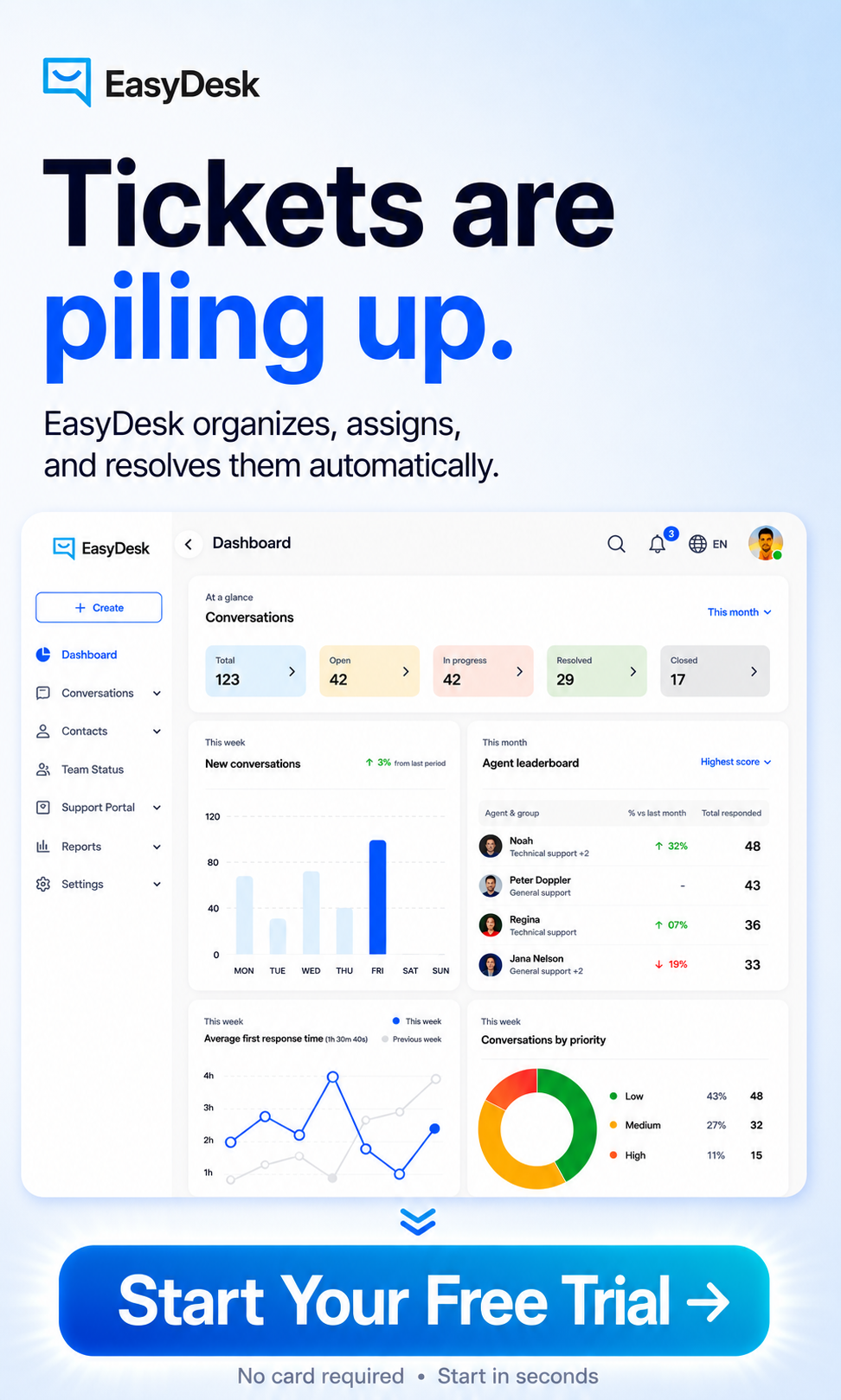
EasyDesk serves as a central hub for multi-channel support, ticket management, automation, SLAs, knowledge base, live chat, and public roadmap features. This integration means changelogs are not isolated from daily support work.
With EasyDesk, teams can track feedback from users, plan roadmap items based on feature requests, and publish changelog updates all within the same platform. When customers submit ideas or report issues, the entire journey from feedback to fix to announcement happens in connected workflows.
Support agents inside EasyDesk can see recent product updates alongside tickets. When a customer asks “Did something change?”, agents find the answer without switching tools or searching through separate systems. This context saves time and improves response quality.
Teams can link changelog entries to knowledge base articles, macros, and automation rules. When a new feature ships, the documentation stays in sync with the changelog entry. Unreleased changes can be drafted ahead of time and published when ready.
For SMBs and startups with limited resources, using a single platform to manage support, feedback, and product announcements eliminates tool sprawl. Instead of juggling separate subscriptions and learning multiple interfaces, teams focus on helping customers.
The 14-day free trial lets you test how support workflows, feedback collection, and changelog updates feel when centralized. You can see how reduced context-switching and connected data improve your team’s efficiency.
FAQs
What Is The Difference Between Changelog Software And Release Notes In A Blog
Release notes published as a blog post are occasional, high-level announcements focused on major releases. Changelog software maintains a continuous, structured log of every meaningful change with categorization, dates, and version numbers. Changelog tools also offer in-app widgets, push notifications, and integrations that standard blog platforms rarely provide.
How Often Should A SaaS Team Update Its Changelog
Update your changelog every time a user-facing change ships, even small improvements. Most teams publishing frequently do this weekly or after each deployment. At minimum, teams with monthly releases should publish a detailed summary for each version so customers stay informed about the product’s evolution.
Who Should Own The Changelog Inside A Company
Product management typically owns the structure and cadence, with engineering providing technical detail and support teams refining customer-friendly language. In smaller startups, one person can handle multiple roles. Clear responsibility always helps maintain consistency regardless of team size.
Can A Changelog Help With Compliance Or Audit Requirements
A well-maintained changelog demonstrates a traceable history of changes, supporting internal audits, security reviews, or vendor assessments. It shows when changes occurred and what they included. However, it complements rather than replaces formal change management records in highly regulated environments.
How Does EasyDesk Fit Into An Existing Tool Stack
EasyDesk can replace separate help desk, basic changelog, and feedback tools for many SMBs while still integrating with common SaaS stacks through APIs and connectors. The 14-day free trial lets you test how support workflows, feedback collection, and product updates feel when centralized in one platform.