Customer expectations have never been higher. Buyers expect instant, personalized, and always-available support, while businesses face constant pressure to improve service quality without dramatically increasing costs. That shift explains why the AI customer support market is projected to reach $83 billion by 2033, with AI customer service tools expected to grow at a CAGR of 23.2%.
customer service toolsThe pace of adoption is accelerating for good reason. Industry analysts predict that AI tools will handle up to 80% of customer issues by 2029, while modern AI agents can already resolve a large share of routine tickets without human intervention. AI-powered chatbots now handle many common inquiries, provide 24/7 support availability, and help reduce customer wait times through instant replies.
Yet choosing the right AI customer support tools is becoming more difficult as the market grows. Businesses can now evaluate dozens of AI customer support solutions, each promising smarter automation, predictive analytics, and better customer experiences. The challenge is no longer whether to adopt AI customer service, but which tools best fit your support operations, customer needs, and long-term growth plans.
The best AI customer support tools do far more than automate repetitive tasks. They analyze customer sentiment, surface knowledge-base content for agents in real time, automate ticket routing and tagging, and deliver personalized recommendations based on customer data. Future AI tools will go even further, offering predictive support that identifies potential issues before customers submit a ticket.
At the same time, not every platform delivers on its promises. The right solution should integrate seamlessly with your existing systems, scale with business growth, provide transparent pricing, and support both AI automation and human agents. After all, exceptional customer support is not about replacing people—it is about helping support teams work smarter while delivering faster, more personalized experiences.
This guide walks through how to evaluate AI customer support platforms, compare features, and choose the best solution for your team without falling for marketing hype.
How to Choose AI Customer Support Tools
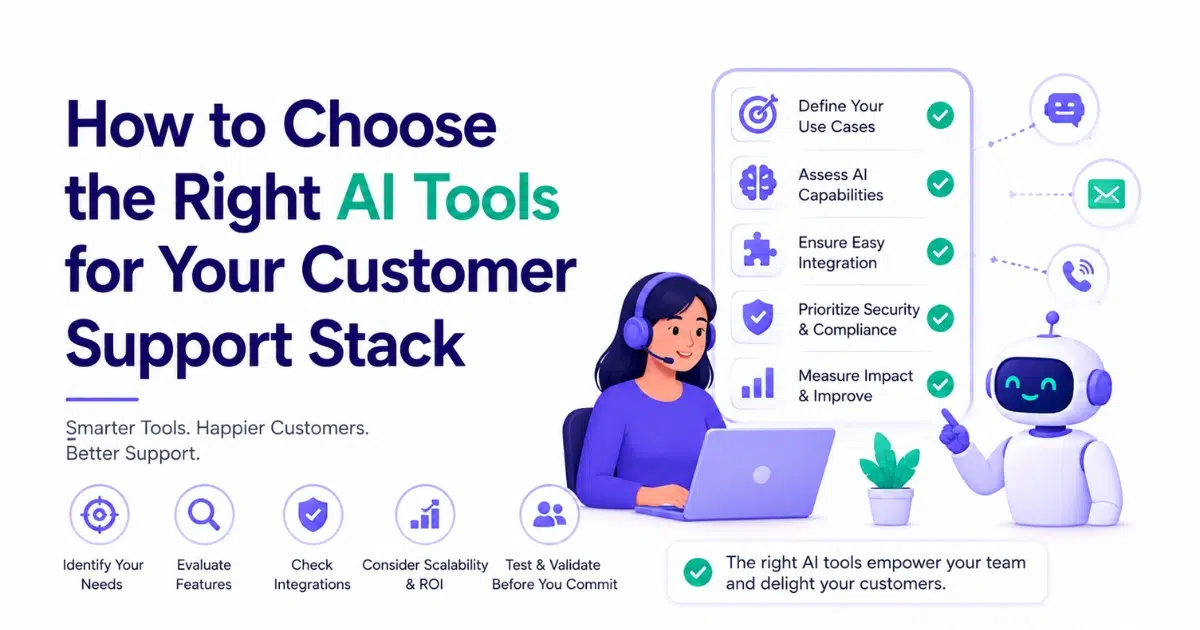
Short on time? Here is the decision in plain terms. To choose the right tools for your stack, work through these steps in order:
- Map your customer journey and find where customers actually get stuck.
- Pull your key support metrics (ticket volume, response times, and CSAT) so you have a baseline.
- Shortlist tools that solve your biggest bottleneck first, not the longest feature list.
- Test how well each tool handles real customer interactions, not scripted demos.
- Check the unglamorous things: data security, brand voice control, and pricing that scales with you.
If you want a single platform that bundles AI agents, ticketing, and automation in one place, that is exactly why we built EasyDesk. More on where it fits later, but first, the thinking that should come before any purchase.
Why AI Customer Service Has Become the New Baseline
A few years ago, ai in customer service felt like a nice-to-have for enterprise teams with big budgets. That has changed. The combination of machine learning, natural language processing, and conversational ai has matured to the point where even a small team can deploy ai powered tools that resolve real questions on day one. The technology that used to require a data science team now ships inside everyday customer service software.
Here is the mindset shift we care about most. For a long time, support was treated as a cost center, a line item to minimize. Modern ai systems flip that logic. When you use AI to automate customer support for the predictable questions, your human agents get freed up for the conversations that actually build loyalty. Done well, this lifts customer satisfaction and lowers operational costs at the same time, which is rare.
Our take: The goal of artificial intelligence in support is not to replace people. It is to remove the repetitive tasks that burn them out so they can spend their energy on complex issues that need a human touch.
AI Agents vs Chatbots vs Basic Automation
These terms get blurred in marketing, so let us be precise. The differences matter when you compare tools:
- Rule-based flows and macros. Useful for automating routine tasks like tagging or routing, but it cannot understand intent. A simple ai chatbot that only matches keywords lives here too.
- Understands phrasing and context, pulls relevant responses from your knowledge base, and can hold a back-and-forth that feels natural.
- The most capable tier. These ai agents can reason across steps, take actions, pull from customer records, and decide when to hand off to a person. Intercom's Fin AI Agent is one well-known example, and our own Eden AI sits in this category.
Why does the distinction matter? Because pricing, accuracy, and the effort to maintain each type are very different. Buying an ai customer support platform built on basic automation and expecting agent-level results is the single most common mismatch we see.
Start With Your Customer Journey, Not the Software
It is tempting to start by collecting demos. We would gently push back on that. The most useful first step is mapping your customer journey and being honest about where customer inquiries pile up. Are people stuck before purchase? After onboarding? At renewal? Each stage produces different customer queries, and the right tool for one stage is the wrong tool for another.
We recommend pulling three weeks of tickets and sorting them into buckets. Most teams discover that a small set of question types drives the majority of their volume. That insight alone tells you what to automate first.
While you are in the data, study customer behavior and customer sentiment patterns. Analyzing customer data this way helps you identify trends before they become fires, and it gives you a baseline to measure any new tool against. If a vendor cannot show you how it improves these numbers, keep looking.
The Criteria We Use to Evaluate Any AI Customer Support Platform
When our team assesses a tool, we score it against six areas. Use this as a checklist when you compare options.
1. Knowledge Base Depth and Natural Language Processing
The quality of any AI answer is capped by the quality of its source material. Strong ai customer service tools ingest your knowledge base, help docs, and past conversations, then use natural language processing to match a customer's real wording to the right article. Ask vendors how they handle gaps in the knowledge base, because that is where weak tools start to guess.
2. Multi Channel Support and Customer Conversations
Your customers do not live in one inbox. Look for genuine multi channel support so that email, live chat, and social media feed into one view. When all customer conversations sit in a single thread, your support agents stop asking people to repeat themselves, and that consistency is what customers actually remember. Some teams also need voice support and self service portals, so confirm those channels are covered if they matter to you.
3. Automation That Handles Customer Interactions
Good ai tools should handle a real share of customer interactions end to end, not just deflect them. We look for tools that resolve customer inquiries on their own for the simple cases, offer response suggestions to assist agents on the harder ones, and cleanly escalate complex customer interactions to a person. The aim is instant support for routine questions and a smart human intervention path for everything else.
Pair this with automated workflows so that tickets route themselves, and you will genuinely reduce ticket volume reaching your queue. Offloading routine tasks and other repetitive tasks is where most of the time savings actually come from.
4. Analytics, Predictive Analytics, and Key Support Metrics
A tool that acts without measuring is a black box. The ai features we value most report on response times, resolution rate, and customer sentiment over time. The strongest ai capabilities go further with predictive analytics that anticipate customer needs before a ticket is even filed. Track these key support metrics from day one so you can prove ROI and spot where service quality is slipping.
5. Human Handoff and Customer Data Security
AI should know its limits. When a request needs judgment, the tool must pass it to human agents with full context so no one starts from scratch. Equally important is how the platform treats customer data. Ask where customer records are stored, who can access them, and how the vendor secures the ai systems that read them. This is non-negotiable for trust.
6. Brand Voice, Pricing, and Total Cost
An AI that answers correctly but sounds nothing like you will quietly erode trust. Choose tools that let you tune brand voice and tone. On budget, watch for custom pricing tiers that look cheap at first and balloon as ticket volume grows. Map the total cost of ownership, including setup and training, not just the sticker price. You can compare our transparent plans on the EasyDesk pricing page.
Comparing AI Customer Service Platforms by Team Maturity
Not every team needs the same tool. The best ai customer service platforms for a five-person startup are rarely the right fit for a 200-agent operation. Here is a simple way to match capability to your stage.
| Team stage | What to prioritize | Where AI helps most |
|---|---|---|
| Startups | Fast setup, low cost, one shared inbox | An AI chatbot for instant support and basic automation to cover off-hours |
| Growing SMBs | Multi channel support and workflow automation | AI agents that resolve customer inquiries and route the rest |
| Mid-market | Analytics, SLAs, and integrations across customer service operations | Predictive analytics and AI that learns from past interactions |
If you want to see how this maps to your situation, we publish role and size-specific guidance for startups, growing SMBs, and SaaS companies.
How to Match Customer Support AI Tools to Your Stack
Once you know your stage, the next question is fit. The best customer support ai tools are the ones that plug into what you already run instead of forcing a rip-and-replace. We always ask three questions before adding anything to a stack.
- Does it connect to our existing support platforms and CRM, or will my team be copying data by hand?
- Will it actually reduce work for support teams, or just add another dashboard to babysit?
- Can it grow with our support operations without a painful migration later?
A quick note on building your own. We have seen teams try to stitch together open-source ai customer support software to save money. Sometimes that works. More often, the maintenance cost of homegrown ai customer tooling outweighs the licensing you saved. Unless ai customer service is your core product, buying a proven customer support platform is usually the faster path to value.
Common Mistakes When Buying Customer Support Tools
We have made some of these ourselves over the years. Learn from them so you do not have to.
- Buying for a feature demo instead of for your real customer needs and ticket mix.
- Skipping a pilot. Always test how a tool handles live customer queries before rolling it out to everyone.
- Ignoring change management. Even the best tool fails if customer service teams are not trained and bought in.
- Forgetting the human layer. AI should assist agents and escalate complex issues, not wall customers off from real help.
- Measuring nothing. Without baselines for response times and CSAT, you cannot prove the tool is working.
Why We Built EasyDesk as a Smarter Support Platform
Everything above is the framework we use ourselves, and it is also the framework we built EasyDesk around. We were tired of teams juggling five disconnected customer service tools that never talked to each other. So we put AI agents, ticketing, automation, and team collaboration into one workspace designed for real support teams, not for a feature checklist.
Eden AI: Our Approach to AI Customer Support
At the center is Eden AI, our AI support assistant. Eden ingests your documentation to deliver personalized support, resolving up to a large share of routine questions instantly without human intervention. It uses smart triage to organize tickets, writes instant conversation summaries so agents are never lost, and learns from every interaction to give more relevant responses over time. Because Eden understands intent rather than just keywords, it analyzes context to deliver finest customer experiences that feel human, not robotic.
In practice, that means three things for your team:
- Customers get accurate, around-the-clock answers, which lifts customer satisfaction without extra headcount.
- so they spend less time on repetitive tasks and more on the work that matters.
- Managers get the analytics to track key support metrics and keep service quality high as you scale.
Customer Service Tools That Work Together
Beyond Eden, EasyDesk gives you the connected customer support tools a modern stack needs: ticket creation and management, SLA tracking, CSAT measurement, and feedback and roadmap management. Because they share one data layer, your customer service operations run from a single source of truth instead of a patchwork. If you are weighing options, our EasyDesk vs Intercom comparison breaks down how our approach to ai customer support differs from the Fin AI Agent model.
Worth knowing: EasyDesk runs a 14-day free trial with no credit card required, so you can test it against your own customer interactions before committing.
A 5-Step Plan to Roll Out AI for a Better Customer Experience
Choosing a tool is half the job. Rolling it out without disrupting your customer experience is the other half. Here is the sequence we recommend.
- Record current ticket volume, response times, and CSAT so you can measure impact honestly.
- Clean up your help docs so the AI has good material. Quality in, quality out.
- Let AI handle your top three question types first, then expand as confidence grows.
- Set clear rules for when complex issues escalate to human agents, and review handoffs weekly.
- Use predictive analytics and customer feedback to refine, retrain, and widen coverage each month.
Follow that path and you will build support that compounds over time. The teams that win with ai customer service are not the ones with the fanciest tool. They are the ones who pair good ai capabilities with steady iteration and genuine care for the customer.
Frequently Asked Questions
What are AI customer support tools?
AI customer support tools are software that uses artificial intelligence, including machine learning and natural language processing, to understand and respond to customer inquiries. They range from a simple ai chatbot to advanced ai agents that can resolve customer inquiries, route tickets, and assist agents with response suggestions.
How do AI tools improve customer satisfaction?
They deliver instant support around the clock, cut response times, and free human agents to focus on complex issues. By automating routine tasks and offering personalized support drawn from past interactions, they raise both service quality and customer satisfaction.
Will AI replace human support agents?
No. The healthiest model is AI handling repetitive tasks and routing, while people handle judgment, empathy, and complex customer interactions. Good ai in customer service makes agents more effective, it does not remove the human layer that customers value most.
How much do AI customer service platforms cost?
Pricing varies widely. Many ai customer service platforms use custom pricing based on agents, resolutions, or ticket volume, so total cost can shift as you grow. Always model the full cost of ownership. You can review EasyDesk's transparent tiers on our pricing page.
What should a small team look for first?
Start simple. Prioritize fast setup, multi channel support, and an AI layer that can automate customer support for your most common questions. As your support operations mature, add predictive analytics and deeper integrations.
Bringing It All Together
Choosing the right ai tools for your stack comes down to discipline, not hype. Map the customer journey, measure your baseline, match tools to your team's maturity, and protect the human relationships that keep customers loyal. Do that, and AI stops being a buzzword and becomes the quiet engine behind exceptional customer experiences.
When you are ready to see what a unified ai customer support platform feels like, we would love to show you. Start a free trial of EasyDesk, explore Eden AI, or browse more practical guides on the EasyDesk blog. Smooth support is closer than you think.