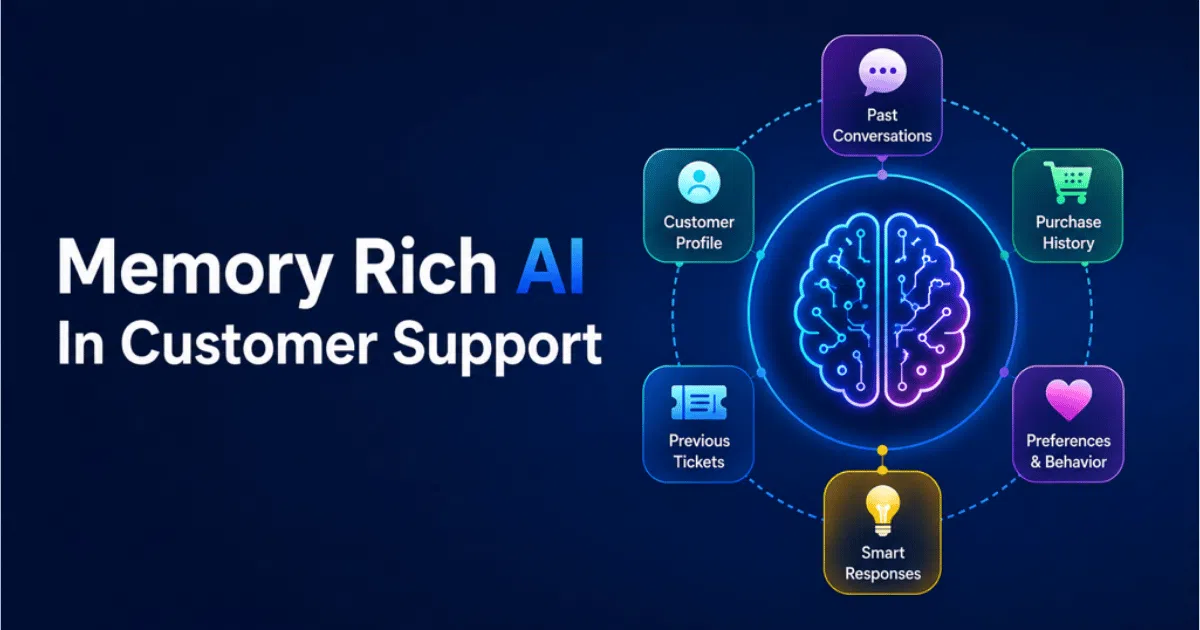
Memory rich AI is changing how customer support works. Traditional support systems forget everything after a conversation ends. Customers repeat themselves. Agents lose context. Experiences feel disconnected. This is the problem a modern memory system in AI is built to solve.
By combining episodic memory, semantic memory, and procedural memory, AI agents can now retain customer history, understand preferences, and carry context across every channel and interaction. This is what agent memory makes possible. The result is support that feels continuous, personal, and intelligent rather than repetitive and frustrating.
In this guide, you will learn exactly how memory rich AI works in customer support, why it matters for CX, and what the future looks like for businesses adopting it today.
What Is Memory Rich AI In Customer Support?
Memory rich AI is a support system that gives AI the ability to remember customers across conversations, channels, and time.
Unlike traditional chatbots that reset after every session, memory rich AI uses persistent memory to store customer history, preferences, and past interactions. It mirrors how human memory works, retaining context so agents do not ask the same questions twice.
This memory infrastructure powers smarter agent behavior, enables semantic search across past interactions, and allows AI to respond with full context every single time a customer reaches out.
Why Traditional Customer Support AI Falls Short

Most customer support AI today operates without any memory of who it is talking to. That is the core problem.
Repetitive Questions
When AI systems have no access to past interactions, every new conversation starts from zero. Customers are asked to re-explain their issue, re-verify their identity, and re-provide information they already shared last week. This happens because stateless agents hold no relevant memories between sessions. There is no chat history to reference, no conversation history to build on. The customer experience feels broken before it even begins.
Lost Context
Context is what makes a support conversation useful. Without AI memory, agents cannot connect a current issue to a previous one. A customer who reported a billing problem three days ago and now has a follow-up question gets treated as a brand-new case. Relevant context disappears the moment a session ends. Support teams then spend time rebuilding what they should already know, wasting both agent time and customer patience.
Channel Switching Problems
Customers do not stay on one channel. They start on live chat, follow up by email, and call in when frustrated. Traditional AI systems cannot carry context across these touchpoints, which is exactly what strong omnichannel customer support for better CX is designed to solve. Each channel operates in isolation. There is no shared memory infrastructure connecting them. So when a customer switches channels, they lose everything. The AI has no record of what was said, agreed, or promised. This forces customers to repeat their entire story.
Ticket Fragmentation
Without a unified memory layer, support tickets become disconnected fragments. A customer may have five open or closed tickets across different channels, but no AI system ties them together into a single coherent picture, limiting many of the benefits of using a ticketing system in the first place. Enterprise agents handling complex accounts cannot access the full history. Enterprise data stays siloed. The result is a fragmented support journey where nobody has the full story and decisions are made with incomplete information.
Poor Personalization
Personalization requires memory. Without stored user preferences, past conversations, and behavioral patterns, generative AI can only respond to what is directly in front of it. It cannot adapt tone, anticipate needs, or tailor responses based on what it knows about the individual. Access controls further limit what AI can retrieve about a customer, making personalization nearly impossible in most enterprise environments today.
Customer Frustration
All of the above lead to one outcome. Customers feel unrecognized, unheard, and undervalued. When memory quality is low, every interaction feels like the first. Customers who have been with a company for years receive the same generic responses as first-time visitors. That gap between what customers expect and what AI delivers is where trust erodes and churn begins.
How Memory Rich AI Works In Customer Support

Memory rich AI does not guess who a customer is or what they need. It knows. Here is exactly how it works.
Customer Identity Recognition
Before a conversation even starts, memory rich AI is already working. At inference time, it pulls from multiple data sources including CRM records, previous tickets, account history, and authentication data, to build a full picture of who is reaching out. This is not a simple lookup. The AI connects the current contact to a complete history of past decisions and interactions in real time. So when a customer sends their first message, the AI already knows their name, their plan, their last issue, and how it ended. No introductions needed.
Conversation Memory
This is where short term memory and long term memory work together. Short term memory tracks everything happening in the current task. What has been said, what has been promised, where the conversation is heading. Long term memory holds everything from past sessions across months or even years. Together, these two forms of term memory mean the AI never loses the thread. Key information from every past interaction stays accessible and relevant. The customer does not repeat themselves. The AI already has what it needs.
Cross-Channel Context
Customers do not stick to one channel. They chat, then email, then call. This is where agentic memory becomes essential and where robust multi-channel customer support software provides the foundation. Memory rich AI maintains a single unified context layer across every touchpoint. When a customer switches from live chat to email, the full conversation history travels with them. Every agent and every AI touchpoint is always working from the same correct information. Channel switching no longer means starting over. The AI picks up exactly where things left off.
Preference Retention
Over time, memory rich AI starts to recognize patterns. Some customers prefer short, direct answers. Others want step-by-step explanations. Some always ask for a human agent when it comes to billing. The AI stores these preferences and applies them automatically in every future interaction. This is what makes customer experience feel personal rather than transactional. The AI is not just responding to the current task. It is responding to everything it already knows about that specific person.
Continuous Learning
Memory matters most when it keeps getting better. After every resolved ticket, every escalation, and every piece of customer feedback, the AI updates its understanding. It uses this to recognize patterns it has not seen before, fill gaps in its knowledge, and improve how it handles similar situations going forward. This is the core of what makes artificial intelligence in support genuinely useful over time. It is not static. Every interaction adds to a richer, smarter memory system that benefits every future customer experience.
Types Of AI Memory Used In Support Systems

Not all AI memories work the same way. Different types of memory serve different purposes in a support system, and understanding each one explains why some AI feels smarter than others.
Short-Term Memory
Short-term memory covers everything happening within a single session. It gives AI the ability to track the current task, hold relevant information from the start of the conversation, and respond with full context at every step. For example, if a customer mentions their account number early in a chat, short-term memory ensures the AI does not ask for it again ten messages later. It reduces friction within the conversation and keeps interactions moving toward faster resolution without losing the thread.
Long-Term Memory
Long-term memory is what separates a newer model AI from a basic chatbot. It stores data from past interactions across days, weeks, and months. Agents can access a complete history of what a customer has experienced, what was resolved, and what was promised. This means the AI never starts from zero. It uses stored context to tailor responses based on everything it already knows, avoiding outdated information and making every follow-up conversation feel like a natural continuation rather than a fresh start.
Semantic Memory
Semantic memory holds factual and conceptual knowledge. It is the layer that gives AI the ability to understand what words and topics mean in context. For example, when a customer says their account is not working, semantic memory helps the AI understand whether they mean login access, billing, or a product feature based on their history and account type. It pulls relevant information from across data sources to form an accurate understanding, reducing the need for clarifying questions and helping agents reach faster resolution.
Episodic Memory
Episodic memory is the most human-like layer of AI memory. It stores specific events and interactions as individual memories with time and context attached. For example, if a customer had a frustrating experience with a refund three months ago, episodic memory retains that episode as a distinct data point. Agents and AI can reference it when the customer contacts support again, acknowledging the experience and adjusting the approach accordingly. This is the layer that makes AI feel genuinely attentive rather than generic, and it plays a major role in building long-term trust across all customer interactions.
Benefits Of Memory Rich AI For Customer Support Teams

Memory rich AI does not just make support faster. It makes it fundamentally better for the teams delivering it and the customers receiving it by strengthening the underlying customer service management system they rely on. Here is what changes when memory is built into the system.
End Repeated Conversations
Nobody wants to explain their problem twice. When past interaction history is stored and automatically retrieved, users arrive with context already in place. Agents know the account, the issue, and the history before saying hello. That alone removes one of the biggest friction points in customer support and gives agents room actually to solve problems rather than just collect information.
Cross-Channel Continuity
A customer who chats today and emails tomorrow should not feel like a stranger the second time. Memory rich AI keeps the full history tied to the user, not the channel. So when they come back through a different touchpoint, everything retrieved is current, complete, and ready. Agents deliver a great customer experience without needing to piece together what happened from scattered tools and disconnected records.
Agent Context Transfer
Handing off a conversation from AI to a human agent is where most systems fall apart. Retrieved history, current task details, and interaction patterns transfer directly to the agent in real time. No gap, no repeated questions, no frustrating restarts. The human picks up mid-conversation with full context, which means the customer never feels the handoff at all.
Persistent Customer Knowledge
Every conversation adds a layer. Every resolved ticket, every preference noted, every pattern observed gets stored and built upon over time, much like a dynamic knowledge base software and canned response system. Agents and AI tools draw from this growing knowledge base at every future touchpoint. The result is support that gets sharper with each interaction rather than resetting to zero every time a user reaches out.
Journey-Based Support
Looking at a single ticket tells you very little. Looking at six months of retrieved history tells you everything. Memory rich AI connects individual interactions into a full customer journey, giving agents the ability to spot patterns, understand context, and make better decisions about how to help, especially when paired with automated vs manual ticketing strategies that scale. Support stops being reactive and starts being genuinely informed.
Proactive Customer Support
This is where the real efficiency gains live. When stored behavioral patterns show a user hitting the same problem repeatedly, the system flags it before they even raise a new ticket. Support teams can reach out first, resolve the issue early, and turn a potential frustration into a moment that builds loyalty. That is not just good support. That is the future of what great customer experience actually looks like.
Real-World Use Cases Of Memory Rich AI
Memory rich AI works differently depending on the industry and on the help desk stack in place, from legacy tools to modern help desk solutions. Here is how it plays out in the real world.
Subscription SaaS Support
SaaS customers interact with support constantly. Onboarding questions, feature confusion, billing disputes, renewal concerns all generate data that a memory rich system stores and uses, directly influencing user adoption strategies that drive SaaS growth. When a customer contacts support for the third time about the same integration issue, the AI does not treat it as a new case. It remembers things from previous sessions, flags the recurring pattern, and routes it to the right specialist immediately. At scale, this reduces resolution time and stops the same problems from cycling through the queue repeatedly.
E-Commerce Customer Service
Speed and accuracy define e-commerce support. Customers expect the system to already know their order number, shipping status, and previous contact history the moment they reach out. Memory rich AI gives agents instant access to that full picture before a single question is asked. No digging through records, no asking the customer to repeat themselves, no wasted time rebuilding context that should already be there.
Banking And Financial Support
High stakes interactions demand high accuracy. In banking support, a memory rich model tracks account activity patterns, flags unusual behavior, and ensures every agent has the right context before engaging on anything financial. Customers disputing a transaction do not need to re-verify their entire history. Support teams can move straight to resolution because the system already holds everything they need.
Healthcare Support
Continuity of information directly affects patient outcomes. When someone contacts healthcare support about an appointment, prescription, or billing issue, being recognized immediately reduces stress and speeds up the process. Memory rich AI gives staff access to a complete interaction history without requiring patients to repeat sensitive details across every contact, improving both accuracy and the overall quality of support at every touchpoint.
IT Service Desks
IT support teams deal with recurring issues at high volume. Every resolved ticket feeds the system, building a knowledge base that sharpens model accuracy over time and pairs especially well with workflow automation in customer support. When a known issue resurfaces, the AI recognizes it instantly and surfaces the fix that worked before. Agents spend less time diagnosing and more time resolving, which lifts efficiency across the entire service desk operation without adding headcount.
Telecom Customer Support
Telecom customers carry long, complex histories with their provider. Plan changes, technical faults, billing disputes, and device upgrades all live in a single unified system that memory rich AI keeps organized and accessible, particularly when delivered through cloud help desk software. When a frustrated customer calls about a recurring network issue, the support agent does not need to ask when it started or what was tried before. The system already knows, and the conversation moves straight to resolution from the first message.
Memory Rich AI Vs Traditional Chatbots
Feature | Memory-Rich AI | Traditional Chatbots |
|---|---|---|
Customer Memory | Remembers previous interactions and preferences | No memory after the conversation ends |
Conversation Context | Maintains context across multiple sessions | Starts every conversation from scratch |
Personalization | Delivers personalized responses | Provides generic responses |
Cross-Channel Support | Shares context across channels | Context remains isolated by channel |
Customer History | Accesses past conversations and actions | Uses only current session data |
Support Experience | Creates continuous customer journeys | Handles individual conversations only |
Proactive Support | Anticipates customer needs | Responds only to user requests |
Knowledge Retention | Retains customer knowledge over time | Does not retain information |
Complex Issues | Handles multi-step and long-term cases | Best for simple and repetitive queries |
Customer Effort | Reduces repeated explanations | Requires customers to repeat information |
Memory Rich AI And The Impact On CX
Customer experience lives or dies on how well a business remembers its customers. When support AI carries real knowledge of who someone is, what they have asked before, and how they prefer to be helped, every interaction feels fundamentally different. Customers get accurate answers to their query without repeating themselves. Agents perform at a higher level because the architecture behind them is doing the heavy lifting before a single message is typed.
Storage of past preferences and interaction history means support feels continuous rather than transactional. Customers notice when a system remembers them. They also notice, very quickly, when it does not.
The impact on CX goes deeper than convenience. Response times drop. First contact resolution improves. Satisfaction scores rise consistently across channels as organizations better align customer support vs customer experience strategies. Performance across every support metric directly reflects the quality of memory built into the underlying system.
Personalized answers, proactive outreach, and context-aware conversations are not premium features anymore. Customers expect them as standard.
Memory rich AI does not just improve support. It changes how customers feel about the brand behind it, and that feeling is what drives loyalty, retention, and long term growth.
Future Trends In Memory Rich Customer Support

Customer support is moving beyond simple conversations and ticket management. Memory-rich AI is helping support teams deliver personalized, proactive, and context-aware experiences. Several emerging trends will shape how businesses use AI memory in customer support over the next few years.
Agentic AI
Agentic AI represents the next stage of intelligent customer support. Unlike traditional AI systems that wait for instructions, agentic AI can make decisions, complete tasks, and take actions independently.
Support systems powered by agentic AI can investigate issues, gather information from multiple sources, recommend solutions, and complete workflows without constant human involvement. For example, an AI agent may identify a billing problem, update customer records, and notify the customer automatically, often tying directly into automated ticket creation workflows. As AI agents become more capable, support teams will spend less time on repetitive tasks and more time on complex customer needs.
Proactive Support
Future support systems will no longer wait for customers to report problems. Memory-rich AI allows support teams to identify potential issues before they affect customers.
By analyzing previous interactions, product usage patterns, and historical support data, AI can detect warning signs and assist early. Customers may receive helpful recommendations, reminders, or troubleshooting guidance before they submit a ticket, especially when those insights are wired into automated workflow software for support. Proactive support reduces customer effort and improves satisfaction because issues are addressed before they become major problems.
Autonomous Service Agents
Autonomous service agents can manage complete support processes without human intervention. They can answer questions, perform actions, update records, and follow up with customers.
Memory plays an important role because these agents retain customer history, previous conversations, and preferences, especially when they are integrated with ticket automation software that handles routing and prioritization. The result is a more natural and continuous support experience. Organizations may use autonomous agents for tasks such as subscription management, order updates, appointment scheduling, and technical troubleshooting.
Omnichannel Memory
Customers frequently move between email, live chat, social media, phone calls, and support portals. Future support systems will maintain memory across every channel, building on solid omnichannel communication for support teams.
Omnichannel memory ensures that customer information, previous conversations, and support history remain available regardless of where the interaction occurs. Customers will no longer need to repeat information when switching channels. Support agents also benefit from complete customer context, which improves response quality and reduces resolution times.
Emotional Context
Memory-rich AI is gradually becoming better at recognizing customer emotions and communication patterns. Future systems may identify frustration, confusion, urgency, or satisfaction based on previous interactions and conversation behavior.
Emotional context allows support teams to adjust tone, prioritize cases, and deliver more empathetic responses. Customers who have experienced previous issues may receive additional attention or faster escalation. This capability can help organizations create more human-centered support experiences.
Predictive Support
Predictive support combines historical data, behavioral patterns, and AI memory to forecast future customer needs.
Support systems may predict product issues, identify customers at risk of churn, or recommend actions that improve customer success. Businesses can use these insights to reduce support volume and improve customer retention. Predictive support transforms customer service from a reactive function into a strategic business advantage.
Final Verdict
Memory rich AI is not a future concept. It is happening now, and the gap between businesses using it and those still running stateless support is already visible in their CX results.
Customers expect to be remembered. They expect context to carry across channels. They expect support that feels personal rather than repetitive. Meeting those expectations is no longer optional for businesses serious about retention and loyalty.
The technology exists. The results are proven. What separates the teams winning at customer experience right now is not budget or headcount. It is the quality of memory built into their support systems.
If your support AI forgets everything after every session, your customers feel it. Memory rich AI fixes that, and the businesses adopting it early are building a CX advantage that will be very difficult to close later.
FAQs
Is Memory Rich AI Safe For Storing Sensitive Customer Data?
Yes, when implemented correctly. Enterprise-grade memory-rich AI systems use role-based access controls, encrypted storage, and strict data governance policies to protect customer information. Compliance with regulations including GDPR is built into the architecture of responsible platforms. Businesses should always verify that their chosen system meets the data privacy standards relevant to their industry and region.
Which Industries Benefit Most From Memory Rich AI In Support?
Memory rich AI delivers measurable results across SaaS, e-commerce, banking, healthcare, IT service desks, and telecom. Any industry where customers have ongoing relationships with a business, contact support repeatedly, or require accurate and personalized responses will see direct improvements in resolution speed, satisfaction scores, and overall CX performance.
How Does Memory-Rich AI Balance Personalization And Customer Privacy?
Memory-rich AI personalizes support by remembering customer interactions and preferences while following strict privacy policies. Organizations use consent management, encryption, access controls, and retention policies to protect customer data and maintain trust across every interaction.
Can Memory-Rich AI Reduce Customer Churn In Subscription Businesses?
Memory-rich AI identifies warning signs such as repeated complaints, declining engagement, and unresolved issues. Support teams can proactively address customer concerns, improve experiences, and deliver personalized assistance that strengthens relationships and reduces the likelihood of customer churn.
How Does Memory-Rich AI Improve Human Agent Performance?
Support agents gain access to customer history, previous conversations, and past resolutions. Complete context helps agents solve problems faster, reduce repetitive questions, improve first-contact resolution rates, and deliver more personalized customer experiences.