Every support team deals with complaints. It is not a sign of failure; it is just part of the job. What separates a good team from a great one is knowing how to handle customer complaints before they turn into churn or a bad review. This guide breaks down a clear, step-by-step process for handling customer complaints, from the first response to the final follow-up. You will learn how to spot the most common complaint types, respond to an unhappy customer without making things worse, and turn repeat issues into real product or process fixes. Whether you manage a small support inbox or lead a full team of customer service representatives, these steps work across email, chat, phone, and social. No fluff, just a practical framework you can put to use today.
What Does Customer Complaints Mean?
A customer complaint is a signal that something did not match customer expectations, whether that is a late order, a bug, or a support reply that felt scripted. Dissatisfied customers are not just venting. They are pointing out a gap worth fixing. Common customer complaints usually trace back to product quality, slow responses, or poor communication. Great customer service is not about avoiding complaints; it is about the response. Handle it well, and you keep a loyal customer, protecting the overall customer experience.
Why Customer Complaints Aren’t the Enemy

Most complaints are not attacks, they are information. Every business owner who treats handling complaints as a growth signal instead of a nuisance ends up with a stronger, more loyal customer base over time, especially when they use a secure, transparent customer support platform to keep those interactions organized.
Proof of Customer Loyalty
If a customer takes the time to complain, they still care enough to give you a shot at fixing it. Customers who have already checked out do not bother emailing support, they just leave and tell no one. Angry customers who reach out are, in a strange way, showing more patience than the ones who silently churn. That effort deserves a real response, not a defensive one.
An Early Warning System
A single complaint rarely means much on its own, but a pattern does. Three customers mentioning the same shipping delay in one week is not a coincidence, it is a warning. Research from Harvard Business Review has found that customers who have a negative experience but get it resolved often report higher loyalty than customers who never had a problem at all. Catching the pattern early lets you resolve issues before they show up in a negative review.
The Map to Real Gaps
Complaints point directly at the distance between what you promised and what customers actually experienced. That gap could be a confusing checkout flow, an unclear return policy, or a support script that does not match how customers actually talk. Treated as valuable feedback instead of noise, that gap becomes a to-do list for product and process fixes that matter.
Second Chance to Win Trust
Most dissatisfied customers do not want an apology, they want proof you can fix the problem. A complaint resolved quickly and well often builds more trust than a transaction that went smoothly from the start, since the customer got to see how your team behaves under pressure. That single moment can turn a one-time buyer into someone who sticks around.
Protection Against Silent Churn
Unhappy customers who never complain are the riskiest group of all. They do not give you a chance to respond, they just disappear and quietly tell others. Online reviews often become the outlet instead, warning off new customers before they ever reach out. Encouraging complaints, and handling complaints well when they come, keeps that damage contained instead of playing out in public.
Types of Complaints Your Team Will See Often

Complaints usually repeat themselves once you have handled enough of them. Most fall into a small set of categories, and recognizing the pattern early helps any business respond faster and give each customer the undivided attention their issue deserves.
Product or Service Quality
This is the most common type, and it covers anything from a defective item to a service that did not perform as advertised. A customer expecting excellent service and receiving something below that bar will almost always speak up, and rightly so. For a small business especially, one bad product experience can outweigh several good ones if it is not addressed quickly, which is why many teams rely on a help desk system to improve support behind the scenes. The fix here is rarely complicated. Acknowledge the issue, look at the root cause, whether that is a supplier problem or a process gap, and offer a solution that matches the scale of the mistake.
Slow Response Times
Waiting is often more frustrating than the original problem. A customer who emails and hears nothing for two days starts assuming the business does not care, even if that is not true. Slow responses turn a manageable issue into a negative experience fast, especially when the customer has already reached out more than once, which is why cutting average resolution time fast has such an outsized impact on satisfaction. Setting clear internal response targets, even simple ones like replying within a few hours, prevents most of these complaints before they start, and customer support software that improves response time by 3x can make those targets realistic instead of wishful thinking.
Billing and Pricing Issues
Unexpected charges, unclear pricing, or a mismatch between what was quoted and what was billed will generate complaints in almost any business, regardless of size. These cases need a calm, factual approach. Pull up the account, walk through exactly what happened, and explain it in plain language. Customers are far more forgiving of a billing mistake than they are of feeling like they are being brushed off or talked down to.
Poor Communication or Follow-Up
Sometimes the original issue gets resolved, but the customer never hears confirmation, or worse, has to chase the business for an update. This type of complaint is about the experience of getting help, not the help itself. It often signals a gap between departments rather than a single agent's mistake. Consistent follow-up, even a short message confirming something is fixed, prevents this complaint from resurfacing on the same ticket.
Rigid Policies and Process Gaps
Customers rarely name the policy directly. Instead, they describe the outcome: no one could help them, or an exception seemed obvious, but nobody was allowed to make it. These complaints often reveal outdated rules that made sense once but no longer fit how the business actually operates or the services it now offers. When a policy keeps generating the same complaint from different customers, that is usually a sign the policy needs revisiting, not that customers are being difficult.
Across all five types, the response that works best stays the same. Stay calm, listen fully, and treat the complaint as information rather than a problem to make disappear.
What Happens When Complaints Go Unhandled

Ignoring a complaint does not make it disappear, it just moves the cost somewhere else, usually somewhere harder to fix. Dealing with an issue late almost always costs a company more than dealing with it on the spot.
Customers Quietly Churn
Most unhappy people do not complain, they just leave. If a customer does not feel like a company will listen or give their issue full attention, they will not waste time explaining the problem, they will simply stop buying. By the time you identify the drop in repeat orders, that customer is long gone and likely will not come back, no matter how good your solutions are afterward.
Negative Reviews Go Public
When a complaint goes nowhere internally, the customer often takes it somewhere external instead. A one-star review with specific details about what went wrong does more damage than most businesses realize, since new customers reading it were never personally involved and have no reason to give the benefit of the doubt. At that point, the company is trying to explain itself to strangers instead of just the person who was affected.
Word-of-Mouth Turns Against You
People talk, and a bad experience travels faster than a good one. Someone who feels ignored after trying to complain will mention it to friends, coworkers, or online communities long after the original issue is forgotten. This is harder to control than a review, since there is no single point of contact to reach out to and try to resolve the story publicly.
Support Costs Keep Climbing
An unresolved complaint rarely stays quiet. The same customer follows up again, sometimes on a different channel, forcing a second or third agent to start from scratch. Every repeat contact costs time and money that a faster first response would have avoided entirely. Structured ticket creation and management keep these contacts organized so you are not constantly restarting from zero. Left alone long enough, one unresolved issue can generate five separate touchpoints before it is finally closed.
Small Issues Turn Into Big Ones
A minor complaint that gets brushed aside rarely stays minor. A customer who feels unheard the first time tends to escalate their tone the second time, and by the third contact, the original issue is tangled up with frustration about the process itself. What started as a simple fix now needs a manager, an apology, and often some kind of goodwill gesture just to get the customer back to satisfied.
The fix is not complicated. Listen the first time, explain what is happening clearly, and resolve the issue before the customer has a reason to go anywhere else.
How To Handle Customer Complaints- Step-By-Step

There is no single script that works for every complaint, but the order of operations rarely changes. Get these six steps right, and most complaints resolve without ever needing to escalate, especially when they are supported by a help desk that improves support behind the scenes.
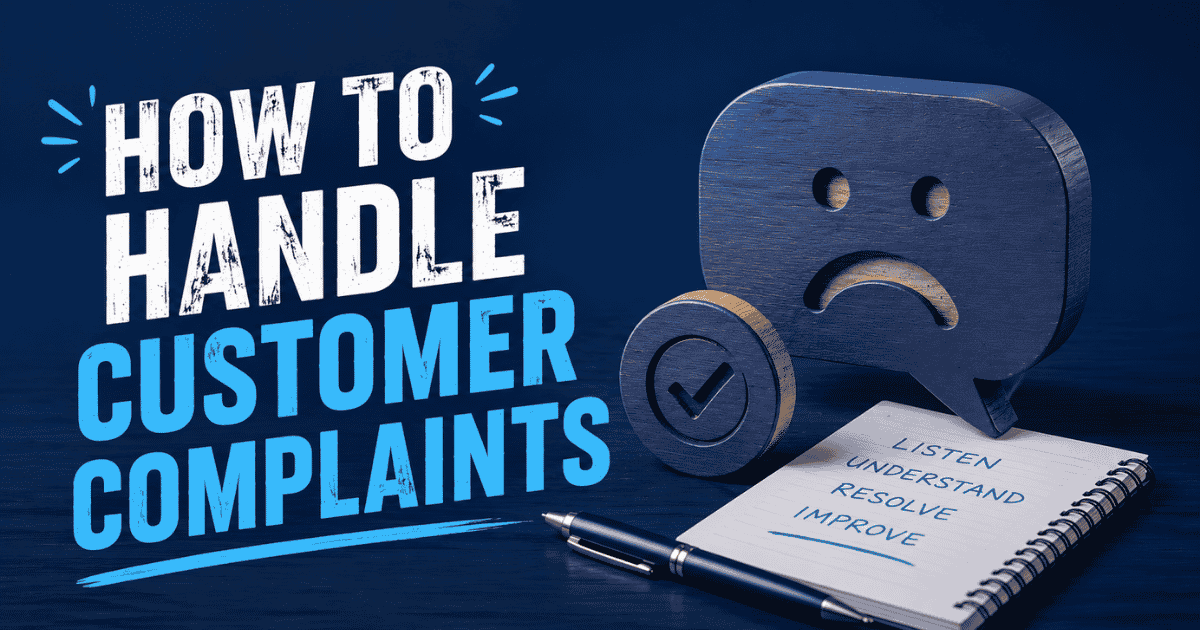
Listen Before You Respond
Before you say anything, understand exactly what went wrong. Read the full message or let the person finish talking without jumping in with a canned response. Interrupting to explain policy or defend a process only makes someone feel unheard, and an unheard customer rarely calms down, no matter what you offer next.
Acknowledge the Problem
A simple, direct acknowledgment goes further than most agents realize. Saying something like "you're right, that response time was too slow" costs nothing and immediately lowers the temperature. Customers do not expect perfection; they expect someone to admit when the business got it wrong instead of dodging the point.
Find the Root Cause
Do not settle for the surface complaint. If a customer says a delivery was late, dig into whether it is a one-off shipping delay or a pattern tied to a specific warehouse or process. The response you deliver should match the actual cause, not just the symptom the customer happened to mention.
Offer a Real Solution
This is where trust gets built or lost. A refund, a replacement, or a fixed timeline only works if it is something you can actually follow through on. Do not offer more than you or your manager can approve, since a promise that falls apart later damages loyalty far more than a smaller, honest fix would have in the first place.
Escalate If Needed
Some issues are bigger than a first response can handle, and that is fine. Loop in a manager or the right team quickly, but keep the customer updated while it happens. Silence during an escalation is what turns a solvable complaint into a lost customer.
Follow-Up After Resolution
Do not close the loop the moment a fix is sent. Check back to confirm it actually worked. This single step matters more than most teams give it credit for, and it is often the difference between a one-time save and real loyalty in the long run.
Handled this way, complaints stop being a drain on your processes and start becoming a regular source of insight you can use to prevent the same issue from showing up again in a future review or future ticket.
How to Handle Complaints Across Different Channels

Not every complaint deserves the same treatment. The channel shapes how fast a client expects a reply and how public the exchange feels, so the same resolution can land completely differently depending on where it happens.
Email Complaints
Email gives you time to think before you respond, which is exactly why sloppy replies stand out. A client writing in usually expects a reasonable wait, often a few hours to a day, but not silence. Take that time to actually read the message twice, apologize where it is warranted, and write a clear resolution instead of a rushed, generic reply. Research on customer communication consistently shows that a slow but thoughtful email beats a fast but shallow one.
Live Chat Complaints
Chat is real-time, so the expectations flip completely. An unhappy customer typing in a chat window wants a response within a minute or two, not a delayed one. This is not the place for a long apology paragraph. Keep it short, acknowledge the issue fast, and move straight into what you can do about it. Employees handling chat need canned responses ready, but every message still has to feel personal, not copy-pasted, which is exactly what live chat support for real-time conversations is built to enable.
Phone Complaints
Phone calls carry tone in a way text never will. An apology said flatly can sound worse than no apology at all. This is where active listening does the most work, since the client cannot see you nodding along, they can only hear whether you are actually paying attention or just waiting for your turn to talk. Confirm the resolution out loud before ending the call so there is no confusion later.
Social Media Complaints
Social complaints are public by default, which changes the job completely. Anyone can see how you serve an unhappy customer here, not just the person complaining. Respond quickly to acknowledge the issue publicly, then move the detailed back-and-forth to a private channel like DM or email. Leaving a complaint unanswered on social media reads as ignoring it, even if you are actively working the case internally, which is why multi-channel support software for customer service is so valuable.
Online Review Complaints
Reviews are written after the fact, so there is no live conversation happening. A short, genuine reply asking for feedback or offering to make it right shows future readers how the business handles criticism, not just the original reviewer. Avoid defensive language entirely. A calm, specific response to a review often does more for your reputation than the five-star reviews sitting next to it.
Mistakes That Quietly Kill Customer Trust

Trust is not lost in one dramatic moment, it usually leaks out through small habits that seem harmless in the moment. Here are the ones that quietly cost businesses the most.
Hiding Behind Policy
Telling a frustrated customer "it's just our policy" closes the conversation instead of solving anything. It might be true, but it does not address the actual request or make the person feel heard. Policies exist to guide decisions, not to replace judgment. A rep prepared to explain why a rule exists, and to look for a reasonable middle ground, keeps far more trust intact than one who just points at a rulebook.
Promises You Can't Keep
Every promise creates expectations, and every broken one creates a bigger problem than the original complaint. If you tell someone a refund will land in three days and it takes ten, you have not just failed to fix the issue, you have added a new one. Only promise what you or your team can actually deliver, even if the honest answer is less impressive.
Slow First Response
How fast you respond sets the tone for the entire interaction that follows. A customer who waits two days for a reply has already formed an opinion about the brand before your message even lands. Speed does not require a full solution right away; even a quick acknowledgment that you are looking into it changes how the rest of the conversation goes.
No Follow-Up After Closing
Closing a ticket the moment a fix is sent, without checking if it actually worked, leaves the door open for the same issue to resurface. Customers notice when a business treats their case as done versus actually resolved. That gap between the two is where a lot of quiet churn happens.
Dismissing the Complaint
Minimizing a complaint, even with good intentions, reads as a lack of empathy. Saying "that's not a big deal" or "most people don't mind that" tells the customer their experience does not matter. Every complaint deserves to be taken at face value first, evaluated second.
Blaming the Customer
Nothing kills trust faster than shifting blame onto the person who reached out for help. Even when a customer misunderstood a process or made an error themselves, the tone of your response should never make them feel foolish for asking. Interactions built on blame rarely end with the customer feeling good about the brand, no matter how technically correct you were.
How to Turn Complaint Data Into Fewer Complaints

Complaint data is only useful if someone actually looks at it. Most businesses collect it and let it sit in a ticketing system, never turning it into anything that prevents the next round of complaints, which is where smarter helpdesk setups for smoother support make a real difference.
Track Every Complaint in One Place
If complaints live scattered across email, chat logs, and someone's memory, patterns disappear before anyone spots them. A single system, even a simple spreadsheet for a small team, lets you see every complaint together instead of one at a time. For remote or hybrid teams, keeping remote support teams aligned and on track depends on this kind of shared view. Without this step, everything after it becomes guesswork.
Look for Repeat Issues
Once complaints are in one place, patterns get obvious fast. Maybe five customers mentioned the same confusing checkout step this month, or three flagged the same bug. A single complaint might be a fluke. The same complaint from unrelated customers rarely is. During peak seasons, holiday helpdesk setup tips for small support teams can make spotting and handling these patterns much easier. This is the point where data stops being noise and starts pointing at something worth fixing.
Share Findings With the Right Teams
A support agent can log a bug, but they usually cannot fix it. That requires getting the pattern in front of product, engineering, or whichever team actually owns the problem. Managing support tickets efficiently using a shared platform helps ensure those patterns do not get stuck in the inbox. Complaint data that stays inside the support inbox and never reaches the people who can act on it accomplishes nothing beyond documentation.
Fix the Root Problem, Not Just the Symptom
It is tempting to treat every ticket as a one-off and move on once it is closed. But if the same shipping delay or the same unclear policy keeps generating tickets, closing each one individually just resets the clock until the next complaint arrives. Fixing the underlying cause, even if it takes longer, is the only way the volume actually drops over time, and simplifying holiday support with your helpdesk app is one example of tackling seasonal root causes instead of just firefighting.
Measure Response and Resolution Times
Numbers matter here as much as the complaint content itself. Tracking how long it takes to first respond and how long it takes to fully resolve an issue tells you where the process is slow, not just where customers are unhappy. A team that consistently takes three days to close tickets has a process problem, regardless of how good individual replies are, as shown when EasyDesk improved response time for a growing team.
Review Trends on a Regular Schedule
None of this works as a one-time exercise. Set a recurring check, whether that is weekly or monthly, to look at complaint volume, common categories, and whether previous fixes actually reduced the numbers they were meant to fix. Trends shift as products change and new issues surface, so a system built once and never revisited slowly stops reflecting reality, and it is often a sign that your desk support is failing and needs fixing.
How EasyDesk Takes the Pressure Off Your Support Team
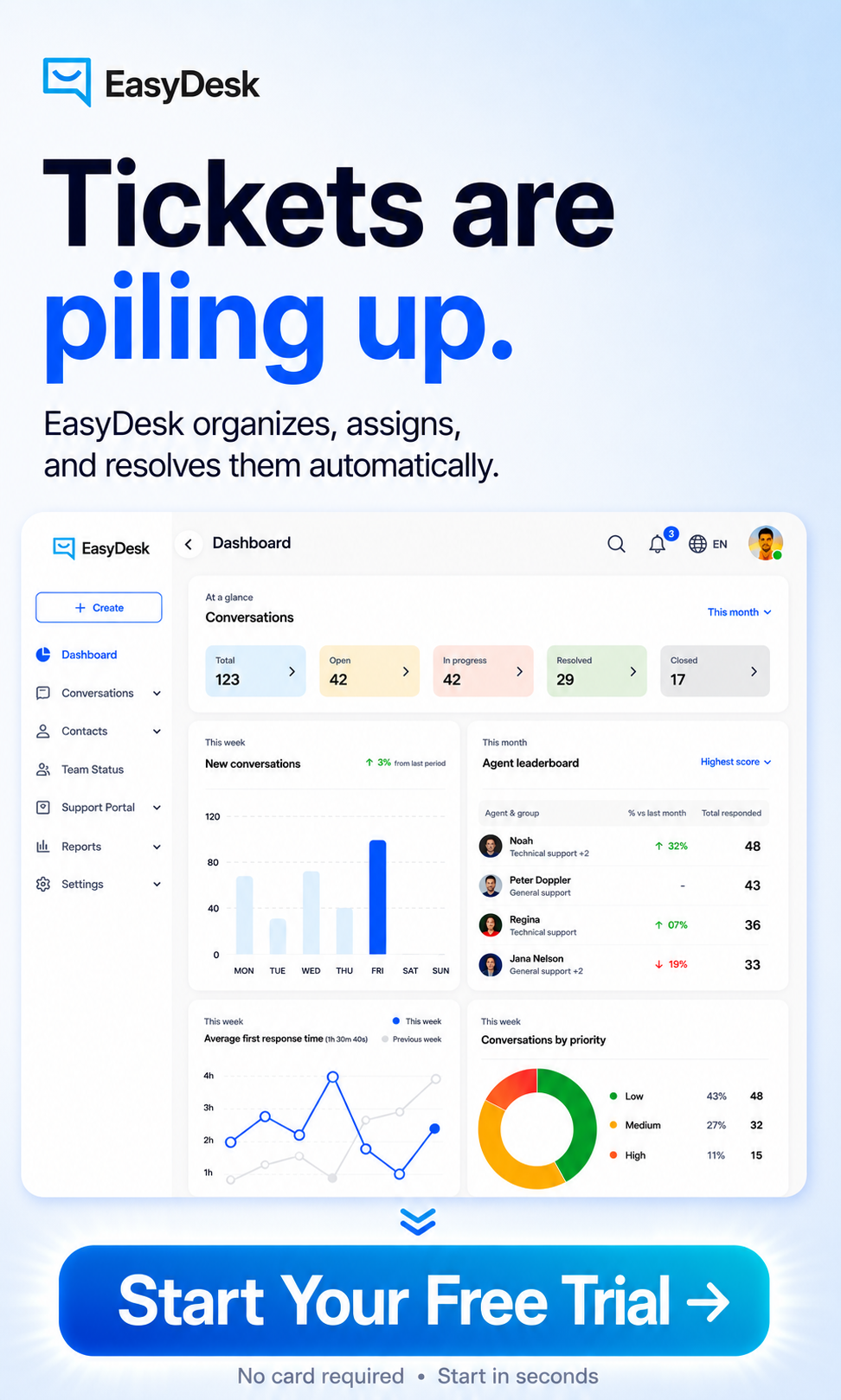
Handling complaints well takes structure, and structure is easier with the right tools in place. EasyDesk's secure, efficient customer support platform brings email, chat, and other support channels into one shared inbox, so nothing gets missed or duplicated across agents. Its AI assistant, Eden, helps by suggesting instant answers from your knowledge base, sorting incoming tickets by priority, and generating quick conversation summaries so agents do not start from zero on every handoff, all powered by automated workflow software for smarter support. SLA tracking keeps response and resolution times visible instead of guessed at, and canned responses cut down repetitive typing on common issues, all inside EasyDesk's helpdesk ticketing software. None of this replaces good judgment or empathy, it just removes the manual busywork so your team can spend more time actually resolving the complaint in front of them.
FAQs
What's A Good Response Time For A Customer Complaint?
There is no single universal number, but faster is almost always better. Live chat and social media complaints usually need a reply within minutes, while email can reasonably wait a few hours to a day. What matters more than hitting an exact number is acknowledging the complaint quickly, even before you have the full fix ready. Silence is what actually damages trust, not a short delay before a complete answer.
How Do You Handle A Complaint With No Clear Solution?
Some issues genuinely have no perfect fix, such as a delayed shipment stuck with a third-party carrier, for example. In these cases, be honest about what you can and cannot control. Offer whatever partial resolution is available, whether that is a refund, a credit, or a clear timeline, and keep the customer updated instead of going quiet just because there is no clean answer.
What If The Customer's Complaint Isn't Reasonable?
Stay calm and avoid arguing the point directly. Acknowledge how they feel without agreeing to something outside policy or common sense. Explain clearly what you can offer and why, using plain language instead of corporate jargon. Most unreasonable requests soften once the customer feels heard, even if the final answer stays the same.
How Do You Train New Agents To Handle Complaints?
Role-playing real complaint scenarios works better than reading a script. Pair new agents with experienced ones for their first few weeks, and review actual past tickets together to show what a good resolution looks like versus a rushed one. Confidence with complaints comes from repetition, not a single training session.
Is A Complaint The Same As Feedback?
Not exactly. Feedback is often unprompted and general, while a complaint points to a specific, unresolved problem the customer wants fixed. Both are valuable, but complaints usually need a direct response; feedback does not always require one.