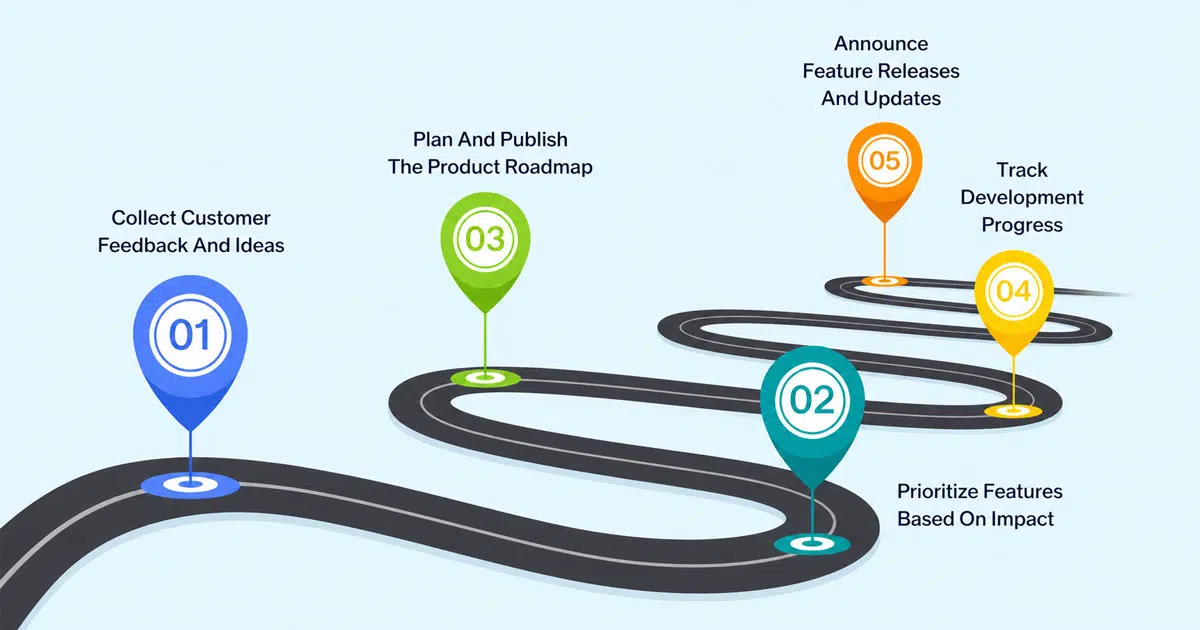
The SaaS market reached US$171.9 billion in 2022, with 15,000 SaaS companies in the US alone. A public product roadmap helps support platforms stand out in this competitive market. It creates transparency between product teams and users while collecting valuable feedback that optimizes the product development process.
We'll show you how to build a public roadmap that works for your support platform. You'll learn best practices to gather customer feedback and maintain transparency while you keep stakeholders lined up. You'll also learn how to choose the right saas product roadmap tool. These strategies help you turn your external roadmap into a powerful tool for user participation and product strategy.
What Is Public Product Roadmap
A public product roadmap is a freely accessible page that shows your product vision, priorities, and product development progress. Unlike an internal product roadmap used by internal teams, an external roadmap shares high-level plans without sensitive roadmap details. Product managers use a public roadmap tool or roadmap portal to present upcoming features, major releases, and planned features. SaaS companies rely on a visual roadmap to keep enterprise customers, existing customers, and potential customers on the same page. A public SaaS roadmap connects business objectives with product strategy and supports data-driven decisions across multiple teams.
A public product roadmap also supports the entire feedback cycle. Users submit feedback, vote on feature requests, and join the feedback loop through a feedback board or roadmap repository. Product teams collect valuable feedback, receive feedback from customers interested in new features, and align agile teams around user stories and key features. This customer-centric SaaS roadmap improves user engagement, team collaboration, and gathering feedback across cross-functional teams. Public roadmap examples show how product owners share release notes, recently shipped updates, and project board column status inside a visually appealing roadmap tool.
Why Modern Support Platforms Need Public Roadmaps
Modern support platforms operate in highly competitive SaaS markets where transparency builds customer trust. A public product roadmap aligns product teams, enterprise customers, and existing customers around upcoming features, major releases, and product strategy while creating a structured feedback loop that strengthens long-term user engagement.
Building Trust With Existing Customers
Transparency drives customer loyalty more powerfully than most product features. Data shows 94% of consumers are likely to be loyal to a brand that practices transparency. Share your product development process through a public product roadmap and you demonstrate commitment to openness that appeals to existing customers.
Your customers want to feel confident you have ambitious plans for the product. A public roadmap shows your product teams aren't standing still. It signals continuous improvement and long-term viability. This assurance matters because 73% of customers are willing to pay more to do business with a transparent company.
Your roadmap creates psychological investment among users when you share it. Customers who see their feature requests acknowledged on your roadmap portal develop ownership in your product's success. They stick around to see those features ship and become supporters of your platform. This emotional connection strengthens retention in ways pricing adjustments cannot match.
Your public roadmap also confirms that customer feedback influences your product strategy. Users submit feedback and later see those ideas reflected in upcoming releases. Trust deepens. You've proven their voices matter. This feedback analysis loop transforms passive users into active participants who feel valued and heard.
How Transparency Cuts Down Support Tickets
Support teams spend hours answering the same question over and over: "When will you add feature X?" A public roadmap eliminates this repetitive workload management. Research indicates public roadmaps reduce support tickets by up to 40%. Your customers find answers themselves instead of reaching out.
The time savings compound across your organization. Customer success teams redirect energy from status updates to strategic customer relationships. Product managers spend less time in meetings explaining what's coming next. Development teams face fewer interruptions about feature timing.
Users gain a point of view on the product development progress. They see which features are in progress, planned, or under review. This visibility manages expectations before problems arise rather than after. Customers understand development takes time and can track progress without asking.
Your roadmap becomes a self-service resource for information about upcoming features. Customers check the freely available page to see if their needed functionality is coming. They find new features they didn't know to ask about. This discovery reduces frustration and increases satisfaction with your platform.
How Product Teams Line Up With Customer Needs
A public roadmap creates direct communication channels between product teams and users. You test assumptions about customer problems before investing development resources. Share your strategic plan and users tell you whether you're solving their most pressing challenges.
Customer feedback volume increases by a lot with public roadmaps. Studies show they generate 3x more input compared to private planning. This data helps product managers make informed decisions about feature prioritization. You collect valuable feedback that shapes smarter product strategy.
The feedback board integration on your public roadmap lets customers upvote feature requests. This voting mechanism provides quantitative data on what people need. You see which planned features generate excitement and which ones matter less to your user base. Tools with anonymous voting get 50-70% more participation than those requiring account creation.
Your entire feedback cycle closes when customers see their suggestions implemented. You show users their input drives development decisions. This confirmation encourages ongoing engagement and more feedback. Customers become partners in building the product rather than passive recipients of updates.
Standing Out in the Support Industry
Public roadmaps distinguish your support platform in crowded markets. Prospects who assess multiple options appreciate transparency about your product vision. They see your commitment to continuous improvement and strategic direction. This openness influences purchasing decisions, with public roadmaps increasing conversions by 15%.
Your roadmap serves as powerful sales collateral. Sales teams use it during demos to address feature parity questions. Enterprise customers assess long-term viability before committing. When they see your ambitious roadmap with major releases planned, confidence in your platform grows.
Customer retention improves measurably with public roadmaps. Data shows they increase retention by 25%. Users are less likely to churn when they see requested features on your roadmap. They understand improvements are coming and choose to wait rather than switch to competitors.
The transparency also attracts top talent to your organization. Potential team members see your forward-thinking approach and want to join. Your public roadmap signals an intuitive culture that values openness. This advantage in hiring strengthens your ability to deliver on business objectives and maintain competitive positioning.
Key Elements Of Effective Public Roadmaps
Successful public roadmaps share common structural elements that improve user engagement and product development progress. You need specific components working together to create a roadmap that users trust and reference often.
Clear Status Categories For Features
Status categories help users understand where each feature sits in your development cycle. You want labels that communicate progress without creating confusion. Productboard's internal teams use a workflow that moves features through distinct phases: New idea, Discovery, Design, Backlog, Planned for delivery, Delivery, Testing, Announcement, and Launched. This granular approach works well for internal teams tracking detailed progress.
Your public roadmap needs simpler categories. Most saas companies use three to five status buckets that customers can grasp right away. Common structures include "Up next," "In progress," and "Now available" or variations like "Under review," "Planned," and "In progress". These broad categories manage expectations without locking you into rigid commitments.
The status labels you choose should reflect your development pace and communication style. Some product teams prefer "Shipping," "Next," and "Future" to indicate priority without specific timelines. Others use "Exploring," "In Progress," "Done," and "Leave It For Now" to show honest assessment of feature viability. Your labels become part of how existing customers understand your product strategy.
Status-based roadmaps move posts between columns when their status changes. This keeps your roadmap portal current without manual updates. Users see real progress happening. They trust your roadmap details reflect actual work.
Visual Roadmap Design That Engages Users
Visual elements transform your public product roadmap from a text document into a compelling communication tool. Color coding helps users scan and understand information fast. You can assign colors by priority, status, strategic goal, or product area. Whitespace prevents overwhelming users and creates a clean, professional appearance. That's why a product roadmap software is neccessary.
Swimlanes organize your roadmap by team, product module, customer segment, or theme. These horizontal or vertical lanes clarify ownership and work distribution. Swimlanes let each audience focus on relevant features if you serve enterprise customers alongside small teams.
Icons and labels add context without cluttering the layout. Simple visual markers indicate risk level, platform, or customer segment. A legend explaining your color scheme, icons, and lane meanings helps every viewer interpret the roadmap correctly. Filters let users show or hide specific items based on their interests.
Column-based views work well when you avoid strict deadlines. Features appear in status columns rather than date ranges. Time-based roadmaps display features by month, quarter, or half-year periods. You can offer multiple views of the same roadmap so users choose their preferred format.
Feedback Board Integration
Feedback boards turn your public roadmap into a two-way conversation. Users need easy ways to submit feedback on roadmap items. Comment sections let customers explain why they need specific features and share use cases your product teams hadn't thought of.
Voting mechanisms provide quantitative data on demand. Users upvote feature requests to signal priority. This voting turns subjective opinions into measurable insights. When you see clear voting patterns, informed decisions become easier.
The entire feedback cycle closes when you connect user input to your product strategy. Customers watch their submitted ideas move from feedback board to roadmap to shipped features. This progression demonstrates that gathering feedback produces real outcomes. Your roadmap tool should notify users when features they voted for change status.
Timeline And Release Information
Timeline presentation requires careful balance. Specific release dates create pressure and disappointment when plans shift. Broad timeframes like quarterly buckets communicate priority without boxing your agile development team into rigid deadlines.
Time-based roadmaps require manual ETA settings for posts to appear. Column-based roadmaps organized by status work better than date commitments if you prefer flexibility. GitHub's approach uses quarterly columns with release phase labels like "preview" and "ga" to show progression.
You can display multiple roadmap views: status-based, monthly, and quarterly. Users interested in long-term strategic plans appreciate quarterly views. Those tracking upcoming features prefer monthly timelines. Offering both serves different stakeholder needs without maintaining separate roadmaps.
4 Best Practices Of Public Product Roadmap
A successful public product roadmap needs structure and clarity. It must support your product strategy, guide product teams, and strengthen trust with existing customers. Clear systems for collecting feedback, open communication, stakeholder alignment, and audience-focused design turn a simple roadmap portal into a powerful product management asset.
Collect Valuable Feedback From Users
A public product roadmap should support the entire feedback cycle. Users must submit feedback easily through a feedback board, roadmap portal, or in-app widget. Simple voting on feature requests increases participation and drives more feedback. Product teams collect valuable feedback from support tickets, sales calls, surveys, and usage data.
A structured feedback loop helps product managers connect user feedback to business objectives. Organize feedback inside a roadmap repository or product roadmap tool. Prioritize existing ideas based on revenue impact, customer benefits, and strategic plan alignment. Agile teams use this system to make data-driven decisions and ship key features that match real needs.
Maintain Transparency In Product Development Process
A public roadmap builds trust when it shows real product development progress. Share upcoming features, major releases, and planned features on a freely accessible page. Transparency keeps enterprise customers and potential customers on the same page with your product vision.
Communicate delays clearly. Honest updates reduce churn and strengthen user engagement. A public SaaS roadmap should focus on themes instead of sensitive roadmap details. This balance protects the customer support strategy while keeping customers interested in your SaaS product roadmap.
Keep Stakeholders On The Same Page
A public product roadmap works as a single source of truth. Internal teams, cross-functional teams, and external stakeholders review the same visual roadmap. Regular updates inside your roadmap tool prevent confusion across multiple teams.
Monthly updates inside your roadmap portal highlight upcoming releases and shipped recently improvements. Release notes explain new features and customer benefits in simple terms. Clear communication improves team collaboration and keeps product owners, development team members, and customer success aligned with business objectives.
Design For Your Audience
Different users expect different roadmap details. Enterprise customers focus on long-term strategic plan alignment and major releases. Small teams look for quick improvements and practical customer benefits.
Clear language matters. Avoid technical jargon when possible. Focus on user stories and outcomes instead of backend processes. A visually appealing roadmap tool with mobile access improves user engagement. A customer-centric public SaaS roadmap supports gathering feedback, encourages customers interested in new features, and keeps your roadmap public, open, and effective.
How To Choose The Right Public Roadmap Tool
Selecting the right tool for your public product roadmap requires matching software capabilities to your specific workflow and stakeholders. Product roadmap tools help product managers plan, communicate, and track product development progress. A good product roadmap tool makes the difference between clear product strategy and chaotic planning.
Features You Need In A Product Roadmap Tool
Your roadmap tool needs user-friendly interfaces that reduce training time and encourage adoption among teams. Fast drag-and-drop updates and multiple roadmap views like timeline, Kanban, and Gantt keep agile teams productive. Immediate editing and in-tool commenting enable cross functional teams to cooperate without friction. Purpose-built roadmap tools output visually appealing roadmaps and stay web-based for enterprise-wide sharing quickly.
Integration With Project Management Tool Systems
Your public roadmap cannot sit in a silo. Sync with Jira, Salesforce, GitHub, and analytics platforms keeps roadmaps current with execution data. Sleekplan integrates with Jira and GitHub Issues to sync your public roadmap with existing workflows. Native connections with development tools create a single source of truth for product teams.
Custom Domain And Branding Options
Sleekplan lets you set custom domains and customize colors so your roadmap tool fits your brand styles. ProdCamp allows customization with your logo, favicon, name, and domain. Branded experiences make your freely available page feel like a natural extension of your product.
Access Controls For Internal Teams
Setup public or internal roadmaps depending on your needs. Restrict access to certain users or team members while allowing anonymous voting on public boards. Enterprise-grade security has encryption, SSO, MFA, and role-based access.
Comparing Popular Roadmap Tools For Support Platforms
ProductPlan creates shareable roadmaps with clear swimlanes and beefed-up security. Airfocus offers visual roadmaps with Insights features that collect customer feedback in one place. Aha Roadmaps excels at integrations despite rough design. Jira has boards, timelines, and dashboards on a single platform.
How EasyDesk Enables Modern Customer Support And Product Transparency
EasyDesk helps SaaS companies manage customer support and product transparency in one place. Support tickets, feature requests, and user feedback flow into a central system. Product teams collect valuable feedback and connect it directly to the public product roadmap. This structured feedback loop supports the entire feedback cycle and keeps internal teams and external stakeholders on the same page.
A shared roadmap portal makes product development progress visible. Customers submit feedback, track upcoming features, and view release notes on a freely accessible page. Product managers align product strategy with business objectives while agile teams ship key features. This clear process improves user engagement, strengthens customer benefits, and supports a customer-centric public SaaS roadmap.
FAQs
How Often Should You Update A Public Product Roadmap For SaaS Platforms?
Update your public product roadmap at least once a month. Regular updates show product development progress and keep existing customers engaged. Frequent refreshes also strengthen your feedback loop and improve user engagement.
Can A Public Product Roadmap Improve SaaS Customer Retention?
Yes. A public SaaS roadmap increases transparency and builds trust. When customers see upcoming features and major releases, they stay longer. Clear product strategy and visible progress reduce churn.
Do Small SaaS Teams Need A Public Roadmap Tool?
Yes. Even small teams benefit from a structured product roadmap tool. It helps collect valuable feedback, manage feature requests, and align internal teams. A simple roadmap portal keeps everyone on the same page.
Is Anonymous Voting Important For A Feedback Board?
Yes. Anonymous voting increases participation in your feedback board. More users submit feedback when friction stays low. Higher participation improves data-driven decisions for your product teams.
What Metrics Should You Track For A Public Product Roadmap?
Track user engagement, number of feature requests, feedback volume, and roadmap views. Measure how many ideas move from feedback board to shipped features. These insights strengthen your product development process.
Should A Public Roadmap Include Pricing Or Commercial Details?
No. A public roadmap should focus on customer benefits and product vision. Pricing and sensitive roadmap details belong in internal planning documents. Keep your external roadmap strategic and high-level.
Can A Public Product Roadmap Support Enterprise Sales Conversations?
Yes. Enterprise customers review your public product roadmap to assess long-term business objectives. A clear visual roadmap with major releases builds confidence. It supports sales teams during strategic discussions.