Modern customers expect fast, clear, and human support from the very first interaction. When someone reaches out with a question, issue, or purchase concern, the clock starts immediately. How quickly your team responds often matters more than the final outcome. A fast first reply builds trust, reassures customers that help is on the way, and prevents frustration from escalating into churn or negative reviews.
In 2026, customer support response time has become a core performance indicator for SaaS, ecommerce, and service-based teams alike. With more channels than ever email, live chat, social media, and in-app messaging customers expect timely replies wherever they choose to contact you. Falling behind even slightly can push customers toward competitors that appear more responsive.
This guide breaks down what response time really means, why it directly impacts revenue and retention, and how modern teams can reduce delays without burning out agents or hiring excess staff and how to reduce customer support response time with automation.
What Is Customer Support Response Time?
Customer support response time measures how long your team takes to send the first reply after someone reaches out for help. It starts the moment a customer submits their request and ends when they receive a response from either a human agent or an automated system. This metric is different from resolution time, which tracks how long it takes to fully solve the issue and close the ticket. Customer service response time shapes how customers judge your support experience.
In 2026, most customer service teams track First Response Time (FRT) as a core KPI, broken down by channel, email, live chat, social media, phone, and self-service portals all have separate benchmarks because customer expectations vary dramatically between them.
Here’s a concrete example of how it works: a customer emails your support team at 9:15 AM asking about a billing discrepancy. Your help desk logs the ticket creation timestamp. At 10:42 AM, an agent sends a reply explaining the charge and offering a refund option. The first response time for that ticket is 1 hour and 27 minutes.
Business hours matter when calculating these averages. Many companies exclude nights, weekends, and holidays from their response time metrics. A ticket submitted at 11 PM on Friday might not count against response time until Monday morning opens.
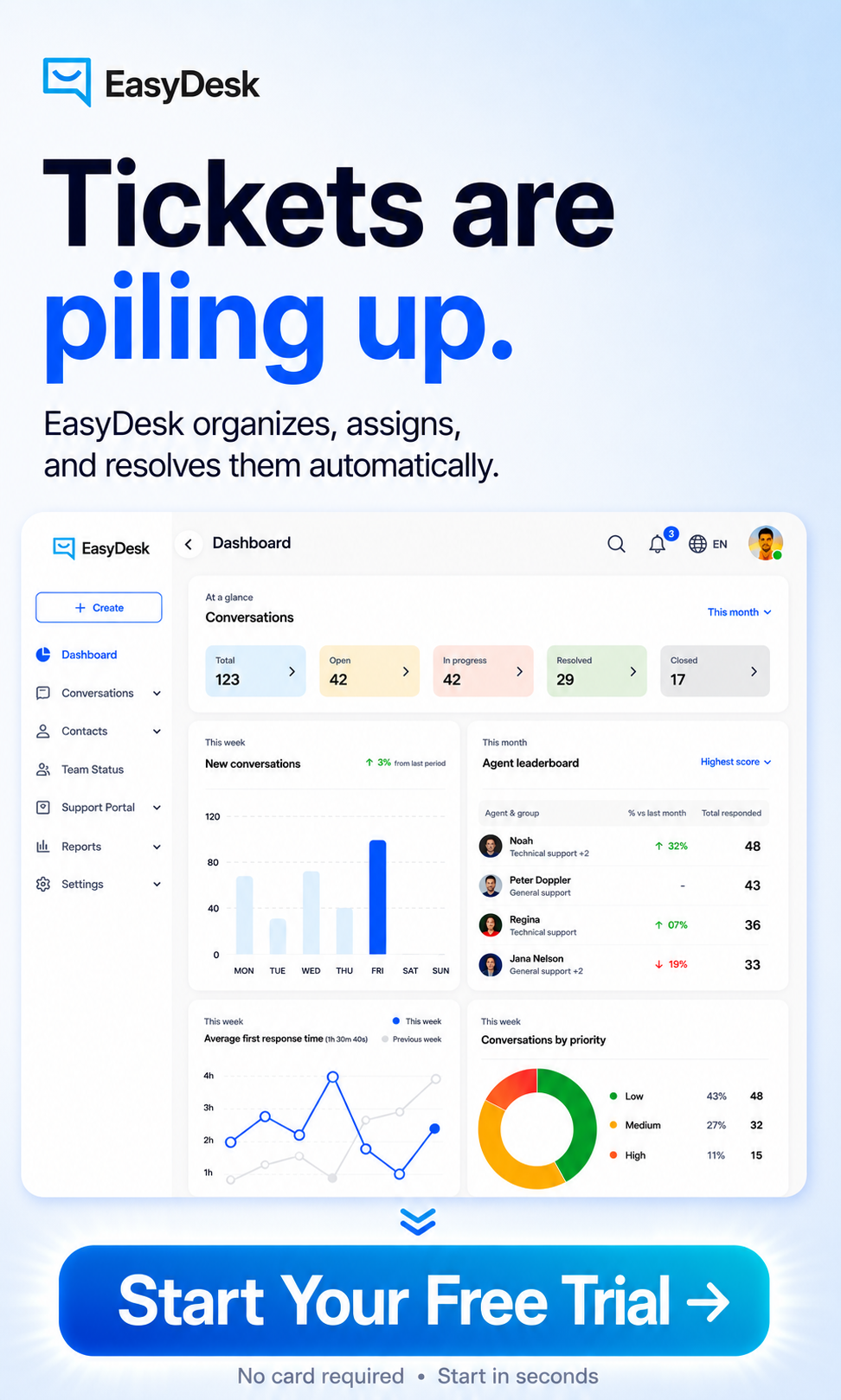
Tools like EasyDesk automatically capture timestamps for each ticket interaction, which removes manual tracking and gives you accurate data without extra work.
Why Reducing Response Time Is Important For Businesses?
Speed shapes how customers judge a business. Customer service response time affects satisfaction, loyalty, and revenue. When teams respond quickly, they build trust and reduce frustration. Faster support response time helps manage customer requests efficiently and improves overall customer experience.
Faster Response Builds Customer Trust
Customer expectations have changed. People expect quick replies across email, chat, and social media platforms. A fast customer service response shows that a business values its customers and their time.
Studies show that 90% of customers expect a response within 10 minutes for urgent issues. Slow response times create a poor experience and push customers away. Faster response times help build stronger customer relationships and improve customer loyalty. A support team that responds quickly sets a positive tone for the entire customer service experience.
Lower Response Time Improves Customer Satisfaction
Customer satisfaction depends heavily on response speed. A lower average first response time improves how customers feel about a brand. Even a fast acknowledgment can make a big difference.
Research suggests that companies with faster first response time FRT see up to 20% higher customer satisfaction scores. Customer service teams that respond faster can handle customer issues before they escalate. This leads to better support experience and helps customers stay loyal. Clear expectations and timely replies improve trust and satisfaction.
Quick Replies Reduce Resolution Time
Response time directly affects resolution time. When support agents reply early, they gather full context faster and move toward solutions without delay. This reduces repeated follow ups and avoids confusion.
Data shows that faster response speed can cut resolution time by nearly 30%. Ticket routing and routing rules ensure each support ticket reaches the right agent quickly. Escalation rules help manage urgent issues without delays. This structure helps customer support teams resolve complex issues more efficiently.
Automation Helps Manage High Ticket Volume
Automation tools help reduce customer support response time at scale. Automated responses handle incoming messages instantly and guide customers to find answers through knowledge bases or self service options.
Reports indicate that automation can cut response times by up to 40%. Support teams can automate repetitive tasks like password resets, email templates, and ticket classification. This allows human involvement where it matters most. Teams can manage support requests better without sacrificing quality.
Faster Support Drives Revenue And Retention
Response time is a key driver of long term revenue. Customers turn to competitors when they face delayed responses. A slow support response time often leads to lost opportunities and reduced trust.
Studies show that improving response time can increase customer retention by up to 15%. Businesses that respond quickly create better customer conversations and improve overall service quality. Faster support helps retain customers, increase loyalty, and drive sustainable business growth.
What Is A Good Customer Support Response Time In 2026?
There’s no single magic number for response time because expectations depend heavily on the channel and the type of customer you’re serving.
For live chat, customers expect near-instant engagement. Most benchmarks suggest aiming for a first reply in under one to two minutes. Anything longer and many customers will abandon the chat entirely.
Social media DMs fall into a middle ground. During business hours, responding within thirty to sixty minutes is considered acceptable, though faster is always better for platforms where public visibility can impact your brand.
Email remains the most forgiving channel, but expectations have tightened. Standard support tickets should receive a response within one to three business hours. VIP customers or urgent issues like outages or payment failures need faster attention, often within fifteen to thirty minutes.
For internal IT or HR support teams, first acknowledgment within thirty minutes to two hours is typical, depending on priority and the complexity of internal processes.
B2B and enterprise teams often formalize these targets through SLAs. A common structure might require 95% of priority-one tickets answered within fifteen minutes, while lower-priority questions can wait a few hours.
Consider setting different target times for pre-sales versus post-sales inquiries. A potential customer asking about pricing probably needs faster attention than someone requesting a feature tutorial. Similarly, critical issues deserve faster response than general “how-to” questions.
EasyDesk lets you configure these targets per channel and priority, then report on them in a single dashboard so you can see exactly where you’re hitting the mark and where you’re falling short.
Key Reasons Behind Slow Support Response Times
Before investing in new tools or expanding your team, start with honest diagnostics. The fastest path to improvement often involves fixing what’s broken rather than adding more resources on top of a flawed system.
Scattered Tools And No Clear Ownership
Many support teams still juggle multiple inboxes, social platforms, and chat widgets without a unified view. Customer emails land in a shared Gmail folder, Instagram DMs sit in another app, and live chat logs live somewhere else entirely. With no single source of truth, tickets slip through cracks, and agents waste time figuring out what’s already been handled.
When there’s no clear ticket ownership, customer requests bounce between agents or sit untouched because everyone assumes someone else will handle it.
Staffing And Volume Mismatches
Consider a common scenario: a team of three customer service agents handling over 800 tickets per week with no automation. They manually triage everything, copy-paste the same answers repeatedly, and scramble to keep up. Average email response time? Over 12 hours. Peak season pushes that to 24 hours or more.
This isn’t a laziness problem, it’s a systems problem. The same team with proper routing, canned responses, and self service options could handle the same volume in half the time.
Technology Gaps That Compound Delays
Without a knowledge base, customers contact support for questions they could answer themselves. Without macros, agents type the same paragraph hundreds of times. Without routing rules, billing questions go to technical support, wasting everyone’s time. Without time based alerts for SLA breaches, urgent issues sit unnoticed in the queue.
Running A Quick Audit
Pull the last 30 days of tickets and sort by response time. Look for patterns:
- Which channels have the longest wait time?
- What hours or days see the biggest backlogs?
- Which topics or categories pile up most often?
EasyDesk’s reporting and views help teams spot exactly where incoming requests stack up, whether that’s Monday mornings, shipping questions, or complex issues that require escalation.
Core Strategies To Reduce Customer Support Response Time
Fast customer service response times do not happen quickly. They result from clear processes, smart tooling, and intentional team design. The strategies below to reduce customer response times focus on practical, proven methods modern support teams use to reply faster without sacrificing quality or agent well-being.
1. Set Clear, Channel-Specific SLAs
SLAs service level agreements are the formal targets your team commits to for response and resolution times. Instead of vaguely aiming for “as soon as possible,” SLAs give everyone a concrete goal.
A practical example: “All chat tickets receive a first response in under 2 minutes, 95% of the time.” For email, you might target 4 hours for standard questions and 30 minutes for priority-one incidents like payment failures or service outages.
Define different SLAs based on priority levels. A P1 outage affecting multiple customers needs immediate response. A general “how do I” question can wait a few hours without damaging customer experience. B2C customers might have different expectations than B2B enterprise accounts with premium support agreements.
Share these SLA policies publicly on your help center, contact page, or onboarding emails. When you manage customer expectations upfront, they’re less likely to feel frustrated by reasonable wait times.
EasyDesk stores these SLA rules, tracks them automatically, and highlights at-risk tickets in the queue so agents know exactly which customer queries need attention first.
2. Centralize All Requests Into A Single Help Desk
The chaos of juggling separate email inboxes, live chat widgets, social DMs, and contact forms creates slow response times almost by default. Messages get lost. Agents duplicate effort. Customers get frustrated repeating themselves.
Centralization means every message regardless of where it originates, becomes a ticket with clear ownership and complete history in one place. Website forms, support@ inboxes, live chat, WhatsApp messages, Facebook and Instagram DMs, and in-product widgets all feed into the same queue.
When a customer interaction arrives, agents see the full context: previous conversations, ticket status, assignee, and SLA timer. No more switching between tabs or asking colleagues “did anyone reply to this?”
EasyDesk turns each message into a structured ticket with tags, status, assignee, and SLA timers visible at a glance. This centralization alone can dramatically shortens response time by eliminating the overhead of managing scattered support channels.
3. Use Smart Routing And Prioritization
Without routing rules, every ticket lands in the same generic queue. Simple password reset questions compete with critical outage reports for attention.
Rules-based routing solves this: billing questions go to the finance queue, technical incidents to Tier 2 engineers, and VIP accounts to a premium support queue. Tickets should be prioritized using a simple schema P1 through P4 based on impact and urgency rather than just arrival time.
A concrete rule example: “Any ticket containing ‘down’, ‘cannot login’, or ‘payment failed’ automatically gets P1 priority and routes to the on-call engineer.”
This approach ensures that customer service representatives handle the right tickets based on their expertise, and urgent issues get immediate response rather than waiting behind less critical requests.
EasyDesk’s automation engine reads subject lines, channel source, tags, and customer data to automatically assign tickets and set priorities. You can also use escalation rules to ensure that tickets approaching SLA breach get bumped up the queue.
4. Automate Acknowledgments And Simple Workflows
There’s a difference between a robotic auto-reply that says “We received your email” and a helpful acknowledgment that sets clear expectations and points customers toward useful resources. Good automated responses are short, specific, and honest about timing. This can be easily done using customer service software.
This type of proactive communication reduces follow-up emails from customers wondering if their message went through. This is great for customer support success.
Beyond acknowledgments, automation can handle:
- Tagging and categorizing tickets on arrival based on keywords or channel
- Assigning tickets based on working hours and agent skills
- Triggering reminders before SLA breaches so nothing slips through
EasyDesk workflows let you build these automations with a simple interface, no custom code required. You can automate repetitive tasks without technical expertise.
5. Use Canned Responses And Knowledge Base Content
Some questions appear hundreds of times per month. “Where is my order?” “How do I reset my password?” “What’s your refund policy?” Typing personalized responses to each one wastes hours of agent time.
Pre-written templates often called canned responses or macros save 30 to 60 seconds per ticket while still feeling personal. The key is training agents to customize the first and last lines. “Hi Sarah, thanks for reaching out about your order” followed by a template explanation, ending with “Let me know if you have any other questions!” feels human even when the middle is standardized.
When you connect your knowledge base to your help desk, agents can insert article links directly into replies. Instead of explaining a complex process step-by-step, they can say “Here’s our detailed guide on setting up integrations: [link].”
This approach helps customers find answers faster while reducing agent workload.
EasyDesk’s knowledge base and reply templates live inside the ticket view. Agents answer questions without switching tools or hunting through separate systems.
6. Offer Real-Time Channels Where It Makes Sense
Live chat and messaging widgets deliver significantly faster first response times than email, but they also require higher agent focus and concurrency. Industry benchmarks show that while a single agent can process 15–25 email tickets per hour, the same agent typically manages only 3–6 simultaneous chat conversations without a drop in quality. This makes chat a high-impact but resource-intensive channel.
For small and mid-sized teams, deploying live chat across every page often backfires. Support leaders across SaaS and ecommerce increasingly restrict chat to high-intent moments such as pricing pages, checkout flows, in-app billing screens, and account settings. These touchpoints correlate directly with conversion, retention, and revenue protection, where a fast reply delivers measurable business return.
Outside business hours, top-performing teams replace live chat with structured forms or conversational bots that set clear expectations. Industry data shows that customers are more tolerant of delayed responses when timing is communicated upfront, reducing repeat follow-ups and duplicate tickets.
EasyDesk enables teams to manage real-time conversations and email tickets within one interface, allowing agents to maintain context across channels while balancing workload efficiently.
7. Train And Empower Your Support Team
Response time is often a skills and process issue, not purely a headcount problem. Customer service department that lacks product knowledge must pause to ask colleagues or escalate, adding delays to every interaction. Lower response time is one of the core reasons for customer loyalty.
Ongoing training helps agents answer more questions confidently in the first reply:
- Monthly product update sessions covering new features and known issues
- Internal documentation with troubleshooting steps for common problems
- Clear decision-making guidelines so agents can handle refunds, credits, and exceptions without waiting for manager approvals
When human agents have the knowledge and authority to resolve issues on first contact, both average response time and resolution time improve.
EasyDesk reports can identify topics where agents hesitate or escalate too often. Use that data to design specific training around those themes, building product knowledge where it matters most.
How To Measure And Optimize Response Time Over The Long Term
To keep response times fast over months and years depends on visibility and discipline. Teams need clear numbers, structured queues, and realistic schedules to avoid gradual slowdowns as volume grows, channels expand, and customer expectations continue to rise.
Track the Right Metrics
Improvement requires measurement. Focus on these core metrics:
| Metric | What It Measures | Why It is Importaint |
| Average First Response Time by channel | Speed of initial reply per channel | Shows where you’re fast vs slow |
| Median FRT | Middle value, avoiding outlier skew | More accurate than average alone |
| SLA compliance rate | Percentage of tickets within target | Tracks consistency, not just speed |
| Volume by hour and day | When tickets arrive | Guides staffing decisions |
A simple before/after comparison tells you if changes are working. For example: “After introducing routing rules and canned responses last month, our email FRT dropped from 8 hours to 3.5 hours.”
EasyDesk dashboards display these metrics in real time, broken down by agent, team, and channel. As a result, you can provide accurate feedback to customer support staff to improve customer response times.
Use Views And Queues To Keep Work Organized
Dedicated views help agents focus on the right tickets at the right time:
- Unassigned: Tickets waiting for ownership
- Breaching Soon: Tickets approaching SLA deadline
- VIP Customers: High-priority accounts requiring faster service
- Refund Requests: Tickets needing specific handling
Managers might use a view showing SLA breaches and backlog trends, while support agents see their own open tickets and today’s tasks.
EasyDesk lets you save and share these views so everyone works from the same priorities without constant communication overhead.
Adjust Staffing And Schedules Based On Data
Historical ticket data reveals patterns. Maybe Mondays from 9 AM to noon account for 30% of weekly volume. Maybe product launches trigger 3x normal ticket volume for 48 hours.
Use these patterns to staff peak times appropriately. Consider part-time or flexible shifts for evenings and weekends once the data shows clear demand.
Start small: add one extra agent to chat during peak hours and compare before/after average first response time in EasyDesk. Measure the impact before making larger staffing changes.
How EasyDesk Helps You To Reduce Customer Support Response Time
EasyDesk is built for teams that need faster replies without adding complexity or process overhead. Instead of managing separate tools for email, forms, and internal coordination, support teams work from one clean, centralized system where every request becomes a trackable ticket with clear ownership and context.
Response time improves immediately because nothing gets lost or delayed. All customer messages flow into a shared inbox with visible SLAs, priorities, and assignment status. agents know exactly what to answer first, while managers gain real-time visibility into backlogs and at-risk tickets. Custom SLAs ensure that high-impact issues receive attention before minor requests, reducing escalations and customer frustration.
Automation plays a key role in speed. routing rules direct tickets to the right team instantly, smart acknowledgments set expectations upfront, and saved replies eliminate repetitive typing. Agents spend less time on admin work and more time delivering helpful, timely responses.
Built-in collaboration keeps conversations efficient without exposing internal discussions to customers. Reporting dashboards then close the loop by showing where response times improve and where bottlenecks remain.
the outcome is consistent speed, happier customers, and a support team that scales responsibly as volume grows.
FAQs
What Is The Difference Between First Response Time And Resolution Time?
First response time measures how long it takes to send the first meaningful reply after a customer contacts support. Resolution time tracks the full journey from ticket creation to final resolution and closure. A team can respond quickly, but still take longer to fully resolve complex issues that require follow-ups or escalation.
How Often Should We Review Response Time Targets?
Response time targets should be reviewed at least once every quarter. Teams should also reassess SLAs after product launches, major marketing campaigns, staffing changes, or noticeable shifts in ticket volume and customer behavior.
Do Auto-Replies Help Customers Or Feel Robotic?
Auto-replies help when they set clear expectations and provide useful next steps. Short messages that confirm receipt, share response time estimates, and link to relevant resources add value. Auto-replies feel frustrating when they are vague, repetitive, or overly formal.
Can Small Teams Reduce Response Time Without Hiring More Agents?
Small teams can improve response time by centralizing all channels, using templates for common questions, prioritizing urgent issues, and offering self-service options. Limiting real-time chat to high-impact pages also helps manage workload without increasing headcount.
How Long Does It Take To See Improvements After Adopting A Help Desk?
Most teams notice measurable improvements within two to four weeks. Faster results usually come from early setup work such as defining SLAs, creating canned responses, and configuring routing rules for common ticket types.
What Role Does Self-Service Play In Response Time Reduction?
Self-service reduces incoming ticket volume by helping customers find answers independently. A clear knowledge base and structured FAQs prevent repetitive questions, allowing agents to focus on higher-priority requests and respond faster overall.
How Does Channel Mix Affect Customer Support Response Time?
Different channels create different workload patterns and response expectations. Balancing real-time channels like live chat with asynchronous options such as email helps teams maintain speed without overwhelming agents or lowering response quality.