Every business depends on IT support to keep employees productive and customers satisfied. When technical issues happen, teams need a reliable way to manage requests, resolve incidents, and maintain service quality. That is where help desk and ITSM solutions come into the picture.
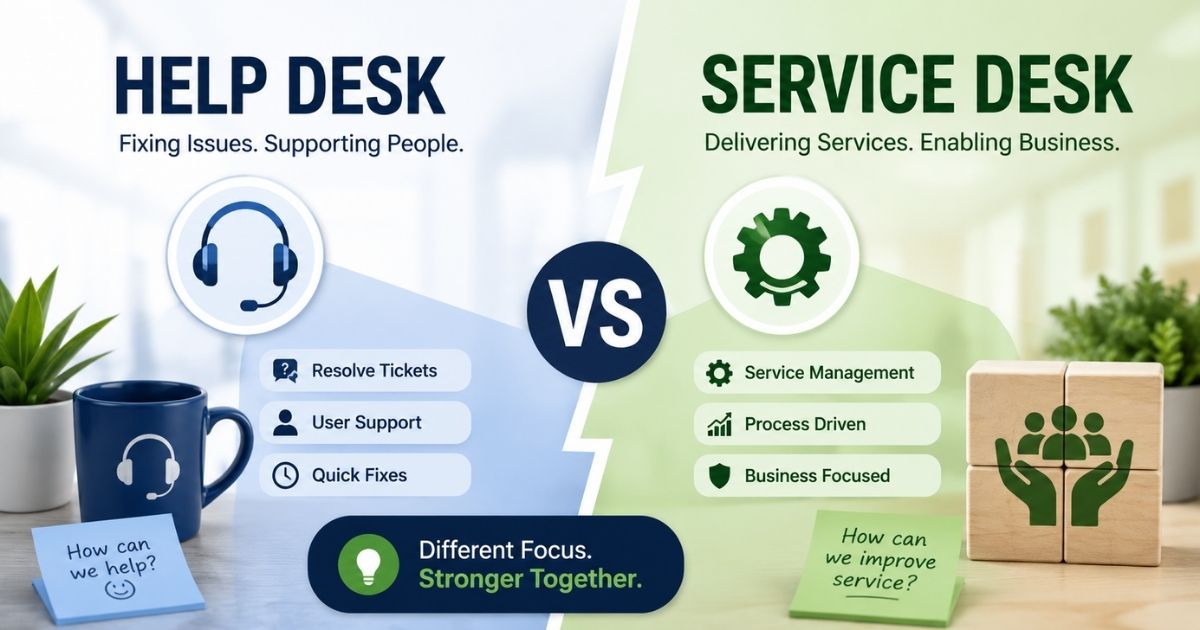
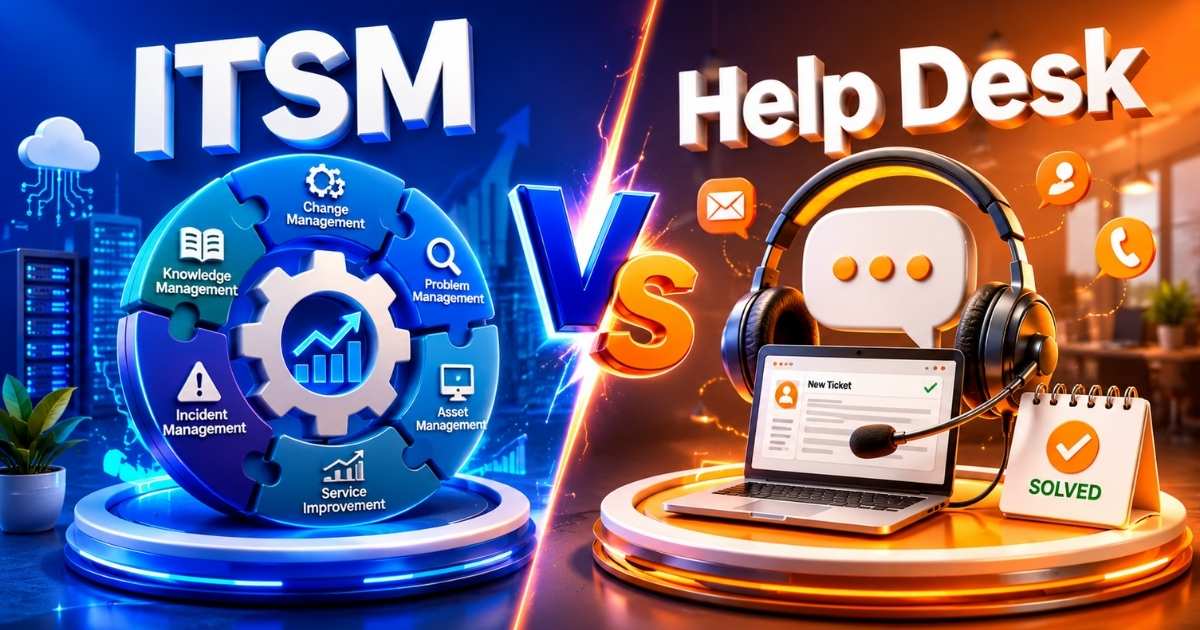
Many people use ITSM and help desk as if they mean the same thing. In reality, they serve different purposes. A help desk focuses on resolving user issues and support tickets, while ITSM takes a broader approach to managing IT services across the organization.
Understanding the difference is important before investing in any support platform. The right choice can improve efficiency, reduce downtime, and support future growth. This guide breaks down ITSM vs help desk, including their features, benefits, limitations, and the situations where each solution works best.
What Is A Help Desk And How Does It Work?
A help desk is a centralized support system that helps users report and resolve technical issues. It acts as a single point of contact between employees and IT teams. The primary goal of a help desk is incident resolution and quick support for everyday technical problems such as password resets, software errors, and access requests. Traditional help desk tools focus on resolving technical issues as quickly as possible to maintain operational efficiency and reduce disruptions.
A help desk works through a structured process. Users submit tickets through email, chat, phone, or self-service portals. The support team then tracks, prioritizes, and resolves issues based on service level agreements. Many organizations also use ticketing systems to organize requests and streamline workflows and knowledge management features to help users find answers on their own.
When comparing ITSM vs help desk, a help desk provides basic support and fix support for immediate technical issues. It improves service delivery and employee productivity, making it a practical solution for small businesses and organizations with limited support needs.
What Is ITSM And Why Does It Matter In Modern IT Operations?
IT Service Management (ITSM) is a structured approach to managing and delivering IT services across an organization. Unlike a traditional help desk that focuses on fixing technical issues, ITSM covers the entire service lifecycle. It includes incident management, problem management, change management, asset management, and service lifecycle management. Many ITSM frameworks are based on the IT Infrastructure Library, which provides best practices for service management and continuous improvement and aligns with secure, transparent customer support platforms.
ITSM matters because modern businesses rely heavily on technology. IT teams must do more than resolve issues. They need to manage service requests, support new services, improve service delivery, and maintain service level agreements. An IT service desk often serves as the central hub for these activities.
When evaluating help desk vs ITSM, the key difference is scope. ITSM takes a proactive and strategic approach to improve operational efficiency, support business goals, and deliver comprehensive support to every service consumer.
ITSM Vs Help Desk: Key Differences Explained
Although both solutions support IT services, they differ in scope, goals, and processes. A help desk focuses on resolving technical issues and service requests, while ITSM takes a broader service management approach that covers the entire service lifecycle and long-term business objectives.
Aspect | Help Desk | ITSM |
|---|---|---|
Primary Focus | Resolves immediate technical issues and support requests | Manages and improves the entire service lifecycle |
Approach | Reactive and issue-focused | Proactive and strategic |
Scope | Basic support and incident resolution | Comprehensive IT service management |
Core Processes | Ticket management and technical support | Incident management, problem management, change management, and asset management |
Service Delivery | Focuses on resolving issues quickly | Focuses on continuous improvement and service quality |
Service Requests | Handles common service requests and user issues | Manages service requests as part of a larger framework |
Change Management | Limited or absent | Includes structured change management processes |
Knowledge Management | Basic knowledge base support | Advanced knowledge management practices |
Service Desk Role | Functions as a traditional help desk | Often operates through an IT service desk model |
Service Level Agreements | Supports basic SLA tracking | Monitors and manages SLAs across services |
Best For | Small businesses with simple support needs | Large businesses with complex IT operations |
Business Impact | Improves support efficiency | Aligns IT services with business strategy |
Asset Management | Usually limited | Includes full asset management capabilities |
Long-Term Value | Focuses on short-term issue resolution | Supports operational efficiency and long-term growth |
Help Desk Vs ITSM Outcome | Faster support for daily issues | Better control, governance, and service management |
Essential Features Comparison Between ITSM And Help Desk Software
Essential features often reveal the biggest difference between ITSM and help desk software. While both support IT services, they are built for different goals. A feature-by-feature comparison helps businesses choose the right solution based on support needs, service management requirements, and future growth plans.
Feature | Help Desk Software | ITSM Software |
|---|---|---|
Incident Management | Focuses on resolving user issues and tickets | Includes incident management with root-cause analysis |
Change Management | Limited or unavailable | Structured change management processes |
Asset Management | Basic device tracking | Full asset management across IT environments |
Automation | Supports simple ticket automation | Automates complex workflows and service lifecycle tasks |
Service Management Scope | Covers support requests | Manages the entire service lifecycle |
Incident Management
A help desk focuses on quick incident resolution. The goal is to resolve technical issues and restore normal operations as fast as possible. Most tickets involve password resets, software errors, account access problems, and other day-to-day support requests, often handled more effectively when you turn emails into trackable tickets.
ITSM takes incident management further. It looks beyond the immediate problem and investigates recurring issues. According to the ITIC Global Server Hardware and OS Reliability Survey, downtime can cost large organizations thousands of dollars per minute. That is why ITSM teams use problem management practices to identify root causes and prevent the same issue from returning.
Change Management
Most help desk platforms provide limited support for change management. Teams can document requests, but the process often remains manual. This works for small businesses with simple IT environments.
ITSM software includes structured change management processes. Every change follows approval workflows, risk assessments, and implementation plans. A report from the Project Management Institute found that organizations with formal change processes complete projects more successfully than those without them. Strong change management reduces disruption and protects service delivery across the organization.
Asset Management
Help desk software usually tracks basic information about devices and users. Support agents can view equipment details when resolving technical problems. For many teams, that level of visibility is enough.
ITSM platforms provide comprehensive asset management capabilities. They track hardware, software licenses, contracts, and configuration data across the entire IT infrastructure. Gartner estimates that effective asset management can reduce software spending by up to 30%. Better visibility helps IT operations teams make smarter decisions and control costs more effectively.
Automation
Automation exists in both solutions, but the depth is very different. Help desk software automates simple tasks such as ticket routing, notifications, and status updates. This improves response times and reduces manual work.
ITSM software automates workflows across multiple service management processes. It can handle approvals, change requests, asset updates, and service requests without human intervention. Research from McKinsey shows that workflow automation can improve productivity by 20% to 30%. More automation allows IT teams to focus on strategic work instead of repetitive tasks.
Service Management Scope
A help desk follows a support-first approach. It focuses on resolving technical issues and helping users get back to work, often by relying on ticketing software built for better customer support. The scope is usually limited to ticket management and technical support.
ITSM covers the entire service lifecycle. It includes incident management, problem management, change management, asset management, and continuous improvement. The IT Infrastructure Library framework supports this broader approach. While help desk vs ITSM discussions often focus on tickets, the real difference is scope. ITSM aligns IT services with business goals and creates a more proactive service management strategy.
Benefits And Limitations Of ITSM Vs Help Desk Solutions
Every business wants reliable IT support, but not every organization needs the same solution. Both help desk and ITSM platforms offer valuable benefits. However, they also come with limitations. Understanding those trade-offs helps businesses choose a solution that matches their current needs and future goals.
Area | Help Desk Benefits & Limitations | ITSM Benefits & Limitations |
|---|---|---|
Cost | Lower cost but limited functionality | Higher cost but broader capabilities |
Setup Complexity | Fast deployment but fewer advanced features | More complex implementation but greater control |
Scalability | Suitable for smaller teams but limited growth support | Scales well but requires more resources |
Process Coverage | Handles support tasks well but lacks depth | Covers full service management but may be excessive for simple needs |
Business Alignment | Improves support operations but limited strategic value | Aligns IT services with business goals but requires planning |
Cost And Value
A help desk is usually the more affordable option. Many vendors offer simple pricing plans and quick deployment. Small businesses often choose ticketing software designed to enhance customer support because it delivers core support features without a large investment.
ITSM platforms require a bigger budget. Costs increase because of advanced features such as asset management, change management, and service lifecycle management. Gartner research shows organizations that mature their IT service management practices often achieve lower operational costs over time. The higher upfront investment can deliver stronger long-term value for growing businesses.
Setup And Complexity
Help desk software is easy to implement. Most teams can configure workflows, create ticket categories, and start supporting users within days. Small growing businesses can use help desk tools where the learning curve is usually short, which helps employees adapt quickly.
ITSM software requires more planning. Teams must define processes, service level agreements, approval workflows, and service catalogs. According to HDI research, implementation complexity remains one of the biggest challenges for ITSM projects. The additional effort creates a stronger service management framework, but it demands more time and resources.
Scalability And Growth
A help desk works well for organizations with straightforward support requirements. It handles service requests, incident resolution, and technical support efficiently. Many small businesses can operate successfully with the right help desk setup for customer support for years.
Growth often changes those requirements. More employees, services, and systems create additional complexity. ITSM platforms are designed for that environment. They support the entire service lifecycle and help IT teams manage expanding operations. IDC reports that scalable ticket automation software for modern support teams helps organizations improve productivity while supporting digital transformation initiatives.
Process Coverage
Help desk solutions focus on resolving technical issues. Their primary purpose is to provide support and restore service quickly. This approach works well when users need answers, fixes, or assistance with common technical problems.
ITSM takes a broader view of service delivery. It includes incident management, problem management, knowledge management, asset management, and change management processes. The result is comprehensive support across the organization. Businesses gain more visibility into services, recurring issues, and operational performance throughout the entire service lifecycle.
Business Impact
A help desk improves day-to-day support operations. Faster response times and organized ticket management help employees stay productive. For many organizations, that benefit alone justifies the investment.
ITSM delivers a more strategic advantage. It aligns IT services with business objectives and supports continuous improvement. Research from Axelos, the steward of the IT Infrastructure Library framework, shows that mature ITSM practices help organizations improve service quality and customer satisfaction. While help desk vs ITSM decisions often focus on support, the bigger difference is how closely IT contributes to business success.
ITSM Vs Help Desk: Which One Fits Different Business Sizes?
Business size plays a major role when choosing between ITSM and help desk software. A solution that works well for a small company may not support a large enterprise. The right choice depends on team size, IT complexity, growth plans, and service management requirements.
Factor | Help Desk | ITSM |
|---|---|---|
Team Size | Best for small support teams | Supports large and distributed IT teams |
IT Complexity | Handles simple support environments | Manages complex IT operations |
Growth Potential | Limited scalability | Designed for long-term growth |
Process Requirements | Basic support workflows | Advanced service management processes |
Business Objectives | Focuses on issue resolution | Aligns IT services with business strategy |
Team Size
A help desk is often the right fit for smaller organizations. Support teams can manage service requests, technical support, and incident resolution without dealing with complex workflows. Using structured ticket creation and management, the setup is simple, and employees can start using the system quickly.
Larger businesses usually require more structure. A report from Statista shows that enterprises continue to expand their digital operations, creating higher service demands. ITSM software helps large IT teams coordinate tasks, manage service delivery, and maintain service level agreements across multiple departments and locations.
IT Complexity
Many small businesses operate with a straightforward technology environment. A few applications, devices, and users are often manageable through traditional help desk tools. The focus remains on resolving technical issues as efficiently as possible.
Complex environments require a broader approach. Large organizations manage cloud services, business applications, security systems, and multiple infrastructure components. ITSM provides problem management, asset management, and change management capabilities that help control complexity. This improves operational efficiency and reduces risks across the organization.
Growth Potential
A help desk works well during the early stages of business growth. It provides the core features needed to support users and manage support requests. Many organizations begin with a help desk approach because it is affordable and easy to maintain.
Growth often introduces new services, larger teams, and more demanding processes. According to IDC, worldwide digital transformation spending continues to grow each year as organizations expand technology investments. ITSM supports that growth by managing the entire service lifecycle and providing a framework that scales with business needs.
Process Requirements
Organizations with simple support needs rarely require advanced service management processes. A help desk can manage tickets, track issues, and provide quick fixes without adding unnecessary complexity. This makes it a practical solution for businesses with limited IT requirements.
ITSM supports organizations that rely on structured processes. Features such as change management, knowledge management, incident management, and service lifecycle management help standardize operations. The IT Infrastructure Library framework promotes consistent service delivery and continuous improvement across all IT services.
Business Objectives
A help desk focuses primarily on support. Its main purpose is to resolve issues, reduce downtime, and help users stay productive. For many small businesses, that objective is enough to meet daily operational needs.
ITSM serves a broader business purpose. It connects IT services with organizational goals and long-term strategy. Research from Axelos shows that mature IT service management practices help improve service quality, reduce service disruptions, and increase customer satisfaction. When comparing help desk vs ITSM, the biggest difference is how closely technology supports overall business success.
Cost, Implementation, And Scalability Comparison Of ITSM And Help Desk Platforms
Cost, implementation, and scalability often determine whether a business chooses a help desk or an ITSM platform. Both solutions support IT services, but they differ in investment, deployment effort, growth capacity, and long-term value for the organization.
Factor | Help Desk | ITSM |
|---|---|---|
Initial Cost | Lower subscription and setup costs | Higher upfront investment |
Implementation Time | Faster deployment | Longer implementation process |
Training Requirements | Minimal training needed | Requires deeper team training |
Scalability | Suitable for smaller environments | Supports enterprise-scale growth |
Long-Term ROI | Lower investment but limited expansion | Higher investment with greater long-term value |
Initial Cost
A help desk is usually the more budget-friendly option. Most vendors offer simple pricing plans based on agents or users. Small businesses often choose help desk software because it delivers essential support features without requiring a significant investment.
ITSM platforms typically cost more. The price reflects advanced capabilities such as asset management, change management, knowledge management, and service lifecycle management. According to Gartner, organizations continue to increase spending on IT service management tools as digital operations grow. Although the upfront cost is higher, businesses often gain broader service management capabilities and stronger operational control.
Implementation Time
A help desk can often be deployed within days or weeks. Most platforms include prebuilt workflows, ticketing systems, and self-service portals that require minimal configuration. This allows support teams to start resolving technical issues quickly and benefit from behind-the-scenes improvements a help desk provides.
ITSM implementation takes longer because it involves multiple service management processes. Organizations must define workflows, approval structures, service catalogs, and service level agreements. Research from HDI shows that process design remains one of the most time-consuming parts of ITSM adoption. The additional effort creates a stronger foundation for long-term service delivery and governance.
Training Requirements
Help desk software is designed for simplicity. Support agents can learn the system quickly and begin managing tickets with limited training. Managing support tickets efficiently reduces onboarding time and helps teams become productive faster.
ITSM requires a broader understanding of IT service management principles. Teams often need training on incident management, problem management, change management, and service lifecycle management. Axelos reports that organizations using IT Infrastructure Library practices frequently invest in structured training programs. Better knowledge leads to improved efficiency and more consistent service delivery across the organization.
Scalability
A help desk works well for organizations with straightforward support requirements. It can handle service requests, technical support, and incident resolution effectively. However, limitations often appear as the business grows and new services are introduced.
ITSM platforms are built for expansion. They support larger user bases, multiple departments, and complex IT operations. IDC research shows that businesses continue to expand digital services and cloud environments each year. Moving from shared inboxes to automated email-to-ticket systems is one way ITSM provides the structure needed to manage that growth while maintaining service quality and operational efficiency.
Long-Term ROI
A help desk delivers quick value by improving support processes and reducing response times. Organizations can resolve issues faster and provide better experiences for employees and customers. For businesses with basic needs, the return on investment can be significant.
ITSM focuses on long-term business outcomes. It improves service management, reduces recurring issues, supports proactive operations, and aligns IT services with organizational goals. According to Forrester research, companies that mature their service management practices often see measurable improvements in productivity and service quality. In the help desk vs ITSM debate, ITSM usually provides greater long-term value for organizations planning sustained growth.
How To Choose Between ITSM And Help Desk For Long-Term Growth
The choice between ITSM and help desk software should not depend only on current support needs. A platform that works today may create limitations tomorrow. Businesses should evaluate growth plans, service complexity, budget, and long-term operational goals before making a decision.
Business Size Matters
Small businesses often benefit from a traditional help desk. The setup is simple, costs are lower, and support teams can resolve technical issues without dealing with unnecessary complexity. This approach works well when service requests and IT operations remain manageable.
Growth changes those requirements. According to Statista, global digital transformation spending continues to increase as organizations expand technology investments. Businesses that expect rapid growth may benefit more from ITSM because it supports the entire service lifecycle and larger service management demands.
Support Requirements First
Every organization has different support needs. Some only need a system for ticket management, technical support, and incident resolution. In those cases, a help desk can provide all the essential features required to support users effectively.
Complex support environments often require more than issue resolution. Multiple departments, recurring issues, and strict service level agreements usually call for a broader IT service management strategy. ITSM helps organizations manage services proactively rather than reacting to problems after they occur.
Process Maturity Counts
Organizations with basic workflows can operate successfully with a help desk approach. Teams can manage support requests, provide assistance, and maintain service delivery without extensive process controls.
Businesses with mature IT operations often need structured processes. Incident management, problem management, change management, and knowledge management become increasingly important as complexity grows. Research from Axelos shows that organizations using IT Infrastructure Library best practices often achieve higher service quality and greater operational consistency.
Growth Plans Shape The Decision
A help desk may meet current requirements, but future expansion can quickly expose limitations. More employees, applications, and services create additional demands on support teams and infrastructure.
ITSM platforms are built for scalability. They support asset management, service lifecycle management, and cross-department collaboration. IDC research indicates that organizations continue expanding cloud services and digital platforms every year. A scalable ITSM solution can support that growth without requiring a complete platform replacement later.
Long-Term Value Wins
Initial cost is important, but long-term value often matters more. Help desk software usually requires less investment and delivers quick results. For businesses with straightforward support needs, that can be the most practical choice.
ITSM often produces greater value over time. It improves service management, reduces recurring technical problems, supports continuous improvement, and aligns IT services with business goals. When evaluating help desk vs ITSM, the best choice is the solution that supports both current operations and future business objectives.
Why EasyDesk Is A Smart Choice For Modern Help Desk And ITSM Needs
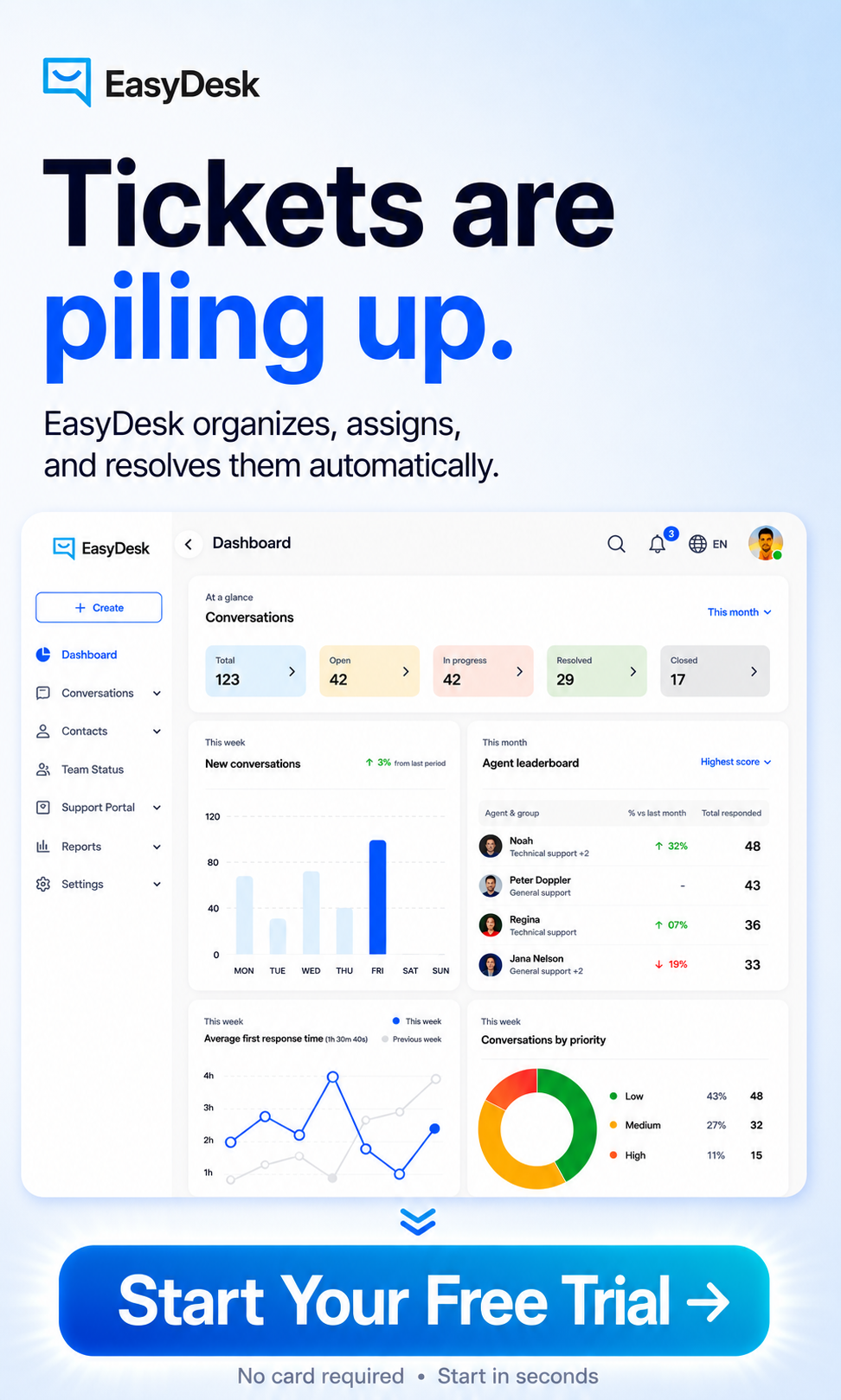
EasyDesk is a strong choice for businesses that need both modern help desk functionality and scalable service management capabilities. This customer support platform combines ticket management, workflow automation, SLA tracking, knowledge management, and multichannel support in one solution. This helps teams improve service delivery without adding unnecessary complexity.
Support teams can manage customer conversations from email, chat, and other channels through a centralized multi-channel support workspace. Automated ticket routing, structured workflows, and self-service tools reduce manual work and improve response times. EasyDesk also helps organizations maintain service level agreements and keep support operations organized as ticket volumes grow.
As businesses expand, support requirements become more complex. EasyDesk helpdesk ticketing software provides the flexibility to scale operations, improve operational efficiency, and support long-term growth. For organizations comparing help desk vs ITSM solutions, EasyDesk offers a practical balance between simplicity, automation, and service management capabilities.
FAQs
Can A Help Desk Become Part Of An ITSM Strategy?
Yes, a help desk can be part of a broader ITSM strategy. Many organizations start with a help desk and later expand into full IT service management. Understanding what help desk software is used for helps clarify how ITSM includes service management processes such as change management, asset management, and service lifecycle management beyond basic support.
Is ITSM Only Suitable For Large Businesses?
No, ITSM is not limited to large businesses. Small businesses can also benefit from ITSM when they manage multiple IT services, service requests, or growing support operations. Many modern ITSM platforms offer scalable features that fit different business sizes.
Does ITSM Improve Customer And Employee Experience?
Yes, ITSM often improves both customer and employee experiences. Structured service delivery, faster incident resolution, self-service portals, and knowledge management help users get support more efficiently. Better service management also reduces recurring technical issues.
What Role Do Self-Service Portals Play In Help Desk And ITSM Solutions?
Self-service portals allow users to submit service requests, track tickets, and access support resources without contacting IT teams directly. A well-structured knowledge base and canned responses improve operational efficiency, reduce ticket volume, and support faster service delivery across the organization.
Why Do Businesses Move From Traditional Help Desk Tools To ITSM Platforms?
Business growth often creates more complex IT operations and service management needs. A traditional help desk focuses on resolving technical issues, while ITSM supports the entire service lifecycle. That broader approach helps organizations manage services more proactively and strategically.