Customer support teams are busier than ever. More tickets, more channels, and higher customer expectations make it harder to maintain both speed and quality. Closing a large number of tickets may look productive, but volume alone does not tell the full story. A team can resolve hundreds of customer inquiries and still leave customers frustrated.
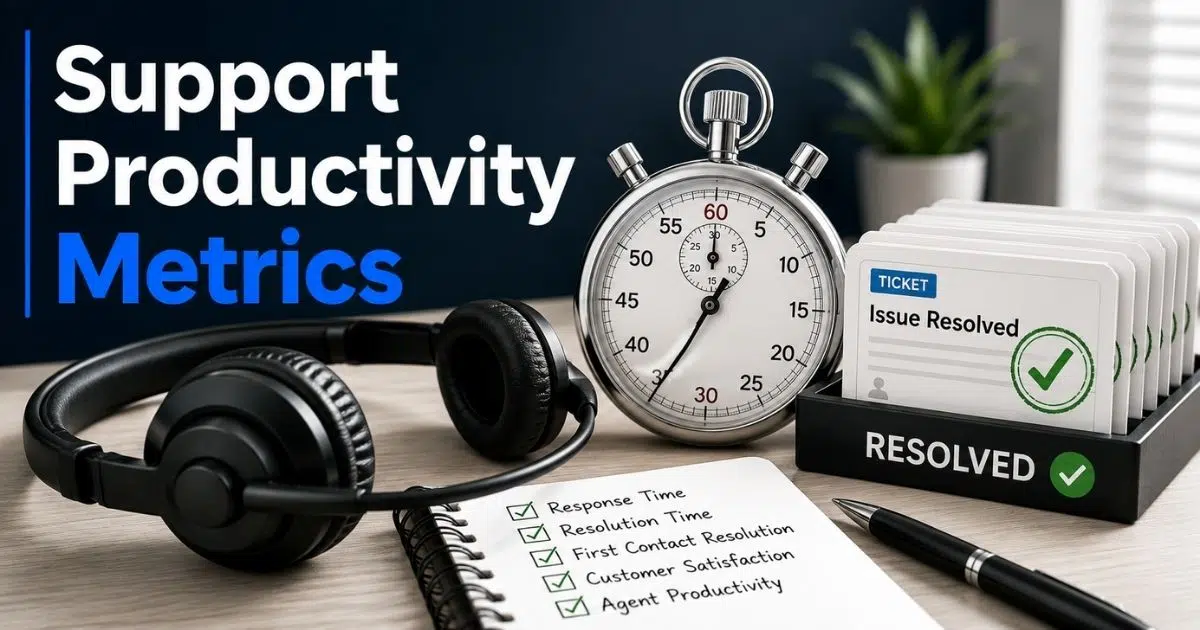
That is where support productivity metrics come in. They help measure how efficiently a customer service team handles customer requests while maintaining customer satisfaction and service quality. Metrics such as first contact resolution rate, average response time, average resolution time, customer satisfaction score, and service level agreement compliance reveal what is working and where improvements are needed.
When tracked correctly, customer service productivity metrics help teams identify bottlenecks, allocate resources more effectively, prevent burnout, and make data-driven decisions that improve both operational efficiency and the customer experience. The result is better support, happier customers, and stronger business outcomes.
What Are Support Productivity Metrics?
Support productivity metrics are the numbers that show how efficiently a customer service team handles work while maintaining customer satisfaction. They help businesses measure customer service productivity, track productivity across support teams, and understand whether resources are being used effectively. Common productivity metrics look at response time, resolution time, tickets resolved, and the quality of customer interactions.
A strong set of customer service metrics goes beyond speed alone. Good customer service depends on balancing efficiency, customer service quality, and employee productivity. For example, a team may close many customer requests each day, but a low first contact resolution rate or poor customer satisfaction score can signal deeper problems.
Effective productivity metrics combine quantitative output with qualitative impact. They help leaders measure customer service performance, make data-driven decisions, improve operational efficiency, and create a positive customer experience for both customers and customer service agents.
Why Support Productivity Metrics Are Important For Customer Service Teams
Support teams handle hundreds of customer inquiries every day. Without clear data, it becomes difficult to know what is working and what needs attention. Support productivity metrics help teams measure efficiency, improve customer service performance, and make better decisions based on facts instead of assumptions. They also help balance productivity, customer satisfaction, and employee well-being. Recent industry research shows that teams that track customer service KPIs such as first contact resolution, average response time, and customer satisfaction score consistently deliver better service outcomes.
Better Visibility Into Team Performance
Productivity metrics give leaders a clear view of how a customer service team performs. Metrics such as tickets resolved, response time, and average resolution time show whether customer service agents can meet customer needs efficiently.
Performance metrics also help identify overloaded and underused team members. Managers can allocate resources more effectively and ensure work is distributed fairly. Data creates a clearer picture of overall performance and helps support teams stay productive without creating unnecessary pressure.
Higher Customer Satisfaction
Customer satisfaction has a direct correlation with support quality. Metrics such as customer satisfaction score, customer effort score, and first contact resolution rate reveal how customers feel after customer interactions.
Customers want quick and accurate answers. Research shows that customer issues resolved during the first contact often lead to higher customer satisfaction and stronger customer loyalty. Modern customer support software that improves response time can be critical in meeting these expectations. High-performing teams typically maintain first contact resolution rates above 70%, which helps create a positive customer experience.
Faster Identification Of Bottlenecks
Support processes often contain hidden delays. A slow initial reply, long wait time, or growing ticket creation volume can affect customer service quality without anyone noticing immediately.
Customer service productivity metrics help uncover those problems. Tracking workflow data highlights friction points and shows where customer queries get stuck. Once teams identify bottlenecks, they can improve operational efficiency and reduce the average time needed to resolve customer requests, following best practices from a dedicated customer support productivity guide for high-performance teams.
Smarter Resource Planning
Support demand rarely stays the same. Some days bring more customer requests than others. Metrics help managers understand workload trends and prepare for changes before service quality drops.
Operational metrics such as ticket volume, average wait time, and agent utilization show how customer service agents spend their time. Leaders can use that information to allocate resources, schedule more training, or shift people to high-demand areas. A structured approach to tracking customer support metrics and KPIs ensures these insights turn into focused, ongoing improvements. Better planning helps teams meet customer expectations without burnout.
Better Business Decisions
Data helps leaders move beyond guesswork. Customer service metrics provide insights into customer needs, support capacity, and service quality. That information supports data-driven decisions across the organization.
Support productivity metrics also connect customer service performance to broader organizational goals. Faster resolution time, stronger customer satisfaction, and improved operational efficiency often contribute to customer lifetime value, customer retention, and overall revenue growth. Businesses that measure productivity consistently are better positioned to improve customer experience and drive more profit over time.
Top 15 Support Productivity Metrics Every Support Team Should Track
No single metric can tell the full story of a customer service team. Some metrics measure speed, while others focus on quality, workload, or customer satisfaction. A balanced set of support productivity metrics helps teams understand customer service performance from every angle. The following metrics are among the most important customer service KPIs for measuring productivity, improving operational efficiency, and creating a positive customer experience.
1. First Response Time (FRT)
First Response Time measures how long customers wait before receiving an initial reply after ticket creation. It is often the first impression customers have of your support team.
A fast response time shows customers that their concerns matter. Research shows that most customers expect a response within hours, not days. Lower FRT often leads to higher customer satisfaction and better customer experience.
2. Average Resolution Time
Average resolution time measures how long it takes to fully resolve customer issues from start to finish. It remains one of the most important customer service productivity metrics.
Shorter resolution time usually means support processes are working efficiently. Long resolution times can signal workflow issues, resource shortages, or complex customer requests that need additional attention, which is why many teams follow proven ways to cut average resolution time without sacrificing quality.
3. First Contact Resolution Rate (FCR)
First contact resolution rate measures the percentage of customer issues resolved during the first interaction. It is one of the strongest indicators of customer service quality.
Customers appreciate quick solutions. Industry studies show higher FCR rates often lead to better customer satisfaction and customer loyalty. A strong contact resolution rate also reduces repeat customer inquiries.
4. Customer Satisfaction Score (CSAT)
Customer satisfaction score measures customer happiness after a support interaction. Most CSAT surveys use a scale from 1 to 5 or 1 to 10.
CSAT scores are calculated by dividing satisfied customers by total respondents. A higher customer satisfaction score indicates a more satisfied customer base. Regular tracking, supported by a dedicated CSAT score guide for support teams, helps teams understand how service changes affect customer sentiment over time.
5. Customer Effort Score (CES)
Customer effort score measures how easy it is for customers to solve a problem or complete a request. Customers prefer simple experiences with minimal effort.
A low-effort experience often creates a positive experience and encourages customer loyalty. CES helps support teams identify friction points that may frustrate customers during customer interactions.
6. Tickets Resolved Per Agent
Tickets resolved per agent measures how many customer requests each support representative closes during a specific period.
This metric helps managers track productivity and evaluate workload distribution. It can also reveal whether some team members handle significantly more customer queries than others. Balanced workloads often improve employee productivity and agent happiness.
7. Average Handle Time (AHT)
Average handle time includes talk time, hold time, and after-call work. It measures the total time customer service agents spend on customer interactions.
AHT is a useful productivity metric, but it should never be viewed alone. Extremely low handle times may reduce customer service quality if agents rush through customer issues without proper resolution.
8. Agent Utilization Rate
Agent utilization measures how much of an agent's available time is spent assisting customers. It highlights how resources are being used.
Healthy utilization supports operational efficiency. Extremely high utilization may lead to burnout, while very low utilization can indicate unused capacity. Effective support teams maintain a balance between productivity and employee well-being.
9. Ticket Volume
Ticket volume tracks the number of customer inquiries received during a specific timeframe. Most teams review call volume and ticket volume daily or weekly.
Changes in volume help managers allocate resources more effectively. Sudden increases may require additional support staff, automated systems, or process adjustments to maintain service quality, especially when using helpdesk ticketing software to centralize requests.
10. Ticket Backlog
Ticket backlog measures unresolved customer requests that remain open beyond expected response or resolution targets.
A growing backlog can hurt customer satisfaction and increase wait time. Regular backlog monitoring helps teams spot workflow bottlenecks before they affect overall performance, and ticket automation software can further reduce backlog by streamlining routing and prioritization.
11. Escalation Rate
Escalation rate indicates the percentage of tickets that require higher-level support. It shows how often frontline agents cannot resolve customer issues independently.
High escalation rates may point to training gaps or knowledge limitations. More training and stronger documentation, along with the right IT help desk software for modern teams, often help reduce escalations and improve first contact resolution.
12. Average Wait Time
Average wait time measures how long customers remain on hold before speaking with a support representative. It is calculated by dividing total hold time by answered calls.
Long wait times often lead to frustration and lower customer satisfaction. Support teams that reduce wait time usually create a better customer experience and improve overall service performance.
13. Call Abandonment Rate
Call abandonment rate measures the percentage of calls that customers end before reaching an agent.
A high abandonment rate often signals long queues or insufficient staffing. Customers who abandon calls may seek help elsewhere or develop a negative perception of the company.
14. SLA Compliance Rate
Service Level Agreement compliance measures how often a team meets established service targets. Common SLA goals include response time and resolution time commitments.
Strong SLA compliance demonstrates reliability and consistency. It also helps customer service teams meet customer expectations and maintain trust across support channels, particularly when supported by dedicated SLA management tools for support teams.
15. Reopened Ticket Rate
Reopened ticket rate measures how often previously resolved tickets return because the original issue was not fully fixed.
A low reopened ticket rate usually reflects strong customer service performance. Frequent reopenings may indicate rushed resolutions, poor communication, or incomplete troubleshooting. Tracking this metric helps support teams improve both quality and efficiency.
How To Calculate Support Productivity Metrics Correctly
Support metrics are only useful when they are calculated the right way. Incorrect formulas can create a false picture of customer service performance and lead to poor decisions. A clear calculation method helps support teams track productivity, compare results over time, and improve operational efficiency with confidence. The following formulas cover some of the most important customer service productivity metrics.
First Response Time Formula
First Response Time measures how long customers wait before receiving an initial reply. It is one of the most important customer service metrics because it directly affects customer experience.
To calculate it, divide the total time taken to send first replies by the total number of tickets received. For example, if customer service agents spend 500 minutes sending first responses across 100 tickets, the average response time is 5 minutes. Faster responses often help teams meet customer expectations and improve customer satisfaction.
First Contact Resolution Formula
First contact resolution rate measures the percentage of customer issues solved during the first interaction. A high first contact resolution rate often reflects strong customer service quality and efficient support processes.
Use this formula:
(Issues Resolved On First Contact ÷ Total Issues) × 100
If a support team resolves 750 customer queries on the first contact out of 1,000 total cases, the first contact resolution rate is 75%. Strong FCR rates usually reduce repeat customer requests and create a more positive customer experience.
Customer Satisfaction Score Formula
Customer satisfaction score, or CSAT, measures customer satisfaction after a support interaction. Most companies collect feedback through surveys that use a scale from 1 to 5 or 1 to 10.
To calculate CSAT, divide the number of satisfied customers by the total number of survey responses and multiply by 100.
(Satisfied Customers ÷ Total Respondents) × 100
If 180 out of 200 respondents report a positive experience, the CSAT score is 90%. A higher customer satisfaction score often indicates stronger customer loyalty and better customer service performance.
Average Resolution Time Formula
Average resolution time measures how long it takes to fully resolve customer issues. It helps teams evaluate efficiency across the entire support journey and mirrors improvements seen when teams achieve 3x faster response times with EasyDesk.
Use this formula:
Total Resolution Time ÷ Total Tickets Resolved
Suppose support teams spend 2,000 hours resolving 500 tickets. The average resolution time would be 4 hours per ticket. Tracking resolution time helps identify bottlenecks, improve workflow efficiency, and allocate resources more effectively.
Agent Utilization Rate Formula
Agent utilization measures the percentage of available work hours spent assisting customers. It helps managers understand how customer service agents use their time.
Use this formula:
(Time Spent On Customer Interactions ÷ Total Available Work Time) × 100
For example, if an agent spends 6 hours helping customers during an 8-hour shift, the utilization rate is 75%. A balanced utilization rate supports employee productivity without increasing burnout risk. Many organizations review this metric alongside agent happiness and other performance metrics to maintain long-term productivity.
What Good Support Productivity Benchmarks Look Like
Tracking support productivity metrics is important, but numbers only become useful when you know what good performance looks like. Benchmarks help customer service teams compare results against industry standards and internal goals. They also make it easier to spot problems early and improve customer service performance before customer satisfaction starts to decline.
First Response Time
Customers expect quick replies when they reach out for help. A strong first response time benchmark depends on the support channel, but many leading support teams aim to respond to customer inquiries within one hour for email support and within minutes for live chat.
Fast response time helps create a positive customer experience. Customers feel acknowledged even if the issue is not resolved immediately. Short response times also improve customer satisfaction and help support teams meet service level agreement targets.
First Contact Resolution Rate
A good first contact resolution rate typically falls between 70% and 79% for many customer service teams. High-performing organizations often achieve even higher rates.
Strong first contact resolution means customer issues are solved during the first interaction. Fewer follow-ups reduce workload and improve customer service quality. Customers also appreciate simple solutions that do not require multiple conversations.
Customer Satisfaction Score
Customer satisfaction score remains one of the most important customer service KPIs. Across industries, a CSAT score above 80% is generally considered strong, while scores above 90% are often viewed as excellent.
Higher customer satisfaction scores often reflect good customer service and efficient support processes. Regular reviews help teams understand how customer needs change over time and whether service improvements are creating a positive experience.
Average Resolution Time
Average resolution time varies based on issue complexity. Simple customer requests may be resolved within hours, while technical issues can require several days. The goal is not always the lowest number but the right balance between speed and accuracy.
Customer service productivity improves when teams reduce unnecessary delays. Shorter resolution time often indicates better operational efficiency and smoother support processes. Quality should always remain a priority alongside speed.
SLA Compliance Rate
Most organizations set service-level agreement targets to maintain service quality. A common benchmark for SLA compliance is 90% or higher. Teams that consistently meet SLA commitments usually provide a more reliable customer experience.
Strong SLA compliance shows that customer service agents can handle customer requests within expected timeframes. It also helps build customer trust and supports long-term customer loyalty. Reviewing SLA performance regularly allows managers to make data-driven decisions and allocate resources more effectively.
Common Mistakes Teams Make When Tracking Support Metrics
Many support teams track customer service metrics, but not all teams use them correctly. A metric can help improve performance or create the wrong behavior depending on how it is used. Focusing on the wrong numbers often leads to poor customer service quality, frustrated employees, and missed organizational goals. Understanding these common mistakes helps teams get more value from their support productivity metrics.
Focus On Speed Alone
Fast response time looks good on reports, but speed is only one part of customer service performance. Some teams push customer service agents to reply quickly without making sure customer issues are actually resolved.
A fast initial reply does not guarantee a positive customer experience. Customers care about accurate answers and complete solutions. Strong customer service productivity comes from balancing response time, resolution time, and customer satisfaction together.
Ignore Quality Metrics
Many organizations focus heavily on tasks completed and tickets resolved. Volume matters, but quality of output matters just as much. A large number of closed tickets does not always mean good customer service.
Quality assurance scores, customer satisfaction score, and customer effort score help measure customer sentiment after support interactions. These quality metrics reveal whether customers find the support helpful and whether teams consistently meet customer expectations.
Use Too Many Metrics
More data is not always better. Some support teams collect dozens of performance metrics and operational metrics but struggle to act on them. Too many reports can create confusion and slow decision-making.
The most effective customer service teams focus on a small group of important metrics. Customer service KPIs such as first contact resolution, average response time, CSAT, and SLA compliance often provide enough information to guide meaningful improvements and data-driven decisions.
Forget Employee Well-Being
Support productivity is not only about customer outcomes. Employee productivity and agent happiness also affect long-term performance. Teams that ignore employee experience often face burnout and higher turnover.
Work-life boundary metrics can help identify employees who regularly work outside normal hours. Vacation utilization rate can also reveal whether team members take enough time off. Healthy employees are more likely to provide good customer service and maintain consistent performance.
Measure Activity Instead Of Results
Activity metrics show how busy a team is, but they do not always show business impact. Metrics such as time spent, agents time, or number of customer interactions can be useful, but they rarely tell the full story.
Outcomes-based metrics focus on results instead of activity. Customer lifetime value, customer loyalty, customer churn rate, net promoter score, and goal achievement rate provide deeper insights into overall performance. A shift toward outcome-based metrics often helps teams improve customer experience while supporting more profit and long-term growth.
How To Improve Support Productivity Without Hurting Service Quality
Improving productivity should never come at the cost of customer satisfaction. Faster replies and more tickets resolved may look good on a report, but poor service can quickly damage customer loyalty. The best customer service teams focus on efficiency, quality, and employee well-being at the same time. A balanced approach helps support teams improve performance while continuing to meet customer needs and business goals.
Use Automation For Repetitive Work
Customer service agents often spend valuable time on routine customer requests. Password resets, status updates, and ticket routing can consume hours each week. Automated systems can handle many of these tasks without reducing service quality.
Automation gives agents more time for complex customer issues. It also reduces average response time and improves operational efficiency. Research shows that support teams using workflow automation in customer support can resolve requests faster while maintaining a positive customer experience.
Focus On First Contact Resolution
First contact resolution is one of the most effective ways to improve customer service productivity. Every issue solved during the first contact eliminates extra work for both customers and support teams.
A higher first contact resolution rate often leads to lower resolution time and higher customer satisfaction. Managing support tickets efficiently using EasyDesk, along with better knowledge resources, clearer workflows, and more training, helps agents solve customer queries without transferring them to other teams. Customers also appreciate quick and complete answers.
Improve Team Workload Balance
Uneven workloads can hurt both productivity and employee morale. Some agents may handle too many customer interactions while others spend time on less urgent work. Balanced task distribution helps improve overall performance.
Support leaders should review ticket volume, tasks completed, and the planned-to-done ratio regularly. Data makes it easier to allocate resources where they are needed most. A balanced workload also improves agent happiness and reduces burnout risk.
Track Quality Alongside Speed
Many teams focus heavily on response time and average resolution time. Speed matters, but customer service quality matters just as much. A direct correlation exists between service quality and long-term customer loyalty.
Metrics such as customer satisfaction score, customer effort score, net promoter score, and quality reviews provide a clearer picture of performance. Those important metrics help teams enhance customer satisfaction while maintaining strong productivity levels.
Build A Data-Driven Improvement Process
Strong support teams do not rely on assumptions. Collecting data from customer interactions helps leaders identify bottlenecks and improve support processes over time. Better insights often lead to better decisions.
Data-driven decisions help teams align support activities with organizational goals. Teams can identify opportunities to attract new customers, retain other customers, increase customer lifetime value, and generate more profit. Better service quality also creates a positive experience that encourages customers acquired through marketing and sales efforts to stay longer and contribute more overall revenue, especially when powered by a modern help desk that improves support behind the scenes.
How Support Productivity Metrics Help Managers Make Better Decisions
Support productivity metrics do more than measure team activity. They help managers understand what is happening inside the support operation and where improvements are needed. Accurate data supports smarter planning, better resource allocation, and stronger customer service performance. When leaders rely on facts instead of assumptions, they can make decisions that improve both customer experience and business results.
Spot Workload Imbalances Early
Managers need to know whether work is distributed fairly across the customer service team. Metrics such as tickets resolved, ticket volume, and time spent on customer interactions make that possible.
Measuring productivity helps leaders identify overloaded and underused employees. One agent may handle most customer inquiries while another spends more time on other tasks. Early visibility allows managers to allocate resources more effectively and maintain healthy employee productivity across the team.
Find Process Bottlenecks Faster
Support metrics often reveal hidden problems before customers notice them. Long average wait time, slower resolution time, or rising ticket creation numbers can point to workflow issues.
Tracking workflow metrics helps identify bottlenecks in support processes. Collecting data from daily operations highlights friction points that slow progress. Managers can then improve workflows, remove delays, and increase operational efficiency without sacrificing customer service quality.
Support Employee Growth
Performance metrics are not only useful for evaluating results. They also help managers support employee development and career growth. Strong leaders use data to coach rather than criticize.
Metrics such as quality assurance scores, first contact resolution rate, and service level agreement compliance can reveal skill gaps. Higher escalation rates may indicate the need for more training. Tracking internal mobility rates also provides insights into employee development participation and future leadership opportunities.
Align Teams With Business Goals
Support leaders need to connect daily activities with broader organizational goals. Customer service metrics help show how support contributes to business success beyond ticket handling.
Customer satisfaction score, net promoter score, customer lifetime value, and customer churn rate all have a direct correlation with long-term growth. Better customer service often leads to stronger customer loyalty, more customers acquired through referrals, and increased customer lifetime revenue. Those outcomes help drive overall revenue and more profit for the organization.
Balance Productivity And Well-Being
High productivity should never come at the cost of employee well-being. Support managers must monitor both output and employee experience to maintain sustainable performance.
Work-life boundary metrics track work completed outside normal hours and can reveal burnout risks. Vacation utilization rate shows whether employees take their allotted time off. Remote work teams can also benefit from engagement metrics that measure communication and participation levels. Effective productivity metrics balance efficiency, quality, and well-being, helping managers improve overall performance without creating unnecessary pressure.
How EasyDesk Helps Teams Track And Improve Support Productivity
Support productivity improves when teams have access to the right data at the right time. EasyDesk’s customer support platform gives support teams a clear view of customer service performance through real-time dashboards, reports, and customer service metrics. Managers can track important metrics such as first response time, average resolution time, first contact resolution rate, customer satisfaction score, ticket volume, and service level agreement compliance from a single platform.
EasyDesk also helps teams streamline support processes with automation, ticket routing, and workflow management tools, functioning as a ticketing software system built for better support. Customer service agents spend less time on repetitive tasks and more time solving customer issues. That leads to faster resolutions and a better customer experience.
With detailed reporting, automated workflow software for smarter support, and data-driven insights, EasyDesk helps businesses track productivity, improve operational efficiency, enhance customer satisfaction, and make smarter decisions that support long-term growth.
FAQs
Which Support Productivity Metric Has The Biggest Impact On Customer Satisfaction?
First contact resolution rate is often considered the most important customer service metric because it measures how often customer issues are resolved during the first contact. Customers value quick and complete solutions. A higher first contact resolution rate usually leads to better customer satisfaction, stronger customer loyalty, and a more positive customer experience.
Can Small Support Teams Benefit From Productivity Metrics?
Yes. Support productivity metrics are valuable for teams of all sizes. Even a small customer service team can use customer service metrics to identify bottlenecks, improve support processes, and track overall performance. Metrics such as average response time, customer satisfaction score, and tickets resolved help managers make data-driven decisions without needing a large support operation.
Should Teams Track Productivity And Employee Well-Being Together?
Yes. Effective productivity metrics should balance efficiency, service quality, and employee well-being. High output alone does not guarantee long-term success. Metrics related to workload, agent happiness, remote work patterns, and time spent outside regular work hours can help prevent burnout while maintaining customer service productivity.
How Often Should Support Metrics Be Reviewed?
Most support teams review operational metrics such as ticket volume, average wait time, and response time daily or weekly. Frequent reviews help managers react quickly to changing customer needs. Monthly reviews are useful for broader key performance indicators such as customer lifetime value, net promoter score, and customer churn rate.
Can Productivity Metrics Help Increase Business Revenue?
No, productivity metrics do not directly increase revenue. However, they help improve customer service quality, customer experience, and operational efficiency. Better service often helps businesses retain customers, attract new customers, improve customer lifetime value, and support growth in overall revenue over time.