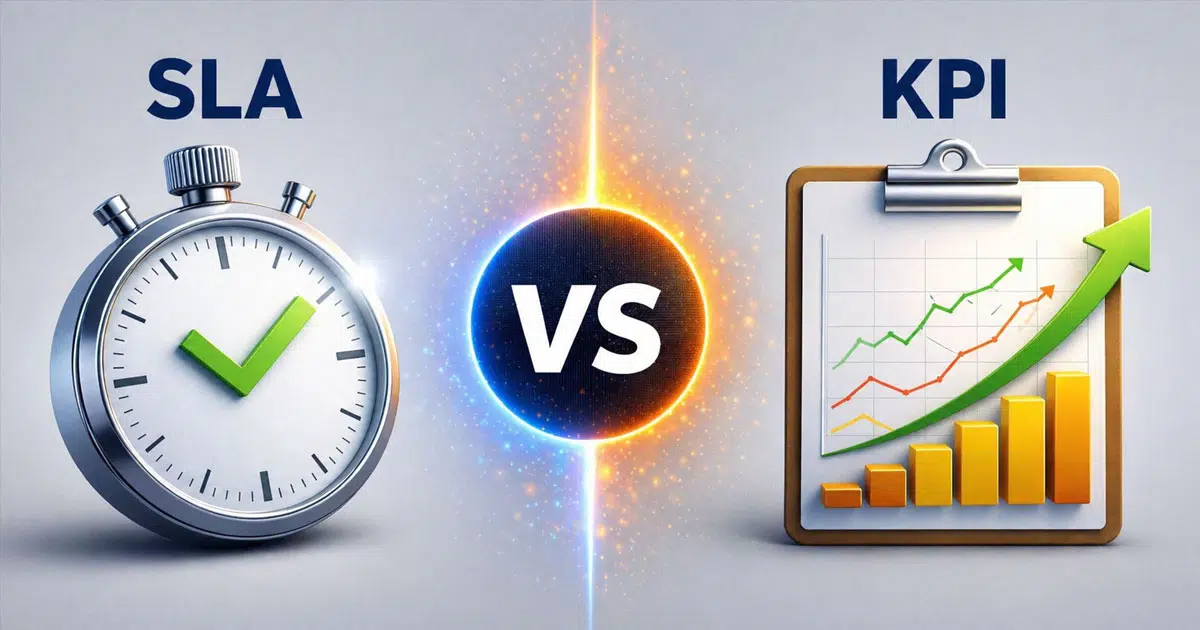
Choosing between SLA vs KPI often depends on how organizations measure business performance and align daily execution with strategic goals. A service level agreement defines clear service levels, contractual obligations, and expectations for consistent service delivery, especially in IT service delivery and service-based environments. In contrast, a key performance indicator focuses on performance metrics, evaluating KPIs, and tracking performance through internal metrics that guide decision-making and business decisions.
While SLAs ensure accountability and SLA performance against agreed standards, KPIs provide measurable value by identifying areas for specific performance improvements and optimizing workflows. Service management teams rely on service level metrics and specific metrics to track progress and improve service delivery. A strong strategic link between SLAs and KPIs helps support teams align performance targets with customer-based outcomes and overall business impact.
SLA Vs KPI: Key Differences
The main difference comes down to contractual commitments versus performance measurement. Understanding this distinction helps you build the right framework for your organization.
Aspect | Service Level Agreement (SLA) | Key Performance Indicator (KPI) |
|---|---|---|
Nature | Formal agreement with contractual obligations | Internal metrics for tracking performance |
Primary Focus | Service promises and external accountability | Internal performance tracking and continuous improvement |
Audience | Customers, clients, legal teams, external stakeholders | Management, teams, internal decision makers |
Consequences | Penalties, service credits, contract termination | Strategy adjustments, process improvements, coaching |
Measurement Type | Binary pass or fail against agreed thresholds | Trend analysis with leading and lagging indicators |
Flexibility | Rigid and requires formal negotiation to change | Adaptable as business priorities shift |
Timeframe | Fixed during contract period | Variable based on strategic objectives |
Accountability | Shared between service provider and client | Internal team responsibility |
SLA focuses on managing customer expectations and providing clear service expectations. When you miss an SLA target, there are real consequences. KPI focuses on operational efficiency and helps teams stay focused on business goals. Missing a KPI target prompts corrective action rather than penalties.
Purpose And Scope
Purpose shapes the entire approach to performance management. Your choice between SLAs and KPIs depends on who you are accountable to and what you are trying to achieve.
Purpose Aspect | SLA | KPI |
|---|---|---|
Why Implement | Assure clients of concrete commitments and legal clarity | Measure efficiency and strategic goal achievement |
Scope Breadth | Focused on service delivery promises | Covers sales, operations, quality, finance |
Stakeholders Addressed | Clients, legal, external auditing | Internal teams, leadership, operations |
Content Focus | Uptime, response times, resolution time | Efficiency ratios, customer satisfaction, process costs |
Service Level Agreements
A service level agreement establishes contractual service commitments between providers and clients. These agreements define baseline performance expectations that both the service provider and customer agree upon.
SLAs cover specific service delivery promises like system uptime, response times, and resolution targets, which are often formalized through ticket SLA management for faster support response. For example, a mobile service provider might commit to 99.9% network availability or promise to resolve service requests within four hours for critical issues.
The consequences matter here. SLAs include penalties for not meeting agreed service standards. This might mean service credits, discounts, or even contract termination. These formal agreements create accountability that protects both parties, especially when you follow a structured service level agreement helpdesk guide for support teams.
SLAs focus on external accountability and managing client expectations. They help service customers understand exactly what they will receive and what happens if standards fall short. In regulated industries like finance and healthcare, SLA compliance is not optional.
Key Performance Indicators
A key performance indicator KPI serves as an internal metric tracking progress toward business goals. KPIs measure operational efficiency, team performance, and strategic objectives without the weight of contractual obligations.
KPIs provide insights for decision making and process improvements. They might track first contact resolution rate, average resolution time, customer satisfaction scores, or desk metrics that reveal team productivity. These customer service KPIs for support teams help you identify areas for improvement before problems escalate.
The real power of KPIs lies in proactive performance management. While SLAs tell you if you passed or failed, KPIs show trends and patterns. They help you spot issues early, allocate resources effectively, and incentivize continuous improvements across your organization.
KPIs serve strategic objectives by connecting daily operations to business outcomes. They enable data driven decisions that improve service delivery over time.
Measurement Focus
The measurement approach impacts visibility and your ability to take action. How you measure performance determines what insights you gain and how quickly you can respond.
Measurement Aspect | SLA | KPI |
|---|---|---|
Measurement Type | Compliance versus standard | Trends and performance gradients |
Frequency | Tied to contract schedule | Continuous or periodic monitoring |
Indicators Used | Mostly lagging indicators | Mix of leading and lagging |
Visibility | Reported to external entities | Visible internally via dashboards |
SLA Measurement Approach
SLA measurement tracks compliance against specific contractual commitments. The focus is binary. Did you meet the service level or not? This straightforward approach makes SLA metrics easy to understand and communicate.
You measure customer facing service quality and delivery standards. This includes tracking incident management response times, system uptime percentages, and resolution time against agreed thresholds. Every measurement connects back to the SLA agreement you signed.
SLA reports go to external stakeholders for contract compliance verification. These reports need precise documentation because they have legal implications. You need robust monitoring systems that accurately capture when incidents start, when you respond, and when you resolve issues.
The limitation of SLA measurement is its backward looking nature. You know if you failed, but the damage is already done.
KPI Measurement Approach
KPI measurement monitors trends, patterns, and performance improvements over time. Instead of binary outcomes, you see gradients and trajectories that reveal the full picture of service performance.
Tracking KPIs means measuring both leading and lagging indicators for predictive analysis. Leading indicators like incident volume trends or early warning signals help you act before problems become SLA breaches. Lagging indicators like customer satisfaction confirm whether your efforts worked, especially when you use well-chosen customer support metrics and KPIs.
KPI dashboards give internal teams and management the visibility they need for decision making. You can slice data by team, geography, severity, or time period. This flexibility supports customer support productivity for high-performance teams and strategic planning and resource allocation in ways that SLA reports cannot.
The strength of KPI performance tracking is its ability to gauge performance continuously and assess performance against evolving business needs.
Stakeholders And Responsibility
Stakeholder involvement differs dramatically between these approaches. Understanding who participates and who is accountable shapes your implementation strategy.
Stakeholder Aspect | SLA | KPI |
|---|---|---|
Who Is Involved | Clients, vendors, legal, contract managers | Internal leaders, operations, teams |
Approval Process | Formal sign off with external parties | Internal alignment and consensus |
Reporting Requirements | External reports and compliance documentation | Internal dashboards and meetings |
Accountability Structure | Shared between provider and client | Internal team accountability |
SLA Stakeholder Management
SLA creation involves clients, service providers, and legal teams working together on agreement terms. This collaborative process requires formal approval and sign off from all contracting parties before commitments become binding.
External reporting and communication requirements come standard with SLAs. You must document performance, report breaches, handle escalations, and sometimes provide public disclosure. This creates administrative overhead but ensures transparency.
SLAs create shared accountability between provider and client organizations. The client has responsibilities too. They must report incidents properly, avoid misuse, and follow agreed procedures. This partnership approach works better than one sided obligations.
KPI Stakeholder Management
KPI stakeholder management engages internal teams, managers, and business leaders in metric selection. The focus stays on customer service roles and responsibilities within operational teams responsible for performance delivery rather than external parties.
One major advantage is flexible adjustment based on changing business priorities. When strategic goals shift, you can update KPIs without legal renegotiation. This adaptability helps organizations respond to market changes and evolving customer expectations.
KPIs drive internal accountability without external contractual pressure. Teams own their numbers and work to improve them because they see the connection to business value. This creates a culture of measurable outcomes rather than compliance checking.
Implementation Requirements
Resource and process requirements vary significantly between SLA and KPI implementations. Planning for these differences helps you avoid surprises.
Implementation Aspect | SLA | KPI |
|---|---|---|
Process Requirements | Legal review, negotiation, formal contracts | Data systems, analytics capabilities |
Monitoring Needs | Compliance tracking with precise logging | Dashboards and visualization platforms |
Documentation | Contract management and penalty frameworks | Strategy alignment documentation |
Review Cycles | Contract renewal periods | Ongoing performance improvement cycles |
SLA Implementation
Implementing SLAs requires formal contract negotiation and legal review processes. You cannot rush this phase. Vague definitions lead to disputes, and poorly structured penalties damage relationships.
You need robust monitoring systems to ensure compliance tracking. This means logging incidents precisely, defining severity levels consistently, and handling exceptions like maintenance windows. Many organizations use SLA management software or external monitoring services to verify their own measurements.
Penalty frameworks and escalation procedures must be clear from the start. What happens when you miss targets? Who gets notified? How quickly? These details prevent confusion when breaches occur and can be codified in a robust SLA management system.
Documentation and reporting systems for contract management create ongoing administrative work. But this discipline protects both parties and supports consistent service delivery.
KPI Implementation
KPI implementation requires data collection systems and analytics capabilities. You need reliable data sources, consistent definitions, and the technical infrastructure to capture performance information accurately, all of which should be embedded into your broader customer support team operations.
Dashboard tools and visualization platforms make KPIs actionable. Without good visualization, data sits unused. The best implementations connect KPI dashboards to regular review cycles where teams discuss results and plan improvements, often through an integrated customer service management system.
Establishing review cycles and performance improvement processes turns measurement into action. Weekly operational reviews, monthly strategic discussions, and quarterly planning sessions keep KPIs relevant and teams focused.
The critical success factor is alignment between metrics and business strategy. KPIs disconnected from strategic goals become vanity metrics that look good but mean nothing, so they should always support clear goals to improve customer service.
Business Impact Considerations
Business context often determines which approach works better. Your industry, client relationships, overall customer experience strategy, and organizational maturity all influence the right choice, especially in complex models like a SaaS customer experience strategy.
Business Factor | SLA Impact | KPI Impact |
|---|---|---|
Client Trust | Provides contractual assurance | Demonstrates improvement over time |
Legal Protection | Explicit through penalties | Minimal direct protection |
Operational Flexibility | Constrained by agreements | Highly adaptable |
Cost Implications | Breach penalties can be significant | Investment in analytics systems |
In internal operations, KPIs offer flexibility and continuous improvement focus. You can optimize workflows, track progress against strategic goals, and adapt quickly without renegotiating contracts, which is central to customer support productivity for high-performance teams.
Consider industry regulations, customer expectations, and competitive factors when choosing your approach. Financial services and healthcare often require strict SLA compliance. Technology companies may emphasize KPI driven innovation. Managed services providers typically need both.
The cost of failure differs, too. SLA breaches in data centers cost approximately $5,600 per minute, which is why many organizations rely on SLA tracking software to improve response time. KPI misses rarely have an immediate financial impact but accumulate into larger problems over time.
SLA Vs KPI: Which Should You Choose
Choose SLAs when you need formal service commitments, external accountability, and contractual protection. If your clients demand guarantees, if regulations require documented service standards, or if you are managing high-stakes service relationships, SLAs are essential.
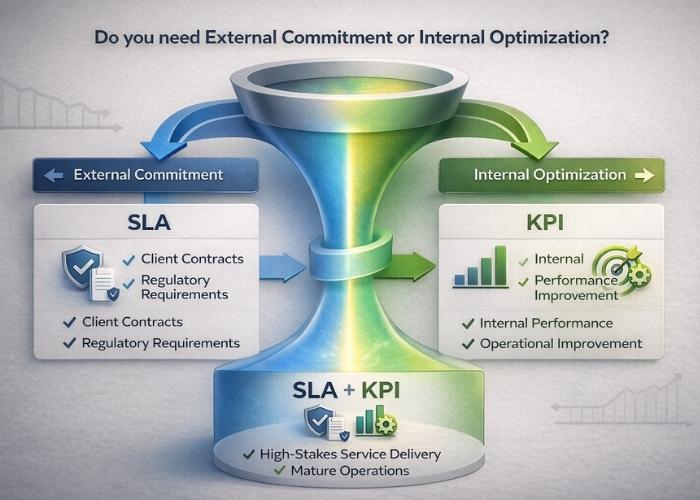
Choose KPIs when you want operational insights, performance improvement, and internal goal tracking. If your focus is optimizing internal operations, driving team performance, or building a culture of continuous improvement, KPIs provide the visibility you need.
Use both together when managing client services that require contractual commitments and internal optimization. Many successful organizations set SLA targets externally while tracking internal KPIs that exceed those thresholds. This creates a safety buffer and drives improvement beyond minimum requirements.
Consider your industry, client relationships, and organizational maturity when making the decision. Mature organizations often integrate both approaches. They use KPIs to ensure SLA compliance while building capabilities that exceed customer expectations and deliver lasting business impact.
FAQs
How Do SLA And KPI Differ In Measuring Performance?
SLAs measure performance against contractual thresholds with binary pass or fail outcomes. You either met your uptime commitment or you did not. KPIs measure performance trends over time, showing gradients and patterns. They track both leading indicators that predict future performance and lagging indicators that confirm results. SLA measurement serves external compliance reporting while KPI measurement supports internal decision making and process improvement, such as using automation to reduce customer support response time.
Which Between SLA And KPI Directly Impacts Customer Satisfaction?
Both impact customer satisfaction, but in different ways. SLA breaches directly damage customer experience through service failures. When your promised response time fails, customers feel it immediately. KPIs affect customer satisfaction indirectly by driving internal improvements. Better first contact resolution rate, faster average resolution time, and higher service quality scores all translate to happier customers. Organizations that track both typically achieve the strongest client satisfaction results.
When Should Businesses Prioritize KPI Over SLA?
Businesses should prioritize KPIs over SLAs when focused on internal operations, process improvement, or strategic transformation. If you are not in a client facing service role, KPIs provide more relevant insights. Startups and growing companies often benefit from KPI flexibility before formalizing SLA commitments. Organizations undergoing significant change need KPI adaptability rather than rigid contractual constraints. However, once you serve external clients with formal contracts, SLAs become necessary regardless of internal KPI maturity.
Can SLA And KPI Work Together In A Performance Strategy?
SLAs and KPIs work together effectively in most performance strategies. Set SLAs to define minimum acceptable service levels for clients. Use KPIs internally to track performance above those minimums. When your internal KPI targets exceed SLA thresholds, you create safety margins that prevent breaches. KPIs also help investigate root causes when SLA issues occur. The combination provides external accountability through SLAs and internal optimization through KPIs, delivering better outcomes than either approach alone.
What Mistakes Reduce The Effectiveness Of SLA And KPI?
Common SLA mistakes include vague definitions that cause disputes, unrealistic targets that guarantee failure, and overly punitive penalties that damage relationships. Common KPI mistakes include tracking too many metrics that dilute focus, selecting vanity metrics unconnected to business goals, and setting targets without proper baseline performance data. Both approaches fail when organizations lack proper monitoring systems, skip regular reviews, or fail to act on the insights generated. Alignment with actual business outcomes matters more than the number of metrics tracked.