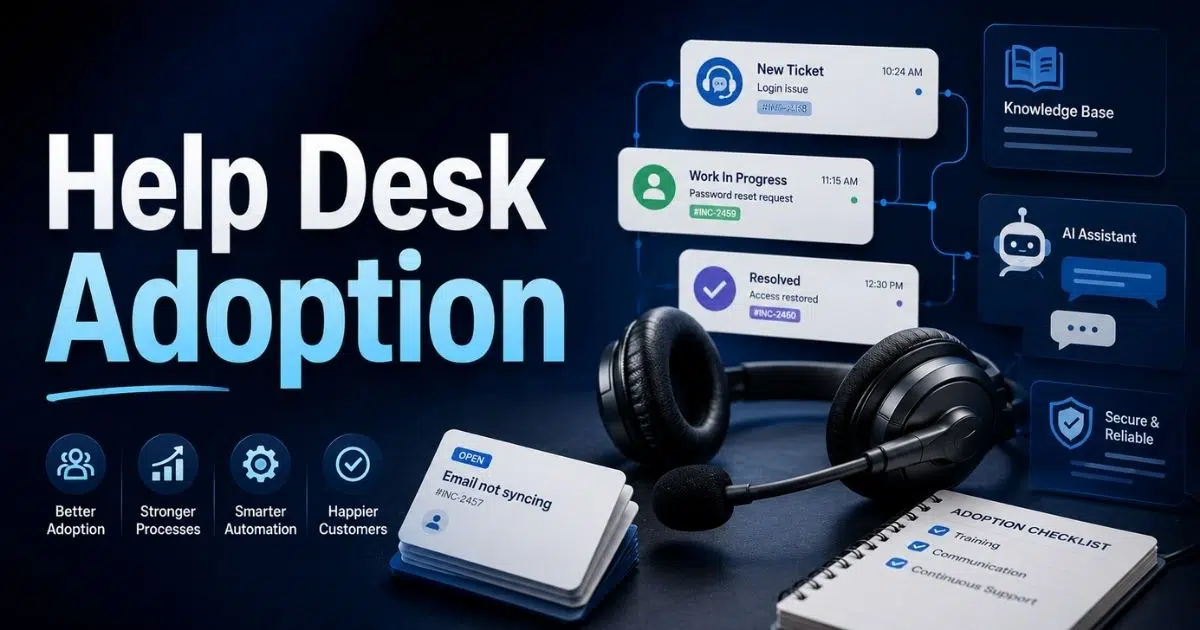
Customer expectations keep rising. People want fast replies, smooth communication, and support that actually solves problems. But many companies still struggle to get teams fully comfortable with their help desk software. Tickets stay unmanaged, workflows break, and employees return to old habits like spreadsheets or email chains. Poor help desk adoption creates delays, confusion, and frustrated customers that better workflow automation in customer support is designed to prevent.
Strong help desk adoption changes everything. Support teams work faster, managers gain better visibility, and customers receive consistent service across every channel. Modern businesses now focus on easy onboarding, automation, AI support, and employee experience to improve software adoption across teams.
This guide covers everything you need to know about help desk adoption, from common challenges to proven strategies, metrics, mistakes, and future trends shaping customer support in 2026, especially for teams selecting the best IT help desk software for modern teams.
What Help Desk Adoption Really Means For Modern Support Teams
Help desk adoption means more than installing a new help desk software platform. It means support teams, service desk agents, and end users actually use the system every day. Many organizations invest in AI tools, self-service portals, and virtual agents, but organizations struggle when employees return to legacy systems or old support processes. Strong user adoption happens when tools solve real pain points, match business needs, and offer user-friendly interfaces. Good training, change management, and ongoing support also play a big role.
Modern help desk adoption now connects closely with AI adoption and service management. Companies use artificial intelligence, machine learning, and AI capabilities to reduce ticket volume, improve response times, and increase customer satisfaction. AI technologies help human agents handle complex issues faster while knowledge bases and self-service options support customers around the clock. Businesses also focus on data security, data quality, AI governance, and necessary skills before implementing AI initiatives. Organizations that stay focused on continuous improvement gain valuable insights, cost savings, better decision-making, and long-term success.
Key Challenges That Slow Down Help Desk Adoption In Companies
Many organizations invest heavily in service desk systems and AI tools but still fail to achieve strong help desk adoption. Employees resist change, support teams face workflow confusion, and legacy systems create friction. Without proper training, buy-in, and ongoing support, even advanced solutions struggle to deliver long-term value.
Poor Employee Buy-In
Employees often resist new service desk systems when they do not understand the benefits. Many organizations introduce ai technologies without clear communication. Teams worry about job displacement, extra work, or losing control over support tasks. That fear slows user adoption and creates frustration across departments.
Research shows 70% to 80% of AI initiatives fail because of weak change management and low employee engagement. Only 13% of workers have received proper AI training. Strong adoption starts when organizations explain business needs, provide assistance, and connect new tools with daily workflows.
Complex And Outdated Systems
Legacy systems create major barriers for help desk adoption. Old service management platforms often lack user-friendly interfaces and modern AI capabilities. Employees waste time switching between disconnected tools, knowledge bases, and support systems. That hurts efficiency and increases response times.
Many support teams still rely on outdated processes because new platforms feel too complex. Research also shows poor data quality and outdated infrastructure cause nearly 70% of failed AI projects. Companies need simple solutions that match organizational goals and reduce pain points for end users and service desk agents.
Weak Training And Support
Training remains one of the biggest adoption gaps in modern organizations. Employees cannot use new features properly when companies rush implementation. Many users receive little guidance after deployment. That creates confusion and reduces confidence in new technology.
Studies show only 38% of companies currently offer AI-related training programs. Support teams need continuous learning, practical examples, and real assistance during the adoption process. Good training helps human agents identify problems faster, improve decision-making, and handle complex issues with more confidence. Ongoing support also helps organizations stay focused on continuous improvement instead of returning to the status quo.
Data Security And Trust Concerns
Data security concerns slow down AI adoption in many industries. Employees worry about sensitive data exposure, weak AI governance, and system reliability. Customers also expect secure access to their information across every support channel.
Recent studies show organizations still struggle with verification, privacy, and confidentiality in AI systems. Trust becomes essential when businesses implement artificial intelligence inside service desk operations. Clear policies, better practices, and transparent communication help employees feel safer while adopting AI tools and virtual agents for customer support.
Lack Of Clear Success Metrics
Many companies fail to define key metrics before implementation. Teams cannot measure value when goals stay unclear. That makes it harder to prove cost savings, customer satisfaction improvements, or service efficiency gains.
Successful organizations track ticket volume, response times, self-service usage, and customer feedback from the start. AI-powered support systems can reduce routine support tasks and improve productivity when businesses monitor performance consistently. Research shows 77% of support teams say AI meets or exceeds expectations when companies align adoption with measurable organizational goals.
Steps To Build A Successful Help Desk Adoption Strategy
A successful help desk adoption strategy needs more than new technology. Employees need clear direction, proper training, and simple workflows. Companies that align AI tools, service management goals, and user needs usually achieve better customer satisfaction, faster response times, and long-term adoption success by investing in the right helpdesk setup to boost customer support.
Define Clear Business Goals
Every successful adoption plan starts with clear organizational goals. Companies need to identify pain points before they implement new service desk systems or AI capabilities. Some businesses focus on reducing ticket volume. Others want better customer support, faster response times, or stronger self-service options. Clear goals help teams stay focused and measure real value, especially in choosing helpdesk software for small growing businesses.
Research shows 95% of organizations still struggle to measure ROI from AI adoption because goals remain unclear. Businesses should connect help desk adoption with customer satisfaction, operational efficiency, and long-term service improvement from the start.
Choose User-Friendly Tools
Complicated systems slow user adoption fast. Employees avoid tools that create extra support tasks or confusing workflows. Modern service desk platforms need user-friendly interfaces, simple navigation, and easy access to knowledge bases and support resources.
AI tools also need practical value for support teams and end users. Research shows 84% of professionals see productivity benefits from AI when systems match daily work needs. Businesses should test solutions carefully before deployment. A simple service management platform often creates better adoption than feature-heavy systems employees rarely use, especially when combined with dedicated ticket automation software for modern support teams.
Train Teams The Right Way
Training plays a major role in help desk adoption success. Employees need practical examples, hands-on assistance, and enough time to build confidence with AI technologies and service systems. Quick onboarding sessions rarely solve real adoption challenges.
Recent reports show only 13% of employees have received formal AI training, even though 77% of employers plan AI reskilling programs. Support teams perform better when companies create ongoing learning programs instead of one-time training sessions. Strong training also helps service desk agents handle complex issues and improve decision-making.
Build Trust Around AI
Many organizations struggle with AI adoption because employees fear job displacement, data security risks, or unreliable automation. Human agents often worry that artificial intelligence will replace their role completely. That concern affects buy-in and slows adoption across support teams.
Companies need clear AI governance, transparent communication, and realistic expectations. Research shows 54% of professionals remain concerned about AI data privacy and security. Businesses should explain how AI tools support employees instead of replacing them. Virtual agents and machine learning systems work best when human support stays part of the process.
Track Performance And Improve
Successful help desk adoption requires continuous improvement. Companies should monitor key metrics like response times, self-service usage, customer satisfaction, and ticket resolution rates. Without performance tracking, teams cannot identify weak areas or improve service quality.
Modern organizations also collect valuable insights from employees and customers regularly. Feedback helps businesses adjust workflows, improve processes, and introduce new features that match real business needs. Studies show companies with structured AI adoption plans achieve faster productivity growth and better long-term efficiency.
Employee Training Methods That Improve Help Desk Adoption Rates
Strong training helps employees feel comfortable with new service desk systems and AI tools. Many organizations focus too much on software setup and ignore user adoption. Clear guidance, practical support, and continuous learning help support teams improve efficiency, customer satisfaction, and long-term adoption success.
Hands-On Practice Sessions
Employees learn faster when they use the system in real situations. Long presentations and technical manuals rarely improve help desk adoption. Support teams need practical exercises that match daily support tasks, ticket management, and customer service workflows.
Research shows employees who receive at least five hours of AI training report higher confidence and regular tool usage. Practice sessions also help service desk agents understand AI capabilities, self-service tools, and virtual agents without feeling overwhelmed. Real examples create stronger user adoption than theory-based training.
Role-Based Training Programs
Different employees use service desk systems in different ways. Support agents, managers, HR teams, and end users all have unique business needs. Generic training often creates confusion because it ignores real workflows and department-specific pain points.
Companies achieve better adoption when training matches job roles and daily responsibilities. Research from Microsoft Copilot studies shows employees respond better to context-sensitive learning and role-specific guidance. Role-based training also improves decision-making, response times, and confidence with AI technologies across support teams.
Peer Learning And Team Support
Employees often trust coworkers more than formal trainers. Peer learning creates a comfortable environment where users can ask questions, share solutions, and discuss concerns openly. That support helps employees adapt faster to new technology and service management processes.
Research shows many employees prefer social learning and trial-and-error methods instead of formal onboarding videos. Team collaboration also helps organizations identify gaps in workflows, knowledge bases, and support systems early. Strong internal support encourages employees to stay focused on continuous improvement instead of returning to legacy systems.
Short And Continuous Learning
One-time training sessions rarely create long-term help desk adoption. Employees forget information quickly when companies stop support after implementation. Short lessons, quick updates, and ongoing assistance work better for modern support teams.
Recent workplace studies show only 12.5% of employees receive comprehensive AI training from their organizations. Businesses that provide continuous learning programs usually see better AI adoption, higher efficiency, and fewer support errors. Small learning sessions also help employees adapt to new features without disrupting daily service operations.
Clear AI And Security Guidance
Employees often hesitate to use AI tools because of data security concerns. Many users worry about sensitive data exposure, AI governance, and job displacement. That fear slows adoption and reduces trust in new systems.
Clear policies help employees understand how artificial intelligence supports human agents instead of replacing them. Research shows only 20% of workers feel fully prepared to implement AI effectively in the workplace. Organizations should explain acceptable practices, customer data protection rules, and safe AI usage during every training program.
Help Desk Adoption Best Practices For Remote And Hybrid Teams
Remote and hybrid work models changed how support teams communicate, solve issues, and manage service requests. Employees now depend heavily on digital tools, AI support, and self-service systems. Strong help desk adoption helps organizations maintain service quality, improve response times, and support employees across different locations.
Simple Access Across Devices
Remote employees need fast and secure access to service desk systems from anywhere. Complicated login steps and slow platforms reduce user adoption quickly. Support teams work better when tools function smoothly across laptops, tablets, and mobile devices.
Research shows over 70% of employees now expect flexible digital work environments with reliable remote access. Cloud-based service management systems help organizations create better workflows, stronger customer support, and faster issue resolution. Easy access also improves efficiency for service desk agents and end users.
Clear Communication Standards
Remote teams often struggle with communication gaps. Employees miss updates, misunderstand support processes, or use different service channels incorrectly. That confusion increases ticket volume and slows response times.
Clear communication rules help support teams stay aligned. Businesses should define support workflows, escalation paths, and response expectations from the start. Studies show poor workplace communication costs businesses billions in lost productivity every year. Shared knowledge bases, AI tools, and regular updates improve consistency across remote and hybrid environments.
Self-Service And AI Support
Remote employees prefer fast solutions without waiting for human agents. Self-service portals, virtual agents, and AI capabilities help users solve common issues independently. That reduces support pressure and improves customer satisfaction by delivering effective self-service customer support experiences.
Recent reports show AI-powered support systems can resolve up to 80% of routine service requests automatically. (g2.com) Organizations that implement AI technologies correctly usually see lower ticket volume and faster support delivery. Strong self-service systems also give employees better access to knowledge and support resources anytime.
Regular Training And Feedback
Remote environments make training more difficult. Employees often miss updates about new features, support practices, or system changes. Weak communication reduces confidence and slows help desk adoption over time.
Organizations should provide short training sessions, live assistance, and regular feedback opportunities. Research shows employees perform better when companies offer continuous learning instead of one-time onboarding programs. Feedback also helps businesses identify pain points, improve service processes, and strengthen user adoption across distributed support teams.
Strong Security And Governance
Data security remains a major concern for remote support operations. Employees often access systems from personal devices and different networks. Weak security practices increase risks around sensitive data, customer information, and internal systems.
Businesses need clear AI governance, secure authentication, and strong access controls for remote service management. Studies show human error still causes most cybersecurity incidents in organizations worldwide. Security training, role-based access, and transparent policies help employees trust AI tools and remote support systems more confidently.
Metrics And KPIs That Measure Help Desk Adoption Success
Help desk adoption becomes easier to measure when businesses track the right KPIs. Clear metrics help organizations identify weak areas, improve support processes, and increase user adoption. Strong measurement also helps teams prove the value of AI tools, service management systems, and ticketing software built for better customer support.
User Adoption Rate
User adoption rate shows how many employees actively use the service desk platform. This metric helps organizations understand whether support teams and end users accept the system or avoid it. Low adoption often points to poor training, weak communication, or difficult workflows.
Research shows nearly 70% of digital transformation projects fail because of low employee adoption and resistance to change. Businesses should track login frequency, feature usage, and self-service activity regularly. Strong adoption rates usually reflect better user experience and smoother support operations.
Ticket Resolution Speed
Response times and resolution speed directly affect customer satisfaction. Slow ticket handling often signals workflow problems, poor knowledge access, or overloaded support teams. Businesses need to monitor how quickly service desk agents solve support tasks across different channels.
Studies show 88% of customers expect faster responses as customer service standards continue to rise. AI capabilities, virtual agents, and machine learning tools help reduce ticket volume and improve service efficiency. Faster resolution times also increase trust in help desk systems and support processes.
Self-Service Usage
Self-service adoption reflects how comfortable employees feel solving issues independently. Knowledge bases, AI tools, and automated support systems reduce pressure on human agents when employees actually use them. Low self-service usage usually means users cannot find answers easily.
Recent reports show 61% of customers prefer self-service options for simple support issues. Businesses should monitor search activity, article views, and portal engagement regularly. Strong self-service usage improves efficiency, lowers support costs, and creates better customer experiences across remote and hybrid teams.
Customer Satisfaction Scores
Customer satisfaction remains one of the clearest indicators of help desk adoption success. Better workflows, faster support, and effective AI technologies usually improve customer experiences over time. Poor service quality often points to adoption gaps or inconsistent support practices.
Organizations commonly track CSAT scores, Net Promoter Scores, and customer feedback surveys to measure service quality. Research shows 73% of customers switch brands after multiple poor support experiences. Strong service management systems help support teams maintain consistent communication and improve long term customer trust.
Employee Productivity Growth
Employee productivity shows whether new systems actually improve daily work. Support teams should complete support tasks faster without increasing stress or confusion. Businesses also need to monitor workflow efficiency after implementing AI initiatives and new service tools.
Studies show employees can save up to 2.5 hours daily through effective AI adoption and automation support. Companies should track task completion rates, ticket handling capacity, and collaboration efficiency regularly. Productivity growth often proves the real value of help desk adoption across the organization, especially when teams actively reduce average resolution time in customer support.
Common Mistakes Businesses Make During Help Desk Adoption
Many businesses invest in modern service desk systems but fail to achieve strong adoption across teams. Poor planning, weak communication, and rushed implementation often create frustration for employees and customers. Small mistakes during adoption can reduce efficiency, increase ticket volume, and slow long-term success, even though a well-designed help desk improves support behind the scenes.
Lack Of Clear Adoption Goals
Many organizations start help desk adoption without clear business goals. Teams focus too much on software installation and ignore user adoption, customer satisfaction, and workflow improvements. That creates confusion across support teams and service desk agents.
Research shows nearly 70% of digital transformation projects fail because organizations lack defined goals and adoption strategies. Businesses should identify pain points, expected outcomes, and key metrics before implementation. Clear goals help teams measure value, improve decision-making, and align support processes with organizational needs.
Poor Employee Communication
Employees resist new tools when leadership fails to explain the benefits clearly. Many workers fear job displacement, complex workflows, or extra support tasks after AI adoption. That concern slows buy-in and creates negative attitudes toward new systems.
Strong communication helps employees understand how AI tools and service management systems improve daily work. Research from Grammarly shows poor communication reduces workplace productivity significantly across remote and hybrid teams. Companies should explain new features, support processes, and AI capabilities early to build trust and confidence.
Weak Training Programs
Many organizations rush implementation without proper employee training. Users receive short onboarding sessions but little ongoing support after launch. That creates confusion and lowers confidence in service desk systems and AI technologies.
Research shows employees with formal AI training adopt workplace tools faster and report higher productivity levels. Businesses need role-based learning, practical examples, and continuous assistance to improve help desk adoption. Strong training also helps human agents solve complex issues more efficiently.
Complex And Cluttered Systems
Overloaded platforms create major adoption problems. Employees avoid service desk tools that feel difficult, slow, or filled with unnecessary features. Complicated interfaces increase response times and reduce workflow efficiency for support teams, especially when they rely on manual vs automated ticketing approaches.
Simple and user-friendly interfaces improve user adoption much faster than feature-heavy systems. Studies show employees prefer tools that reduce manual work and provide easy access to knowledge bases and support resources. Businesses should focus on practical solutions instead of adding too many unnecessary functions.
Ignoring Feedback And Metrics
Some companies stop optimization efforts after deployment. They fail to collect employee feedback, track customer satisfaction, or monitor key metrics. That mistake prevents organizations from identifying adoption gaps and service issues early.
Successful businesses use continuous improvement strategies to strengthen adoption over time. Metrics like ticket volume, self-service usage, response times, and employee engagement reveal valuable insights about system performance. Research also shows that organizations that monitor adoption data regularly achieve better long-term efficiency and customer support outcomes.
Future Trends That Will Shape Help Desk Adoption
Help desk adoption will change rapidly over the next few years as AI technologies become more advanced and customer expectations continue to rise. Businesses now focus on smarter automation, stronger data security, faster support experiences, and better human-AI collaboration across modern service management systems.
AI Agents Will Handle More Support Tasks
AI agents and virtual agents will take over more routine support tasks in the future. Modern AI tools already manage ticket routing, self-service responses, and customer assistance across multiple channels. Businesses want faster support without increasing support team workloads.
Research shows AI could handle nearly 68% of customer service interactions by 2028 through advanced agentic AI systems. Human agents will still manage complex issues and sensitive situations. Companies that balance automation with human support will likely achieve better customer satisfaction and stronger help desk adoption.
Hyper Personalized Support Experiences
Customers no longer accept generic support experiences. Future service desk systems will use machine learning, customer data, and AI capabilities to create more personalized interactions. AI technologies will identify customer preferences, behavior patterns, and past support history automatically.
Studies show personalization can increase business revenue by up to 15% while improving customer loyalty significantly. Personalized support also helps service desk agents respond faster and make better decisions. Businesses that implement personalized service experiences will likely see stronger adoption from both employees and customers.
Stronger AI Governance And Security
AI adoption continues to grow, but businesses also face rising concerns around data security, compliance, and governance. Organizations now realize that weak AI governance creates serious risks for sensitive data and customer trust.
Recent reports show 74% of businesses rolled back at least one AI customer service tool because of governance and security concerns. Future help desk adoption strategies will focus heavily on transparency, auditability, and secure AI practices. Strong governance frameworks will become essential for successful service management and long-term AI adoption.
Voice And Omnichannel Support Growth
Future support systems will connect voice, chat, email, social media, and self-service platforms into one seamless experience. Customers expect support teams to continue conversations smoothly across every channel without repeating information.
Voice-powered support and omnichannel service models already shape customer service trends in 2026. Businesses that unify customer data and support workflows will improve response times and reduce frustration. Better omnichannel experiences also create easier access for remote teams and end users.
Human And AI Collaboration
Future workplaces will depend more on collaboration between human agents and artificial intelligence. AI tools will support employees with decision-making, knowledge access, and workflow automation instead of replacing jobs completely.
Research shows over 80% of organizations plan to expand human agent responsibilities as AI adoption grows. Successful organizations will focus on training employees to work alongside AI systems effectively. Businesses that combine human expertise with AI efficiency will create stronger support experiences and better long-term adoption outcomes.
How EasyDesk Supports Faster Help Desk Adoption
EasyDesk helps businesses improve help desk adoption with a simple and user-friendly helpdesk ticketing software platform. Support teams can manage tickets, automate workflows, and track customer requests from one place without dealing with complex systems, gaining all the core benefits of using a ticketing system. The clean interface reduces confusion and helps employees adapt faster across remote, hybrid, and in-office environments while maintaining secure, transparent customer support.
EasyDesk also supports AI-powered automation, self-service portals, knowledge bases, and smart ticket routing to reduce ticket volume and improve response times, positioning it as one of the best ticket management systems for growing teams. Service desk agents gain faster access to customer data, support history, and internal knowledge, which improves decision-making and customer satisfaction when they use a comprehensive customer support platform like EasyDesk.
Businesses can also track key metrics, monitor team performance, and identify adoption gaps through built-in reporting tools. EasyDesk helps organizations create smoother support processes, better employee experiences, and stronger long term help desk adoption across every department.
FAQs
Can Small Businesses Improve Help Desk Adoption Without Large IT Teams?
Yes. Small businesses can improve help desk adoption by using user-friendly service desk tools, self-service portals, and simple support workflows. Proper training, AI tools, and ongoing assistance also help employees adapt faster without needing large support teams.
Does AI Replace Human Agents In Modern Service Desks?
No. AI technologies support human agents instead of replacing them completely. AI capabilities help automate repetitive support tasks, reduce ticket volume, and improve response times, while human agents still manage complex issues and sensitive customer interactions.
Why Do Employees Resist Help Desk Adoption?
Employees often resist adoption because of poor training, unclear communication, and concerns about job displacement or complex systems. Many organizations also fail to explain the value, benefits, and business goals behind new service management tools and AI initiatives.
Can Self-Service Portals Increase Customer Satisfaction?
Yes. Self-service systems help customers access knowledge bases, solutions, and support resources quickly without waiting for service desk agents. Faster access to information improves customer satisfaction and reduces pressure on support teams at the same time when powered by a strong knowledge base and canned responses for faster support.
What Role Does Data Quality Play In Help Desk Adoption?
Data quality affects AI adoption, decision-making, and service efficiency. Poor customer data, outdated knowledge, and disconnected systems create workflow problems and reduce trust in AI tools, service management platforms, and automated support processes.