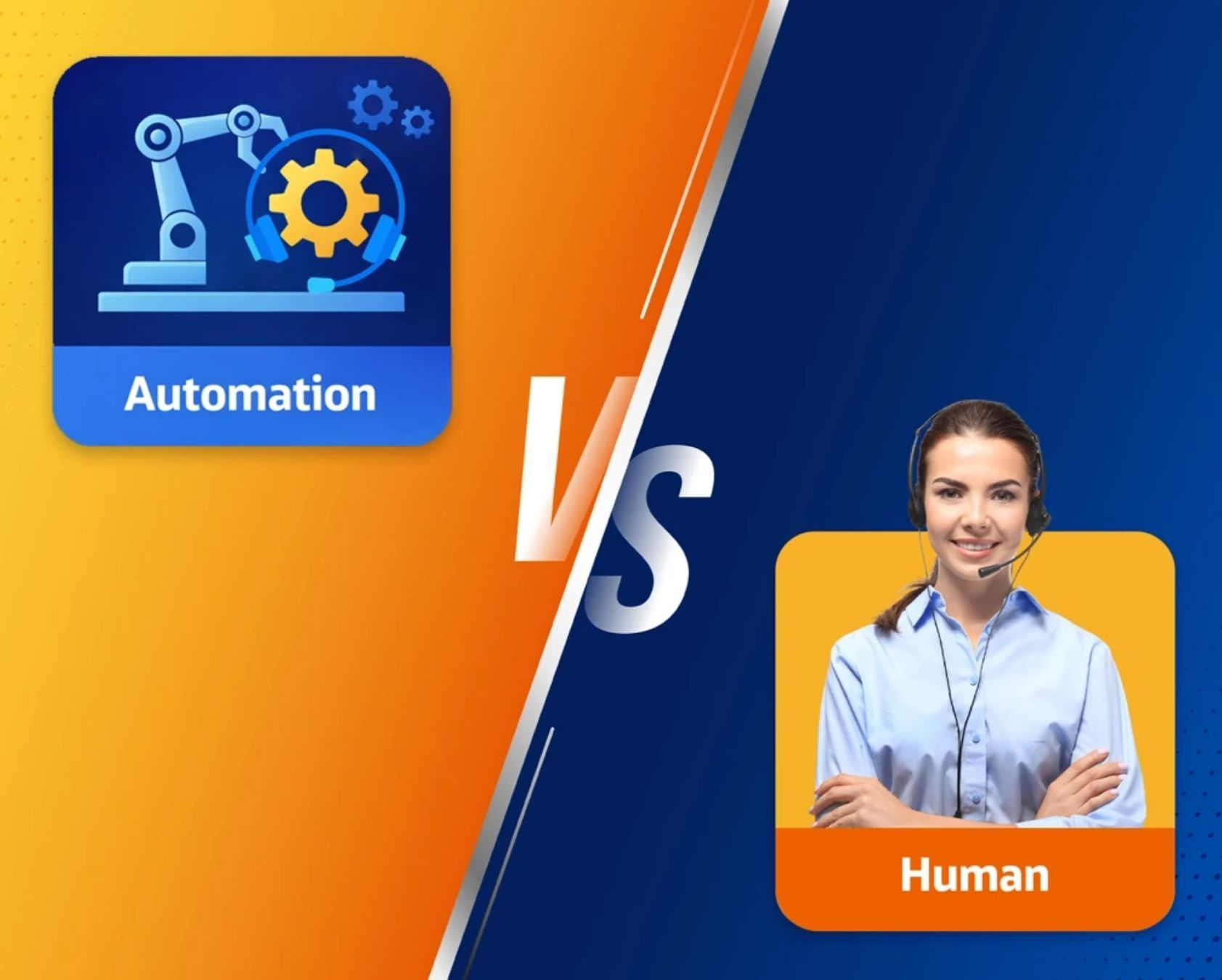
Choosing between automation and human customer service affects response times, costs, customer satisfaction and the relationships you build with your customers over time. The right approach depends on what your business needs, what your customers expect, and how complex their problems tend to be.
Modern customer service leaders face pressure from all directions. They need to respond faster, handle more volume and cut operational costs. But they also need to maintain those personal connections that keep customers coming back. Both automation and human support bring something valuable to the table. AI tools can deliver instant answers around the clock. Human agents offer emotional intelligence and nuanced understanding that technology simply cannot replicate. The challenge is finding the right balance between efficiency and genuine human touch.
Automation Vs Human Customer Service: Key Differences
The fundamental difference lies in how each approach handles customer interactions and solves problems. Automation relies on rules, scripts, and artificial intelligence to process customer messages. Human customer service depends on judgment, empathy, and critical thinking to navigate conversations. Both have their place, but understanding their strengths and weaknesses helps you make smarter decisions.
| Aspect | Automation | Human Customer Service |
|---|---|---|
| Response Speed | Instant replies under seconds | Slower, usually minutes or more |
| Availability | 24/7 support without limits | Limited to business hours or shifts |
| Cost Per Interaction | Low cost around $0.50–$0.70 | Higher cost around $6–$8 |
| Scalability | Handles high volume easily | Needs hiring and training to scale |
| Handling Complex Issues | Struggles with complex or unclear problems | Strong in problem solving and critical thinking |
| Emotional Intelligence | Limited understanding of emotions | High empathy and emotional intelligence |
| Consistency | Consistent responses every time | Varies by agent and situation |
| Accuracy | Depends on data and training quality | Can adapt and verify in real time |
| Customer Preference | Lower for complex interactions | Preferred by majority of customers |
| Relationship Building | Weak for long-term engagement | Strong for trust and loyalty |
| Use Case Fit | Best for repetitive tasks and FAQs | Best for complex and sensitive issues |
| Setup Effort | High initial setup and training required | Faster to deploy with trained agents |
Response Speed And Availability
Automation delivers rapid responses that human teams cannot match for routine inquiries. Chatbots respond in under two seconds. Human agents typically take two to five minutes or longer for initial responses. That gap matters when customers want quick answers about order status or basic troubleshooting.
Automation also provides 24/7 availability without overtime costs or shift scheduling headaches. Your customers can get help at 3 AM without waiting for business hours to resume. For global companies serving multiple time zones, this coverage becomes essential.
But speed is not everything. When customers face complex billing disputes or frustrating technical problems, they often prefer waiting a few extra minutes for a real person who actually understands their situation. The willingness to wait depends heavily on what kind of help they need.
Cost Efficiency And Scalability
The numbers tell a clear story about operational costs. Automated chatbots cost roughly $0.50 to $0.70 per interaction. Human agents cost $6 to $8 per interaction in many settings. That difference adds up quickly when you handle thousands of customer interactions monthly.
Scalability is where automation really shines. During holiday rushes or product launches, smarter helpdesk setups and automated systems handle volume spikes without hiring temp staff or burning out your existing team. You do not need to worry about training, overtime or benefits for additional capacity.
However, building quality automation requires significant upfront investment. You need solid training data, ongoing maintenance and regular updates to keep your knowledge base accurate. Human agents bring their own costs through salaries and training, but they adapt to new situations without requiring months of development work. Companies report 3.5x return on automation investment in the first year, but only when implementation is done right.
Handling Complex Issues
Automation struggles when problems get complicated. Bots follow decision trees and scripts. When customer messages fall outside those predetermined paths, responses become unhelpful or outright wrong. Edge cases, ambiguous descriptions and multi-layered problems trip up even sophisticated AI agent systems.
Human agents excel at asking clarifying questions. They interpret context clues that automation misses entirely. When a customer describes symptoms rather than specific error codes, humans piece together what is actually happening. They can dig into backend systems, consult colleagues and find creative solutions.
Consider technical support scenarios. A customer calls about slow software performance. The real issue might be a compatibility conflict, a corrupted file or a hardware limitation. Human reps explore possibilities. Automation often gets stuck in loops or escalates without resolution.
Emotional Intelligence And Empathy
Human emotions are messy. Frustration, anger, confusion and anxiety all show up in customer care interactions. Human agents read these emotional signals and adjust their approach accordingly. They offer empathetic support that calms upset customers and rebuilds customer trust.
Current automation technology detects sentiment to some degree. But it lacks the nuanced understanding needed for truly sensitive conversations. When a customer starts expressing frustration, bots often miss the cues entirely or respond in ways that feel tone-deaf.
This emotional connection matters enormously for relationship building. Complaint resolution, apology situations and retention conversations all require genuine personal interaction. Customers remember how you made them feel. A fast but robotic response during a stressful moment leaves a negative impression that lingers.
Consistency And Accuracy
Automation delivers identical responses every time. No bad days. No forgotten details. No variation based on who happens to answer. For routine tasks where accurate responses matter, this consistency becomes a real advantage.
Human agents bring variability. Knowledge gaps, communication styles, mood and workload all affect service quality. Training helps, but you cannot eliminate human variation entirely. Quality control requires ongoing effort and monitoring.
But accuracy cuts both ways. Automation is only as good as its data quality and programming. Poorly trained bots give confidently wrong answers. Human agents make mistakes too, but they recognize when something seems off and seek clarification. They know when to escalate rather than guess.
Customer Satisfaction Impact
Research consistently shows that customers prefer human support for most interactions. A recent study found that 84.7% of consumers would rather speak with a human agent even when assured the AI could resolve their issue. Another survey showed 79% of Americans prefer human interaction for customer service.
Demographic differences matter here. Younger customers show more comfort with automation for simple tasks. Older customers tend to prefer human touch regardless of query complexity. Industry context matters too. Retail and telecom customers often express frustration when automation fails them repeatedly.
Self-service automation resolves issues without human intervention only about 14-25% of the time in many contexts. The rest require escalation. Using a modern ticketing system helps ensure customer satisfaction depends not just on resolution, but on how smooth and frustrating-free the journey feels.
When To Choose Automation Over Human Support
Automation delivers the most value when speed, scale, and consistency outweigh the need for human judgment. Choosing the right scenarios ensures efficiency without compromising customer experience or service quality.
Best Fit For Routine Tasks
Automation works best for routine inquiries where speed and consistency matter more than personal connections. Password resets, order status checks, shipping updates, and basic account information requests all fit this profile. These repetitive tasks consume human agent time without requiring problem-solving skills or emotional intelligence.
Automating such interactions reduces workload significantly. Studies show that up to 60% of support tickets fall into repetitive categories. Handling these through automation improves response time and allows support teams to focus on complex customer issues that require deeper understanding.
Ideal For High Volume Support
High-volume support operations benefit most from automation efficiency compared to manual ticketing. When businesses receive thousands of similar questions daily, manual handling becomes inefficient and costly. Automation ensures consistent responses without delays or variability in quality.
E-commerce platforms and SaaS companies often rely on automation to manage scale. Automated systems can process large volumes instantly, reducing queue times and improving customer satisfaction. This approach also helps maintain service quality during peak demand periods.
Strong For After Hours Support
After-hours coverage represents another strong automation use case. Customers expect immediate assistance regardless of time zones or business hours. Automated email-to-ticket systems and other automation provide continuous availability without requiring round-the-clock staffing.
Businesses with global audiences benefit greatly from this capability. Automated responses ensure that customers receive instant acknowledgment and basic solutions, which improves experience and reduces frustration caused by delayed responses.
Works With Clear Boundaries
Successful implementations depend on clearly defined scope. Automation should handle well-structured queries while complex issues route to human agents. Without clear boundaries, automation can create confusion and poor customer experiences.
A hybrid model works best where automation manages initial interactions and escalates when needed. Clear routing rules and ticket automation workflows ensure that customers receive appropriate support without unnecessary delays or repeated interactions.
Start Small And Scale Gradually
Effective automation strategies begin with limited use cases such as FAQs and simple transactional queries. Gradual expansion allows teams to test performance, identify gaps, and refine workflows before scaling further.
Continuous monitoring ensures that automation improves efficiency without harming customer satisfaction. Businesses that take a phased approach often achieve better results, balancing automation benefits with human support quality.
When Human Agents Outperform Automation
Human support becomes essential when context, empathy, and judgment matter more than speed. In these moments, real conversations drive better outcomes than scripted or automated responses.
Complex Issues Need Judgment
Complex issues demand human judgment that automation cannot replicate. Billing disputes requiring investigation, technical troubleshooting beyond basic scripts, and product customization requests all need real people with critical thinking abilities. When customers face complex problems, they need someone who can actually solve them.
Automation often struggles with edge cases and multi-step reasoning. Human agents can connect information across systems, ask clarifying questions, and adapt solutions in real time. This flexibility ensures accurate resolution and reduces repeated contacts.
Emotional Situations Need Empathy
Emotionally charged situations require empathetic support. Angry customers need to feel heard. Frustrated customers need patience and understanding. Human agents provide comfort during stressful moments and rebuild relationships that automation would damage further.
Empathy directly impacts customer satisfaction and loyalty. Studies show that customers are more likely to stay with brands that handle complaints with care. Human interaction transforms negative experiences into opportunities for trust-building.
High Value Customers Expect Personalization
High value customers expect personalized support. Your VIPs and long-term clients deserve tailored responses that reflect their history and importance. These relationships justify the higher cost per interaction because they represent significant lifetime value.
Personalized service strengthens loyalty and increases retention. Human agents can adjust tone, offer customized solutions, and create meaningful engagement that automated systems cannot replicate effectively.
When Automation Falls Short
Consider situations where automation has failed. An e-commerce company ships the wrong item. The bot apologizes and initiates a return. But a human agent notices the opportunity to expedite replacement, add a discount code, and turn a complaint into a loyalty moment.
Human agents identify context beyond predefined rules. They recognize opportunities to exceed expectations and improve customer experience in ways automation cannot anticipate.
Human Interaction Builds Relationships
Customer relationships grow through meaningful conversations. Human agents create trust through understanding, responsiveness, and adaptability. These interactions go beyond problem-solving and contribute to long-term brand perception.
Businesses that invest in human support for critical touchpoints often see higher retention and stronger customer loyalty. The human element remains a key driver of lasting customer relationships, especially when combined with efficient support ticket management.
How To Build A Hybrid Customer Service Model
A hybrid customer service model blends automation speed with human expertise. This approach improves efficiency, reduces costs, and delivers better customer experience when designed with clear workflows and seamless transitions.
Define Clear Escalation Rules
The foundation of a hybrid model starts with defining when automation should hand off to human agents. Clear escalation rules prevent confusion and ensure customers receive the right level of support at the right time.
Triggers often include negative sentiment detection, complex requests, high value interactions, or direct customer requests for human support. Well-defined criteria improve consistency and prevent automation from handling situations beyond its capability.
Ensure Seamless Handoffs
Seamless transitions between automation and human agents are critical. When customers move from automated systems to live support, they should not repeat their issue or provide the same information again.
Passing full conversation history, context, and previous actions ensures smooth handoffs. This reduces frustration and improves customer satisfaction, as customers feel their time is respected and their issues are understood.
Use Automation For Pre Processing
Automation should handle initial tasks such as collecting information, categorizing tickets, and automated ticket assignment and routing. This preparation reduces the workload on human agents and improves response efficiency.
AI tools can perform sentiment analysis, identify urgency, and organize data before escalation. Workflow automation in customer support allows agents to focus on problem-solving rather than data gathering, improving productivity and resolution speed.
Implement In Phases
A phased rollout reduces risk and allows teams to refine processes before scaling. Start with a limited set of use cases such as FAQs or simple transactional queries.
Testing automation in controlled scenarios helps identify gaps and improve workflows. Guidance from ticketing software best practices makes sure gradual expansion ensures that the system evolves based on real performance data rather than assumptions.
Monitor And Optimize Continuously
Ongoing monitoring ensures that the hybrid model delivers consistent results. Track key metrics such as customer satisfaction, resolution time, and escalation rates to evaluate performance.
Customer feedback plays a critical role in optimization. Regular analysis and insights from advanced ticketing software help identify areas for improvement, ensuring that the balance between automation and human support continues to deliver value as business needs evolve.
How To Measure Success In Automated Vs Human Support
Measuring success in automation vs human support requires different metrics and evaluation methods. A balanced approach ensures accurate insights into performance, cost efficiency, and long-term customer experience outcomes.
Define Metrics For Automation
Automation performance focuses on efficiency and accuracy. Ticket automation software and other customer support AI systems must handle repetitive tasks with minimal errors while delivering consistent responses. Key metrics include resolution rate without human intervention, escalation frequency, and error rate.
High escalation rates indicate gaps in automation rules or poor scope definition. Technology companies often refine these systems using training data and continuous monitoring. Call routing, automated ticket management software, and automated categorization also play a critical role in ensuring automation performs effectively across multiple channels.
Evaluate Human Service Performance
Human service requires different evaluation criteria. Human agents excel in handling complex issues, emotional situations, and personalized interactions. Metrics such as customer satisfaction and first contact resolution provide insights into performance.
Human interaction enables deeper understanding of the customer's problem, especially when critical thinking and empathy are required. Comparing performance across different customer types helps identify where human support delivers the most value.
Compare Cost And Efficiency
Cost analysis provides clarity in the ai vs human comparison. Automation reduces operational costs by handling large volumes efficiently, while human teams require salaries, training, and ongoing management.
However, relying on just AI may reduce costs but can impact service quality in complex scenarios. Strategies to reduce customer support response time with automation show that hybrid service models often deliver the right balance by combining automation efficiency with human expertise.
Measure Customer Trust And Loyalty
Success goes beyond immediate resolution. Metrics such as retention rate, repeat purchases, and satisfaction surveys reveal long-term impact. Customer trust builds when support experiences feel reliable and consistent.
Human interaction enables relationship building, while automation ensures rapid responses. Turning emails into trackable support tickets and tracking these outcomes helps determine whether your support strategy strengthens or weakens customer relationships.
Optimize Through Continuous Improvement
Continuous improvement requires regular analysis and refinement. Review conversation data to identify failure points and improve automation rules. Use A/B testing to compare different approaches and refine responses.
Businesses should adapt strategies based on ai vs performance insights. Whether improving automation or enhancing human workflows, ongoing optimization ensures better handling of customer interactions and evolving service demands.
How EasyDesk Balances Automation With Human Touch
EasyDesk understands that modern customer care requires both technological efficiency and genuine human connection. The platform delivers intelligent routing that directs customers to appropriate support channels based on issue complexity and customer value.
The intelligent routing system uses sentiment analysis to detect when customers need human interaction rather than automated responses. When negative sentiment appears or when conversation patterns suggest complexity, escalation happens smoothly. High-value customers receive priority access to human agents without navigating endless bot menus.
EasyDesk automation handles routine tasks while preserving human agent capacity for work that actually needs them. Order tracking, basic troubleshooting, and common FAQ responses flow through EasyDesk’s smarter support features. This approach keeps agents focused on complex problem-solving and relationship-building where their skills matter most.
Training programs enhance human agent effectiveness in hybrid environments. Agents learn to work alongside a secure, efficient customer support platform like EasyDesk rather than compete with it. They understand when to take over conversations, how to use customer data gathered by automation, and how to deliver personalized support efficiently.
Frequently Asked Questions
Will Automation Eventually Replace All Human Customer Service Agents?
Research suggests complete replacement will not happen. Predictions indicate that by 2027-2029, agentic AI may handle up to 80% of common customer service issues. But human agents remain essential for complex, emotional and high-stakes interactions. Many companies that cut human agents aggressively are now rehiring. The human touch remains irreplaceable for situations requiring judgment, creativity and genuine empathy.
How Do Customers Really Feel About Talking To Chatbots Instead Of People?
Customer feelings are mixed but lean toward human preference. Large majorities prefer humans for emotionally sensitive interactions. Many accept automation for speed and simple tasks. Trust levels remain lower for bots. Customers often believe automation exists to save company money rather than improve their experience. Transparency about when automation is in use increases acceptance. Younger generations show more comfort with automated interactions.
What Types Of Businesses Benefit Most From Automated Customer Service?
Businesses with high volume, repetitive inquiries see the greatest automation value. E-commerce, telecom, utilities and logistics companies fit this profile well. Companies operating globally across time zones need 24/7 coverage automation provides. Organizations with well-structured knowledge bases implement automation more successfully. Low-margin businesses where cost per interaction impacts profitability significantly also benefit from automation at a better price point.
How Can Small Businesses Compete With Large Automated Companies?
Small businesses can leverage affordable chatbot tools with simple automation flows. Their natural advantage is human touch that larger competitors struggle to provide at scale. Personal service, fast issue resolution and genuine follow-up differentiate small businesses effectively. Ensure automation never blocks customer access to real people when needed. The goal is using automation to enhance rather than replace the personal interaction that small businesses excel at.
What Are Common Customer Service Automation Mistakes?
Over-automation tops the list. Forcing customers through bots when they clearly need human help creates frustration. Poor bot design with rigid scripts and robotic responses damages customer experience. Missing or clunky escalation paths make customers repeat themselves endlessly. Ignoring emotional and sentiment cues leaves frustrated customers feeling unheard. Neglecting maintenance leads to outdated knowledge bases and stale FAQ information. Privacy and data security missteps create legal and trust problems.