Every customer interaction shapes how people feel about your brand. Your customer service team handles hundreds or thousands of customer inquiries each week, and without measurable data, you cannot know if those customer conversations build loyalty or push people away.
Customer support performance metrics bridge the gap between daily support work and business outcomes. They transform anecdotal feedback into strategic intelligence that guides operational decisions. This guide walks through the key metrics, benchmarks, and practical approaches that help support teams deliver quality service while meeting customer expectations, building on core customer support metrics best practices.
What Customer Support Performance Metrics Mean
Customer support performance metrics are quantifiable measurements that evaluate how well support teams achieve their objectives. These customer service metrics fall into three categories: efficiency metrics that track how quickly issues resolve, quality metrics that measure how well agents handle service requests, and satisfaction metrics that capture how customers perceive their experience.
The distinction between KPIs and metrics matters here. Key performance indicators are strategic with specific timelines, such as reducing customer attrition by 10% in six months. Metrics are operational and discrete, like tracking your contact resolution rate daily. Together, they give your customer service department a complete view of performance.
Why Are Customer Support Performance Metrics Important
Customer support performance metrics help teams track efficiency, improve service quality, and make data-driven decisions. Clear visibility into response time, resolution speed, and workload ensures a consistent customer experience and scalable support operations.
Faster Response Outcomes
When you measure first response time, you can see exactly how long customers wait before hearing from an agent. Teams without this visibility operate on gut feeling. Response time data grounds decisions in reality and shows whether process changes improve speed. Organizations that track response metrics can identify bottlenecks before they frustrate customers.
Response benchmarks vary by channel, but live chat often expects replies within 60 seconds while email responses should stay under one hour for competitive service. Companies that reduce first response time by even 20% often see noticeable improvements in customer satisfaction scores. Faster responses also reduce ticket escalations, keeping workflows smooth and predictable.
Better Customer Retention
The connection between support quality and customer loyalty is direct. A strong support interaction can boost repeat business, while a poor one damages relationships built over years. Research shows that high first contact resolution rates, around 74% industry standard, correlate strongly with customer satisfaction. When your team hits that benchmark, satisfied customers stick around longer and refer new customers to your business.
Retention also improves when customers feel heard quickly and receive accurate solutions without follow-ups. Studies indicate that increasing customer retention by just 5% can boost profits by 25% to 95%. Consistent support performance builds trust, which directly impacts long-term revenue and reduces churn.
Clear Team Visibility
Metrics expose workflow inefficiencies that remain invisible during daily operations. A customer service team’s efficiency might feel productive while average resolution time creeps upward. Volume tracking paired with resolution metrics reveals whether your ticket backlog grows or shrinks. Agent utilization rates show whether people face burnout or underutilization. The optimal range sits between 70% and 85% depending on channel mix.
Visibility also helps managers identify skill gaps and training needs. For example, if certain agents consistently take longer to resolve issues, targeted coaching can improve performance. Clear reporting ensures accountability while helping teams balance workload distribution more effectively.
Smarter Decision Making
Without data, support leadership makes decisions based on intuition alone. Performance indicators remove guesswork from resource allocation, training priorities, and technology investments. When you see that 40% of customer queries relate to one product feature, you know where to focus knowledge base improvements.
Data-driven decisions also improve forecasting accuracy. Leaders can predict ticket volume trends, allocate resources efficiently, and avoid overstaffing or understaffing. This approach reduces operational costs while maintaining service quality across all support channels.
Scalable Support Growth
As companies grow, support cannot scale through hiring alone. Customer service metrics identify whether processes, tools, or knowledge management need improvement before adding headcount. Ticket volume trends reveal seasonal spikes and campaign-driven increases, enabling proactive planning for your service organization.
Scalability depends on optimizing workflows rather than increasing team size. Businesses that invest in automation and self-service options often handle higher ticket volumes without proportional increases in staffing. This ensures sustainable growth while maintaining a consistent customer experience.
Core Customer Service KPIs Every Team Must Track
These top customer service metrics form the foundation for measuring how your customer service team’s efficiency impacts overall satisfaction. Tracking the right customer service KPIs helps teams improve speed, accuracy, and overall service quality.
First Response Time
First response time measures the gap between when a customer opens a ticket and when they receive an initial reply. This metric indicates agent productivity in handling multiple concurrent tickets. Calculate it by adding all response times across tickets and dividing by total ticket count. Customers prefer faster acknowledgment, and channel expectations differ significantly. Live chat demands responses within minutes, while email allows 24 to 48 hours.
Industry data shows that reducing first response time can increase customer satisfaction by up to 15%. Teams that monitor this KPI closely often identify delays caused by poor ticket routing or insufficient staffing during peak hours.
Average Resolution Time
Average resolution time tracks the full lifecycle from ticket creation to closure. This includes initial response plus all follow-ups, escalations, and back-and-forth communication. Long resolution times signal poor routing, complex workflows, or insufficient knowledge resources. Calculate this by dividing total time solving all tickets by the number of tickets solved, then apply proven ways to cut average resolution time to close gaps against your targets.
High-performing teams often maintain resolution times under 24 hours for standard queries. Reducing this metric improves operational efficiency and helps teams handle larger ticket volumes without increasing headcount.
Customer Satisfaction Score
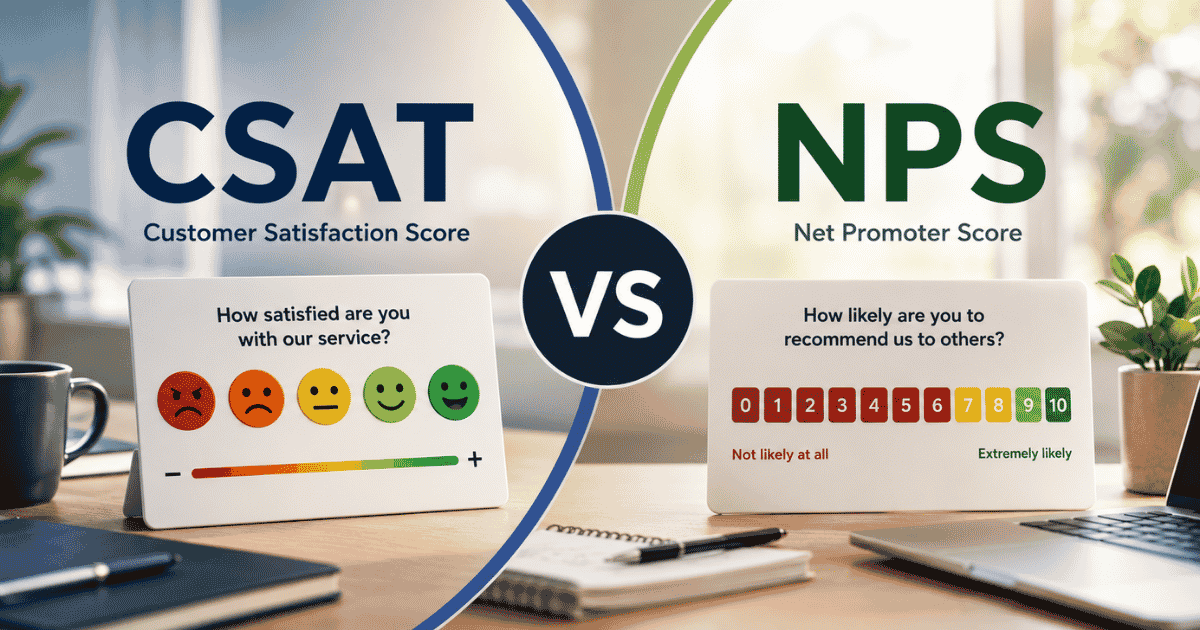
CSAT captures how satisfied customers feel immediately after a support interaction. Surveys typically use a 1 to 5 or 1 to 7 scale, with the score calculated as satisfied responses divided by total responses, multiplied by 100. This important customer service metric highlights gaps in agent coaching or workflow design. Tracking customer satisfaction score trends reveals whether your customer experience improves or declines.
A CSAT score above 80% is generally considered strong across industries. Consistent monitoring helps identify patterns where service quality drops, allowing teams to take corrective actions quickly.
Net Promoter Score
Net promoter score NPS measures customer loyalty by asking how likely someone is to recommend your company on a 0 to 10 scale. Scores of 9 to 10 represent promoters, 7 to 8 are passives, and 0 to 6 are detractors. Subtract detractor percentage from promoter percentage for your NPS. This metric reflects broader customer sentiment beyond individual support interactions.
Companies with high NPS scores often experience faster growth due to word-of-mouth referrals. Tracking NPS alongside support metrics helps connect service quality with long-term business impact.
Ticket Volume Trends
Tracking how many support tickets arrive in a given period provides essential context for workload management. Volume spikes often correlate with product launches, seasonal demand, or service outages. Understanding these patterns enables forecasting and resource planning for your support teams.
Analyzing ticket trends also helps teams prepare for predictable surges. Businesses that anticipate demand can adjust staffing levels and maintain consistent service quality during peak periods.
SLA Compliance Rate
Service level agreement compliance measures whether your team meets committed response and resolution timeframes. Calculate this as tickets that met SLA divided by all tickets with an SLA, times 100. Many teams rely on alerts and dashboards to catch SLA breaches early.
Maintaining high SLA compliance improves customer trust and ensures accountability across teams. Organizations with strong SLA performance often report fewer escalations and higher overall customer satisfaction.
Customer Support Productivity And Efficiency Benchmarks
Understanding productivity benchmarks helps you set realistic targets for your customer service agent performance. Clear benchmarks improve visibility into workload, efficiency, and output quality across teams, especially when combined with automated ticket management software that reduces manual handling time.
Tickets Per Agent
This metric shows how many support tickets each team member handles in a specified period. The number should be contextualized by ticket complexity. An agent handling 50 password resets operates differently than one resolving 10 complex technical issues. Both create value, but comparing them directly misses important nuances.
High-performing teams often segment tickets by type before evaluating productivity. Industry averages range from 20 to 50 tickets per day depending on complexity. Balanced measurement ensures fair evaluation and prevents unrealistic expectations.
Time Per Ticket
Average time invested in each service request varies dramatically by channel and issue type. Simple inquiries might take 3 minutes while complex customer issues require 45 minutes or more. Track this metric by ticket category to identify where training or documentation improvements would help most.
Reducing time per ticket without compromising quality improves throughput significantly. Teams that optimize workflows and knowledge resources often see efficiency gains of 20% to 30% over time.
Agent Utilization Rate
Many contact centers aim for 70% to 85% utilization depending on channel mix. While higher utilization suggests better agent productivity, excessively high rates lead to burnout and declining service quality. At 100% utilization, agents never have break time, administrative tasks, or training opportunities.
Maintaining the right balance improves both productivity and employee satisfaction. Teams that monitor utilization closely can adjust workloads and prevent performance drops caused by fatigue.
Resolution Consistency
First contact resolution rate captures whether similar issues resolve with similar quality standards. The 74% industry benchmark provides a useful target. Variation in resolution rates often points to knowledge gaps or inconsistent process adherence among team members.
Improving consistency requires better documentation, standardized workflows, and ongoing training. Teams with high resolution consistency reduce repeat tickets and improve customer satisfaction.
Workflow Efficiency Gains
Track improvements in how support operates over time. Measuring before and after specific changes, like new tools or training programs, reveals whether investments drive continuous improvement in your support processes.
Organizations that continuously optimize workflows often achieve measurable gains in efficiency and cost reduction. Even small process improvements can lead to significant productivity increases when scaled across large support teams.
First Response Time And Its Impact On Customer Experience
Speed of initial response shapes customer perception more than most teams realize. Fast acknowledgment sets the tone for the entire interaction and directly influences satisfaction, trust, and long-term loyalty.
Speed Builds Trust
Customers form impressions within their first interaction with support. A quick first response signals that your company values their time. In competitive markets, response speed becomes a differentiator. If one company responds in 2 minutes and another in 2 hours, the faster responder wins trust regardless of ultimate resolution quality.
Studies show that 90% of customers rate immediate response as important when they have a support query. Faster response times create confidence and reduce uncertainty, which strengthens customer relationships from the very first touchpoint.
Reduces Customer Friction
Friction in customer interactions takes multiple forms. Waiting without acknowledgment causes customers to drop off entirely or escalate unnecessarily. A customer waiting 3 minutes without any response feels longer than a 10 minute wait with regular status updates. Quick acknowledgment reduces this friction significantly.
Reducing friction improves engagement rates and prevents unnecessary escalations. Even automated responses can reassure customers that their issue is being handled, which improves overall experience and reduces frustration.
Sets Service Expectations
Your first response time establishes a baseline for future customer expectations. If you consistently respond within 2 hours, customers internalize that standard. Missing it subsequently feels worse than if your baseline were 24 hours. This creates accountability for maintaining your speed standards.
Consistency matters more than occasional speed. Teams that define clear response benchmarks and meet them regularly build predictable service experiences, which customers value highly.
Impacts Satisfaction Scores
Research connects fast first response directly to higher satisfaction. Lower response time usually means happier customers. However, the relationship is not perfectly linear. A very slow but thorough response might produce lower satisfaction than a quick but incomplete one.
Balancing speed with quality is critical. Teams that combine fast acknowledgment with accurate follow-ups often achieve higher CSAT scores and better overall service outcomes.
Affects Brand Perception
In the age of social media metrics, customers publicly share support experiences. A company known for responsive support attracts new customers, while one known for slow responses pushes them toward competitors. Social media metrics and public perception tie directly to response speed.
Brands with strong support responsiveness often see better online reviews and higher trust signals. This visibility influences purchasing decisions and strengthens market positioning.
Improves Retention Rates
Customers who receive quick responses show higher customer loyalty. Fast acknowledgment communicates competence and respect. Both factors drive customer retention and reduce customer attrition over time.
Research indicates that customers are more likely to stay with brands that respond quickly to issues. Improving first response time can significantly reduce churn and increase lifetime customer value.
Average Resolution Time And Case Handling Efficiency
Resolution time measures your team’s ability to close customer issues completely. It reflects how efficiently teams handle requests from start to finish while maintaining service quality and consistency.
Faster Issue Closure
Faster closure means customers move forward with their work or life sooner. For time sensitive issues like account lockouts, quick resolution becomes business critical. However, rushing to close tickets without genuine resolution generates repeat contacts and frustration.
Industry benchmarks suggest that most standard queries should resolve within 24 hours, while complex issues may take longer. Teams that balance speed with accuracy reduce repeat tickets and improve overall customer trust.
Reduced Backlog Pressure
When average resolution time increases while volume stays constant, ticket backlog grows. This creates pressure on the team and extends wait times for all customers. Agents facing large backlogs feel stressed and less equipped to handle nuanced customer needs.
Backlog growth also impacts service levels and SLA compliance. Teams that actively monitor resolution time can prevent bottlenecks and maintain a steady workflow across support channels.
Better Resource Allocation
Resolution time data informs hiring and training decisions. If your average is 3 days but industry standard is 1 day, the gap might indicate training needs, knowledge base gaps, or workflow inefficiencies. Address root causes before adding headcount.
Data-driven allocation ensures resources are used efficiently. Instead of scaling teams blindly, organizations can optimize processes and improve performance with targeted improvements.
Improved Service Quality
Faster resolution sometimes improves quality service because it forces teams to eliminate unnecessary steps. Simplifying workflows often improves both speed and accuracy simultaneously.
Teams that streamline processes reduce human error and ensure consistent outcomes. Clear documentation and structured workflows play a key role in maintaining high service standards.
Higher Team Efficiency
Teams that resolve issues quickly achieve higher operational efficiency. They complete more work with the same resources, reducing support costs and improving overall satisfaction scores.
Efficient teams often handle 20% to 30% more tickets without compromising quality. This improvement directly impacts cost savings and supports scalable growth in customer support operations.
Customer Satisfaction Metrics And Feedback Analysis
Understanding customer sentiment requires systematic feedback collection and analysis. Strong feedback systems help teams identify experience gaps, improve service quality, and make informed decisions based on real customer insights.
CSAT Score Trends
A single CSAT score of 7 out of 10 tells you little. But a trend from 8.2 to 6.5 over three months signals serious problems. Trend analysis reveals whether customer experience improves or declines. Survey data should be brief and targeted to specific interaction elements.
High-performing teams track CSAT weekly or monthly to catch early warning signs. A drop of even 5% can indicate workflow issues, agent performance gaps, or product-related concerns that need immediate attention.
NPS Insights
Net promoter score provides insight into relationship strength and likelihood of recommendations. Segment NPS by customer type to see whether support quality varies. Enterprise accounts might show higher NPS than small business customers, suggesting different service levels or expectations exist.
Segmenting NPS by region, product, or support channel provides deeper clarity. Companies that act on segmented insights often improve retention and identify high-value customer groups more effectively.
Feedback Loop Clarity
Collecting satisfaction data creates no value without acting on it. Survey results should feed into team debriefs, agent coaching sessions, and process improvements. Clear feedback loops connect customer input to operational changes.
Organizations with structured feedback loops often see faster improvements in service quality. Closing the loop with customers also increases trust and shows that feedback leads to real change.
Complaint Pattern Analysis
Beyond numeric scores, analyzing complaint themes reveals systemic issues. If 40% of complaints mention lack of product knowledge, training is needed. Natural language processing tools help identify patterns across large volumes of customer conversations.
Pattern analysis helps prioritize improvements based on impact. Addressing recurring issues reduces ticket volume and improves overall customer satisfaction over time.
Experience Gap Detection
Comparing CSAT scores across channels, agents, or issue types reveals where experience falls short. If chat satisfaction scores 6 out of 10 while email scores 8 out of 10, channel specific problems exist that need attention.
Gap analysis helps teams focus on areas with the highest potential for improvement. Targeted actions based on these insights often lead to quick wins in customer experience.
Continuous Improvement Signals
Satisfaction metrics create feedback mechanisms for ongoing improvement. Teams can test changes and measure impact through experience data. This data driven approach replaces guesswork with valuable insights.
Organizations that continuously track and refine their approach often achieve steady gains in satisfaction scores. Small improvements over time compound into significant enhancements in overall customer experience.
Ticket Volume Trends And Workload Distribution Insights
Volume patterns tell you where to focus resources and when. Understanding these trends helps teams plan staffing, improve response time, and maintain service quality during demand fluctuations, which is especially critical for small teams using smart ticketing tools during peak seasons.
Volume Spike Patterns
Ticket volume follows predictable patterns around product launches, seasonal demand, and known service issues. Companies that staff for average volume face crises during predictable peaks. Data analysis can identify these patterns months in advance.
Businesses that prepare for spikes often maintain consistent service levels even during high demand. Historical data helps forecast future surges, reducing last-minute pressure on support teams.
Peak Time Analysis
Beyond overall volume, intra-day and intra-week patterns matter. Many support teams experience Monday surges and Friday afternoon declines. Aligning staff schedules to volume patterns improves response time during peaks.
Teams that optimize scheduling based on peak hours often reduce wait times significantly. Even small adjustments in shift planning can improve efficiency and customer satisfaction.
Workload Balance Issues
Metrics reveal whether workload distributes evenly across team members. Some customer support agents might handle high complexity tickets while others manage simple requests. Distribution should reflect capacity and expertise.
Balanced workloads prevent burnout and improve team performance. Assigning tickets based on skill level ensures faster resolution and better service quality.
Team Capacity Planning
Volume trends enable forecasting. If ticket volume grows 10% monthly, you can plan hiring, training, and tool investments accordingly. Meeting customer demand requires proactive resource planning.
Accurate forecasting helps avoid both understaffing and overstaffing. Teams that plan ahead maintain stable performance even as demand increases.
Resource Allocation Needs
Volume data paired with resolution time and CSAT reveals resource adequacy. Growing volume with stable resolution time suggests adequate capacity. Growing volume with increasing resolution time signals insufficient resources.
Combining multiple metrics provides a clearer picture of performance. This approach helps leaders make informed decisions about staffing, tools, and process improvements.
How To Handle High Support Volume Without Service Drop
High volume periods test your team’s systems and processes. Teams that rely on structured workflows, automation, and real-time monitoring maintain service quality even during sudden demand spikes, often by implementing dedicated ticket automation software.
Prioritize Critical Tickets
Not all tickets carry equal urgency. Outage reports and account lockouts demand faster response than general inquiries. Define priority criteria clearly based on customer impact and tier.
Organizations that implement priority-based triaging often reduce response delays for critical issues by up to 40%. Clear categorization ensures that high-impact problems receive immediate attention without overwhelming the entire system.
Use Smart Routing
Modern support platforms enable intelligent ticket routing based on agent expertise, availability, and workload. This reduces unnecessary escalations and improves first contact resolution rate.
Smart routing can increase resolution efficiency by 20% or more by assigning the right issue to the right agent. It also minimizes handling time and improves overall team productivity.
Enable Self Service
Knowledge base articles and FAQ resources let customers resolve issues independently. Well-designed self-service customer support can handle 10% to 20% of typical support requests, reducing agent workload significantly.
Well-structured self-service systems improve customer experience by offering instant solutions. They also reduce ticket volume, allowing agents to focus on complex queries that require human intervention.
Automate Repetitive Tasks
Automation handles high volume, low complexity work like password resets, account lookups, and status checks. Agent assist tools free your team to focus on complex customer interactions requiring human feedback, especially when you streamline support with ticket automation across all channels.
Automation can reduce manual workload by up to 30%, improving response time and operational efficiency. It also ensures consistency in handling repetitive tasks across the support process.
Scale Team Resources
During sustained high volume, temporary staffing becomes necessary. However, scaling should be short term while process improvements create lasting capacity. Training new staff takes time and produces lower initial quality.
Organizations that combine short-term scaling with long-term optimization strategies maintain better service quality. Efficient onboarding and clear workflows help new agents perform effectively during peak periods.
Monitor Real Time Metrics
During peak periods, real time dashboards become critical. Managers need immediate visibility into response time, queue length, and agent utilization to identify areas needing quick intervention.
Real-time monitoring enables quick decision-making and prevents service breakdowns. Teams that actively track live metrics respond faster to issues and maintain consistent performance under pressure.
Support Automation Tools And Their Role In Scaling Support
Automation extends your team’s capacity without proportional cost increases, especially when powered by purpose-built ticket automation software for modern teams.
Ticket Automation Systems
These systems automatically route, prioritize, categorize, and respond to tickets based on predefined rules. Automation reduces manual effort and improves consistency across support interactions, particularly when you adopt automated ticket creation workflows.
AI Chatbots Support
Chatbots handle initial customer contact, gather information, answer frequently asked questions, and route complex issues to human agents. Effective bots train on specific company data and improve continuously, and work best alongside a streamlined email-to-ticket automation setup.
Workflow Automation Tools
Internal processes like approval chains, escalations, and notifications benefit from automation. This removes waiting time and ensures nothing falls through cracks in the customer journey, making the shift from manual vs automated ticketing a key strategic choice.
Knowledge Base Systems
Centralized information accessible to both agents and customers improves first contact resolution. Well organized knowledge base content enables self service and speeds agent responses, especially when delivered through a dedicated ticketing system for customer support.
Integration With CRM
Integration between support systems and CRM platforms enables agents to see complete customer context. This improves personalization and reduces friction when a customer feels they must repeat information.
Data Integration And Real Time Reporting For Support Teams
Unified data creates accurate performance visibility. When support data flows across systems without gaps, teams gain clarity into operations, identify issues faster, and improve overall decision-making.
Unified Data View
Support teams typically use multiple tools including ticketing systems, CRM platforms, knowledge bases, and communication channels. Unified data platforms aggregate this information for comprehensive visibility into performance indicators.
Organizations with unified data views reduce reporting errors and improve accuracy. Centralized insights help teams understand customer journeys and agent performance without switching between multiple tools.
Real Time Dashboards
Dashboards display current performance metrics enabling rapid response to emerging issues. Real time visibility of queue length, response time, and agent utilization helps managers allocate resources dynamically.
Teams using real-time dashboards often respond to issues 30% faster compared to those relying on delayed reports. Immediate visibility ensures proactive management instead of reactive problem-solving.
Cross Tool Integration
Integration between ticketing, CRM, knowledge base, and analytics tools creates data flow. Customer interactions leave traces across multiple systems. Integration connects these traces for complete understanding.
Well-integrated systems improve collaboration and reduce manual data handling. This ensures smoother workflows and better coordination across support teams.
Accurate Performance Tracking
When data scatters across systems, tracking becomes error prone. Unified integration enables accurate measurement because data comes from single sources of truth. This supports compliance with SLAs and regulatory requirements.
Accurate tracking builds trust in performance data. Teams can rely on insights to make informed decisions without worrying about inconsistencies or missing information.
Faster Decision Support
Real time data enables faster decisions. Instead of waiting for weekly reports, managers respond to emerging problems within hours. This direct correlation between data availability and response speed improves outcomes.
Faster decisions reduce operational delays and improve service quality. Teams that act on real-time insights maintain better control over performance and customer experience.
Data Driven Improvements
Continuous data analysis reveals improvement opportunities. A/B testing process changes becomes possible with baseline key metrics. Improvement becomes measurable rather than speculative.
Organizations that adopt data-driven strategies often see consistent gains in efficiency and customer satisfaction. Continuous optimization ensures long-term success in support operations.
How To Align Support Metrics With Business Goals And Outcomes
Metrics create maximum value when connected to broader business objectives.
Map Metrics To Goals
Strategic alignment connects support metrics to business outcomes. If your goal is reducing customer churn, track NPS, CSAT, repeat contact rate, and resolution time. If reducing costs matters most, focus on cost per interaction and automation rate.
Customer service metrics important for alignment include customer effort score and contact resolution rate measures, as they directly reflect how easily customers can resolve issues. When these important metrics improve, businesses often see a direct correlation with higher retention and lower support costs.
Focus On Revenue Impact
Support centers that retain customers, increase lifetime value, and drive referrals generate revenue impact. NPS correlates with referral likelihood. Improving NPS from 30 to 50 might increase referral rates significantly.
Customer service performance plays a key role in revenue growth. Faster average response time and improved first contact resolution reduce friction in customer journeys, which leads to higher conversion rates and stronger customer loyalty.
Improve Customer Lifetime Value
Every support interaction strengthens or weakens customer relationships. Exceptional experiences increase loyalty and repeat business. Track lifetime value by customer segment to see whether support quality varies.
Customer effort score CES helps measure how easy it is for customers to get support. Lower effort scores indicate smoother experiences, which directly impact repeat purchases and long-term value. Businesses that reduce customer effort often see measurable improvements in retention.
Align Teams With KPIs
When support teams understand how daily work connects to business outcomes, motivation improves. Teams should be accountable for important metrics within their control, not external factors.
Clear visibility into customer service team's performance helps identify gaps and improve consistency. Regular tracking of customer service team's performance ensures that teams stay aligned with goals and continuously improve their output.
Track Long Term Growth
Monthly metrics provide operational visibility. Quarterly and annual tracking reveals longer term trends. Response time that improves slightly month over month might show consistent improvement year over year.
Sustained customer service efforts drive continuous improvement over time. Monitoring trends across important metrics such as average response time and resolution efficiency helps organizations scale effectively while maintaining service quality, particularly when leveraging ticketing software built for best-in-class support.
How Easydesk Helps Improve Support Performance Metrics
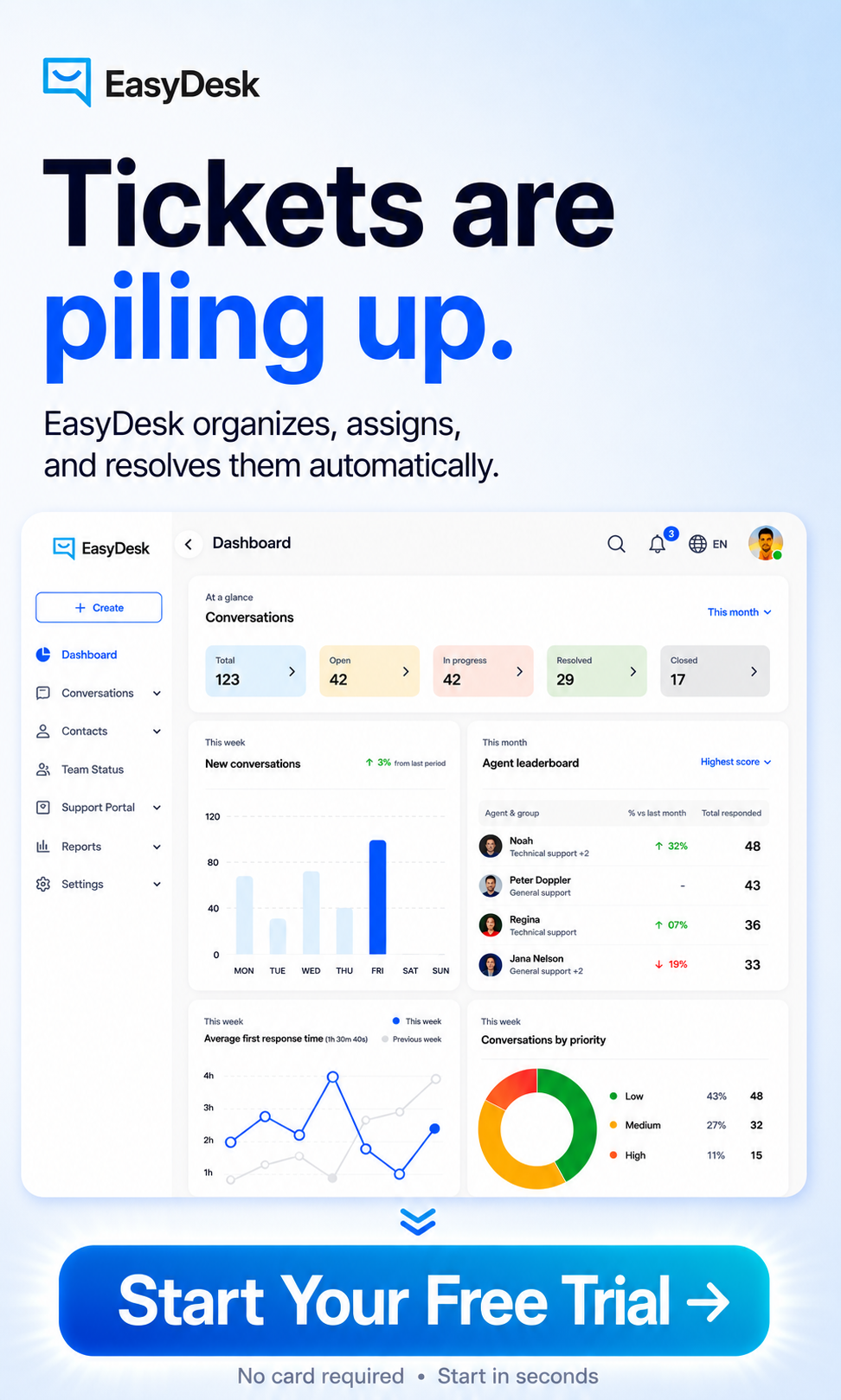
EasyDesk centralizes customer support workflows, helping teams improve response speed, resolution efficiency, and overall service quality. A unified EasyDesk customer support platform ensures better visibility, faster execution, and measurable improvements across key performance metrics.
Faster Response Handling
EasyDesk improves response time through automated ticket routing and smart prioritization. Incoming customer queries are assigned based on urgency, agent availability, and expertise using streamlined ticket automation workflows.
This reduces delays in first response and ensures that critical issues receive immediate attention. Faster acknowledgment improves customer experience and helps teams meet SLA commitments consistently.
Efficient Ticket Management
A structured ticketing system allows support teams to manage high volumes without confusion. The EasyDesk ticket management system organizes tickets based on status, priority, and category, making it easier to track progress.
This improves resolution time and reduces ticket backlog. Teams gain clear visibility into workloads, which enhances operational efficiency and prevents missed requests by managing support tickets efficiently with EasyDesk.
Automation For Productivity
Automation features handle repetitive tasks such as ticket assignment, status updates, and follow-ups. This reduces manual workload and allows agents to focus on complex customer issues, similar to broader automated ticket management software capabilities.
By automating routine processes, teams improve productivity and maintain consistency in support operations. This directly impacts key metrics like resolution time and agent efficiency, especially when you streamline customer support with ticket automation.
Centralized Communication Channels
EasyDesk integrates multiple communication channels including email, live chat, and other platforms into a single interface. This helpdesk ticketing software ensures all customer interactions are managed in one place.
Centralization eliminates the need to switch between tools, reducing response delays and improving coordination. Teams can deliver consistent support experiences across all channels using a unified ticketing software system.
Data Driven Performance Tracking
Built-in reporting and analytics provide real-time insights into support performance metrics. Managers can track response time, resolution efficiency, and customer satisfaction trends using EasyDesk’s smarter support features.
These insights help identify gaps and drive continuous improvement. With clear data visibility, teams can make informed decisions and optimize support processes for better outcomes using EasyDesk helpdesk ticketing software.
FAQs
How To Optimize Customer Support Performance Metrics Across Teams?
Start by benchmarking current state against industry standards like the 74% FCR target. Conduct root cause analysis when metrics underperform. Invest in agent training to address knowledge gaps and simplify processes that add unnecessary complexity. Regular monitoring with feedback loops enables continuous improvement across all team members.
Which Customer Support KPIs Drive Long Term Business Growth?
Net promoter score correlates with customer loyalty and referral likelihood. First contact resolution reduces costs while improving satisfaction. CSAT trends predict whether customer relationships strengthen or weaken over time. Cost per interaction improvements boost margins while maintaining quality service, especially when powered by the #1 ticketing software for better support.
How Does Automation Improve Customer Support Productivity At Scale?
Automation handles 20% to 30% of typical volume through chatbots and self service. It provides instant responses without agent availability constraints. Staff efficiency improves when agents focus on complex issues requiring judgment. Automation enables 24/7 availability and scales without proportional cost increases.
What Factors Influence First Response Time In Support Teams?
Staffing levels directly impact how quickly agents can respond. Ticket prioritization affects which requests get attention first. Channel characteristics matter since chat demands faster response than email. Agent knowledge, tools access, and internal approval processes all influence speed.
How To Balance Resolution Time With Customer Satisfaction Goals?
Focus on first contact resolution as your balance point since it measures both speed and quality. Segment approaches by customer type since enterprise accounts might prefer thorough resolution over speed. Keep customers informed during longer resolution processes to maintain satisfaction even when issues take time.