Personalized customer experience is no longer a nice extra. Customers expect it. In fact, 71% of consumers say they want brands to understand their needs during customer service interactions. Customer expectations keep rising every year. Support teams that use customer data to respond in a relevant way stand out. Personalized customer engagement makes customers feel heard, and that directly improves customer satisfaction and loyalty.
About 76% of consumers are more likely to purchase from a company that offers customer personalization. Small details matter. Tailored replies, personalized content, and faster resolutions shape the full customer experience. Strong customer data management and clear personalization strategies help teams handle common challenges. When done right, every interaction supports growth and builds stronger customer relationships.
What Is Personalized Customer Experience In Support
Personalized customer experience in support focuses on each individual customer. Teams use customer data such as purchase history, browsing behavior, past interactions, and location data to understand customer needs. Collecting and analyzing collected data helps gain insights into customer behavior and customer preferences. Successful personalization relies on ethical data practices, strong data management, and respect for customer privacy and data privacy. A data-driven approach with artificial intelligence AI and data analytics allows brands to deliver personalized experiences that match customer expectations across the full customer journey.
Personalization efforts improve customer satisfaction and customer engagement. Agents access browsing history and previous interactions to avoid repetitive tasks in customer service interactions. Leveraging data, personalization tools, and personalization strategies helps deliver tailored experiences, personalized messages, and relevant content. Personalized recommendations, personalized product recommendations, and personalized outreach encourage customers, strengthen customer relationships, and increase customer loyalty in a competitive market.
Why Personalized Customer Experiences Are Important For Support Teams
Personalized customer experience gives support teams a clear edge. Customers expect brands to know their history and preferences. Data shows companies that invest in personalization grow revenue up to 10% faster. Support becomes a growth driver, not just a cost center.
Higher Customer Satisfaction
Personalized customer experience directly improves customer satisfaction. Agents use customer data like past interactions, purchase history, and browsing behavior to understand each situation. Customers feel heard when support reflects their specific customer needs.
Research shows 81% of consumers prefer brands that offer tailored experiences. Satisfaction rises when issues get resolved without repeating information. Personalization builds trust. Trust strengthens customer relationships and keeps expectations aligned with service delivery.
Stronger Customer Loyalty
Customer loyalty grows when support feels personal. Customers stay with brands that recognize their preferences and previous interactions. Studies reveal 61% of consumers spend more with companies that customize experiences.
Personalized recommendations and relevant content create emotional connections. Customers become active participants instead of one-time buyers. Higher lifetime value follows naturally. Loyalty reduces churn and supports long-term business growth in a competitive market.
Better First Contact Resolution
First contact resolution improves with a data-driven approach. Agents who access full customer history solve issues faster. Organizations that use artificial intelligence report up to 25% improvement in resolution rates.
Customer satisfaction can reach 90% when problems get solved on the first contact. Multiple contacts drop satisfaction close to 55%. Personalization tools reduce repetitive questions. Faster solutions mean smoother customer service interactions and lower operational costs.
Lower Support Ticket Volume
Proactive customer support personalization strategies reduce ticket volume. Customer insights and data analytics reveal patterns in customer behavior. Teams act early and address common challenges before escalation.
Targeted outreach and personalized messages provide relevant content at the right time. Customers find answers without submitting tickets. This approach improves the overall customer experience while controlling support costs and encouraging customers to stay engaged.
Improved Agent Productivity And Morale
Personalization tools increase agent productivity. A unified view of customer data reduces time spent searching across systems. Research shows 62% of employees waste time looking for information during work hours.
Artificial intelligence supports faster decisions and smarter responses. Agents resolve issues with confidence and clarity. Higher success rates improve morale. Engaged agents build stronger customer relationships and consistently deliver personalized customer experiences.
Key Elements That Enable Customer Personalization In Support
Building a tailored customer experience requires specific infrastructure elements working together. Your support operation needs the right foundation to collect data, surface insights, and deliver smooth interactions.
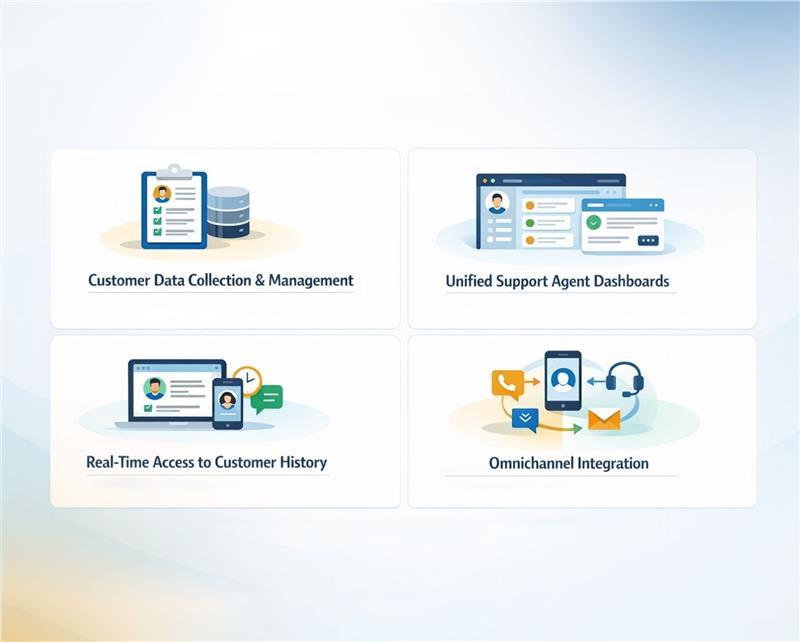
Customer Data Collection And Management
Data collection forms the backbone of successful personalization. Most customers (81%) prefer interactions tailored to their past purchases and priorities. You need to gather purchase history, browsing behavior, customer feedback, and interaction records to understand individual priorities.
Customer data platforms revolutionize how you organize information. Traditional databases grew up siloed by department or channel. CDPs structure data around the customer instead and create a single customer view. This approach gives your entire organization access to complete customer profiles rather than fragmented records.
Unified Support Agent Dashboards
Unified dashboards bring everything agents need into a single interface. These platforms provide live analytics across all support channels including email, chat, and phone. Agents stop juggling multiple systems and gain immediate access to complete customer context.
The dashboard presents multiple work streams. Agents see conversations they're handling, work items from their queues, and recently closed interactions. This multi-stream view helps prioritize workload management and maintain awareness of team structure and capacity.
Workspaces that surface purchase history, previous interactions, account status, and priorities let agents personalize service right away. The interaction feels like continuing a relationship rather than starting from scratch. Agents don't waste time reconstructing information from multiple channels.
Real Time Access To Customer History
Real-time access to customer data transforms support quality. Agents provide faster and more informed assistance when they have quick access to past purchases and support history. CRM tools deliver real-time access to customer priorities, history, and interactions that make it possible for agents to tailor responses and solutions.
Every interaction leaves a trail. Past purchases, support tickets, customer feedback, and priorities create a detailed record. Your team skips the basics and gets straight to solutions when they tap into that information. Up-to-date, detailed notes help deliver consistent experiences even as cases move between agents.
Omnichannel Integration For Smooth Experiences
Omnichannel integration makes sure customers receive consistent service whatever channel they use to reach out. A connected system shows your team the full story, no matter where the conversation started. Customers avoid repeated explanations and experience smooth transitions between channels.
Knowing how to move interactions naturally from one channel to another defines truly omnichannel customer service. Chat history and context come with it when the conversation moves. Your agents see past interactions in the CRM and use this information to tailor service to that individual.
Essential Technologies For Personalized Experience
The right technology stack turns personalization from theory into practice. Four core technologies work together to power personalized customer experiences at scale.
CRM Systems For Complete Customer Profiles
CRM systems serve as the central hub for customer data across your organization. These platforms unify information from marketing, sales and customer service interactions into a single customer profile. Agents access purchase history, order status, outstanding service issues and past interactions through one customizable dashboard when you implement CRM software.
This single source of truth matters because 82% of service professionals report customer expectations are higher than ever. CRM systems make sure everyone at your company provides the expected service level, whatever channel customers previously used to contact you—phone, chat, email or social media. A top-tier CRM centralizes interactions from all channels into a unified customer timeline. This approach improves responsiveness and makes true customer personalization possible, no matter where conversations started.
AI And Machine Learning For Predictive Support
Artificial intelligence analyzes historical data through machine learning to identify patterns and forecast future customer behavior. Predictive AI helps you look forward instead of backward. You can anticipate what customers need before they ask. This technology identifies the highest-value leads and spots customers likely to leave. Teams can intervene proactively.
Machine learning powers adaptive capabilities by training on customer interaction data. These algorithms recognize patterns and make accurate predictions. Performance gets better continuously based on experience. AI-driven sentiment analysis detects customer emotions by analyzing word choice and punctuation. This helps support teams adjust responses appropriately and deliver more empathetic service.
Knowledge Management Platforms
Knowledge management for customer service involves sourcing, synthesizing, curating and publishing trusted information to customers and agents. Modern knowledge management systems help agents find answers through AI-enabled search methods and conversational guidance. Machine learning refines intent understanding while AI reasoning guides self-service systems and contact center agents through conversations.
AI-powered search uses machine learning to understand conversation context and suggests relevant articles proactively. This capability makes sure agents find what they need in seconds rather than digging through outdated documents. Guided workflows provide step-by-step paths to resolution. They break down complicated processes into manageable steps.
Chatbots And Virtual Assistants
Generative AI-powered chatbots use natural language processing and responses from large language models that understand intent, maintain context and pull answers from trusted knowledge sources. These conversational interfaces resolve queries 24/7 through preferred channels like phone, web, messaging and email.
NLP serves as core technology that makes it possible for chatbots to parse customer messages and extract meaning from unstructured text. Large language models trained on vast data amounts make chatbots capable of understanding context and generating coherent responses. Nearly half (49%) of US adults have turned to an AI chatbot for customer service in the past 12 months.
Common Challenges And Solutions In Personalized Support Experiences
Personalized customer experience requires more than good intent. Support teams often face barriers that affect customer satisfaction and customer loyalty. Clear personalization strategies, strong customer feedback management, and the right tools help overcome these common challenges and protect the overall customer experience.
Data Silos Across Platforms
Customer data often lives in separate systems. Marketing, sales, and support work with different records. Around 42% of marketers say poor alignment blocks personalization efforts. About 56% of customers repeat information across channels. Fragmented past interactions damage trust and weaken personalized customer engagement.
Solutions:
- Centralize customer data in one system
- Integrate CRM and support platforms
- Enable shared access to previous interactions
- Use strong data management processes
- Audit and remove duplicate records
- Align teams around shared customer insights
Privacy And Compliance Risks
Privacy laws add pressure to personalization efforts. GDPR fines can reach €20 million or 4% of annual revenue. Only 51% of customers trust brands with their data. Weak ethical data practices harm customer relationships and reduce loyalty.
Solutions:
- Follow strict data privacy policies
- Collect clear and documented consent
- Limit unnecessary data collection
- Encrypt sensitive customer data
- Train teams on compliance rules
- Communicate ethical data practices clearly
Inconsistent Cross-Channel Experience
Customers expect seamless tailored experiences. Support, email, chat, and social channels often operate in isolation. Mixed personalized messages confuse customers. Disconnected service lowers customer satisfaction metrics and breaks the customer journey.
Solutions:
- Map the full customer journey
- Sync personalization tools across channels
- Share customer insights in real time
- Create unified communication guidelines
- Track browsing behavior and past interactions centrally
- Monitor consistency with data analytics
Limited Agent Training
Knowledge gaps reduce successful personalization. About 43% of marketers cite lack of skills as a barrier. Agents may not understand customer behavior or personalization tools. Poor execution leads to generic customer service interactions.
Solutions:
- Provide structured tool training
- Teach agents how to read customer data
- Use artificial intelligence for live guidance
- Run regular skill workshops
- Share proven personalization strategies
- Review performance with coaching sessions
Low Technology Adoption
Advanced systems fail without proper use. Complex tools discourage teams. Artificial intelligence and support automation tools remain underused. That limits personalized recommendations and relevant content delivery.
Solutions:
- Choose simple and user-friendly tools
- Roll out personalization tactics step by step
- Assign internal technology champions
- Track adoption metrics regularly
- Offer continuous technical support
- Highlight early wins to build confidence
Poor Data Quality And Insights
Accurate personalized customer experience depends on clean data. Incomplete browsing history or outdated purchase history leads to wrong assumptions. Weak data analytics blocks teams from gaining insights into customer interests and needs.
Solutions:
- Clean and update databases regularly
- Validate collected customer data
- Remove duplicate or inactive profiles
- Automate real time data updates
- Use dashboards to monitor accuracy
- Analyze customer feedback for insight gaps
Strong alignment, ethical data practices, and smart personalization tools turn these customer service challenges into growth opportunities. Each fix improves customer satisfaction and strengthens long-term customer relationships.
How EasyDesk Supports Personalized Customer Experience
EasyDesk helps teams deliver a personalized customer experience with a unified view of customer data. EasyDesk simplifies your customer support activities with it's essesntial features. Agents can see past interactions, purchase history, browsing behavior, and customer preferences in one place. That context improves customer service interactions and raises customer satisfaction. Support becomes faster and more relevant across the full customer journey.
Smart automation and artificial intelligence turn customer insights into action. Teams can send personalized messages, share relevant content, and offer personalized recommendations based on real customer needs. Strong data management and secure systems protect customer privacy while enabling personalization strategies. EasyDesk reduces repetitive tasks, strengthens customer relationships, and helps businesses deliver consistent personalized customer engagement that drives loyalty and long term growth. You can enjoy EasyDesk at a suitable price.
FAQs
Can Small Support Teams Deliver Personalized Customer Experience Without Large Budgets?
Yes, small teams can deliver personalized customer experience with the right personalization tools and clear personalization strategies. A unified view of customer data and simple automation improve customer service interactions. Even basic customer insights can raise customer satisfaction and customer loyalty.
Does Personalized Customer Experience Increase Customer Lifetime Value?
Yes, personalized customer experience often increases lifetime value. When teams use purchase history, browsing behavior, and past interactions, they deliver relevant content and personalized recommendations. Customers respond with repeat purchases and stronger customer relationships.
Is Customer Data Management Essential For Effective Customer Personalization?
Yes, strong customer data management is essential for successful personalization. Clean and organized customer data helps teams understand customer behavior and preferences. Accurate insights support tailored responses and protect customer privacy through ethical data practices.
Can Personalized Customer Engagement Reduce Customer Churn?
Yes, personalized customer engagement can reduce churn. When support reflects individual customer needs, customers feel valued. Relevant content, proactive outreach, and smooth customer journey experiences strengthen loyalty and improve overall customer satisfaction.
How Do You Measure The Success Of Personalized Customer Experience In Support?
Track metrics like customer satisfaction scores, first contact resolution, customer loyalty rate, and repeat purchase behavior. Data analytics and customer feedback reveal whether personalization efforts improve the customer experience and drive long-term growth.