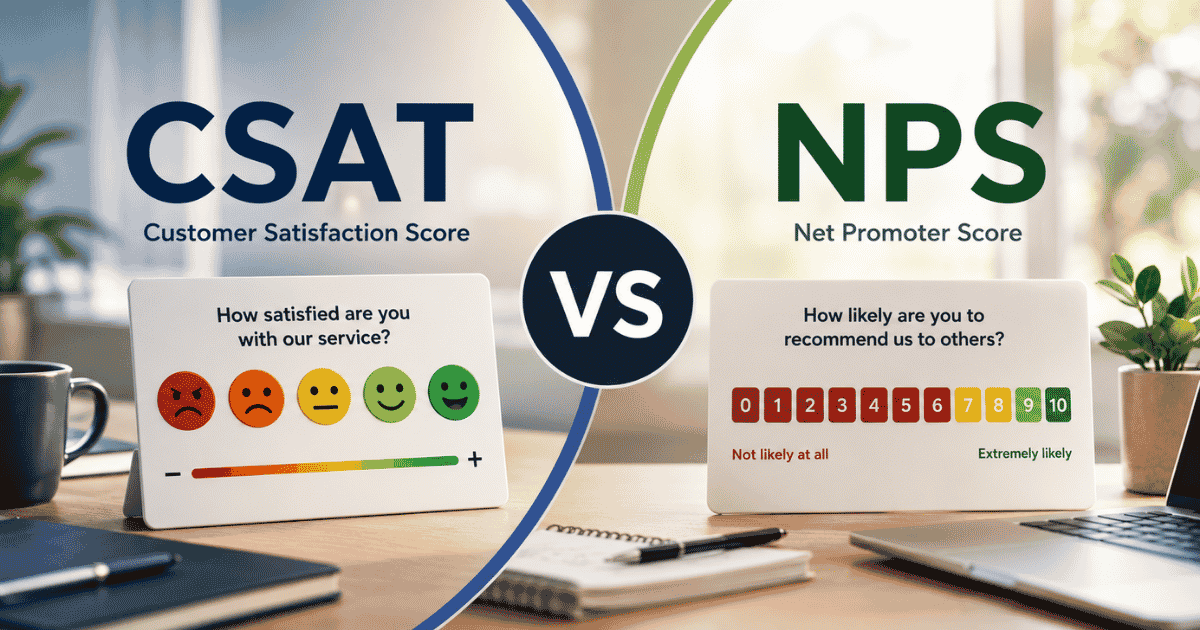
Every customer interaction reveals something valuable, but choosing the right metric can make a big difference. The debate around CSAT vs NPS often comes down to what you want to measure. A customer satisfaction score helps you understand how customers feel after a specific interaction, while a net promoter score measures long-term customer loyalty and the likelihood of recommendations.
Many businesses also use a customer effort score to evaluate how easy it is for customers to complete a task. Together, these metrics provide meaningful customer feedback across the entire customer journey. This guide compares CSAT and NPS to help you choose the right customer experience metric for your business goals.
What Is CSAT

CSAT, or Customer Satisfaction Score, measures how happy customers are with a specific interaction, product, or service. Businesses usually collect responses immediately after a purchase or support experience to understand customer satisfaction and identify areas for improvement.
A higher score often indicates more satisfied customers and a better customer experience. Unlike an NPS score, which focuses on long-term loyalty, CSAT measures immediate satisfaction. Many businesses use both CSAT and NPS as customer experience metrics to gain a complete view of customer sentiment, and dedicated CSAT score guides for support teams can help them use these measures more effectively.
What Is An NPS

Net Promoter Score (NPS) is a customer feedback metric that measures how likely customers are to recommend a business, product, or service to others. The Net Promoter Score (NPS) survey asks customers to rate their likelihood of recommending your brand on a scale of 0 to 10. While it does not directly measure customer satisfaction, it helps evaluate long-term customer loyalty and brand advocacy. Many businesses use NPS alongside customer satisfaction surveys to better understand customer sentiment rather than calculate customer satisfaction alone.
Key Difference Between CSAT And NPS

CSAT and NPS are two of the most widely used customer experience metrics, but they serve different purposes. Understanding how each metric works helps businesses measure customer satisfaction metrics for support teams, collect meaningful customer feedback, improve decision-making, and strengthen long-term customer relationships.
Feature | CSAT | NPS |
|---|---|---|
Primary Purpose | Measures customer satisfaction after a specific interaction | Measures long-term customer loyalty and advocacy |
Focus Area | Immediate customer experience | Overall customer relationship |
Survey Question | "How satisfied were you?" | "How likely are you to recommend us?" |
Rating Scale | Usually 1–5 or 1–7 | 0–10 |
Measures | Satisfaction with a recent experience | Likelihood of recommending your brand |
Best Time To Send | After support, purchase, or onboarding | Periodically during the customer lifecycle |
Customer Insight | Short-term satisfaction | Long-term loyalty and brand perception |
Business Use | Improve service quality and support performance | Track customer retention and business growth |
Actionable Outcome | Resolve immediate customer issues | Build loyalty and improve customer experience strategy |
Best For | Support teams and service improvement | Leadership, customer success, and strategic planning |
Purpose Of Measurement
CSAT focuses on immediate satisfaction after a specific interaction, such as a support ticket, product purchase, or onboarding experience. It is a customer satisfaction metric that helps businesses understand how satisfied customers are at a particular moment. A high CSAT score often indicates that customers had a positive experience with a recent interaction.
NPS takes a broader view by measuring customer advocacy and long term customer loyalty. Instead of focusing on one event, it evaluates how likely customers are to recommend your business to others. When comparing csat vs NPS, the first measures satisfaction with a recent experience, while the second reflects the strength of the overall customer relationship.
Survey Question Format
CSAT surveys usually ask a direct question such as, "How satisfied were you with your experience?" Customers respond using a rating scale that reflects their level of satisfaction. Because the question is simple and specific, businesses can quickly identify areas that need improvement.
NPS surveys use a different approach. Customers answer one question that asks how likely they are to recommend the company on a scale of 0 to 10. The wording is designed for measuring customer loyalty rather than evaluating a single interaction. This difference makes nps vs CSAT suitable for different business objectives.
Response Scale
The CSAT score commonly uses a five-point or seven-point rating scale ranging from very dissatisfied to very satisfied. Businesses calculate the percentage of positive responses to determine overall satisfaction after a specific interaction. This makes CSAT easy to understand and simple to monitor over time.
NPS surveys classify respondents as Promoters, Passives, or Detractors based on their ratings. The final score is calculated by subtracting the percentage of Detractors from the percentage of Promoters. Although both nps and csat rely on customer feedback, they use different scoring methods and provide different insights.
Best Use Cases
CSAT measures satisfaction after customer support conversations, product deliveries, onboarding sessions, or service requests. It is especially useful when businesses want to understand immediate satisfaction and identify problems that require quick action. Some organizations also pair CSAT with questions about how much effort customers spent completing a task.
NPS works best when evaluating the entire customer journey instead of a single interaction. It helps businesses understand customer sentiment over time and identify opportunities to improve customer retention. Organizations that want a long-term view of customer loyalty often rely on NPS alongside CSAT.
Data Interpretation
A strong CSAT score usually means customers were happy with a recent experience. However, a positive score does not always guarantee future loyalty because it reflects only one touchpoint. Businesses should review trends instead of relying on individual survey responses.
NPS provides insight into long-term customer loyalty and future business growth. A high score suggests stronger customer advocacy and a healthier customer relationship. Looking at both metrics together gives businesses a more complete understanding of customer sentiment and overall satisfaction.
Business Impact And Actions
CSAT helps teams identify service issues and improve day-to-day operations. Support managers can quickly address problems, coach employees, and improve service quality based on customer feedback. Faster improvements often lead to better experiences across individual customer interactions.
NPS supports strategic business decisions by highlighting opportunities to strengthen the overall customer relationship. Businesses can use feedback to improve products, refine customer experience strategies, and increase customer retention. Rather than choosing one metric over the other, many organizations achieve the best results by using CSAT and NPS together to guide continuous improvement.
How To Calculate CSAT
Customer Satisfaction Score (CSAT) measures how satisfied customers are after a specific interaction. The formula is simple:
CSAT (%) = (Number Of Satisfied Responses ÷ Total Responses) × 100
Most businesses consider customers who select the highest ratings, such as 4 and 5 on a five-point scale, as satisfied.
Example:
A business receives 200 survey responses after customer support interactions.
- Satisfied responses (4 and 5): 170
- Total responses: 200
CSAT = (170 ÷ 200) × 100 = 85%
The business has a CSAT score of 85%, indicating that most customers were satisfied with their experience. Tracking this score regularly helps identify service issues, monitor improvements, and evaluate customer satisfaction across different touchpoints.
What Is A Good CSAT Score?
A good CSAT score depends on your industry, but 75% to 85% is generally considered good, while 85% or higher is considered excellent. Instead of focusing only on the number, compare your score over time and against industry benchmarks. A consistently improving CSAT score is often more valuable than achieving a high score once, as it reflects continuous improvements in customer experience.
How To Calculate NPS
Net Promoter Score (NPS) measures how likely customers are to recommend your business to others. Customers rate their likelihood on a scale of 0 to 10. Based on their responses, they are grouped into three categories, making NPS one of the core customer support metrics alongside CSAT and other KPIs.
- Promoters: Scores of 9–10
- Passives: Scores of 7–8
- Detractors: Scores of 0–6
NPS Formula:
NPS = % Of Promoters − % Of Detractors
Example:
A survey receives 100 responses:
- Promoters: 60
- Passives: 25
- Detractors: 15
Promoters = 60%
Detractors = 15%
NPS = 60 − 15 = 45
The company's Net Promoter Score is 45. Tracking NPS over time helps businesses measure customer loyalty, identify trends, and evaluate the long-term impact of their customer experience strategy.
What Is A Good NPS Score?
An NPS above 0 means you have more Promoters than Detractors, which is generally positive. A score of 30 to 50 is considered good for most industries, while 50 or higher is excellent. Rather than focusing only on the score itself, monitor changes over time and compare your results with industry benchmarks. Continuous improvement in NPS often reflects stronger customer loyalty and a healthier customer base, especially when tied to clear goals to improve customer service for long-term success.
CSAT Vs. NPS: The Best Customer Feedback Metric For Your Team

Choosing between CSAT and NPS depends on what you want to improve. Both metrics provide valuable insights, but they answer different business questions. Using the right approach helps you collect better customer feedback and make more informed decisions.
Evaluate Your Business Goals
Start by identifying what you want to measure. If your goal is to understand how a customer feels after a specific interaction, a CSAT survey is the better choice. CSAT measures immediate satisfaction after events such as a purchase or a support conversation.
If your priority is customer advocacy and long-term loyalty, NPS is more suitable. A good NPS score indicates that customers are willing to recommend your business, making it a valuable metric for measuring overall brand loyalty.
Compare Customer Feedback Depth
CSAT provides detailed feedback about a single experience. It helps businesses identify what worked well and where service quality needs improvement. High satisfied responses and positive responses often indicate that customers had a successful interaction.
NPS looks beyond one experience and evaluates the entire customer relationship. Survey responses reveal whether customers are likely to remain loyal and recommend your business, giving leadership teams a broader understanding of customer sentiment.
Measure Customer Loyalty Vs. Satisfaction
Customer satisfaction and customer loyalty are closely related but not identical. CSAT focuses on immediate satisfaction and helps businesses understand whether a recent interaction met customer expectations, making it a key part of broader customer service KPI frameworks for support teams.
NPS focuses on long term loyalty by identifying loyal customers and unhappy customers. Many businesses also use CES customer effort score alongside CSAT and NPS to understand how easy it is for customers to complete a task or resolve an issue.
Combine CSAT And NPS Effectively
Many successful organizations use both metrics together. CSAT helps monitor day-to-day service quality, while NPS measures overall customer advocacy and long-term business health.
Review the average score from your CSAT survey together with your NPS results to identify trends. If satisfaction is high but NPS remains low, your business may deliver good service without creating strong brand loyalty.
Choose The Right CX Metric
There is no single metric that works for every business. Choose CSAT when you want to evaluate a specific interaction and make quick operational improvements. Select NPS when your focus is customer retention, referrals, and long-term growth.
For the most complete view of customer experience, combine CSAT, NPS, and CES customer effort score. Together, they provide meaningful insights that help businesses improve customer satisfaction, strengthen loyalty, and deliver better experiences over time.
CSAT VS NPS: Which Is The Best Option For You
There is no universal winner in the debate of CSAT vs NPS because each metric serves a different purpose. The primary difference is that CSAT helps measure satisfaction after a specific interaction, while NPS evaluates long-term customer loyalty. Both rely on how customers answer survey questions, but they provide different insights. Many businesses achieve the best results by using both instead of choosing only one.
- Choose CSAT to measure satisfaction after support, purchases, or onboarding.
- Choose NPS to evaluate customer loyalty and referral potential.
- Use CSAT to identify dissatisfied customers and improve service quickly.
- Treat CSAT as one of the most valuable transactional metrics for daily operations.
- Combine CSAT and NPS to gain a complete view of the customer experience and make better business decisions.
Can CSAT Metric Replace NPS
No. CSAT cannot fully replace NPS because both metrics measure different aspects of the customer experience. CSAT evaluates customer satisfaction after a specific interaction, making it ideal for identifying service issues and short-term improvements. NPS focuses on customer loyalty and the likelihood of customers recommending your business over time. Using only one metric can leave important insights uncovered. Many organizations achieve better results by combining CSAT and NPS to understand both immediate satisfaction and long-term customer relationships.
How To Build A Customer Feedback Program With CSAT And NPS

A strong customer feedback program helps businesses understand customer expectations, improve experiences, and make informed decisions. Combining CSAT and NPS gives you a complete picture of customer satisfaction, loyalty, and opportunities for business growth, especially when embedded in a thoughtful SaaS customer experience strategy.
Define Your Feedback Goals
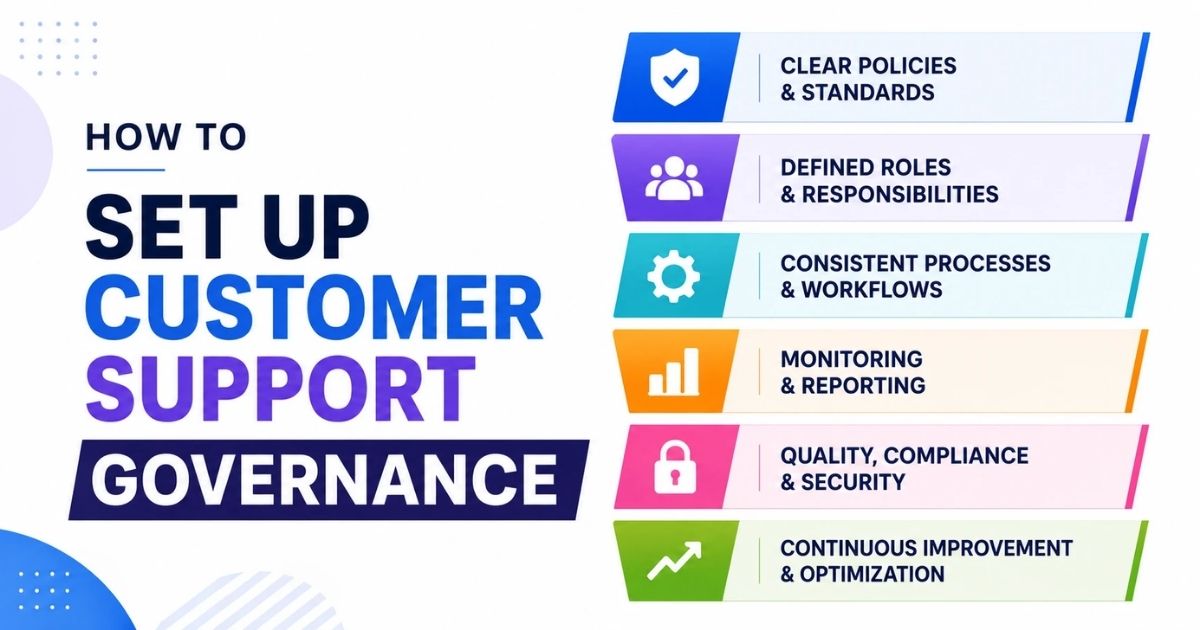
Start by deciding what you want to achieve. Your goals may include improving support quality, increasing customer retention, or identifying product issues. If your focus is on individual interactions, measure CSAT after key touchpoints. If your objective is to predict loyalty and understand long-term relationships, include NPS metrics in your strategy and clarify customer service roles and responsibilities so every team member knows how they influence these scores. Clear goals make it easier to collect meaningful data and evaluate success over time.
Collect CSAT And NPS At The Right Time
Timing has a direct impact on response quality. Send a customer satisfaction score CSAT survey immediately after a purchase, support conversation, or onboarding session to collect immediate feedback while the experience is still fresh. Schedule NPS surveys periodically to understand how customers feel about your business over a longer period, and ensure you can deliver consistently across every touchpoint with a clear multi-channel customer support strategy. Choosing the right timing improves total responses and helps you gather more accurate direct feedback from every customer type.
Centralize Customer Feedback
Customer feedback often comes from multiple sources, including surveys, reviews, support tickets, emails, and live chat, especially when you operate a multi-channel customer support environment. Store all feedback in one centralized system so your team can access it easily, for example by using multichannel helpdesk software for faster support. Bringing quantitative scores together with qualitative feedback gives you a more complete picture of the customer experience, especially when your data flows through a centralized help desk platform that streamlines support. Centralized data also improves operational efficiency by reducing duplicate work and making collaboration easier across teams, particularly when supported by a modern customer service management system.
Analyze Trends And Customer Insights
Collecting survey results is only the first step. Review trends in CSAT, NPS, and qualitative data to identify recurring patterns. Compare feedback across products, support channels, or customer type to understand where improvements are needed, and use dedicated CSAT management tools like EasyDesk to visualize and act on these trends. Monitoring whether you maintain a good CSAT score while improving NPS helps reveal changes in brand perception and overall brand health. Looking beyond a single metric provides deeper actionable insights for future decisions.
Act On Customer Feedback
Feedback only creates value when it leads to action. Identify the most common customer concerns, prioritize improvements, and communicate changes to your teams. Address recurring service issues, improve product features, and respond to customer suggestions whenever possible, while also optimizing key drivers of satisfaction such as average resolution time in customer support. Turning customer feedback into meaningful improvements strengthens customer recommending behavior and builds trust with your customer base. Even small changes can have a positive impact when they address common customer pain points and remove obstacles to customer support productivity for high-performance teams.
Measure Results And Improve Continuously
A customer feedback program should evolve as your business grows. Regularly measure CSAT, monitor NPS metrics, and review business outcomes to understand whether your changes are delivering results. Track progress using both satisfaction scores and customer behavior rather than relying on a single metric, and refine your customer support team operations as you learn what drives better outcomes. Compare new results with previous performance, identify areas for improvement, and continue refining your strategy. Continuous measurement helps improve customer experiences, supports business growth, and ensures your feedback program remains relevant as customer expectations change.
Wrapping Up
Choosing between CSAT and NPS depends on what you want to measure. CSAT helps evaluate customer satisfaction after specific interactions, while NPS provides insight into long-term customer loyalty and advocacy. Both metrics serve different purposes and work best when used together as part of a broader customer feedback strategy.
Combining them gives your team a clearer understanding of customer expectations, service performance, and overall brand perception. By collecting feedback at the right time, analyzing trends, and acting on customer insights, you can continuously improve the customer experience. A well-planned feedback program not only strengthens customer relationships but also supports better decision-making, higher retention, and sustainable business growth.
Frequently Asked Questions
Can A Business Have A High CSAT But A Low NPS?
Yes. A business can deliver excellent service during individual interactions and still have a low NPS. Customers may be satisfied with a recent purchase or support experience but may not feel strongly enough about the brand to recommend it. Using both metrics helps identify this gap and provides a more complete understanding of customer experience.
How Often Should Businesses Send CSAT And NPS Surveys?
CSAT surveys work best immediately after a customer interaction, such as a purchase, support ticket, or onboarding session. NPS surveys are usually sent quarterly, biannually, or annually because they measure long-term customer loyalty rather than satisfaction with a single event. Survey frequency should balance data collection with a positive customer experience.
Should Small Businesses Use Both CSAT And NPS?
Yes. Small businesses benefit from using both metrics because they answer different questions. CSAT highlights immediate service issues that require quick action, while NPS measures customer loyalty and long-term brand perception. Together, they help businesses improve customer satisfaction and make better strategic decisions.
What Can Affect CSAT And NPS Scores?
Several factors influence survey results, including product quality, customer support, response time, pricing, ease of use, and overall customer expectations. Changes in any of these areas can positively or negatively impact both CSAT and NPS. Reviewing customer comments alongside survey scores provides valuable context.
Which Teams Should Monitor CSAT And NPS?
Customer support, customer success, product, marketing, and leadership teams should all review CSAT and NPS data. Each department can use customer feedback differently to improve products, optimize services, strengthen customer relationships, and enhance the overall customer experience. Sharing insights across teams leads to faster improvements and better business outcomes.