IT teams today operate under constant pressure. Hybrid work, expanding cloud and SaaS environments, zero-trust security requirements, and a growing number of digital channels all drive rising service demand. When a major product update rolls out, or a security incident hits, ticket backlogs can spike overnight. Most organizations respond by hiring more agents, but that approach does not scale.
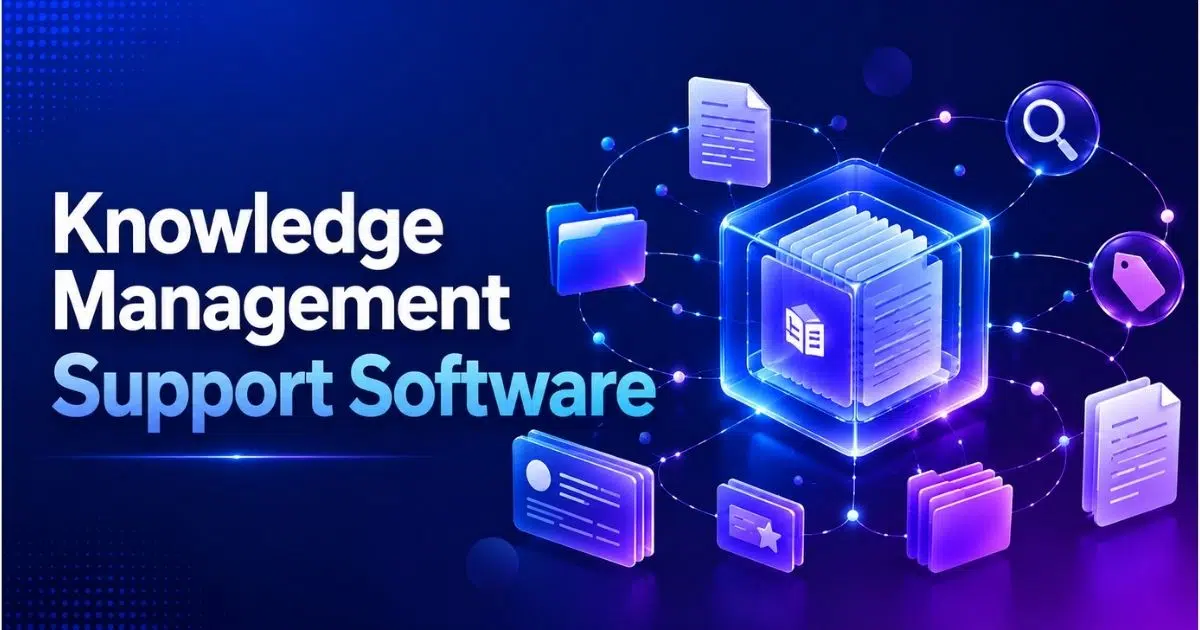
Knowledge management support offers a better path. In practical terms, it means capturing solutions from resolved cases, organizing them so any support agent or AI tool can find them quickly, and delivering consistent guidance across chat, email, portals, and phone. Think of recurring VPN failures, SaaS access requests, or security policy questions. Instead of every agent solving the same problem from scratch, a well-maintained knowledge base lets the next person pick up a proven solution in seconds. Modern knowledge bases serve both human and AI agents, answering routine questions around the clock and covering a broad range of customer issues without adding headcount.
This article walks through what knowledge management support is, the end-to-end knowledge management process, the platform features that make it work, the benefits for IT teams and customers, best practices for sustainable success, and how a purpose-built platform supports these workflows.
What Is Knowledge Management Support
Knowledge management support is the discipline of capturing, organizing, maintaining, and delivering operational knowledge within IT support and customer service environments. It encompasses the people, processes, technology, content, and culture needed to turn individual problem-solving into a shared, reusable asset. Unlike broader knowledge management, which may cover strategic learning or cross-functional innovation, knowledge management support is anchored in service desk operations, ITSM workflows, and contact center interactions where speed and accuracy directly affect service levels.
At its core, knowledge management involves capturing, organizing, sharing, and applying knowledge so that organizational knowledge does not live only in the heads of a few experienced agents. Tacit knowledge is based on personal experience and intuition, and it often walks out the door when employees leave.
Knowledge management support systems act as a centralized repository for information, connecting incident resolution data, product documentation, policy guides, and procedural workflows in one structured knowledge base. This structure supports decision-making and innovation by giving support agents a reliable foundation to work from rather than improvising answers. Purpose-built knowledge base software with integrated canned responses amplifies these benefits by standardizing answers and enabling scalable self-service.
Knowledge Management Support Process
Effective knowledge management support follows a repeatable lifecycle integrated into ticket and case workflows. Rather than treating knowledge as a separate project, the best teams embed it directly into how they handle incidents and requests. This section walks through the process from knowledge capture to continuous improvement.
Knowledge Identification And Capture
The knowledge management process includes knowledge identification, capture, and sharing as its foundational steps. IT teams identify knowledge gaps by analyzing incident and request patterns in systems like Jira Service Management or ServiceNow. When ticket data reveals that the same VPN dropout or MFA failure appears dozens of times per week, that pattern signals a gap worth filling.
Knowledge capture should happen within 24 to 48 hours after resolution, while critical information like error codes, environmental variables, and root causes are still fresh. Agents who delay capture risk losing the details that make an article genuinely useful to the next person who encounters the same problem.
AI-driven search and suggestion tools can help accelerate this step. Some platforms auto-suggest draft articles derived from aggregated closed ticket metadata and chat transcripts. These drafts still require humans to validate accuracy and add context, but they reduce the blank-page problem that discourages busy agents. Both technical knowledge (shell commands, network configurations) and procedural knowledge (updated access workflows from recent policy changes) should be captured. Defined workflows ensure effective knowledge circulation so that resolved cases do not stay trapped in individual inboxes.
Knowledge Creation And Standardization
Raw notes become structured knowledge articles through consistent templates and editorial standards. A well-designed template includes sections for the problem statement, environment details (operating system, browser, network), step-by-step resolution, known limitations, and links to relevant documentation. Metadata fields like category, tags, severity, affected services, and last-updated date make each article searchable and sortable.
Effective content requires proper indexing, tagging, and varied formats. Some issues call for text walkthroughs; others benefit from annotated screenshots or short decision trees. Style guides and review checklists keep language simple enough for new employees and non-technical readers, while preserving the technical information that experienced agents need. The KCS methodology emphasizes avoiding duplication in knowledge articles, so teams should search existing content before creating something new. Mapping each article to specific services or configuration items supports precise search results and helps during audits or outages.
Knowledge Storage And Organization
Knowledge storage works best when built around a centralized repository that serves as a single source of truth. Rather than scattering content across shared drives, wikis, and email threads, a unified knowledge base brings FAQs, runbooks, SOPs, and internal documentation into one searchable location. Research on hybrid retrieval systems shows that combining vector embeddings with keyword matching across multiple data sources delivers fast, accurate results even at enterprise scale.
Categories, tags, labels, and role-based permissions replace chaotic folder trees. Enriching articles with links to ticket history, change records, and product release notes gives agents useful context without forcing them to hunt across systems. Knowledge management systems enhance collaboration by breaking down silos, allowing team members from different departments or regions to contribute to and benefit from the same content. Internal knowledge management becomes far more effective when everyone works from one organized base rather than maintaining separate collections.
Knowledge Delivery To Agents, Customers, And AI
The value of knowledge only materializes when it reaches the right person at the right moment. Modern platforms surface relevant articles inside agent workflows in real time. As an agent types a ticket summary or chat response, the system suggests related knowledge articles, giving immediate access to proven solutions without context switching. This is how agents answer faster and with greater consistency.
For customers, self service experiences through portals and virtual agents let users describe issues in natural language and receive relevant information instantly. Research on semantic search combined with generative AI shows significant accuracy improvements when systems interpret intent rather than just matching keywords (colab.ws). As self-service customer support strategies mature, this matters because 57% of customers prefer engaging through digital channels, expecting to find answers without waiting for a human agent.
AI agents must be governed so they deliver accurate answers from approved knowledge sources only. Retrieval-augmented generation (RAG) architectures force AI to reference source documents, reducing hallucination. Role-based access, versioning, and audit logs ensure that ai agents never surface outdated or sensitive content.
Knowledge Review, Feedback, And Continuous Improvement
Continuous improvement keeps knowledge relevant and useful over time. Without regular review, even the best knowledge base degrades. Teams should schedule review cycles based on article criticality and usage: highly critical or frequently accessed articles every 90 days, long-tail content every 180 days or annually.
Feedback mechanisms like thumbs up/down ratings, inline comments, and direct agent feedback trigger investigations into unclear or incomplete content. Metrics such as article views, attach rates (how often agents link an article to a ticket), deflection rates, and first contact resolution guide priorities for updates, consolidations, or retirements.
Knowledge coaches or content owners play a critical role in curating content, preventing duplicate articles, and retiring outdated material. Communities of Practice can help retain both explicit and tacit knowledge by creating spaces where experienced agents mentor newer team members through shared documentation and discussion. Without this ongoing investment, research shows a 40 to 55% drop in accuracy when a knowledge base is not maintained for 12 months.
Features Of An Effective Knowledge Management Support
Technology does not replace process, but the right tools remove friction and amplify the value of every knowledge article your team creates. Platforms that bundle EasyDesk’s smarter, secure customer support features with robust knowledge capabilities make it easier to operationalize these practices. This section outlines the platform capabilities that matter most for IT and support teams handling real-world scenarios like software rollouts, security incidents, and seasonal demand spikes.
Unified Knowledge Base And Search
A single knowledge base that aggregates FAQs, runbooks, SOPs, internal documentation, and product guides prevents scattered, overlapping content. Support agents should not need to search five different systems to find one answer.
Intelligent search goes beyond basic keyword matching. The best platforms combine semantic search, federated indexing across data sources like SharePoint, wikis, and ticket history, and relevance tuning that boosts newer and more frequently used articles. Filters and facets for product, date, region, and service line help agents narrow search results quickly. Content management systems that unify these sources into a single search experience save significant time per ticket.
Contextual Knowledge Suggestions For Agents
Inline suggestions that appear as agents type ticket summaries or chat responses directly reduce handle time. When an agent is working on a password reset combined with an MFA issue, the system surfaces both the password reset flow and the MFA troubleshooting guide inside the ticket view without requiring the agent to leave their console. Modern IT help desk software for modern teams bakes these capabilities into the daily workflow so agents always have the right context at hand.
Knowledge capture apps built into the agent interface let team members create or update articles during case resolution. This keeps the context fresh and removes the friction of switching to a separate authoring tool. The result is that agents spend less time searching and more time solving.
Self-Service And Customer Experience Capabilities
Customer self service portals with dynamic FAQs adapt based on trending topics and product launches. During an outage or major release, the most relevant content surfaces prominently, helping users find answers before they submit a ticket. Coupling these portals with a knowledge base and canned responses for faster support ensures consistent, high-quality answers at scale.
AI powered chatbots and virtual agents use approved knowledge articles to answer questions around the clock. A B2B SaaS company that deployed an AI support agent ingesting its knowledge base and historical tickets achieved 68% ticket deflection in just 30 days, with response times dropping from roughly six hours to under one minute for deflected cases. At Xero, 95% of questions are answered by self-service content, demonstrating what a mature knowledge-driven self service strategy can achieve. Complementary tools like live chat support for real-time conversations help bridge gaps when automated flows are not enough. Support for multimedia content like annotated screenshots and short videos further improves customer experience for users unfamiliar with technical error messages.
AI-Assisted Knowledge Authoring And Governance
AI features that draft articles from resolved tickets or change records reduce the manual effort of knowledge creation. Machine learning models classify, tag, and detect duplicate content to maintain a clean, non-redundant base. Editors and subject matter experts validate these drafts before publication.
Governance tools include version history, approval workflows, and review reminders tied to policy changes or product releases. Workflow engines and automated workflow software for smarter support reinforce these policies by enforcing approvals and ownership changes consistently. These safeguards are essential because roughly 67% of enterprise AI deployments still lack formal knowledge governance policies. Without them, enterprise knowledge risks becoming unreliable.
Analytics, Reporting, And Insight Generation
Reporting views that correlate knowledge base usage with support KPIs like average handle time, ticket backlog, and contact resolution rates show the real impact of knowledge management support on operations. When combined with ticket automation software for modern support teams, these insights also reveal which workflows can be automated next. Trend analysis identifies topics needing deeper coverage, such as a spike in tickets related to a new integration introduced in 2025.
Connecting knowledge analytics to customer satisfaction scores and cost-per-ticket metrics makes the business case tangible. These insights also reveal where increased collaboration between teams can fill remaining content gaps, and they help leadership prioritize investment in knowledge resources.
Benefits Of Knowledge Management Support For IT Teams And Customers
The benefits outlined here reflect real-world patterns observed across ITSM implementations, contact centers, and SaaS support operations. Where credible, specific outcomes are referenced.
Faster Resolution And Higher First-Contact Fix Rates
Reusable knowledge articles shorten troubleshooting for recurring incidents like email delivery failures and VPN errors. Junior agents resolve issues that previously required escalation by following guided decision trees from the knowledge base. A global enterprise that integrated its knowledge base with AI-driven self-service cut mean time to resolve (non-critical) from roughly 18 hours to about 8 hours and achieved 70% ticket deflection. When knowledge is embedded in the workflow, agents in phone, chat, and messaging channels achieve higher first contact resolution without needing to call back or transfer.
Reduced Ticket Volume Through Self-Service
Knowledge management reduces ticket volume by enabling self-service for simple requests like password resets, access instructions, and device enrollment. AI-powered search and FAQ pages absorb seasonal spikes such as quarter-end reporting or holiday support peaks. Pairing these initiatives with ticket automation to streamline customer support and broader self-service customer support best practices further improves coverage and consistency. Databricks achieved 23% ticket deflection through structured self-service, while Seagate reached 32% in under one year by coupling an AI-surfaced knowledge base with problem management. These reductions free it teams to focus on high-value work like major incident management and strategic projects, helping increase productivity across the entire organization.
Improved Consistency, Compliance, And Risk Management
A centralized, governed knowledge base prevents conflicting answers across channels and regions. This is especially critical for security procedures, regulatory steps, and approval workflows where inconsistency creates real risk. Audit trails and version history show which knowledge article version was in effect during a specific incident, supporting compliance requirements. Knowledge management tools help prevent knowledge loss when employees leave, and knowledge management systems preserve critical know-how that would otherwise disappear with departing staff. Effective management of this intellectual capital protects the organization long-term.
Faster Onboarding And Skill Development
Structured knowledge bases shorten the ramp-up time for new hires from months to weeks by providing guided content, searchable runbooks, and troubleshooting walkthroughs. Knowledge management reduces the learning curve for new hires, allowing new employees to contribute meaningful work much sooner. When these resources are tightly integrated with a ticketing system that structures support work, new agents also learn how to navigate real cases effectively. Knowledge centered service practices encourage agents to learn as they document and use knowledge, turning every resolved ticket into a training opportunity. This is especially valuable for distributed or remote teams where shadowing a senior agent is not always practical. Knowledge management protects organizations from knowledge loss when employees leave, ensuring that hard-won expertise stays accessible regardless of turnover.
Better Customer Experience And Employee Satisfaction
Accessible, accurate knowledge translates directly into tangible customer experience outcomes. Customers get faster answers, lower wait times, and self service experiences that meet their customer expectations. In one documented case, customer satisfaction scores rose from 3.9 to 4.7 after deploying knowledge-driven deflection and faster responses.
On the employee side, agents feel more confident and less stressed when they can rely on trusted knowledge instead of ad hoc help from colleagues. This reduces burnout and turnover. Leadership must champion knowledge sharing to foster a healthy knowledge culture, and successful knowledge sharing requires active buy-in across all levels of an organization. When both knowledge workers and customers are empowered with the right information, loyalty and advocacy follow. Effective knowledge management prevents knowledge loss when employees leave, protecting the organization's ability to resolve issues consistently.
Best Practices For Effective Knowledge Management Support
The right tools matter, but sustainable success with knowledge management practices depends on process discipline and organizational commitment. These practices apply whether you are launching a new initiative or modernizing a legacy system with a structured approach.
Align Knowledge Strategy With Support Objectives
Map knowledge goals to measurable outcomes such as reducing average handle time by 20% within 12 months or cutting SLA breaches by a specific target. Involve stakeholders from IT operations, security, customer support, and product teams in defining priorities. Objectives should guide which services, products, or regions get deep coverage first, ensuring effort goes where ticket volume is highest.
Adopt Knowledge Centered Service Principles
Knowledge centered service habits mean creating or updating knowledge as a byproduct of solving each case, not as a separate project. Assign roles like knowledge coaches who guide agents on article quality and reuse. Always review existing knowledge first to avoid duplicate creation. The KCS methodology emphasizes avoiding duplication, which keeps the knowledge base clean and trustworthy.
Focus On Depth And Quality Before Volume
Start with the top incident types that drive the majority of tickets. The Pareto principle applies here: roughly 20% of incident types cause 80% of volume. Shallow or incomplete answers damage trust and reduce adoption, so focus on creating valuable content that genuinely resolves problems. Regular content audits help retire outdated information and consolidate overlapping articles before they confuse agents or customers.
Unify Data Sources And Reduce Silos
Connect ticketing, CRM, documentation repositories, and collaboration tools to present a single source of truth. Unified indexing respects existing permissions while avoiding duplicate storage. Consistent terminology and tagging across departments improve discoverability. A helpdesk ticketing software that centralizes multi-channel communication makes this unification far easier to implement in practice. When internal knowledge management systems feed from the same data sources, every team member works with the same information.
Design For Discoverability And Ease Of Use
Structure content for least-click access, with intuitive navigation and clear titles that reflect real user queries. Use analytics to refine search synonyms, keywords, and filters based on how people actually search. Simplify language and include step lists, screenshots, or short videos where they truly help comprehension. The goal is to make easily accessible content the default, not the exception. Well-designed helpdesk setups for smoother support combine these content decisions with channel routing and automation. AI powered search that understands natural language further improves discoverability across the entire organization.
Institutionalize Review, Measurement, And Continuous Improvement
Set review cadences for critical, high-traffic, and long-tail knowledge articles with clear responsibility owners. Monitor KPIs such as deflection rate, attach rate, self service success rate, and customer satisfaction for ongoing tuning. Create lightweight feedback loops where agents and customers can flag confusing or outdated content. Integrating these practices with ticket creation and management for structured support keeps operational data and knowledge improvement tightly aligned. Track trends over at least 6 to 12 months to capture the compounding effect of a growing, well-maintained knowledge base. Effective management of this cycle turns knowledge management support from a one-time effort into a lasting competitive advantage.
How EasyDesk Supports Knowledge Management For Modern IT Teams
EasyDesk’s customer support platform is built to make knowledge management support a natural part of everyday support work, not an afterthought. The platform embeds knowledge capture directly into ticket workflows, prompting agents to create or update knowledge articles at resolution time so that critical information is documented while context is fresh.
EasyDesk connects to common data sources like email, chat logs, and configuration management data to enrich knowledge articles automatically with relevant documentation and ticket context. Its support ticket management capabilities ensure that every inquiry is tracked, prioritized, and resolved efficiently. AI agents within EasyDesk suggest relevant articles to support agents and end users in real time, helping both groups find answers faster and with greater accuracy. This means agents spend less time hunting for information and more time delivering accurate answers to customer issues.
Reporting capabilities in EasyDesk show how knowledge management support impacts resolution times, ticket deflection, and customer experience, giving support leaders clear visibility into what is working and where gaps remain. When combined with ticket automation that streamlines customer support and ticketing software built for better customer support, these insights translate directly into continuous process improvements. Role-based access controls and approval workflows ensure that only authorized publishers edit sensitive content, while automatic review reminders keep the knowledge base current and reliable.
For IT teams looking for the right tools to turn every resolved ticket into reusable, trusted knowledge, EasyDesk delivers the practical outcomes that matter: fewer repeat tickets, faster onboarding for new employees, and a smoother support experience across every channel. Its positioning as the best ticket management system for growing teams and a ticketing software built for better customer support reflects this focus on practical, measurable outcomes.
Frequently Asked Questions
How Does Knowledge Management Support Work With Existing ITSM Tools
Knowledge management platforms typically integrate through plugins or built-in modules into tools like Jira Service Management, ServiceNow, or Zendesk. Agents can search, link, and create knowledge articles directly from within their primary ticketing interface without switching between applications. Synchronization of user roles and permissions keeps access controls consistent across systems, ensuring that sensitive content stays protected regardless of which tool an agent is using.
What Is The Difference Between A Knowledge Base And A Document Repository
A knowledge base stores structured, reusable solutions optimized for quick retrieval. Articles are short, standardized, and linked to specific issues or services. A document repository holds broader files like PDFs, slide decks, and reports that may not follow consistent formatting or metadata standards. Modern platforms often index both, but they serve different purposes: the knowledge base drives operational support and self service, while the repository serves archival and reference needs.
How Can Smaller IT Teams Start With Knowledge Management Support
Start with the most frequent support questions and turn them into simple articles, even if stored in a basic wiki or shared document initially. Establish lightweight habits such as capturing one new piece of internal knowledge for every resolved incident. As volume and complexity grow, transition into more advanced knowledge base platforms without losing early content. The key is building the habit of knowledge creation and reuse before investing in sophisticated tooling.
How Do AI Agents Affect Knowledge Governance And Accuracy
AI agents should answer only from vetted, approved knowledge sources rather than open internet content. Clear ownership, review cycles, and change controls must exist whenever AI-generated content is promoted to the main knowledge base. Logging and monitoring of AI responses allow teams to quickly correct misleading or incomplete answers. Without these safeguards, AI agents risk surfacing outdated information or generating inaccurate responses that erode user trust.
Which Metrics Best Demonstrate The Value Of Knowledge Management Support
Key metrics include ticket deflection rate, first contact resolution, average handle time, self-service success rate, and agent onboarding time. Tie these to business outcomes such as cost per ticket, customer satisfaction, and employee retention to make the value clear to leadership. Track trends over at least 6 to 12 months, because knowledge base improvements often have compounding effects that only become visible over time. Article-level metrics like views, attach rates, and feedback scores help pinpoint which content delivers the most value and where knowledge gaps remain.