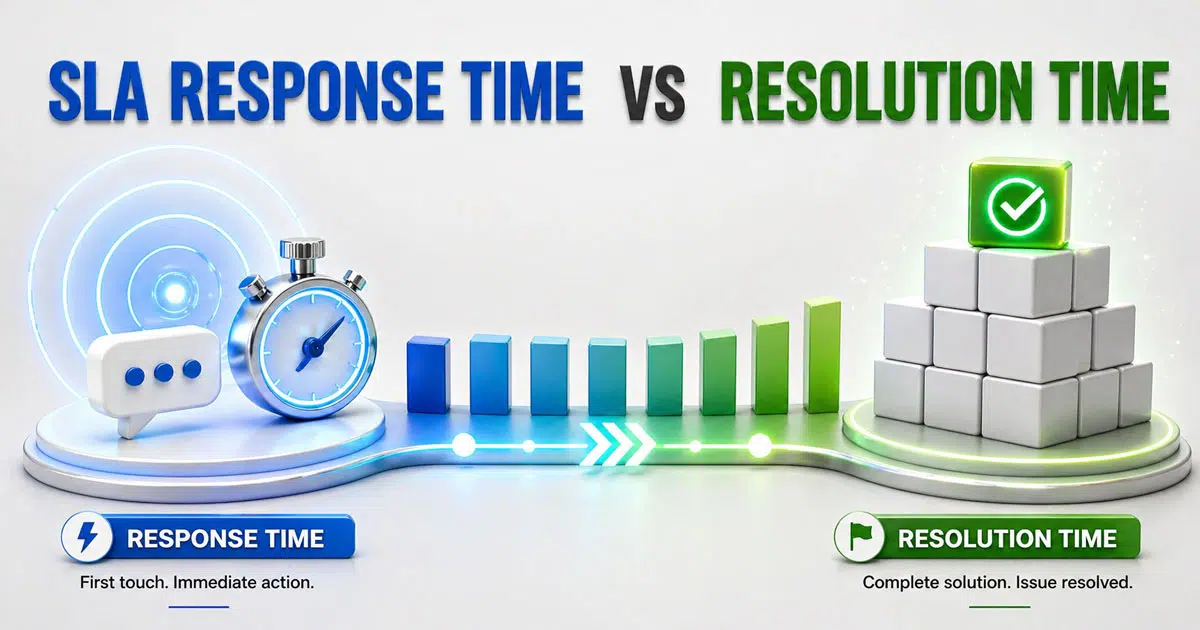
Response time and resolution time serve fundamentally different purposes in service level agreements. Response time measures how quickly your support team acknowledges a customer issue. Resolution time tracks how long it takes to fully resolve that issue from start to finish.
Both metrics matter, but they address different aspects of customer experience. Understanding when to prioritize each one helps IT teams deliver service that meets customer expectations while maintaining operational efficiency.
SLA Response Time Vs Resolution Time: Key Differences
The core distinction is straightforward. Response time measures acknowledgment speed while resolution time tracks complete issue closure.
Response time focuses on the first meaningful response to a service request. This could be an automated acknowledgment, a human message, or an assignment to a support staff member. The goal is letting customers know their issue has been received and someone is working on it.
Resolution time encompasses the entire support process from ticket creation to final closure. This includes diagnosis, troubleshooting, applying fixes, customer verification, and any necessary follow-ups. Resolution time reflects how efficiently your team can fully resolve customer issues.
Both metrics serve different purposes in service management. Fast response builds confidence. Thorough resolution builds trust. Organizations that track both can optimize the complete customer experience rather than just one aspect of service delivery.
Time Measurement And Tracking
Accurate SLA tracking requires clear definitions of when each timer starts and stops. Without precise measurement, performance metrics become unreliable and improvement efforts lose direction.
Metric | Clock Starts | Clock Stops | Typical Range | Primary Focus |
|---|---|---|---|---|
Response Time | Ticket creation | First meaningful acknowledgment | Minutes to hours | Speed of initial contact |
Resolution Time | Ticket creation | Issue fully resolved and verified | Hours to days | Quality of problem solving |
SLA Response Time Measurement
The SLA clock for response time begins the moment a ticket enters your system. This could happen through email submission, chat initiation, phone call logging, or automated monitoring alerts.
The timer stops when your support team provides a first meaningful response. This means more than an auto-generated receipt. It requires acknowledgment that a real person has reviewed the request and taken action.
Typical timeframes vary based on priority levels. P1 critical issues often require response within 15 to 30 minutes. P2 high-severity tickets expect response within one hour during business hours. P3 medium priority allows 2 to 4 hours, while P4 low priority requests may wait until the next business day, making consistent ticket prioritization in customer support essential to meeting these targets.
Response time measures speed of engagement rather than problem-solving capability. A support team can hit every response SLA target while still struggling with resolution times.
SLA Resolution Time Measurement
Resolution time refers to the complete lifecycle from initial contact through final closure. This includes triage, diagnosis, solution implementation, testing, and customer verification that the fix works.
The measurement excludes certain waiting periods in many SLA frameworks. Time spent waiting for customer input, vendor dependencies, or scheduled maintenance windows can pause the clock. These pause rules prevent external factors from unfairly impacting team performance.
Resolution times span much longer periods than response times. P1 critical problems typically target 4 to 8 hour resolution with 24/7 coverage. P2 issues aim for same-day or 8 to 16 business hours. Medium priority tickets often take 1 to 3 business days, while routine requests may extend to 5 or even 10 business days.
Business Impact And Customer Expectations
Both response and resolution times directly affect customer satisfaction and business operations. However, they influence different aspects of the customer relationship.
Impact Area | Response Time Effect | Resolution Time Effect |
|---|---|---|
Customer Confidence | Immediate reassurance | Long-term trust |
Anxiety Management | Prevents frustration during wait | Prevents recurring frustrations |
Ticket Volume | Reduces duplicate submissions | Reduces repeat issues |
Business Continuity | Minimal direct impact | Major operational impact |
Retention | Shapes first impressions | Drives long-term loyalty |
Response Time Impact On Customer Relations
Quick acknowledgment builds customer confidence even before any troubleshooting begins. When end users experience critical issues, knowing that someone received their request reduces anxiety significantly.
Fast response prevents several downstream problems. Customers who feel ignored often submit duplicate tickets, call multiple support channels, or escalate to management. Each of these behaviors increases workload and creates confusion.
Industry benchmarks show that world-class support teams achieve 95% or higher compliance with response SLAs. Meeting response time targets consistently signals reliability and professionalism to customers before you even begin solving their problem.
Resolution Time Impact On Operations
Resolution time directly affects customer productivity and business operations. Every hour a critical system remains down costs money and damages the relationship with your service provider.
For subscription and SaaS businesses, extended resolution times correlate with churn. Customers who experience repeated long wait times for issue resolution will eventually seek alternatives. The operational efficiency of your resolution process determines whether customers stay or leave.
Resource allocation also depends on resolution time performance. Teams with consistently long resolution times require more staff, more escalations, and more rework. Improving resolution efficiency reduces operational costs while improving customer satisfaction.
Team Management And Resource Allocation
Meeting both SLA metrics requires different staffing strategies, skills, and tools. Understanding these requirements helps managers build capable support organizations.
Requirement | Response Time Focus | Resolution Time Focus |
|---|---|---|
Staffing | Coverage during all hours | Skilled specialists |
Automation | Auto-acknowledgment, routing | Diagnostic tools, runbooks |
Training | Quick triage, prioritization | Deep technical skills |
Tools | Ticketing systems, alerts | Knowledge bases, remote access |
Coordination | Shift handoffs | Cross-functional collaboration |
Managing Response Time Requirements
Meeting aggressive response SLAs requires adequate staffing during all coverage periods. P1 incidents need on-call rotations or 24/7 support coverage. The right customer support software can complement staffing by centralizing channels and automating routine steps. Without proper staffing levels, response delays become inevitable during peak hours or after business hours.
Automation provides significant opportunities for improving response speed. Workflow automation in customer support can acknowledge tickets immediately, route tickets automatically, and even provide initial troubleshooting steps through self service options. This reduces the burden on human intervention while meeting customer needs.
Training for response time focuses on efficient ticket triage. Support staff need to quickly assess priority, recognize patterns, and apply the right initial response. This is different from the deep technical training needed for resolution.
Managing Resolution Time Goals
Resolution requires different capabilities than response. Complex issues demand cross-functional skills spanning engineering, operations, and customer support. Teams need specialists who can diagnose root causes and implement lasting solutions.
Clear escalation paths ensure that difficult problems reach the right experts quickly. Without defined escalation procedures, tickets bounce between teams while resolution times stretch beyond SLA targets.
Knowledge bases and documented runbooks accelerate diagnosis. When technicians can reference proven solutions for recurring issues and apply proven ways to cut average resolution time, they spend less time reinventing approaches. Investing in documentation pays dividends through faster resolution and higher quality outcomes.
Performance Tracking And SLA Compliance
Effective SLA tracking requires measuring the right metrics and comparing them against realistic targets. A structured service level agreement helpdesk can clarify which metrics to emphasize and how to operationalize them. Both response and resolution need ongoing monitoring to identify improvement opportunities.
Priority Level | Response Time Target | Resolution Time Target | Compliance Goal |
|---|---|---|---|
P1 Critical | 15-30 minutes | 4-8 hours | 95-100% |
P2 High | 1 hour | 8-16 business hours | 90-95% |
P3 Medium | 2-4 hours | 1-3 business days | 85-90% |
P4 Low | Next business day | 5-10 business days | 80-85% |
Response Time Metrics And Benchmarks
Industry standard benchmarks provide targets for response time SLAs across different channels and priority levels. Phone support expects nearly immediate response. Chat support typically targets under one minute. Email and portal submissions allow several hours depending on priority.
Track performance using median and 95th percentile response times rather than simple averages. SLA tracking software makes it easier to monitor these distributions and intervene before breaches occur. Averages can hide problematic outliers that damage customer experience. The 95th percentile shows how even your slower responses perform.
Compliance rates should target 90% or higher for most priority levels. Organizations aiming for industry benchmarks often set 95% compliance as their goal, with world-class teams exceeding 97%.
Resolution Time Tracking And Analysis
Resolution tracking must account for complexity differences across ticket types. Simple password resets resolve in minutes while complex issues involving multiple systems may take days. Segmenting resolution metrics by issue category provides actionable insights.
Analyze not just whether tickets met SLA but how far beyond target breached tickets went. A ticket resolved five minutes past SLA differs dramatically from one taking three times the allowed duration. Breach magnitude matters as much as breach count.
Balance quality with speed in your measurements. Resolved tickets that reopen or result in low customer satisfaction scores suggest rushing at the expense of thoroughness. Include reopened ticket rates and satisfaction surveys in your resolution metrics.
Common Challenges And Improvement Strategies
Both metrics present distinct operational challenges that require targeted solutions.
Response Time Optimization Challenges
Coverage gaps during peak hours and after-hours periods create the most common response delays. When ticket volume exceeds staff capacity, response times suffer regardless of individual effort.
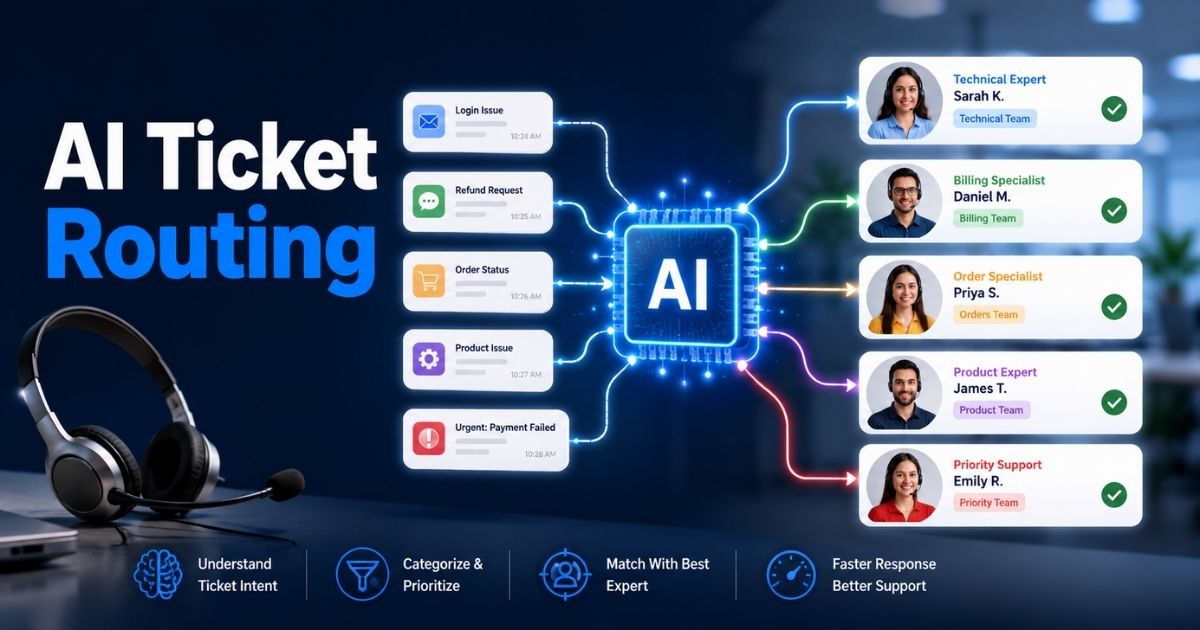
Ticket routing inefficiencies and priority confusion also slow response. If your triage process requires manual review before acknowledgment, you add unnecessary delay. Misclassified priorities mean critical problems wait in low-priority queues.
Solutions include automated triage using artificial intelligence, better priority definitions with clear examples, and staffing models that match demand patterns. Choosing the right balance in the manual vs automated ticketing approaches is key to designing these workflows effectively. Some organizations use tiered acknowledgment where automated systems provide immediate receipt while human responses follow shortly after.
Resolution Time Enhancement Obstacles
Complex issues requiring multiple teams represent the biggest resolution challenge. A well-designed ticket escalation process for faster support helps ensure those problems quickly reach the right experts. When a problem spans infrastructure, application, and business process domains, coordination overhead extends timelines significantly.
External dependencies and customer availability create delays outside your team’s control. Waiting for vendor responses, parts shipments, or customer input can stretch resolution times dramatically. These situations require proactive management and clear communication.
Improvement strategies include establishing dedicated escalation teams, maintaining strong vendor relationships with guaranteed response commitments, building comprehensive knowledge bases that capture institutional expertise, and implementing an SLA management system. Enabling proactive management of dependencies helps resolve issues before they become blockers.
Industry Benchmarks And Best Practices
Different industries apply different standards based on their unique business needs and customer expectations.
Healthcare IT support typically targets P1 response under 15 minutes with resolution in 1 to 4 hours. Patient safety implications drive these aggressive timelines. Financial services similarly emphasize speed due to regulatory requirements and security breaches concerns, underscoring why SLAs matter for service success.
E-commerce businesses often prioritize response time heavily because customer perception during shopping directly impacts revenue. B2B enterprise services may accept slightly longer response times if resolution quality remains high.
Best practice frameworks from ITIL recommend defining clear priority tiers, implementing pause rules for external dependencies, explicitly stating business hours versus 24/7 coverage, and conducting root cause analysis on breaches, all of which align with a robust ticket SLA management approach.
Most importantly, tie your SLA targets to customer expectations rather than internal convenience. Survey customers about what response speed and resolution time they consider acceptable for different issue types. Set targets that meet customer needs while remaining achievable with your resources.
SLA Response Time Vs Resolution Time: Which Should You Prioritize
Neither metric alone defines great customer service. The right focus depends on your specific situation.
Prioritize response time when customer complaints frequently mention slow acknowledgment. If feedback includes phrases like “nobody got back to me” or “I had to call three times,” your response process needs attention. B2C businesses where customers expect immediate attention typically weight response time more heavily.
Prioritize resolution time when issues recur or customers report incomplete fixes. Complex service environments like enterprise software, cloud infrastructure, or managed services often need resolution focus. When the business impact of extended downtime exceeds the frustration of waiting for acknowledgment, resolution becomes primary.
Most organizations benefit from a balanced approach. Set reasonable targets for both metrics and track performance consistently. When resources are limited, let customer feedback guide which metric receives additional investment.
Final Discussion
The choice between response time and resolution time focus ultimately depends on where your current service delivery falls short.
If customers complain about feeling ignored or waiting too long for any acknowledgment, invest in response time improvement. Automation, staffing adjustments, and better routing can yield quick wins, especially when you apply focused automation strategies.
If customers report that problems keep coming back or take too long to fix completely, resolution time deserves attention. This requires deeper investment in skills, knowledge, tools, processes, and often dedicated SLA management software.
Organizations at different maturity levels face different challenges. Newer teams often struggle with response consistency. Mature organizations with solid response performance may need to shift focus toward resolution excellence.
Context matters significantly. Understanding your industry, customer type, and competitive landscape helps set appropriate priorities. What works for a consumer software company may not suit an enterprise infrastructure provider.
FAQs
What counts as a first meaningful response in SLA response time?
A first meaningful response requires human acknowledgment that demonstrates awareness of the issue. This goes beyond automated receipt notifications. It typically includes assignment to an agent, an initial message indicating the request is being reviewed, or preliminary questions gathering more information. The key difference is evidence that a real person has engaged with the ticket.
How do pause rules affect resolution time calculations?
Pause rules stop the SLA clock during periods when resolution cannot proceed due to external factors. Common pause situations include waiting for customer input, vendor response, scheduled maintenance windows, or customer-requested delays. These rules prevent unfair SLA breaches when factors outside your team’s control cause delays. Most SLA tracking systems allow configuring specific pause conditions.
Can response time targets be more aggressive than resolution time targets?
Yes, and this is standard practice. Response time targets are typically measured in minutes while resolution targets are measured in hours or days. This reflects the different nature of each metric. Quick acknowledgment is achievable through staffing and automation. Thorough resolution requires diagnosis, troubleshooting, and verification that cannot be rushed without sacrificing quality.
How should priority definitions impact SLA targets?
Priority levels should create meaningful separation in both response and resolution targets. P1 critical issues affecting business operations might require 15-minute response and 4-hour resolution. P4 routine tasks might allow next-day response and 10-day resolution. The spread between priority levels should reflect genuine differences in business impact. Avoid setting unrealistic expectations at higher priority levels that your team cannot consistently meet.
What tools and practices help teams meet both SLA metrics reliably?
Effective SLA performance requires several capabilities working together. Ticketing systems with accurate time tracking and automatic escalation alerts provide visibility. Knowledge bases give technicians quick access to proven solutions. Automated triage and routing reduce response delays. On-call schedules ensure coverage during all SLA hours. Regular SLA performance reviews identify trends before they become serious problems. The combination of automation for speed and human expertise for quality helps balance both metrics.