Support teams today face a growing challenge: ticket volume keeps climbing, but the budget to hire more agents rarely keeps up. The result is longer wait times, overworked teams, and frustrated customers who want quick answers to simple questions. Most of these questions repeat day after day. Password resets, shipping updates, billing confusion. They fill inboxes and queues while complex issues wait in line. Ticket deflection offers a practical way out.
By giving customers the right self-service resources at the right time, teams can resolve routine inquiries instantly, free agents for work that truly needs a human touch, and deliver a faster, more satisfying customer experience. This article breaks down seven ticket deflection strategies that make it happen, many of which are strengthened by thoughtful ticket automation practices.
Why Support Teams Must Address Repetitive Customer Inquiries
Since 2020, many support teams in SaaS and ecommerce have seen support ticket volume rise by an estimated 20% to 40% year over year. Budgets and headcount, however, have remained largely flat. This imbalance puts pressure on every customer support agent to handle more support requests each day, which leads to slower response times, higher burnout, and declining satisfaction scores. When teams cannot keep up, service quality suffers across the board.
The frustrating reality is that a large share of those incoming tickets are repetitive and low in complexity. Across industries, repetitive questions like password resets, basic billing inquiries, and shipping status checks make up 30% to 60% of total ticket volume. One DTC apparel brand found that 54% of its monthly tickets fell into just four categories: order status (22%), returns policy (14%), sizing and fit (11%), and shipping timeframe (7%). Similarly, a SaaS platform called TaskFlow reported that 28% of its tickets were account access issues, 24% were how-to questions, and 19% were billing inquiries. These routine inquiries drain agent hours that could be spent on complex issues requiring real problem-solving.
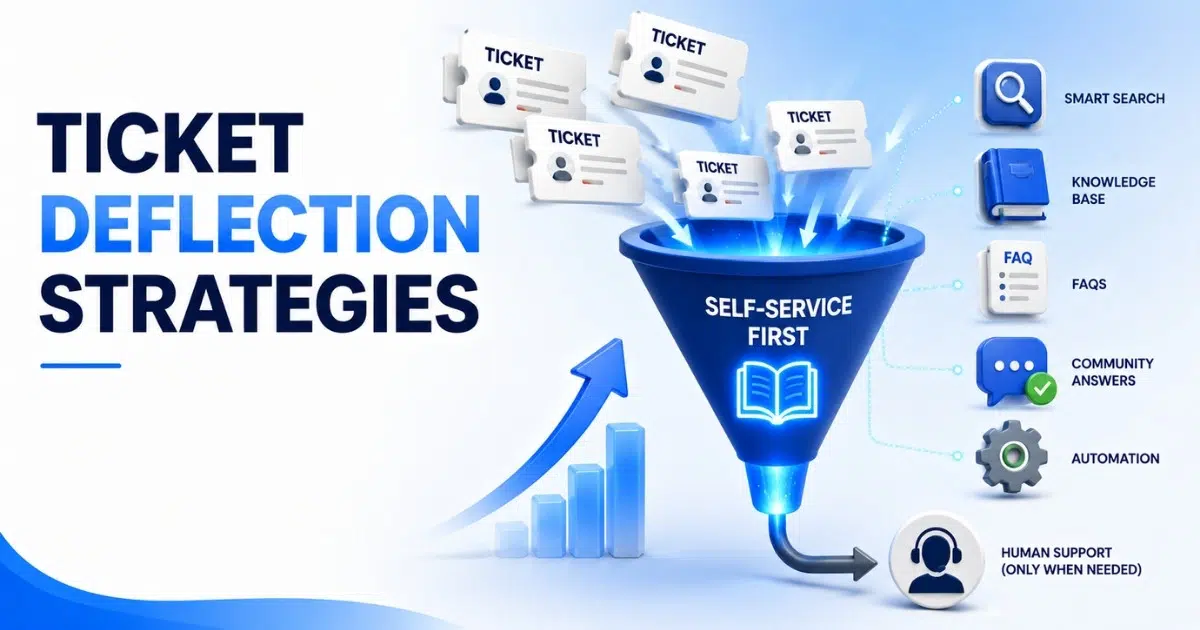
Ticket deflection uses self service content, knowledge base articles, AI agents, and automation to resolve those simple issues instantly, before a ticket ever reaches an agent. Deflecting tier-1 questions allows support teams to focus on complex issues that truly require human judgment. The outcome is faster resolution, higher customer satisfaction, and a support system that scales without requiring proportional headcount growth.
Consider the difference between two teams handling 10,000 tickets per month. A team with a 20% ticket deflection rate still routes 8,000 tickets to agents. A team with a 50% rate handles only 5,000. If average handling time is one hour per ticket, that gap represents 3,000 agent-hours per month, roughly equivalent to two full-time hires. High-performing teams aim to deflect 20% to 40% of incoming tickets as a starting benchmark, then push higher as their self service strategy matures.
What Ticket Deflection Means For Modern Support Teams
Ticket deflection refers to the practice of resolving customer queries through self service channels or automated paths before a formal support ticket is created. The goal is straightforward: when a customer has a question, they find an accurate answer through a knowledge base, a self service portal, an AI chatbot, or in-product help rather than contacting support directly. This approach works best for predictable, high-volume questions where the answer is consistent and well-documented.
It is important to distinguish ticket deflection from two related but different concepts. Ticket resolution happens after a ticket has been created and an agent closes it. Ticket avoidance, on the other hand, often implies hiding contact options or making it difficult for customers to reach a human agent. Effective ticket deflection does neither. Instead, it provides relevant self service resources upfront while keeping clear paths to human support visible for anyone who needs them. The ticket deflection rate measures issues resolved without support tickets being filed, which means the customer's problem was genuinely solved, not just redirected.
Seven Ticket Deflection Strategies That Actually Reduce Repetitive Inquiries
The following six strategies form the core of a practical deflection strategy that support teams can phase in over 60 to 180 days. Each strategy targets a specific cluster of repetitive inquiries, and combining them produces compounding results rather than simply additive ones.
Build A Knowledge Base Customers Actually Use
A well-structured knowledge base is the foundation of every deflection strategy and often contributes a 20% to 30% ticket reduction on its own. Knowledge bases are essential for effective ticket deflection strategies because they give customers direct access to accurate answers at any hour, without waiting for a response during business hours. Effective knowledge bases reduce ticket volume significantly when the content is relevant, well-organized, and easy to find.
Start by mining the last three to six months of support tickets to identify the top 50 recurring questions. Convert each into a clear, step-by-step instructions article with screenshots, short videos, and concrete guidance. A SaaS company decreased support tickets by 45% using a knowledge base built around its most common how-to and troubleshooting questions. A strong knowledge base should be regularly updated so that content reflects current product features, pricing, and workflows. Regularly review and refresh top-performing content for effectiveness, ideally on a quarterly cycle.
Organization must align with how customers think and search. Section labels like "Billing And Payments," "Account Access," and "Getting Started" should mirror the language customers use in their tickets. If customers write "change credit card" or "update payment," the article title should match those words. A well-structured help center is essential for effective ticket deflection, and curating well-organized help centers allows customers to troubleshoot independently without relying on agents. Add a "Was This Helpful?" customer feedback widget to every article and use those scores alongside follow-up ticket data to identify which articles need improvement.
Launch A Self Service Portal For Common Requests
A self service portal serves as a single destination where customers can search the self service knowledge base, access FAQs, and complete routine actions like password resets, plan changes, or order tracking using helpdesk ticketing software. Self-service portals allow users to manage accounts without agent help, which means fewer tickets for common tasks and faster resolutions for customers. Self-service portals can deflect up to 60% of tickets when designed well and kept current.
Design the portal home page with a prominent search field and five to eight "Top Tasks" tiles for the highest-volume actions. Tiles like "Reset Password," "Track Order," "Update Payment Method," and "View Invoice" give customers immediate access to the most common self service options. Self-service tools should be easily accessible and visible from the main navigation, in-product menus, mobile apps, and email footers so customers never struggle to find answers.
Integrating the portal with the ticketing system lets customers log in, see the status of existing tickets, and avoid filing duplicates. This integration also ensures that when a customer does escalate to contacting support, the context from their self service interactions carries forward. Portal analytics, including search terms, exit pages, and time on page, should be reviewed monthly to identify gaps that still generate new customer support tickets.
Deploy AI Powered Agents And Chatbots With Guardrails
AI powered chatbots and virtual agents can handle natural language questions 24 hours a day using natural language processing and a verified knowledge base, offering clear advantages over manual ticket handling. AI agents can handle natural language queries beyond simple scripted responses, which makes them far more capable than the rigid decision-tree bots of a few years ago. Research shows that 62% of shoppers prefer using chatbots over waiting for agents, and AI chatbots can resolve up to 90% of inquiries automatically when trained on strong content.
Start deployment with the highest-volume intents such as password resets, order status, and simple troubleshooting. Design short conversational flows that either solve the issue directly or escalate quickly. Conversational AI can be used to guide users through troubleshooting workflows, walking users through diagnostics step by step before routing to a human agent if needed. E-commerce chatbots reduced support tickets by 25% in documented case studies, proving the practical impact even in early-stage deployments.
Guardrails are critical. Set confidence thresholds so the chatbot only auto-replies when it is confident in the answer. Include a visible "Talk To A Human" option at every step of the conversation to protect customer satisfaction. When the bot encounters a query it cannot resolve with high confidence, it should escalate rather than guess. AI agents should log every interaction and resolution so teams can calculate ticket deflection and containment rates, then retrain models based on unresolved queries. Companies using AI-powered deflection achieve 40% to 60% ticket deflection rates when guardrails, content quality, and escalation paths are all in place.
Use Proactive In Product Guidance And Alerts
Proactive in-product support addresses questions at the exact moment customers feel stuck, reducing the chance they will open a ticket by pairing guidance with automated support workflows. This includes tooltips, walkthroughs, onboarding checklists, and contextual help links that appear based on user behavior rather than requiring customers to search for help on their own.
Product analytics can reveal friction points, such as a feature setup flow where 40% of users abandon at step three. Inserting a tooltip or a link to a relevant articles page at that step directly reduces the volume of "how do I" tickets. During scheduled maintenance or pricing changes, in-app banners can preempt ticket spikes by answering expected questions before anyone asks. Proactive messaging can detect struggle signals and provide assistance automatically, turning potential frustration into a guided experience.
Proactive support also extends beyond the product interface. Automated emails or messages sent when customers reach milestones, renewals, or common trouble spots (first invoice, trial expiration) with links to relevant self service resources help prevent tickets before they form. These touchpoints throughout the customer journey reduce support volume without any agent involvement, and businesses can handle spikes in inquiries without scaling their human support team.
Design Smarter Forms And Workflows For Remaining Tickets
Not every inquiry can be deflected, but interactive intake forms can reduce back-and-forth and often resolve edge cases before submission. Automation can resolve predictable, repetitive support requests efficiently when the right ticket automation workflow logic is built into the form itself.
Add dynamic fields so that as a customer types a subject line, relevant articles from the knowledge base appear beside the form. This self service deflection technique catches many customers who simply did not realize the answer was already documented. Conditional logic, such as a "What are you trying to do?" dropdown, can route customers either to self service options or to the right support queue with full context already attached to the ticket.
For internal support teams, IT service request forms that walk employees through basic diagnostics ("Have you restarted the device?" "Is VPN connected?") before allowing ticket submission can deflect a meaningful portion of software access requests and common troubleshooting tickets, especially when paired with automated ticket management software. Data from these forms also reveals new deflection opportunities when the same issue appears frequently despite existing support resources.
Continuously Measure Ticket Deflection And Customer Feedback
To build an efficient customer support system, teams need to measure ticket deflection consistently and accurately. The deflection rate formula is: Deflection Rate = (Self Service Resolutions / Total Support Demand) x 100. "Total support demand" should include everyone who attempted to contact support, not just those who submitted a ticket. For example, if 2,000 customers visited the help center or opened the chat widget in a month and 800 resolved their issue through self service content, the deflection rate is 40%.
It is worth distinguishing between ticket deflection rate, AI containment rate (the percentage of chatbot interactions that do not escalate), and first contact resolution rate. A good ticket deflection rate is 20% to 40% for most teams. AI-powered teams can achieve ticket deflection rates of 40% to 60%, and high-performing teams can reach deflection rates up to 85% in environments where most questions are predictable and well-documented.
Build a dashboard that shows deflection by channel (knowledge base, self service portal, chatbot) month over month and pairs it with CSAT management and analysis. Track customer satisfaction scores for self service interactions alongside agent-handled ones to ensure deflection success is not coming at the cost of customer experience. Review customer feedback from "Was This Helpful?" widgets, CSAT surveys, and verbatim comments. Negative feedback signals content gaps or automation issues that need attention. Use self service engagement metrics like article views, search terms with no results, and repeat contacts to identify where the self service strategy still falls short.
Benefits Of A Strong Ticket Deflection Strategy
The benefits of ticket deflection extend well beyond fewer support emails. When deflection strategies are implemented with care, they improve nearly every metric that matters to support leadership and the broader business.
Lower Support Ticket Volume
Ticket deflection reduces overall ticket volume significantly, which means agents spend less time on repetitive work and more time on issues that genuinely require human judgment. Many organizations report 30% to 70% reductions in tickets reaching human agents after implementing layered deflection strategies. TaskFlow, a SaaS platform, achieved roughly 72% deflection, dropping human-handled tickets from about 1,400 to approximately 392 per month. Fewer tickets in the queue also means shorter backlogs and more predictable workload planning.
Faster Customer Resolution
With self service solutions and automation handling routine inquiries, response times for common questions drop from hours to seconds. Customers no longer wait in queue for a password reset or a shipping update. Improved customer satisfaction is often achieved through faster self-service resolutions because customers value speed for straightforward issues. When the queue pressure on agents decreases, human-handled tickets also see faster first response times.
Reduced Customer Support Costs
Every ticket resolved through self service costs far less than one handled by a human agent. Effective ticket deflection can lower support costs by $15 to $20 per ticket, which adds up quickly at scale. Handling inquiries through self-service significantly reduces costs and helps teams avoid additional hires by amplifying the inherent benefits of a modern ticketing system. For reference, TaskFlow avoided hiring two additional support agents, resulting in roughly $180,000 in annual cost savings. These cost savings make deflection one of the highest-ROI investments a support team can make, particularly when combined with modern ticketing software for better customer support.
Improved Agent Productivity
When agents are no longer buried under repetitive password resets and order status checks, they can focus on strategic, high-impact work like bug escalations, retention conversations, and process improvements. This shift tends to increase job satisfaction and reduce burnout. Support efficiency improves because agents handle fewer but more meaningful customer interactions each day, which also improves the quality of responses for those complex cases, especially when repetitive requests are routed through ticket automation workflows.
Better Customer Experience And Satisfaction
Fast, accurate help drives higher customer satisfaction. Ticket deflection enhances customer satisfaction by providing instant answers to the questions customers ask most often. TaskFlow's CSAT score rose from 4.1 to 4.6 out of 5 after implementing deflection strategies, and a DTC ecommerce brand saw its score jump from 3.8 to 4.3 over the same period. The key is that customers always see a clear path to a human agent when self service does not fully resolve their issue. Transparency preserves trust.
Common Mistakes That Hurt Ticket Deflection And Customer Satisfaction
Even well-intentioned deflection strategies can backfire if common pitfalls are not addressed. The following five mistakes undermine both deflection effectiveness and the customer experience.
Poor Knowledge Base Organization
When knowledge base articles use internal jargon instead of the language customers actually type, people cannot find answers. Categories that are cluttered, titles that do not match common search queries, and buried content all result in failed self service attempts. The customer gives up and files a ticket anyway. Investing in content creation without investing in organization is one of the most common reasons teams see low deflection rates despite having a large knowledge base.
Limited Self-Service Options
If a team's only self service option is a static FAQ page, many customers who prefer a more guided experience will skip it and head straight to the contact form. Community forums can solve 73% of inquiries through peer support, and community forums can increase engagement and resolve niche issues that a standard knowledge base may not cover. Interactive Voice Response (IVR) systems help reduce call volume significantly for teams that also offer phone support channels. Telecom community forums and live chat support for real-time conversations significantly lowered support ticket volume in several documented cases. Missing any of these self service channels means leaving deflection on the table.
Outdated Help Center Content
Help center content becomes stale as product features change, pricing shifts, and UI evolves. If a knowledge base article shows a screenshot of a menu that no longer exists, customers lose trust in the entire help center. They stop trying self service and go directly to support. The fix is straightforward: tie content review cycles to product release schedules so that every update triggers a content audit of affected articles.
Overreliance On Automation
Deploying a chatbot or AI agent without clear escalation paths, without a human fallback, or with overly broad coverage before confidence levels are high enough can frustrate customers quickly. If someone feels trapped in a loop with a bot that cannot answer their question, customer satisfaction drops sharply and long-term trust erodes. Customer service software should always make escalation to a human agent simple and visible, with robust ticket creation and management capabilities.
Ignoring Customer Feedback And Search Behavior
Self service tools operate in a feedback loop, and ignoring that loop is a critical mistake. If teams do not monitor which articles receive low "helpful" votes, which searches return no results, or which pages have high exit rates, they will not know where gaps exist. Regular review of customer feedback and search analytics is the only way to keep a deflection strategy aligned with what customers actually need. Without this data, teams cannot calculate ticket deflection accurately or improve it over time.
How EasyDesk Supports Effective Ticket Deflection
EasyDesk brings together the tools support teams need to implement ticket deflection without adding complexity. At its core, EasyDesk centralizes knowledge base construction and hosting, making it simple to create step by step articles with screenshots and videos, organize content by customer intent, and ensure titles match the way customers phrase their questions. The platform also supports a fully branded self service portal where customers can complete routine actions, check ticket status, and find answers independently, all in one place.
EasyDesk includes AI powered agents, advanced customer support features, and chat widgets that can be trained on your knowledge base and historical tickets. These agents are built with guardrails: confidence thresholds, explicit escalation options, and continuous learning from unresolved queries. For teams that need multilingual support, EasyDesk's automated ticket resolution capabilities and centralized platform help serve a broader customer base without multiplying headcount. The platform's knowledge base software is designed so teams can start small with a simple FAQ and scale up as their deflection strategy matures, benefiting from a leading ticket management system.
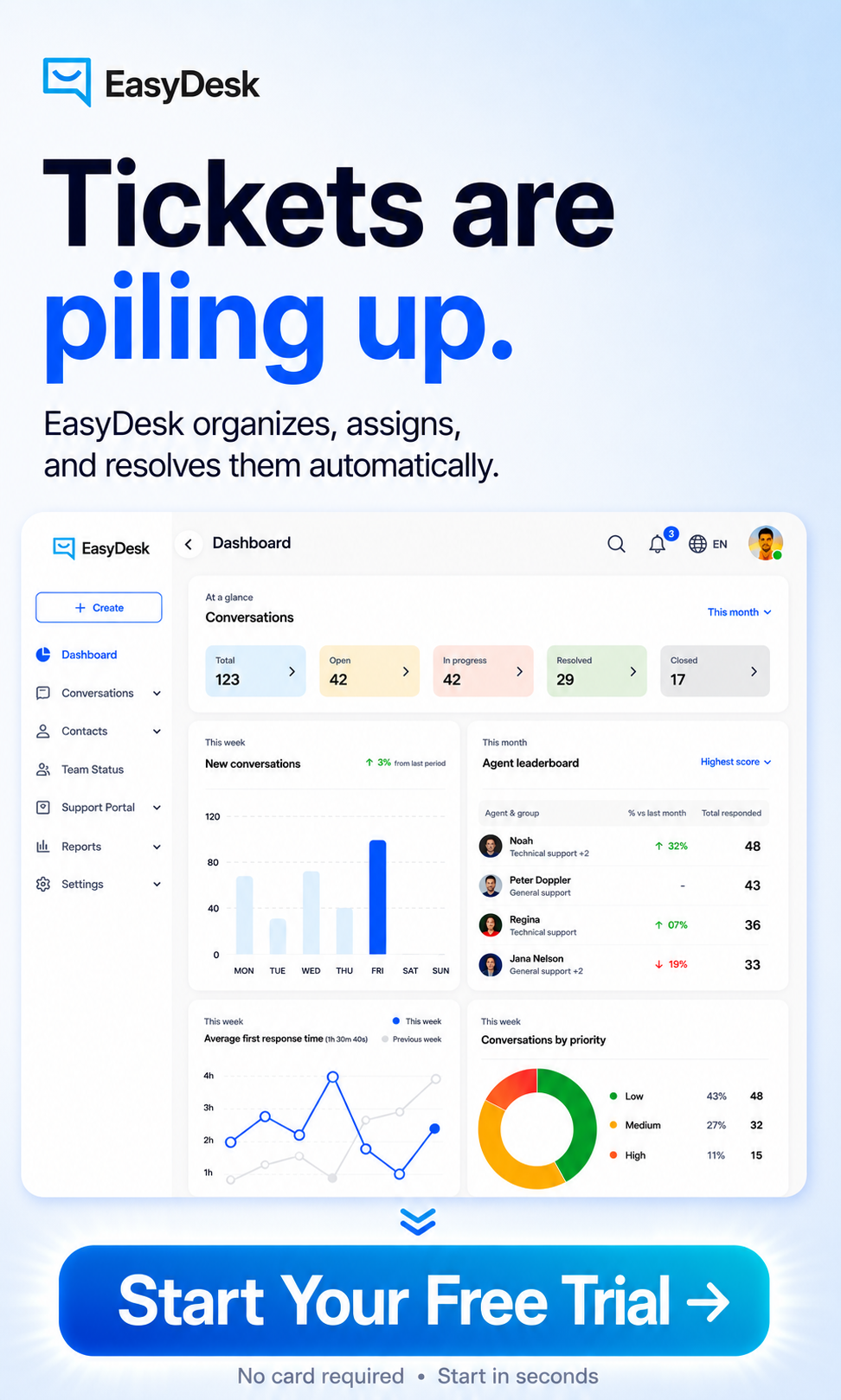
Reporting dashboards in EasyDesk let you measure ticket deflection by channel, by intent category, and over time. You can track self service resolutions, CSAT scores, repeat contacts, and compare satisfaction for deflected versus agent-handled interactions. Whether your team handles 500 or 50,000 support requests per month, EasyDesk provides a clear path to reducing repetitive inquiries while maintaining the kind of customer experience that builds loyalty through the #1 ticketing software system. Explore how EasyDesk can help your team build a deflection strategy aligned to your current ticket patterns and growth trajectory.
Frequently Asked Questions
How Long Does It Take To See Results From A Ticket Deflection Strategy?
Teams often see measurable reductions in repetitive ticket volume within 30 to 60 days after launching a basic knowledge base and self service portal. Early wins typically come from improving existing content and plugging gaps in the top ticket categories. Deploying AI powered tools takes longer because content, model training, and intent coverage need time to mature. Most teams see larger, compounding gains over three to six months as their self service content broadens and chatbot confidence improves through iterative retraining.
What Is A Good Ticket Deflection Rate For Most Teams?
A good ticket deflection rate is 20% to 40% for most teams with basic self service support in place. Organizations that invest in AI agents, strong knowledge bases, and contextual in-product guidance can reach 40% to 60% deflection on routine issues. Exceptional programs in high-volume, low-complexity environments may push to 75% or higher, but teams should always verify their measurement methodology to ensure the rate reflects genuine resolutions rather than customers who simply abandoned.
Which Types Of Issues Should Never Be Deflected?
Issues involving potential fraud, data breaches, serious billing disputes, accessibility complaints, legal or compliance queries, and any sensitive personal matters should always have an immediate, clear route to a human agent. Even if self service information exists for these topics, the risk of a wrong or tone-deaf automated response is too high. These categories require human judgment and empathy that no chatbot can reliably provide today.
How Can Small Support Teams Implement Deflection Without A Big Budget?
Start by auditing ticket history to identify the top repetitive issues. Build a simple FAQ or knowledge base page mapped to those issues. Add suggested articles at the contact form level so customers see relevant self service resources before submitting a ticket. Use free or low-cost chatbot tools for narrow, high-volume intents. Semantic search capabilities in many modern help desk platforms can further improve discoverability without custom development. Measure results carefully and iterate before investing in more advanced AI solutions.
How Do I Know If Customers Actually Prefer Self Service Over Tickets?
Industry surveys consistently show that many customers prefer self service for speed and convenience, especially for simple issues. To validate this for your own organization, track self service engagement metrics such as help center article views and chatbot interaction rates. Then compare repeat contact rates and CSAT scores for self service users against those who filed tickets. If self service usage is high, repeat contacts are low, and satisfaction scores hold steady or improve, your customers are genuinely benefiting from the self service experience.