Businesses today face rising customer expectations for faster support and instant responses. Long wait times and delayed replies can quickly reduce customer satisfaction and harm brand reputation. As support volumes grow, many companies look for ways to improve response speed without overwhelming their support teams.
Customer support automation offers a practical solution. By automating repetitive tasks and routine inquiries, organizations can respond to customer requests more efficiently while allowing agents to focus on complex issues. Automation tools such as chatbots, automated ticket routing, and self-service portals help businesses manage higher ticket volumes without sacrificing service quality.
Knowing when to automate customer support is important. The right balance between automation and human support ensures faster response times, improved efficiency, and a better overall customer experience.
What Is Customer Support Automation
Customer support automation goes beyond simple chatbots answering basic questions. It includes automated customer service tools like conversational AI agents, predictive ticket routing, self-service options, and workflow automation that processes customer inquiries from start to finish.
Modern automated customer service software uses natural language processing to detect intent and machine learning to personalize responses. These automated systems integrate with your CRM to provide context-aware answers. For example, Klarna’s AI assistant now handles two-thirds of all conversations, equivalent to 700 support agents. Their resolution time dropped from 11 minutes to just 2 minutes. That is the kind of customer service automation that moves the needle for growing teams serving customers globally.
Difference Between Automated And Human Support
Both automated and human support have their place. The key is knowing when each approach serves your customers best.
Response Speed And Availability
Automated systems deliver instant replies around the clock. H&M saw 70 percent faster responses after implementing automation, while Klarna achieved 82 percent improvement. Human agents are limited to business hours and shift schedules, which creates delays for customers in different time zones. For routine tasks like order status checks or password resets, allowing customers to get immediate answers through self service options makes sense.
Handling Repetitive Support Requests
AI agents can resolve up to 80 percent of routine service tasks without human intervention. Companies save an average of $127,000 yearly by automating repetitive tasks at 60 to 80 percent automation rates. Self-service costs about $1.84 per interaction compared to $13.50 for agent-assisted support. When the same customer questions appear dozens of times daily, automation tools free your support agents to focus on solving complex problems.
Problem Solving And Critical Thinking
Generative AI achieves 92 percent accuracy in intent recognition and reduces escalations by 45 percent. However, automation technology falters when facing novel situations requiring human inference. Complex issues that need creative problem-solving or deep product expertise still benefit from human interaction. Your live agents bring critical thinking skills that virtual assistants cannot replicate.
Personalization And Customer Empathy
AI uses customer data to deliver tailored responses, and 92 percent of adopters report improved customer satisfaction scores. Yet automated support lacks genuine empathy. About 79 percent of Americans still prefer human agents for sensitive matters. While 20 percent of customer experience teams use AI for sentiment analysis, the human touch remains essential for building customer relationships during difficult conversations.
Escalation And Complex Issue Resolution
Advanced AI escalates roughly 35 percent of cases to human agents with full context attached. This reduces unnecessary escalations by 46 percent compared to older systems. Support agents handling AI-assisted tickets manage 35 to 40 percent more volume. The goal is not replacing human agents but routing customer requests to the right agent at the right time.
Importance Of Response Time In Customer Support
Speed shapes customer loyalty more than most teams realize. When customers contact support, they expect a quick resolution.
Customer Expectations For Instant Support
A full 54 percent of customers now consider fast responses a must-have rather than a nice-to-have. About 57 percent believe voice assistants will grow in importance, and 56 percent expect natural conversations with bots by 2026. These rising expectations mean your customer service team cannot afford delays on simple requests.
Impact Of Slow Response Times On Retention
Delays directly increase churn rates. Companies using customer service automation tools see 3.5 to 8 times return on investment, partly through improved retention. When customers wait too long for answers, they leave. Monitor customer feedback closely to catch warning signs before they become cancellations.
Response Time Metrics Support Teams Track
Key metrics include first response time, average handle time, and resolution time, all of which are central to reducing customer support response time with automation. Automation reduces average handle time by 40 percent through precise routing and instant acknowledgments. Track deflection rates to measure how many customer issues are resolved without creating support tickets. These numbers tell you whether your automation opportunities are paying off.
Relationship Between Response Speed And Satisfaction
The connection is direct. About 92 percent of teams report customer satisfaction gains after implementing automation. Instant first response times correlate strongly with higher satisfaction scores. When customers get quick answers to their questions, they rate the experience positively regardless of whether a bot or human helped them.
Support Response Time Benchmarks
Top-performing teams aim for under one minute first response time. AI-powered systems hit near-instant response compared to multi-minute averages for human-only queues. If your email replies take more than four business hours or chat responses exceed two minutes, consider where intelligent notifications and automated ticketing could help.
Signs Your Support Team Should Start Automating
How do you know when your team is ready? These signals suggest automation should move up your priority list.
Increasing Ticket Volume
When ticket volume grows faster than your hiring plan, something has to give. Many startups hit this point after a product launch or funding announcement. Track monthly ticket volume and tickets per active customer to spot unsustainable trends. Automation helps you scale without immediate headcount increases.
Repetitive Customer Questions
Pull a report of your top topics over the past 30 days. If password resets, invoice downloads, or shipping status questions dominate the list, those are prime automation candidates. A knowledge base and canned responses turn your best answers into reusable content. This handles repetitive customer questions without tying up your team.
Delayed First Response Times
When first response consistently misses your SLA targets, customers start sending follow-up messages. This creates a backlog spiral that slows everything further. Automated notifications and instant acknowledgments buy time while routing urgent issues appropriately.
Overloaded Support Agents
Support agents at capacity cannot deliver quality service. Agent productivity drops when the queue never ends. Automation gives your team breathing room by handling routine tasks automatically. The result is agents who can think clearly about customer needs rather than rushing through tickets.
Limited Availability Outside Business Hours
If your customers span multiple time zones but your team works a single shift, you have coverage gaps. A contact center without after-hours support loses opportunities. Automation covers nights, weekends, and holidays with instant answers while queuing urgent issues for the next available agent.
When To Automate Customer Support Tasks
Customer support automation works best when applied to repetitive and predictable tasks. Businesses should focus on automating high volume and low complexity support activities before expanding automation to broader workflows. Strategic automation helps teams respond faster while maintaining service quality and consistency.
Automating FAQ And Basic Queries
Many customer support requests involve common questions that repeat frequently. Issues such as password resets, account access problems, feature explanations, or subscription updates appear across thousands of tickets. These requests are ideal candidates for automation.
AI-powered chatbots and automated help systems can answer frequently asked questions instantly. When these tools connect to a well-organized knowledge base, they can resolve a large portion of tier one support tickets. Industry research shows that AI-based support systems can resolve nearly 65 percent of simple customer issues without human involvement.
Automating FAQ responses allows customers to receive answers at any time of the day. At the same time, support agents gain more time to address complex or technical issues.
Automating Ticket Routing And Prioritization
Ticket routing and categorization often require manual review from support teams. Agents typically read each ticket and assign it to the appropriate department. This process consumes valuable time and slows response speed.
Automated ticket routing solves this challenge by categorizing incoming requests using keywords, customer segments, or communication channels, using automated ticket assignment methods to match each issue with the right handler. Once the system identifies the request type, it automatically assigns the ticket to the appropriate team. For example, billing inquiries go directly to finance teams while product bugs route to engineering teams.
Automated routing systems can reduce average handling time by nearly 40 percent while maintaining high accuracy rates, especially when paired with automated ticket creation workflows. Faster routing ensures customers receive help from the right department without delays.
Automating Customer Self Service
Self-service solutions allow customers to solve problems without contacting support teams. Many companies build searchable help centers, knowledge bases, and automated guides that answer common questions as part of a broader self-service customer support strategy.
Currently only a small percentage of customers resolve issues independently, yet studies show that strong self-service resources can allow up to 80 percent of simple issues to be resolved without agent involvement, particularly when supported by ticket automation for customer support.
Encouraging customers to explore self service options before submitting a ticket significantly reduces support workload. It also improves customer satisfaction because users find answers faster.
Automating Status Updates And Notifications
Customers often contact support repeatedly just to check the progress of an existing issue. This creates unnecessary ticket activity and increases agent workload.
Automated status notifications address this problem by informing customers whenever ticket status changes. Updates may include confirmation of ticket creation, investigation progress, or final resolution messages.
Businesses can also send proactive notifications about known service issues or maintenance updates. This approach reduces repetitive inquiries and builds trust through transparent communication.
Automating Support Workflows
Workflow automation connects multiple support tasks into a single automated process. Instead of handling tasks separately, systems can automatically trigger actions when certain conditions occur.
For example, refund approvals below a specific amount may be processed automatically, while subscription changes can trigger billing updates and confirmation messages instantly.
Organizations that implement full workflow automation often achieve automation rates between 60 and 80 percent for routine support operations, especially when they follow workflow automation best practices in customer support. These connected workflows allow support teams to handle higher ticket volumes without increasing staffing requirements.
Customer Support Tasks You Should Not Automate
Automation works best when you know its limits. Reserve 20 to 40 percent of interactions for human agents.
Complex Technical Issues
When problems require deep expertise beyond standard troubleshooting, humans excel. The 92 percent accuracy rate for AI intent recognition still means 8 percent get it wrong. Complex issues with multiple variables or unusual configurations need experienced support agents who can investigate thoroughly.
Sensitive Customer Complaints
About 79 percent of Americans prefer human interaction for complaints. When customers are frustrated or upset, empathy matters more than speed. Phone support or live chat with a real person helps de-escalate situations. Automated tools lack the emotional intelligence these moments require.
Escalations And Refund Requests
High-stakes decisions benefit from human judgment. Refund approvals, contract modifications, and escalated complaints involve nuance that automation misses. The human touch builds trust when money or account standing is on the line.
High Value Customer Interactions
About 75 percent of customer experience leaders split AI and human responsibilities strategically. Enterprise accounts, key partnerships, and high-spending customers deserve personalized support. These relationship-driven conversations build long-term customer loyalty that automation cannot replicate.
Relationship Driven Conversations
Some interactions are about connection rather than resolution. Checking in with a customer after a major purchase, celebrating their success, or working through a complex onboarding requires human warmth. Resolving issues is only part of what makes great support memorable.
Benefits Of Automating Customer Support
Customer support automation helps companies manage growing ticket volumes while improving response speed and service consistency. In business today, organizations combine automation tools with human expertise to streamline workflows, support customers across channels, and improve operational efficiency.
Faster Ticket Routing And Response Handling
Automation helps teams route tickets instantly through an automated ticket management system. Instead of manually reviewing every request, systems automatically route tickets to the appropriate department based on keywords, customer type, or support channel.
Support teams can set rules that determine how tickets move through the workflow. This reduces delays and ensures customer issues reach the right specialist quickly. Automated routing allows support teams to handle customer interactions more efficiently while keeping response times low.
Reduced Repetitive Customer Service Tasks
Customer service agents often spend a large portion of their workday performing repetitive customer service tasks such as answering common questions or categorizing requests. Automation tools reduce this burden by responding to frequently asked questions automatically.
Self service portals and AI powered chatbots guide customers toward solutions using knowledge base content. These automated support options allow agents to focus on complex issues that require human expertise instead of repeating the same responses.
Improved Customer Experience Through Instant Information
Automation platforms deliver relevant information quickly when customers contact support. Instead of waiting for a response, automated systems analyze customer questions and present helpful solutions immediately.
Features such as automatic translation also allow companies to support customers globally across different languages. This approach improves accessibility while ensuring that customers receive consistent service across all communication channels.
Proactive Communication During Service Issues
Automation allows companies to provide proactive support when unexpected problems occur. For example, businesses can notify users during system outages before customers contact support, especially when they use a modern ticketing system to streamline support.
These automated alerts inform customers about service interruptions, expected resolution times, and temporary solutions. Proactive updates reduce ticket volume and help organizations maintain transparency during technical disruptions.
Scalable Customer Support Operations
Automation makes it easier for businesses to manage support growth without dramatically increasing staffing by introducing ticket automation software for modern support teams. Automated systems can handle thousands of requests simultaneously while routing complex issues to customer service agents when necessary.
This hybrid approach ensures human agents focus on solving complex problems while automation manages routine support requests. As a result, companies can maintain strong customer relationships while keeping support operations efficient and scalable.
Best Practices For Implementing Support Automation
Rolling out automation requires planning. These practices maximize your chances of success and help you choose between manual vs automated ticketing approaches.
Start With Repetitive Tasks
Begin with your top recurring queries. Teams often see measurable first response improvements within 30 days when they focus on high-volume, low-complexity tickets. This builds confidence before tackling more ambitious automation projects.
Use AI With Human Oversight
Only 25 percent of contact centers achieve full integration despite 88 percent using some AI. The gap exists because teams skip oversight. Keep humans in the loop to catch errors, handle edge cases, and maintain quality. AI agents perform best as assistants rather than replacements.
Monitor Automation Performance
Track customer satisfaction separately for automated versus human-handled conversations. Monitor deflection rates, transfer rates, and drop-off points. Review transcripts monthly to ensure answers remain clear and helpful. IVR software and chatbots need regular tuning.
Maintain A Human Escalation Path
Always provide a clear way to reach human agents. Advanced automation reduces escalations by 46 percent by handling more upfront, but customers must never feel trapped. Design flows that route to humans when confidence drops or emotions run high.
Improve Automation With Support Data
Use customer feedback to refine your automations continuously. Omnichannel support generates rich data about what works and what frustrates customers. Adjust greet callers scripts, update knowledge base articles, and expand automation as you learn what customers need most.
How EasyDesk Helps Teams Automate Customer Support
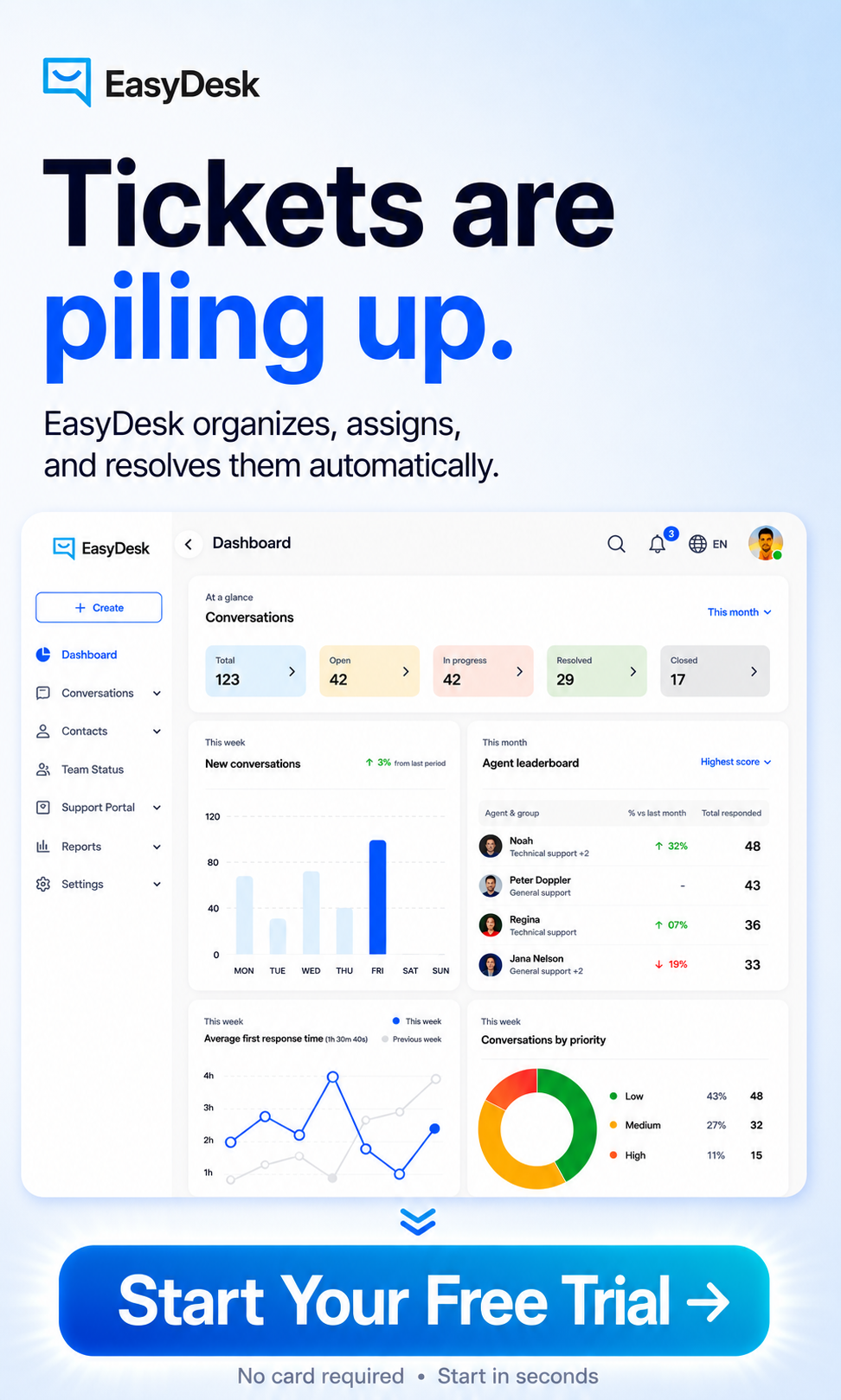
EasyDesk’s customer support platform brings all your customer support channels into one place where automation and human agents work together seamlessly. Ticket automation routes incoming requests to the appropriate department based on keywords, channel, and customer type, cutting manual triage time significantly.
Workflow automation handles end-to-end processes like SLA tracking, automatic priority tags, and escalation alerts when deadlines approach. Your team stays informed without constant inbox monitoring.
The built-in EasyDesk features such as the knowledge base and canned responses turn your best answers into reusable content that both agents and automated systems can access instantly. Collaboration tools within EasyDesk helpdesk ticketing software ensure smooth handoffs when tickets need human attention.
Response time improvements mirror the 3x faster response times EasyDesk achieved for a growing team, similar to the 74 percent first response reductions seen industry-wide. Small teams gain scalable infrastructure without tool sprawl. Start your 14-day free trial of the EasyDesk ticket management system to see how much faster your support can become.
FAQ
How Much Of My Customer Support Should I Aim To Automate?
Most growing teams find a good balance when 60 to 80 percent of incoming questions are handled through self service, chatbots, and automated workflows. The remaining 20 to 40 percent stays with human agents who focus on complex cases, high value accounts, and emotionally sensitive situations. Start small, measure impact, and expand gradually rather than targeting a specific percentage from day one.
Will Automation Hurt My Customer Satisfaction Scores?
Satisfaction usually improves when automation removes wait time and delivers quick answers for straightforward questions. Problems appear only when bots block access to humans or give confusing responses. Monitor CSAT separately for automated and human-handled conversations so you can spot and fix issues early. About 92 percent of teams report satisfaction gains after implementing automation properly.
How Long Does It Take To See Results From Support Automation?
Teams often see measurable improvements in first response time and backlog within 30 days when they focus on top recurring questions. Deeper gains like fewer escalations and better deflection rates become clear over one to three months. Set baseline metrics before turning automation on so comparisons remain straightforward.
Do Small Teams Really Need Customer Support Automation?
Even a three-person support team benefits from simple rules, canned responses, and a shared knowledge base. Early automation habits make later growth less painful because the structure already exists. Start with basics like autoresponders and article suggestions so setup stays light but meaningful.
How Do I Choose Which Tools To Use For Automation?
Look for a platform that centralizes channels, tickets, SLAs, and knowledge base so you avoid juggling multiple disconnected tools, such as a ticketing software built for better customer support. Prioritize ease of setup, clear reporting, and good support over long feature lists your team may never use. Try a limited pilot to see how workflows match your day-to-day reality before committing fully.