Customer expectations keep rising, but support teams are already stretched thin. More tickets, more channels, and tighter SLAs make manual ticket assignment harder than ever. A ticket sent to the wrong agent can delay resolutions, frustrate customers, and create extra work for the entire team. Research shows AI-powered support systems help reduce response times, improve efficiency, and lower operational costs for businesses.
That is why many modern help desks are turning to AI ticket routing. Instead of relying on manual triage, AI analyzes ticket content, understands customer intent, and sends requests to the right agent automatically. The result is faster resolutions, better customer experiences, and more productive support teams. AI-driven routing can also improve first-contact resolution and help teams maintain SLA targets at scale.
In this guide, you'll learn how AI ticket routing works, why support teams are adopting it, and how to implement it successfully in your organization.
What Is AI Ticket Routing?
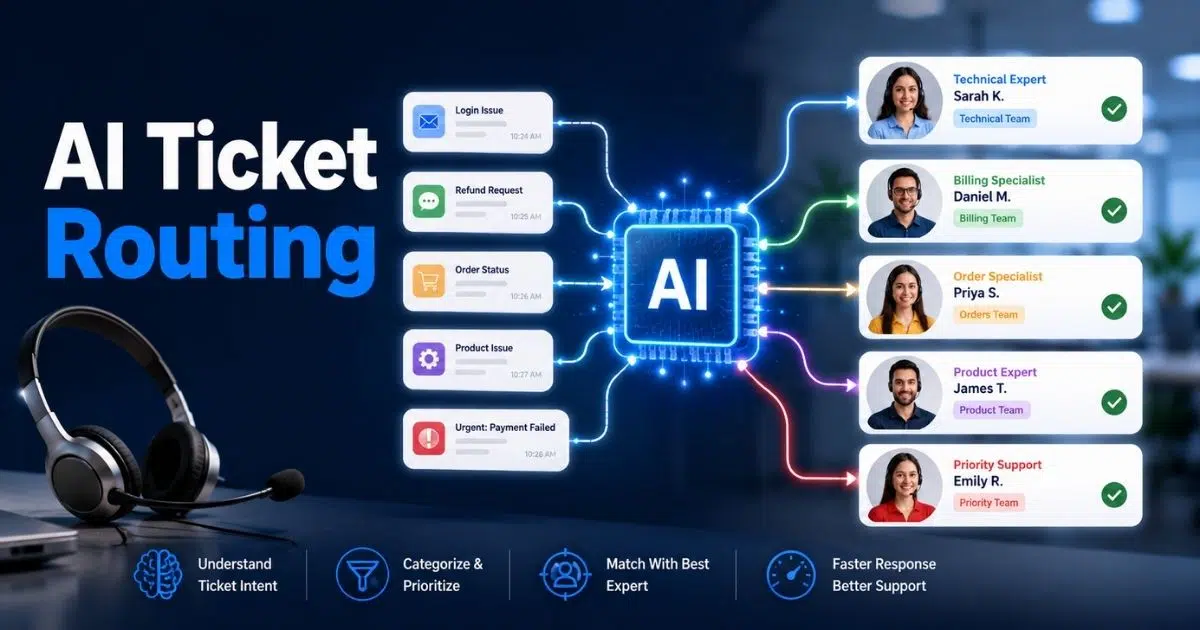
AI ticket routing is the process of using an AI ticketing system to automatically analyze, categorize, prioritize, and assign support requests to the right person or team. Unlike traditional ticketing systems that rely on manual processes, AI-powered ticketing systems use machine learning and natural language processing to understand customer requests, customer history, and ticket context. This form of automated ticket routing helps support teams handle high ticket volumes while maintaining service quality and reducing operational costs. AI can analyze incoming tickets, determine urgency, and route them to the best-fit agent in seconds.
Modern ticketing systems do much more than simple ticket management. An AI system can evaluate sentiment analysis, customer preferences, and historical resolution data to improve ticket handling and customer experience. By automating repetitive tasks and routine tasks, customer service agents can focus on complex issues that require human intervention. This boosts agent productivity, improves response times, and leads to higher customer satisfaction and stronger customer relationships, especially when teams know how to manage support tickets efficiently using EasyDesk. As customer expectations continue to rise, AI-powered ticketing gives support operations a clear competitive advantage.
At its core, AI ticket routing work is about matching the right customer queries with the right service teams at the right time. With intelligent routing, skill-based routing, predictive analytics, and AI models that learn from customer feedback and historical data, businesses can improve support quality and deliver better customer service operations at scale. AI-powered systems can also connect with a knowledge base and self-service options, helping customer support teams resolve issues faster and achieve higher customer satisfaction scores, especially when they use a secure, efficient customer support platform like EasyDesk.
How Does AI Ticket Routing Work?
AI ticket routing may look simple from the outside, but a lot happens in seconds. An AI-powered ticketing system reads support tickets, understands customer intent, and sends each request to the right team automatically. As customer expectations rise, support teams need faster ways to manage growing ticket volume and maintain service quality. In fact, 82% of service representatives say customer demands are increasing across channels.
Ticket Analysis And Classification
Every ticket starts with data. The AI system scans customer requests and support requests as soon as they arrive. Using natural language processing and machine learning models, it reads text, tone, and context to understand what the customer needs.
Modern AI ticketing systems work by identifying keywords, customer history, and customer preferences. An AI-powered system can tell whether a ticket is about billing, refunds, or technical issues. This process improves ticket management and reduces manual processes. Better classification also leads to faster response times and stronger support quality.
Intent And Sentiment Detection
Not every customer query carries the same urgency. AI ticket routing uses sentiment analysis to detect emotions such as frustration or urgency. The system can determine whether a customer service request needs immediate attention.
Artificial intelligence also identifies customer intent from customer interactions. For example, the AI may recognize requests related to account access or product returns. This helps customer service operations prioritize important cases first. Faster prioritization improves customer experience and helps service teams meet SLA targets.
Smart Agent Matching
After classification, the system starts routing tickets to the best person. Intelligent routing uses skill-based routing, workload, language, and expertise to match support tickets with customer service agents.
Historical data and historical resolution data help the AI system learn which human agents solve certain issues faster. This improves agent productivity and customer satisfaction. Proper agent alignment also reduces ticket transfers and leads to higher customer satisfaction scores.
Automation Of Routine Tasks
AI ticketing automation removes repetitive and routine tasks from daily workflows. An AI-powered ticketing platform can tag tickets, update statuses, and assign priorities without human intervention.
This saves time for the customer support team. Human agents can focus on complex issues that require judgment and empathy. Studies show AI tools help organizations reduce operational costs while improving efficiency and support operations. Many companies now use AI for automating routine tasks and handling high ticket volumes.
Continuous Learning And Improvement
AI ticket routing does not stay static. Machine learning models improve as they process more incoming tickets and customer feedback. Agent feedback and resolved cases help refine AI models over time.
Implementing AI ticketing systems requires quality customer data, data security measures, and integration with existing systems. Many modern ticketing systems also connect with a knowledge base and self-service options to improve ticket handling. Organizations that continuously train their AI-powered systems gain a competitive advantage through better customer relationships and improving customer satisfaction. AI also helps service teams scale support without sacrificing service quality.
Why Support Teams Are Switching To AI Ticket Routing
Support teams face more pressure than ever. Customers expect quick replies, personalized help, and 24/7 service. At the same time, ticket volume keeps growing across email, chat, and social channels. AI ticket routing helps teams manage this workload while improving speed, efficiency, and customer satisfaction. Studies show that 82% of service professionals say customer expectations are higher than ever.
Faster Responses For Every Ticket
Customers do not like waiting. Even a short delay can hurt the customer experience and reduce trust. Manual ticket routing often slows support operations because agents must review and assign tickets one by one.
AI ticket routing removes this bottleneck. An AI ticketing system analyzes incoming requests and routes them instantly, highlighting clear differences between manual and automated ticketing approaches. This reduces response times and helps support teams meet SLA goals. Faster service often leads to higher customer satisfaction and stronger customer relationships.
Better Use Of Agent Time
Customer service agents spend a large part of their day on repetitive tasks. Ticket tagging, categorization, and assignment take time away from solving real problems.
AI ticketing automation handles those routine tasks automatically. Human agents can focus on complex issues that require expertise and empathy, especially when they follow workflow automation best practices in customer support. Salesforce reports that employees using AI tools see productivity gains, with 81% saying AI improves their work efficiency.
Higher Customer Satisfaction Scores
Great service depends on getting customers to the right expert quickly. Wrong assignments often lead to transfers, delays, and frustration.
AI-powered ticketing systems use skill-based routing, customer history, and sentiment analysis to match tickets with the best agent. Research shows AI-powered customer support can improve customer satisfaction while maintaining service quality at scale. Faster resolutions also increase first-contact resolution rates and customer loyalty.
Lower Costs And Greater Scale
Growing support teams can become expensive. Hiring more agents is not always the best answer when ticket volume rises.
AI-powered systems help businesses manage high ticket volumes without increasing headcount at the same pace. Automated routing and ticket handling reduce operational costs while keeping support quality high. Many organizations adopt AI because automation delivers better efficiency and long-term cost savings.
Stronger Support For Future Growth
Customer expectations continue to rise every year. Traditional workflows often struggle as businesses expand into new channels and markets.
AI-powered ticketing gives support teams a competitive advantage. Modern systems learn from historical data, customer feedback, and past resolutions to improve over time, especially when paired with ticket automation that streamlines support workflows. Companies such as Salesforce report AI systems handling large volumes of customer interactions with high accuracy, allowing teams to focus on more valuable work.
Key Features Of An AI Ticket Routing Software
Not all AI ticket routing tools offer the same capabilities. The best platforms do more than assign tickets. They help support teams work faster, improve service quality, and deliver better customer experiences by unlocking the key benefits of using a ticketing system. Choosing the right features can make a big difference in daily support operations and long-term growth.
Smart Ticket Classification
A strong AI ticketing system should classify support tickets automatically. It should read customer requests and understand the topic without manual input. This reduces errors and speeds up ticket management.
Modern AI-powered ticketing systems use natural language processing and machine learning to analyze text, context, and intent. The system can identify billing issues, technical problems, or refund requests in seconds. Faster classification helps support teams reduce response times and improve customer satisfaction. AI systems rely on high-quality data to make accurate decisions.
Skill-Based Ticket Routing
The right ticket should reach the right person. Skill-based routing matches customer queries with customer service agents who have the right expertise. This reduces delays and improves support quality.
AI ticket routing uses historical data, customer history, and agent performance to make better decisions. Intelligent routing also considers language, workload, and past resolutions. Routing tickets to the best-suited agent often improves first-contact resolution and reduces unnecessary transfers, especially when teams adopt the best customer support ticketing software to operationalize these rules. Better matches lead to higher customer satisfaction scores and stronger customer relationships.
Priority And Sentiment Detection
Some support requests need urgent attention. A delayed response to a high-priority issue can hurt customer experience and SLA performance. AI-powered systems help identify those tickets immediately.
Sentiment analysis allows the AI system to detect frustration, urgency, or negative emotions. The software can prioritize tickets based on customer sentiment and business rules. This process helps service teams focus on critical issues first. Effective prioritization improves service quality and supports better customer service operations.
Workflow Automation Tools
Manual processes slow down support operations. Repetitive tasks such as tagging, assigning, and updating tickets consume valuable time. AI ticketing automation removes much of this work.
AI-powered ticketing handles repetitive and routine tasks automatically. Customer service agents can focus on complex issues that need human intervention. Research shows AI tools help businesses increase productivity and reduce operational costs across customer support environments, especially when they deploy dedicated ticket automation software for modern support teams. Automation also helps support teams manage high ticket volumes without adding more staff.
Integrations And Analytics
A modern AI ticketing platform should connect with existing systems such as CRM tools, chat platforms, and knowledge base software. Smooth integrations create a unified ticketing process and improve ticket handling.
Analytics and predictive analytics provide insights into customer interactions, response times, and agent productivity. Historical resolution data and customer feedback help refine AI models over time. Businesses that use AI-powered systems with strong analytics gain a competitive advantage and continue improving customer satisfaction and support operations, especially when they adopt modern ticketing software and support automation tools. Research shows AI systems perform best when trained with quality data and continuous feedback loops.
Real Examples Of AI Ticket Routing In Action
AI ticket routing is no longer just a future concept. Companies across healthcare, education, retail, and travel already use it to handle large ticket volumes and improve customer service. Real-world examples show how AI-powered ticketing systems reduce response times, improve customer satisfaction, and help support teams work more efficiently. Businesses that adopt AI often see better service quality while lowering operational costs.
Healthcare Support At Scale
Healthcare organizations deal with thousands of patient requests every day. Appointment scheduling, billing questions, and support tickets can quickly overwhelm service teams. AI ticket routing helps manage these requests more efficiently.
Medline, a major healthcare distributor, manages more than 800,000 tickets annually with AI-powered support tools. The company uses automation to route requests and improve agent productivity, much like teams that adopt structured ticket creation and management software. AI ticketing systems also help healthcare providers automate appointment scheduling and reduce manual work for staff. Faster ticket handling leads to better patient experiences and stronger support operations.
Education Teams Resolve Tickets Faster
Educational institutions support students, teachers, and staff across many channels. A high ticket volume can slow response times and affect service quality. AI-powered ticketing helps schools and online platforms manage customer requests more effectively.
Khan Academy uses intelligent ticket routing to prioritize support requests and assign tickets to the right teams. The organization achieved a 92% customer satisfaction score through Zendesk's AI-powered systems, similar to how EasyDesk improved response time for a growing team by centralizing channels and automating routing. Automated ticket routing also allows support teams to focus on complex issues while routine tasks happen automatically.
Retail Delivers Better Customer Service
Retail and ecommerce businesses handle questions about orders, shipping, and returns every day. Traditional ticketing systems often struggle during peak seasons when customer expectations rise.
AI ticketing systems analyze customer interactions and route tickets based on urgency and intent. Companies such as Grove Collaborative use intelligent routing to eliminate manual assignment and improve efficiency, similar to brands that rely on the #1 ticketing software built for better customer support. Faster resolutions help businesses strengthen customer relationships and improve customer satisfaction across multiple channels.
Travel Brands Offer Instant Support
Travel customers expect quick answers about flights, bookings, and itinerary changes. Delays can lead to frustration and lower customer satisfaction. AI-powered systems help travel companies provide support around the clock.
Research shows AI chatbots in travel reduce wait times and improve customer experiences through instant responses and personalized assistance. Travel AI also handles repetitive tasks, allowing human agents to focus on complex issues. Some travel companies report customer satisfaction rates as high as 96% with AI-assisted support.
IT Teams Handle High Ticket Volumes
Internal IT teams often manage thousands of support requests from employees. Manual ticket management can slow operations and increase costs. AI ticket routing helps teams prioritize and resolve issues faster.
Modern AI-powered ticketing systems use machine learning, historical data, and predictive analytics to route tickets to the best-suited agents. Purpose-built automated ticket management software can reduce resolution times by up to 35% while improving user satisfaction. This allows businesses to scale support operations without sacrificing support quality.
How To Set Up AI Ticket Routing For Your Team
AI ticket routing can transform support operations, but success depends on the right setup. A rushed rollout often creates poor customer experiences and frustrated agents. The best teams start small, use quality data, and improve the system over time. Research shows that 98% of businesses plan to increase AI investments, but long-term success depends on trust, governance, and continuous optimization.
Audit Your Current Workflow
Before choosing an AI ticketing system, review your current ticketing process. Identify common bottlenecks, long response times, and areas where manual processes slow down support teams. This creates a clear baseline for improvement.
Look at ticket volume, customer requests, and support channels. Historical data can reveal patterns that human agents may miss. Teams that understand their workflows can implement AI ticket routing more effectively and avoid unnecessary complexity. A clear audit also helps improve service quality and customer satisfaction later.
Define Routing Rules And Goals
Every support team has different needs. Some prioritize speed, while others focus on customer experience or SLA targets. Clear goals help AI-powered ticketing systems make better decisions.
Set rules based on customer preferences, urgency, language, or agent expertise. Skill-based routing ensures customer service requests reach the best-qualified agents. Strong routing logic reduces internal transfers and improves ticket handling. Better alignment between customers and agents often leads to higher customer satisfaction scores and stronger customer relationships.
Train The AI With Quality Data
AI systems learn from data. Poor data quality often leads to incorrect routing and lower support quality. Clean and diverse datasets help machine learning models make accurate decisions.
Use historical resolution data, customer interactions, and agent feedback to train AI models. Natural language processing helps the system understand customer queries and intent. Continuous learning keeps AI ticket routing accurate as products, services, and customer expectations change. High-quality training data remains one of the biggest factors behind successful AI deployments.
Connect Existing Support Tools
AI-powered systems work best when they connect with existing systems. Integration with CRM platforms, chat tools, and a knowledge base creates a smoother customer journey.
Connected systems give AI access to customer history and past interactions. This allows automated routing to make better decisions in real time, especially when teams move from shared inboxes to automated email-to-ticket systems. Self-service options also become more effective when customer data flows across platforms. Research shows that 71% of CX leaders believe AI works best when embedded directly into agent workflows.
Monitor And Improve Performance
AI ticket routing is not a one-time project. Customer behavior changes, products evolve, and support operations grow over time. Regular reviews keep the system accurate and reliable.
Track key metrics such as response times, resolution rates, and customer feedback. Human intervention remains important for complex issues and edge cases. Many organizations continue refining AI-powered systems after deployment because continuous improvement drives better results. Companies using AI also report faster resolutions and greater efficiency across customer service operations.
Common Challenges Of AI Ticket Routing And How To Solve Them
AI ticket routing can improve support operations, but success is not automatic. Every AI ticketing system faces challenges related to data, workflows, and adoption. Teams that prepare for these issues early can improve customer satisfaction and maintain high service quality. Research shows that data quality, governance, and workflow integration remain among the biggest barriers to successful AI adoption.
Poor Data Leads To Poor Decisions
An AI system is only as good as the data it receives. Incomplete customer data, outdated records, and inconsistent tags can confuse AI models. This often leads to misrouted support tickets and slower response times.
High-quality historical data helps AI ticket routing understand customer requests and customer history more accurately. Businesses should regularly clean datasets and standardize ticket categories. Studies show poor data quality remains one of the biggest obstacles to enterprise AI success.
Integration Can Be Difficult
Many companies use multiple tools for customer service operations. CRM platforms, chat apps, and ticketing systems often store information separately. This makes integration with existing systems more challenging.
AI-powered ticketing works best when customer interactions and support requests flow across all platforms. Strong integrations and automated workflow software for smarter support improve ticket handling and automated routing accuracy. Experts note that fragmented systems reduce AI effectiveness and create gaps in customer experience.
Human Oversight Still Matters
AI-powered systems can automate repetitive tasks and route tickets quickly. Yet some complex issues still need human agents. Customers may also prefer speaking with a person during sensitive situations.
A hybrid model often delivers the best results. Customer service agents can review difficult cases while AI handles routine tasks. Research shows organizations achieve better outcomes when employees remain involved in supervision and exception handling.
Security And Compliance Risks Exist
AI ticket routing processes large amounts of customer data. Without proper controls, businesses may face privacy concerns or compliance issues. Data security should remain a top priority for every customer support team.
Companies should define access rules, encrypt sensitive information, and audit AI-powered ticketing systems regularly. Recent surveys show many organizations still lack mature AI governance frameworks despite increasing adoption. Strong governance reduces risk and improves trust.
AI Requires Continuous Improvement
Customer expectations change over time. New products, policies, and support channels create fresh customer queries. AI models that are not updated can lose accuracy and reduce support quality.
Regular training with customer feedback, agent feedback, and historical resolution data keeps AI ticket routing effective. Many organizations refine their AI systems after deployment to maintain performance. Studies show successful AI adoption depends on continuous optimization rather than one-time setup.
Future Trends In AI Ticket Routing
AI ticket routing is evolving quickly. What started as automated ticket assignment is becoming a smarter system that predicts issues, assists agents, and resolves requests with minimal effort. Businesses that adopt these trends early can improve customer experience and gain a long-term competitive advantage. Industry reports show AI adoption in customer service continues to accelerate as companies seek faster support and lower operational costs.
Predictive Support Will Grow
Future AI systems will not wait for customers to submit support tickets. Predictive analytics will analyze customer data, usage patterns, and historical data to spot issues before they become major problems.
For example, an AI-powered system may detect unusual account activity and alert the customer before a complaint appears. This shift from reactive support to proactive service can reduce ticket volume and improve customer satisfaction, especially when paired with automated ticket management platforms that centralize alerts and workflows. Experts expect predictive support to become a key feature of modern customer service operations.
AI Agents Will Handle More Tasks
Today's AI ticketing systems mainly classify and route tickets. Future AI agents will go much further. They will resolve common customer queries, update accounts, and complete workflows without constant human intervention.
Research shows many businesses are already exploring agentic AI for customer support. However, successful deployment still requires strong governance and oversight. Human agents will remain important for complex issues and sensitive customer interactions.
Hyper-Personalized Support Will Expand
Customers expect support that feels personal. Future AI-powered ticketing systems will use customer history, customer preferences, and past interactions to tailor every response.
AI models will recommend solutions based on previous purchases, support requests, and behavior patterns. Zendesk reports that many CX leaders believe AI is making customer journeys more personalized, especially when combined with knowledge bases and canned responses for faster support. Better personalization can improve customer relationships and lead to higher customer satisfaction scores.
Self-Service Will Become Smarter
Knowledge bases and self-service options will become more intelligent. AI-powered systems will guide customers to answers before they contact support teams.
Advanced ticketing systems may automatically generate articles, summarize solutions, and recommend fixes in real time. Studies suggest AI will handle a growing share of routine customer interactions in the coming years, especially as more teams adopt ticket automation to streamline support, allowing customer service agents to focus on higher-value work. This shift can improve agent productivity and support quality.
Ticketless Support May Emerge
The future may involve fewer tickets altogether. AI-powered ticketing is moving toward systems that detect, fix, and close issues automatically before customers report them.
Industry leaders describe this as a "ticketless" future where artificial intelligence removes friction from customer service operations. Autonomous workflows and self-correcting systems could reduce manual processes and response times even further. Organizations that embrace this shift early may gain a strong competitive advantage.
How EasyDesk Helps Teams Get The Most From AI Ticket Routing
EasyDesk helps support teams take full advantage of AI ticket routing without adding complexity to their workflows. The cloud-based EasyDesk helpdesk ticketing software automatically analyzes incoming tickets, understands customer intent, and routes requests to the right agents based on skills, workload, and priority. This reduces manual ticket handling, speeds up response times, and improves customer satisfaction.
With AI-powered automation, EasyDesk can categorize support tickets, detect urgency through sentiment analysis, and help teams meet SLA targets more consistently using its dedicated SLA management for support teams. It also integrates with existing systems, giving agents access to customer history and past interactions in one place. By automating repetitive tasks with EasyDesk's smarter support features, support teams can focus on complex issues that require human expertise. As ticket volume grows, EasyDesk helps businesses scale customer support efficiently while maintaining high service quality and stronger customer relationships.
FAQs
Can AI Ticket Routing Work For Small Support Teams?
Yes, AI ticket routing is not just for large enterprises. Small support teams can use an AI ticketing system to automate ticket management, reduce manual work, and improve response times. Even with limited resources, AI-powered ticketing helps teams handle growing ticket volume while maintaining service quality and customer satisfaction.
Does AI Ticket Routing Replace Human Agents?
No, AI ticket routing works best alongside human agents. AI-powered systems handle repetitive tasks, automated routing, and ticket categorization, while customer service agents focus on complex issues that require empathy and expertise. This balance improves support quality and customer experience.
Can AI Ticket Routing Support Multiple Channels?
Yes, modern ticketing systems can manage customer requests from email, live chat, social media, and web forms in one place. An AI ticketing system analyzes incoming tickets across channels and routes them to the right teams, creating a consistent customer experience.
How Does AI Ticket Routing Handle Seasonal Ticket Spikes?
AI-powered ticketing helps businesses manage sudden increases in support tickets without adding more staff. Intelligent routing and automated ticket routing distribute workloads evenly, reduce wait times, and help support teams maintain SLA performance during peak periods.
What Metrics Should Businesses Track After Deploying AI Ticket Routing?
Businesses should track customer satisfaction scores, first contact resolution, response times, and ticket handling efficiency. Monitoring customer feedback, agent productivity, and support operations helps teams measure the impact of AI ticketing and identify areas for improvement.