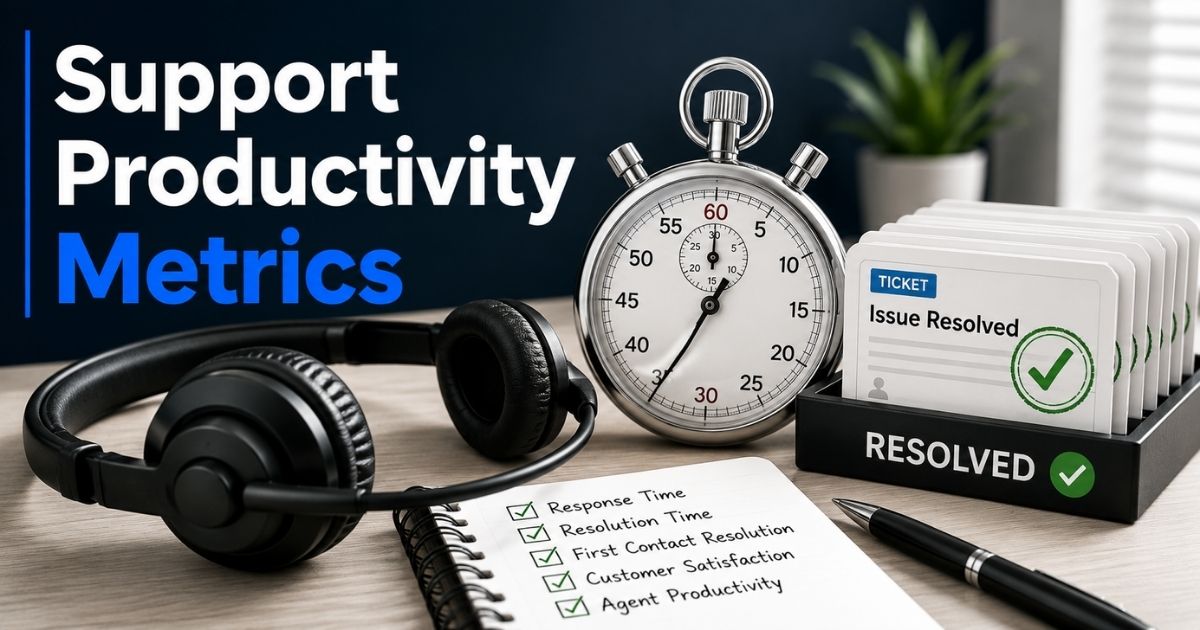
Support leaders often mix up first response time and resolution time. These two performance metrics look similar on a dashboard, but they measure very different things. First response time captures how fast your support team acknowledges a support request. Resolution time measures how long it takes to fully resolve the problem and close the ticket. Both matter for customer satisfaction, but they serve different purposes in the customer experience.
This guide breaks down the key differences between first response time vs resolution time. You will find concrete benchmarks, practical SLA examples, and tips for improving both metrics using EasyDesk. Whether you run a small SaaS startup or a growing B2B support operation, these insights will help you set realistic targets and boost customer satisfaction without compromising quality.
First Response Time Vs Resolution Time At A Glance
Before diving deep, here is a quick side-by-side view of first response time vs resolution time so you can set the right expectations with your team and your customers. Understanding these differences helps you avoid common pitfalls and build service level agreements that work.
Dimension | First Response Time | Resolution Time |
|---|---|---|
Definition | Time from ticket creation to first meaningful response from an agent | Time from ticket creation until the issue is completely resolved and the ticket is closed |
Typical Target In 2025 For B2B SaaS | Live chat under 60 seconds, email under 2 business hours | Simple issues 4-8 hours, complex issues 1-3 business days |
What The Customer Feels | Reassurance that someone is listening and working on it | Closure and relief that the problem is finally over |
Who Owns Improvement | Frontline agents, routing rules, and automation | Full support team plus engineering, product, and other departments |
Best Use Case | Status updates and expectation setting | Outcome tracking and service management reporting |
Risk If Over-Prioritized | Empty “checking on this” replies that do not move the issue forward | Rushed, low-quality fixes that cause recurring issues |
How EasyDesk Tracks It | First public reply timestamp minus ticket creation time | Ticket solved timestamp minus ticket creation time |
This table shows why treating these metrics as interchangeable creates problems. A fast response that says nothing useful frustrates customers. A thorough resolution that takes three days with no initial contact makes customers wonder if anyone saw their request at all.
What Is First Response Time
First response time is the elapsed time between when a customer submits a support ticket and when they receive the first meaningful response from a human agent. An autoresponder saying “We got your message” does not count. The clock starts when the ticket is created and stops when an agent sends a real, helpful reply. This calculation happens automatically based on the first public reply timestamp.
For a SaaS startup serving SMB customers in 2025, common targets look like this: live chat should hit a first response under 30-60 seconds, email support should achieve 1-2 business hours for standard tickets and under 30 minutes for critical bugs, and social media channels should get a response within 60 minutes during business hours. These are good starting benchmarks for small and mid-sized teams.
How does FRT affect customer perception? Imagine a customer reports a login failure at 10:03am. If your agent replies by 10:05am with a clear message like “We see this issue and are investigating, expect an update within the hour,” that fast response reduces anxiety immediately. The customer knows someone is on it. Contrast that with silence until 11:00am. Even if you resolve the issue by 11:15am, the customer spent an hour wondering if their request disappeared into a void.
Managers can set first response SLA policies by channel and priority. For example, you might configure “P1 chat tickets answered in 1 minute during 09:00-18:00 UTC, Monday to Friday.” The system sends real time alerts when tickets approach their FRT deadline, so your service desk teams can act before a breach happens, especially when you use dedicated SLA tracking software to improve response time.
First Response Time Formula And Calculation Tips
The core formula is straightforward: First Response Time equals Time Of First Meaningful Agent Reply minus Time Of Ticket Creation.
To calculate average first response time for a period, add up the FRT across all tickets that received a first response and divide by the number of tickets. For example, if you had 100 tickets with a combined FRT of 200 hours, your average response time is 2 hours.
When supporting B2B customers across time zones, measure FRT in business hours rather than calendar hours. EasyDesk can pause the clock outside your defined business hours so weekends and nights do not skew your metrics. This gives you an accurate picture of how your support team performs during active working periods.
Only count the first substantial, customer-facing reply as valid. Automated workflows that send generic confirmations should not stop the timer. Admins exclude certain templates or automation from FRT calculations, ensuring you measure what actually matters to the customer experience.
Beyond averages, track median and 90th percentile FRT in your reports. Averages hide outliers. You might have an average response time of 30 minutes, but if 10% of your customers wait over 4 hours, that creates real dissatisfaction. Reports show these percentiles so you can spot long-tail delays.
Why First Response Time Matters To SaaS And B2B Teams
Fast first responses reduce anxiety, lower repeat contacts, and set realistic expectations for the fix. When you run a subscription product where renewal depends on trust, that prompt acknowledgment becomes critical. Studies show that 89% of customers feel valued when they get a fast initial response, even if the complete resolution takes longer.
By 2025, most B2B buyers expect at least a meaningful first email reply within 2-4 business hours. For live chat, customers expect near instant responses. Falling short of these customer expectations risks damaging customer loyalty and increasing churn. One industry study found that companies responding in under 2 hours saw roughly 40% higher customer retention than slower competitors.
EasyDesk helps non-enterprise teams hit sub-minute chat responses without hiring a large call center. Triggers route incoming tickets to the right agent automatically. Canned responses let agents send high-quality first replies in seconds. The mobile app means on-call agents can handle urgent support requests during off-hours incidents.
Your customers do not need you to solve everything in five minutes, but they do need you to show up fast and say what will happen next. That initial contact sets the tone for the entire support process.
What Is Resolution Time
Resolution time is the total time between ticket creation and when the customer issue is completely solved, and the ticket is marked resolved or closed. This includes investigation, escalation, waiting on engineering, customer confirmation steps, and everything in between. Unlike first response time, resolution time captures the full lifecycle of a support ticket.
For SaaS support in 2025, typical resolution windows depend heavily on complexity. Simple “how-to” questions and password resets often get resolved immediately or within 1-4 business hours. Configuration or integration issues take 1-2 business days. Complex bugs needing code fixes might stretch to 3-7 business days, depending on release cycles. These ranges should appear in your service level agreements and onboarding materials so customers know what to expect.
Resolution time becomes the customer’s lasting memory of “how long this problem lived in my world.” A login issue that drags on for three days feels worse than a bug that gets a clear workaround within hours. This metric influences customer satisfaction scores, renewal rates, and expansion opportunities.
Resolution time is captured from ticket creation until the status moves to “Resolved” or “Closed.” Managers can customize which statuses count toward resolution reporting, giving flexibility for different support operation structures.
Resolution Time Formula And Calculation Tips
The base formula is: Resolution Time equals Time Of Ticket Resolution minus Time Of Ticket Creation.
To find average resolution time, divide the total resolution time across all resolved tickets by the number of resolved tickets in that period. If 50 tickets took a combined 500 hours to resolve, your average resolution time is 10 hours.
Measuring both average and median helps you understand your true performance. Then segment your data by issue type (bug, billing, onboarding, feature question), customer tier (trial, standard, enterprise), and communication channel (email, chat, in-app widget). This segmentation reveals specific patterns. Maybe billing issues on Mondays take twice as long because your finance team is in meetings.
For teams wanting to isolate internal efficiency, use business hours and pause states. When a ticket status changes to “Pending Customer,” the resolution clock can optionally stop. SLAs support both approaches, so you can see customer-inclusive resolution time and internal resolution time separately.
Why Resolution Time Matters More Than Acknowledgment Alone
Customers tolerate some delay if the fix is thorough and well-communicated. But patience evaporates when an issue drags across days with little progress, especially for critical problems affecting production systems. Higher customer satisfaction comes from closing tickets properly, not just acknowledging them quickly.
Consider a concrete SaaS scenario: a payment failure occurs on the first of the month, and your customer’s own billing cycle runs on the third. They need this resolved within 48 hours or their business operations suffer. This explains why B2B contracts often include tight resolution SLAs for critical priorities. Missing that window damages customer trust in ways that no fast first response can repair.
Automation helps teams cut idle time between updates. Workflow rules can assign follow-up tasks automatically, escalate tickets to engineering queues when certain tags appear, and send status-based reminders to agents. These features bring your real resolution window down without burning out human agents on routine tasks, especially when you apply proven ways to cut average resolution time across your support workflows.
Key Differences Between First Response Time And Resolution Time
First response time answers “When did we acknowledge and guide the customer?” Resolution time answers “When did the problem stop hurting the customer?” Both metrics matter, but they measure different aspects of support efficiency.
Dimension | First Response Time | Resolution Time |
|---|---|---|
Stage Of The Journey | Initial contact | Full ticket lifecycle |
Main Owner | Frontline agent and routing rules | Cross-functional team including engineering and product |
Primary Customer Question | Has anyone seen this? | Is this over yet? |
Good Targets For A Growing SaaS Team | FRT under 1 hour for email, under 1 minute for chat | Resolution within 24 business hours for standard tickets |
Best Supporting Metrics | CSAT after first reply, escalation rate | CSAT after closure, reopen rate, first contact resolution rate |
Conversely, obsessing over resolution time while ignoring FRT creates anxiety. Customers wait hours, wondering if anyone even saw their request. By the time you deliver a perfect fix, their patience is gone.
The solution is setting separate but linked SLAs. For example, configure “First reply under 30 minutes, resolution under 8 business hours for Priority 2 tickets.” This balances reassurance with outcome delivery.
When To Focus On First Response Time Vs When To Focus On Resolution Time
Priorities shift based on your company’s growth stage and the type of issues you handle.
Focus heavily on first response time during launch days or outages when customers flood chat channels. They mainly need confirmation that your team is aware and updating a status page. Speed of acknowledgment matters more than immediate resolution. Early-stage startups in 2025 can use sub-hour FRT as a competitive differentiator against bigger incumbents with slower support processes.
Resolution time becomes the priority during enterprise rollouts involving complex data migrations. A three-day but well-managed resolution with regular updates is more acceptable than a quick but incomplete fix that causes recurring issues. When customer issues involve financial or data risk, leadership watches “time to permanent fix” more than initial response speed, which is where a clear ticket escalation process for faster support becomes essential.
Dashboards allow product and success leaders to slice data by these scenarios. You can filter reports by customer tier, issue type, or priority level to see patterns that inform where to focus improvement efforts.
Benchmarks And SLAs For First Response And Resolution Time
There is no universal “perfect” target for response and resolution times. But there are realistic ranges for SaaS, IT teams, and e-commerce around 2024-2026 that can guide your service level agreements. These industry benchmarks give you a starting point for your own targets.
Here are reference benchmarks that a small or mid-sized B2B SaaS team can use, especially once you have solid ticket prioritization in customer support to route the right issues first:
Live chat should aim for FRT of 30-60 seconds with resolution within 1-4 hours for simple issues. Email support should target FRT under 2 hours on business days with resolution within 24-48 hours. Critical P1 incidents need a first reply under 15 minutes and resolution or workaround within 2-4 hours as defined in your SLAs. Founders can adjust these based on deal sizes, time zones, and customer needs.
EasyDesk allows different SLA policies per customer tier. Premium customers might get 15-minute first replies and 8-hour resolutions, while standard customers get 1-hour first replies and 24-hour resolutions. All of this is managed in one admin screen, making incident management straightforward even for IT help desk teams using modern software without dedicated operations staff.
Customer Tier | Channel | Recommended First Response Target | Recommended Resolution Target |
|---|---|---|---|
Trial | Live Chat | 60 seconds | 4-8 hours for simple issues |
Trial | 2-4 hours | 24-48 hours | |
Standard / SMB | Live Chat | 30-60 seconds | 1-4 hours for simple, 1 business day for intermediate |
Standard / SMB | 1-2 hours | 24 hours | |
Premium | Live Chat | Under 1 minute | 1-2 hours for high priority, 8 hours for medium |
Premium | 2-4 hours | 8-24 hours depending on severity | |
Enterprise | 30 minutes | 8 hours for P2 tickets | |
Enterprise | Critical P1 | Under 15 minutes | 2-4 hours for workaround or fix |
Common Pitfalls When Setting FRT And Resolution Targets
Several common mistakes undermine support efficiency when setting targets:
Defining aggressive FRT targets without adding staff or automation creates stress and poor answers. Agents rush to hit the timer and send unhelpful replies.
Ignoring complexity and setting a single resolution target for all tickets punishes teams who handle complex issues. A P1 bug requiring human intervention from engineering should not have the same resolution expectation as password resets that can be resolved immediately.
Allowing agents to send empty “checking on this” replies just to stop the FRT timer teaches bad habits. Customers want a first meaningful response, not a placeholder.
Failing to explain to customers what “resolved” means leads to disputes. Some customers expect the issue fixed on their timeline, while your definition might include a workaround.
EasyDesk helps avoid these pitfalls through meaningful reply definitions in SLA tracking, granular SLAs by priority and channel, and coachable reporting that shows which agents send substantive first replies versus empty acknowledgments.
How To Balance Response Speed And Resolution Efficiency
Balancing fast response with thorough resolution requires intentional workflow design. Here is how support teams can achieve both without sacrificing operational efficiency or compromising quality.
Prioritizing Urgent Customer Issues
Not every support ticket needs immediate attention. Critical problems affecting production systems or causing revenue loss need different handling than general questions. Set up priority levels that route urgent tickets to senior agents while simpler requests go to self service portals or junior team members. EasyDesk lets you create automated ticket assignment rules so tickets requiring immediate attention get escalated efficiently. This ensures customers with critical issues receive fast responses while routine tasks do not overwhelm your best troubleshooters.
Structured Ticket Handling Workflows
Clear workflows prevent tickets from sitting idle between steps. Define what happens after first response: who investigates root causes, when to escalate to engineering, and how to keep customers updated. Ticket automation software for modern teams can assign follow-up tasks automatically, add watchers when specific tags appear, and trigger reminders for stalled tickets. This structure reduces the gap between quick responses and complete resolution by minimizing downtime between actions.
Support Agent Workload Distribution
Uneven workload distribution hurts both response time and resolution time. One overloaded agent cannot provide quick responses, while underutilized agents represent wasted capacity. Use round-robin assignment or skill-based routing to spread tickets evenly. Automated ticket management software and EasyDesk’s workload views show which agents have capacity, helping managers redistribute tickets before backlogs form. Balanced workloads mean faster first responses and more thorough investigation of technical issues.
Monitoring Key Support Metrics
You cannot improve what you do not measure. Track both FRT and resolution time alongside supporting metrics like first contact resolution rate, reopen rate, and customer satisfaction scores. Real-time alerts in EasyDesk notify managers when SLA breaches approach. Weekly reviews of percentile data reveal whether your performance metrics match your targets, similar to how customer support software improves response time by 3X through better visibility. This continuous monitoring identifies problems before they impact business outcomes.
Continuous Service Performance Improvements
Support efficiency is not a one-time achievement. Review your performance data monthly or quarterly to spot trends. Maybe resolution time for billing issues has increased because your service provider changed their process. Perhaps FRT improved after adding knowledge bases but resolution time stayed flat. Use these insights for continuous improvement. EasyDesk’s historical reports make trend analysis straightforward, helping teams adjust processes and set more ambitious targets as they mature.
How To Improve First Response Time And Resolution Time With EasyDesk
Most teams do not need a bigger support stack. They need clearer workflows and the right automation in one place. EasyDesk customer support platform fits startups and growing SaaS companies by combining essential features for smarter, secure customer support without enterprise complexity.
Unified Multi-Channel Inbox
EasyDesk consolidates email, live chat, and social media into a shared inbox for teams. Agents see new tickets from all channels in one queue instead of switching between platforms. This cuts response time by eliminating context switching. When a support request arrives, your team sees it immediately regardless of which communication channel the customer used.
Smart Ticket Routing And Assignment
Automatic routing by topic, language, and priority ensures the right person sees new tickets first. A billing question goes to your finance-trained agent. A technical issue routes to your senior support team member. EasyDesk’s routing rules and ticket automation workflows reduce the time between ticket creation and first response by removing manual triage steps.
Canned Responses And Knowledge Bases
Canned responses for customer support and other pre-written responses for common issues help agents send high-quality first replies in seconds. Link knowledge base software articles and guides directly in tickets so customers get self service options alongside personalized help. This combination speeds initial response while providing the depth needed for complete resolution. Your support process becomes more efficient without sacrificing quality.
SLA Tracking With Real Time Alerts
EasyDesk highlights tickets approaching their FRT or resolution deadline in color-coded queues. Managers can reassign work before breaches occur. This visibility prevents tickets from falling through cracks and keeps your response and resolution times within targets, similar to how leading ticketing software for better customer support is designed. The service desk stays proactive rather than reactive.
FAQs
How Many Support Metrics Should A Growing SaaS Team Track Beyond FRT And Resolution Time
Early-stage teams can start with 4-6 core metrics: first response time, resolution time, first contact resolution rate, reopen rate, CSAT after closure, and ticket volume per active account. These cover the essentials without overwhelming your team with data.
Should We Pause Resolution Time While Waiting For Customers To Reply
Consider using two views. One “customer-inclusive” resolution time reflects the full experience from the customer’s perspective, including any time they took to respond. One “internal” resolution time pauses when ticket status changes to “Pending Customer,” showing your team’s efficiency purely.
How Often Should We Revisit Our First Response And Resolution Time Targets
Most B2B support leaders should review targets at least twice a year. Also revisit targets after major changes like launching new product lines, expanding into new regions, or landing big customer wins that shift your support volume.
Do Fast First Responses Ever Hurt Customer Satisfaction
Yes, fast but shallow answers can feel dismissive, especially for complex issues. A customer reporting a data migration failure does not want to hear “Got it, looking into this” and then silence for hours. That fast response set an expectation of engagement that the team did not fulfill. FRT should always be tied to “meaningful response” criteria. The first reply should acknowledge the issue, set expectations, and ideally provide initial guidance or next steps. A helpdesk lets teams coach agents using sample replies and templates, so the first answer is both quick and genuinely helpful.
How Can Non Technical Founders Monitor These Metrics Without Getting Lost In Data
EasyDesk offers role-based dashboards with clear labels, daily or weekly email summaries, and at-a-glance SLA health indicators. Founders see trends without digging into raw logs or spreadsheets. Focus on practical questions like “How many customers waited more than a business day for a first reply this week?” and “Which issue types stayed open the longest?” These questions are easily answered in EasyDesk reports, giving you actionable insights without requiring technical expertise. The goal is spotting problems early and celebrating wins, not drowning in numbers—as shown when EasyDesk improved response time for a growing team and why it is often chosen as the best ticket management system for SMBs.