SLA compliance rate has become a critical key performance indicator for IT service desks and customer support teams navigating the demands of digital transformation in 2024 and 2025. This metric represents the percentage of service requests and incidents resolved within the timeframes outlined in your service level agreement, connecting directly to customer expectations and contractual obligations.
Consider typical SLA targets: responding to priority one incidents within 15 minutes and resolving them within four hours. When teams miss these targets consistently, customer experience suffers, and contractual consequences follow. Failure to meet the agreed compliance rate can trigger consequences like service credits or financial penalties, making this metric both an operational and commercial priority.
Achieving high SLA performance requires a balance of people, process, and tools rather than simply hiring more agents. EasyDesk serves as a platform that helps teams track key metrics, automate workflows, and improve SLA compliance rate systematically through real-time monitoring and intelligent automation.
What Is SLA Compliance Rate
SLA compliance rate is the percentage of incidents, tickets, or service requests that met their agreed response and resolution targets within a specific period. The SLA compliance rate is calculated using the formula: (Contacts resolved within SLA threshold / Total contacts) x 100, and is typically reported as a percentage over a rolling period such as monthly or quarterly.
For example, if your support team resolved 850 out of 1000 incidents within their SLA thresholds in April 2026, your compliance rate would be 85%. This straightforward calculation provides a clear view of service performance against commitments.
Understanding related terminology helps clarify what you are measuring. Implementing a dedicated SLA management system with robust tracking features ensures these concepts translate into consistent execution. Response SLAs focus on first acknowledgment times, while resolution SLAs target full ticket closure. These differ from uptime commitments, which track system availability. Availability is often measured in nines on the way to 100%: 90%, 99%, 99.9%, and many cloud and SaaS providers aim for an industry standard of five 9s or 99.999% uptime.
Different thresholds apply based on ticket priority or incident severity. Sev1 incidents (critical outages) might require a one-hour first response and four-hour resolution at 95% compliance, while Sev3 incidents (moderate issues) allow longer timeframes. Compliance is often segmented by severity levels, with different response targets for different priorities. SLA compliance is often measured across several categories of service, requiring teams to track performance across multiple dimensions using ITSM tools or platforms like EasyDesk.
Why Is SLA Compliance Rate So Important For Customer Experience
Modern customers expect fast, consistent service delivery across channels like email, chat, and phone. Research indicates that 70% of customers abandon brands after response delays exceeding one hour, making SLA compliance the foundation of experience quality.
Customer Trust
Strong SLA compliance builds customer confidence through consistent response and resolution times. When customers know they can rely on predictable service, their satisfaction during urgent issues increases significantly. Teams maintaining 95% compliance on Sev1 tickets often see 25% higher Net Promoter Scores compared to those with inconsistent performance.
SLA compliance is crucial for customer satisfaction as it reflects the quality of service provided, with missed SLA thresholds leading to customer frustration and potential churn, underscoring why well-structured service level agreements matter for service success. Consider the impact of a 90-minute delay on an urgent Sev1 issue: research suggests 40% of affected customers begin exploring competitors after such experiences. Repeated SLA failures can erode trust among clients, partners, and stakeholders, negatively impacting brand perception and making it harder to attract and retain new customers.
Higher compliance rates directly improve long-term customer retention. Teams sustaining 97% rates see retention improvements of 15 to 20% through demonstrated dependability during critical moments.
Faster Responses
SLA compliance reduces response and resolution delays by creating clear targets and accountability. When teams focus on meeting specific timeframes, the entire support workflow becomes more efficient.
Automated routing and prioritization significantly improve support speed. Teams that focus on reducing customer support response time with automation find that chat channels implementing automation often achieve two-minute response targets with 98% consistency, dramatically reducing perceived wait times for customers. Customers frequently evaluate support quality based on initial response time, making this metric essential for first impressions. When teams consistently meet critical response targets, customer perception of service quality improves across all interactions.
Better Accountability
SLA metrics improve accountability across support teams and managers by providing objective performance data. When every ticket carries a clear deadline, there is no ambiguity about expectations.
Monitoring SLA compliance helps organizations identify operational bottlenecks and inefficiencies, which can lead to improved productivity and service delivery. Missed targets often reveal workflow or staffing issues, such as 20% of breach clusters occurring during diagnosis phases rather than initial response. When SLAs are breached, it often indicates deeper operational issues, such as inefficient workflows, poor resource allocation, or a lack of real-time visibility into service performance.
Dashboards and reporting tools play a central role in performance tracking. Escalation rules configured in platforms like EasyDesk prevent ticket abandonment, with some teams reporting 35% reductions in ignored tickets after implementing automated alerts.
Reduced Escalations
Better SLA compliance lowers customer complaints and escalations by addressing issues before frustration builds. Teams maintaining high compliance see escalation rates drop by approximately 30% compared to those with frequent breaches.
Delayed tickets increase frustration and churn risk substantially. When customers wait beyond expected timeframes without updates, they often escalate through alternative channels or consider leaving entirely. Proactive status updates reduce repeat follow-ups from customers, keeping them informed and reducing anxiety during resolution.
Tracking recurring issues through category analysis improves service stability over time, helping teams identify and address patterns that cause repeated breaches.
Stronger Retention
Reliable support experiences increase customer loyalty in measurable ways. Teams operating at 95% compliance see 22% better renewal rates in B2B SaaS environments compared to variable performers.
Customers stay longer with brands that consistently meet expectations rather than those delivering occasional excellent service mixed with frequent disappointments. Failure to meet SLA commitments can lead to financial losses, reputational damage, and decreased customer trust, making it crucial for organizations to maintain strict compliance.
SLA performance directly improves renewals and referrals. Enterprise contracts show that 90% adherence doubles referral likelihood compared to inconsistent performers, creating compounding benefits for business growth.
Key Metrics That Influence SLA Compliance Rate
Improving SLA compliance starts with choosing the right key metrics to monitor daily and weekly. Key SLA metrics commonly monitored include availability, mean time to recovery, response time, resolution time, error rates, and security and compliance measurements.
Response Time
First response time directly affects SLA compliance performance by determining whether teams meet initial acknowledgment targets. For P1 tickets, delays beyond 15 minutes can inflate breach rates by 40% or more.
Delayed initial response is often caused by over-reliance on manual processes or insufficient staffing. Without automated acknowledgments, tickets can sit unnoticed during peak periods or shift changes. Automated routing improves response speed significantly, with some teams reporting 25% compliance gains from routing optimizations tuned to historical patterns.
Monitoring average response time patterns helps support managers optimize workflows by identifying problem periods and adjusting coverage accordingly.
Resolution Speed
Average resolution time impacts overall SLA success rates by determining whether teams close tickets within their allotted windows. Unresolved tickets create backlogs that compound operational delays and stress capacity.
Tracking resolution time by ticket priority reveals where improvements will have the greatest impact. Deep dives into ways to cut average resolution time fast highlight tactics like better triage and tooling that complement knowledge base improvements. Sev3 resolutions averaging two days might be accelerated 30% through knowledge base improvements that reduce repeat diagnostic efforts.
Knowledge bases help agents solve issues faster by providing documented solutions for common problems, reducing the time spent researching each ticket from scratch.
Ticket Volume
Sudden ticket spikes affect support capacity and SLA achievement dramatically. During outages or product launches, volume increases of 50% or more can overwhelm teams and drop compliance to 75% or lower.
Seasonal demand or outages often increase compliance risks even for well-prepared teams. Workload forecasting using workforce management tools helps predict these peaks, allowing proactive staffing adjustments. Some teams maintain 92% rates during seasonal highs through aligned staffing schedules.
Balanced ticket distribution supports stable service delivery by ensuring no single agent or queue becomes overwhelmed while others remain idle.
Escalation Rate
Frequent escalations indicate workflow inefficiencies or skill gaps within support teams. Escalations typically account for 15 to 25% of breaches when underlying issues go unaddressed.
Unresolved escalations compound SLA breaches by adding handoff time and coordination delays. A structured ticket escalation process with clear timelines maintains service quality by ensuring handoffs complete within 30 minutes rather than languishing between teams.
Tiered support structures reduce escalation delays by matching ticket complexity to agent expertise, keeping simpler issues from clogging queues while routing complex problems appropriately.
Agent Availability
Staffing levels directly influence SLA compliance rates by determining how many tickets can receive timely attention. Inadequate staffing is a primary cause of SLA breaches, particularly during peak periods.
Understaffed teams struggle to maintain response targets even with strong processes and tools. When agent availability drops to 80% during peaks, compliance can fall by 18 percentage points or more.
Shift planning improves service coverage by aligning staffing to predicted demand. Real-time workforce monitoring supports operational efficiency by alerting managers when coverage gaps emerge, allowing immediate corrective action.
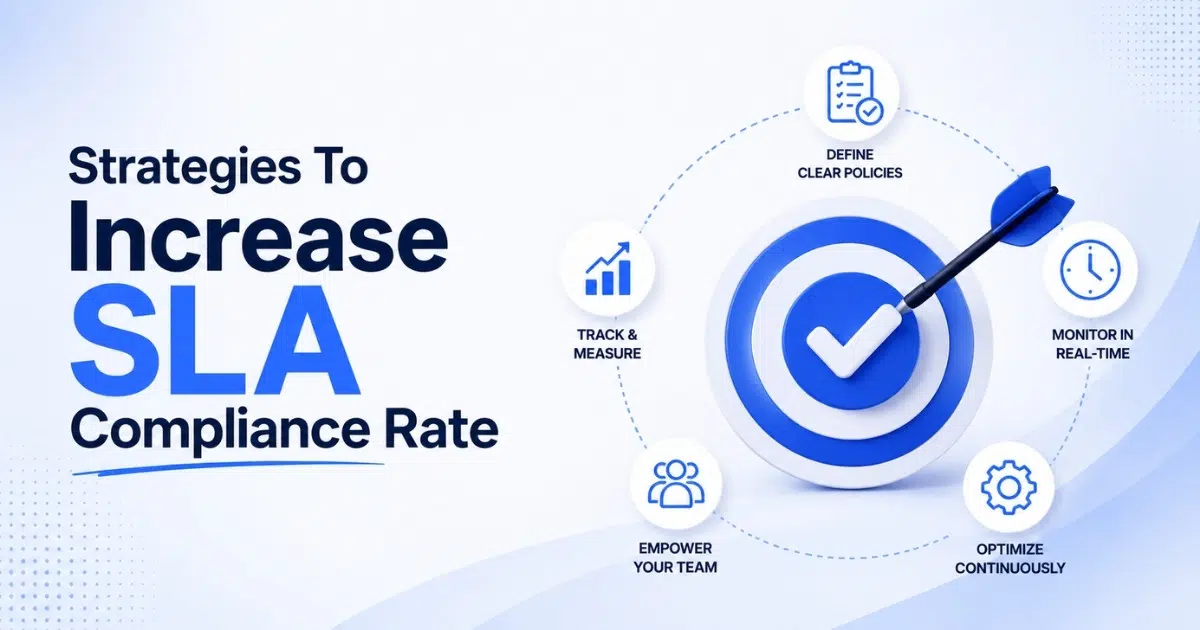
7 Best Strategies To Increase SLA Compliance Rate
This core section presents seven practical strategies service leaders can apply over the next quarter to raise compliance rate. The strategies flow logically from foundational work like setting realistic SLAs to advanced tactics such as automation and predictive analytics.
1. Align SLA Targets With Realistic Service Capacity
Improving compliance starts with setting realistic service level targets based on historical volumes, staffing levels, and channel mix data. Using historical performance data to set realistic goals improves compliance rates by preventing teams from committing to targets they cannot consistently achieve.
Analyze at least 6 to 12 months of incident and request history to understand typical response time and resolution time by severity and category. This data reveals natural performance baselines and identifies where current targets may be unrealistic.
The process for renegotiating SLAs with internal or external customers should balance aspirational goals with achievable performance. Consider recalibrating a Sev2 response SLA from 10 minutes to 20 minutes if analysis shows 88% natural attainment at the shorter timeframe. This adjustment can eliminate chronic breaches while maintaining customer satisfaction.
Maintaining high SLA compliance rates requires balancing realistic targets with adequate resources and effective technology. Dedicated SLA management with EasyDesk for support teams highlights chronic breaches that signal where targets or resources must be adjusted, providing the data needed for informed discussions with stakeholders.
2. Prioritize Work Using Clear Incident Queues
Structured queues by priority, impact, and requested channel ensure that critical tickets receive attention within their response SLAs. Without clear prioritization, high-severity incidents can sit unnoticed in general queues while agents work on less urgent requests.
Automated triage rules, tagging, and routing ensure Sev1 and Sev2 incidents never sit unassigned. Leveraging automated ticket assignment based on rules and skills, incidents should route within 60 seconds of creation to the correct resolver group using automation that considers both severity and required expertise.
Visual queue boards and color-coded SLA timers help agents and managers see which tickets are at risk of breach in the next 15 to 30 minutes. This visibility enables proactive intervention before deadlines pass.
Periodic review of queue design reflects new products, geographies, or customer tiers as business needs evolve. What worked in 2024 may need adjustment for 2026 requirements.
3. Standardize Incident Handling With Playbooks
Well-defined playbooks reduce variation in how agents diagnose, escalate, and resolve recurring incident types. This standardization supports faster resolution time by eliminating guesswork and ensuring consistent quality.
Create step-by-step guides for common scenarios such as password resets, access issues, or payment failures. Include time targets for each stage so agents understand the expected pace of work.
Checklists embedded directly into tickets help new agents follow best practices without slowing down service delivery. EasyDesk workflows can incorporate these guides automatically based on ticket category.
Regularly update playbooks based on post-incident reviews and new product releases to maintain high incidents resolved within SLA targets. Standardized workflows also reduce error rates that might otherwise lead to repeat contacts and lower customer satisfaction.
4. Leverage Automation To Protect Response SLAs
Specific automation opportunities include automatic acknowledgments, ticket classification, and assignment rules that reduce initial response time to seconds. Automation gaps, such as disconnected systems and poor automation, cause SLA breaches by introducing manual delays at critical points.
EasyDesk triggers notifications for impending SLA breaches and can auto-escalate tickets that remain unassigned beyond set thresholds. Purpose-built SLA tracking software to improve response time reinforces these workflows by surfacing at-risk tickets early. Implementing automated reminders and escalations helps teams anticipate approaching deadlines and prevent SLA breaches by ensuring that no request is overlooked.
Consider the impact: automated triage and canned responses can cut average first response from 30 minutes to under 5 minutes for low-priority requests. Chatbots or virtual agents handle simple queries so human teams focus on complex incidents without missing critical service level targets, especially when backed by comprehensive ticket automation software for modern support teams.
Monitor automation outcomes to ensure they continue to exceed customer expectations rather than generate frustration. Poorly designed automation can damage customer experience even while improving raw metrics.
5. Optimize Resource Planning Across Time And Channels
Workforce management is essential for sustaining high SLA compliance when ticket volume spikes around product launches or seasonal peaks. Automated workflow platforms, such as automated workflow software for smarter support, complement accurate forecasting, appropriate staffing, and efficient workflows, which can be achieved through workforce management tools that predict contact volume and generate staffing schedules.
Use weekly and monthly reports to identify high-volume periods, such as Monday mornings or quarter end, and adjust staffing accordingly. Pair forecasting with automated ticket management software to reduce response time so cross-skilled agents can handle multiple channels while maintaining service levels when chat or email volumes surge unexpectedly.
Maintain buffer capacity of approximately 10% for critical hours to protect response SLAs on top-priority incidents. This reserve allows teams to absorb unexpected spikes without immediate breach risk.
Recalibrate schedules periodically as customer behavior evolves, especially when new self-service options change the volume and nature of incoming requests.
6. Track Breach Patterns And Run Root Cause Analysis
Set up regular reviews of SLA breaches segmented by priority, team, product, and incident type to uncover systemic issues. Proactive monitoring of SLA performance allows teams to detect potential breaches before they occur, enabling immediate corrective action and reducing downtime.
Perform simple root cause analysis sessions that focus on process gaps, tool limitations, or training needs rather than individual blame. This approach encourages honest discussion and sustainable improvements.
For example, repeated breaches on Sev3 tickets might reveal a slow vendor escalation step that adds 12 hours to resolution time. Without systematic analysis, such patterns remain hidden while breaches continue.
EasyDesk analytics visualize breach hotspots so leaders can pinpoint areas and prioritize improvements with the largest impact on compliance rate. A structured ticket SLA management approach for faster support response ensures corrective actions are documented and subsequent months show measurable improvement in incidents resolved within SLA.
7. Build A Culture Of Continuous Improvement Around SLAs
Sustainable SLA gains require engaging frontline agents, team leads, and managers in continuous improvement rather than one-time initiatives. Quick fixes rarely produce lasting results without cultural commitment.
Set transparent team goals, such as increasing overall compliance rate from 92% to 97% over two quarters, and share progress openly. This visibility creates shared ownership of outcomes and celebrates progress.
Incorporate SLA performance into coaching conversations, training plans, and recognition programs that reward teams who improve service delivery. When agents understand how their work connects to business goals, engagement increases.
Collect qualitative feedback from agents about bottlenecks in tools or process that slow down response and resolution activities. Their frontline perspective often reveals issues invisible to management. EasyDesk can serve as the single system of record where improvements are planned, implemented, and measured for ongoing SLA optimization.
Challenges That Limit SLA Compliance Rate
Service teams often struggle to meet sla targets because of operational gaps, changing service requirements, and resource limitations. Low compliance rates can affect customer trust, business continuity, and long term service performance.
Poor Resource Planning
Many organizations fail to allocate enough staff during peak support hours. As ticket volume increases, the average time for response and resolution also rises. SLA breaches occur when teams cannot handle workloads efficiently. Poor workforce planning also creates compliance issues across multiple departments. Businesses that ignore capacity forecasting often fail to meet internal standards and customer expectations. A cost effective staffing strategy with flexible scheduling helps support teams maintain the expected level of service quality.
Weak Process Control
Unclear workflows often create delays across ticket handling processes. When service requirements are not properly documented, agents struggle to prioritize incidents correctly. Issues related to escalation paths, approvals, and communication gaps reduce operational efficiency. Weak governance also affects compliance standards because teams follow inconsistent procedures. Preventive measures such as workflow automation and standardized ticket routing help organizations improve service consistency. Strong operational processes also support better business continuity during high demand periods.
Limited Automation Use
Many support teams still depend heavily on manual ticket management. A comparison of manual vs automated ticketing and their benefits shows how, without artificial intelligence and automation tools, repetitive tasks consume valuable agent time. Manual triage increases the risk of human error and delayed responses. Businesses with outdated systems often struggle to meet sla targets consistently. Automation tools help categorize tickets, trigger escalations, and improve response speed. Setting up ticket automation workflows to streamline support means artificial intelligence can also detect patterns, predict workload spikes, and reduce recurring compliance issues before major disruptions happen.
Security Threat Risks
Cybersecurity incidents and malicious activity can quickly disrupt service operations. Unexpected outages often create severe SLA breaches and increase financial penalties for service providers. Security failures also damage customer confidence and operational reliability. Organizations that lack proactive monitoring systems face greater risks during attacks or infrastructure failures. Preventive measures such as threat detection, backup systems, and incident response planning help maintain service availability. Strong security frameworks also reduce long term business impact and support compliance standards.
Poor Performance Tracking
Organizations often struggle because they fail to monitor SLA metrics accurately. Without proper reporting, managers cannot identify root causes behind low compliance performance. Incomplete analytics make it difficult to improve response and resolution workflows. Businesses also miss opportunities to optimize processes and resource allocation. Clear dashboards, reporting tools, and KPI tracking systems help support teams measure progress effectively. Accurate performance visibility allows organizations to resolve operational gaps before compliance issues become larger business problems.
Examples Of SLA Compliance Improvements With Data
Real-world examples demonstrate how targeted interventions raise compliance rate over several months through focused effort.
A mid-sized SaaS company improved response SLAs on Sev1 incidents from 88% in January 2025 to 99% by June through queue prioritization and automation. The team implemented 60-second auto-routing for critical tickets and added visual breach warnings to agent dashboards, cutting total breaches by 65%.
A support team reduced average email resolution time by 30% (from 12 hours to 8.4 hours) after implementing standardized playbooks and queue-based routing in EasyDesk during Q1 2026, mirroring the gains seen when EasyDesk improved response time for a growing team. This improvement pushed overall compliance to 96%, up from 84% before implementation.
A customer success team used EasyDesk dashboards to spot weekend breach spikes and adjusted staffing to stabilize service delivery. Overall compliance improved from 89% to 97%, directly contributing to an 18% increase in renewal rates for enterprise accounts. These results demonstrate how data-driven resource allocation transforms compliance outcomes.
How EasyDesk Supports Higher SLA Compliance Rate
EasyDesk provides integrated service management and customer support capabilities designed to help teams meet strict response and resolution SLAs. As an EasyDesk platform focused on secure, transparent customer support, it combines the tools needed for consistent compliance in one streamlined environment.
Key capabilities include configurable SLA policies enforcing specific response targets like 15-minute Sev1 acknowledgments, real-time countdown timers showing elapsed time on every ticket, visual dashboards displaying at-risk tickets, and automatic alerts when breaches approach. Multi-channel ticketing automates routing and workflows across email, chat, and other channels.
Reporting features allow managers to break down compliance rate by customer, service, team, and priority to guide continuous improvement efforts. This segmentation helps identify patterns and define targeted interventions rather than applying generic solutions across all situations.
The platform addresses the strategies outlined throughout this article: queue prioritization, automated triage, playbook integration, workforce visibility, and breach pattern analysis. Its smarter, secure EasyDesk feature set for customer support helps teams report compliance gains of 10 to 15% through systematic process improvement.
Explore an EasyDesk customer support platform demo to see how it can strengthen service delivery and help your team exceed customer expectations consistently.
Frequently Asked Questions
How Often Should We Review And Adjust Our SLA Targets
Formal SLA reviews should typically occur at least once per year, with quarterly internal reviews for fast-changing environments or new product launches. This cadence balances stability with responsiveness to changing conditions. Use trends in compliance rate, ticket volume, and customer satisfaction data to decide whether targets remain realistic and aligned with expectations.
Should Different Customer Tiers Have Different SLA Compliance Targets
Many organizations define separate service levels for standard, premium, and enterprise customers, especially in B2B SaaS environments. This differentiation reflects the varying value and criticality of different customer relationships. Differentiated SLAs might offer faster response times or 24x7 coverage for higher tiers while keeping core service delivery consistent across the base.
How Can We Manage SLAs Across Multiple Support Channels
Managing different expectations for email, chat, phone, and self-service channels while maintaining a unified view of compliance rate requires careful configuration. Guidance on modern ticketing software and support best practices can help align each channel’s customer expectations and operational characteristics. Train agents to understand these differences so they can prioritize work correctly. An urgent chat should receive attention before a routine email, even if both arrive at the same time.
What Is The Best Way To Communicate SLA Performance To Stakeholders
Stakeholders such as executives, product owners, and key customers need simple, visual summaries rather than raw ticket data. Effective communication connects metrics to business impact and strategic priorities. Use monthly or quarterly dashboards highlighting compliance rate trends, major incidents, and key improvement projects in progress. Pair quantitative metrics with brief narrative explanations that put numbers into a business context.
How Do We Handle Exceptions When SLAs Cannot Be Met
Even with strong processes, rare situations such as large outages or third-party failures may prevent meeting agreed service levels. These exceptions require clear handling procedures to maintain customer trust. Document exceptions clearly within tickets, including root cause, timelines, and customer communication. This record supports post-incident reviews and potential discussions about SLA adjustments. Reach out proactively to affected customers, outlining immediate steps taken and longer-term actions to prevent similar issues.