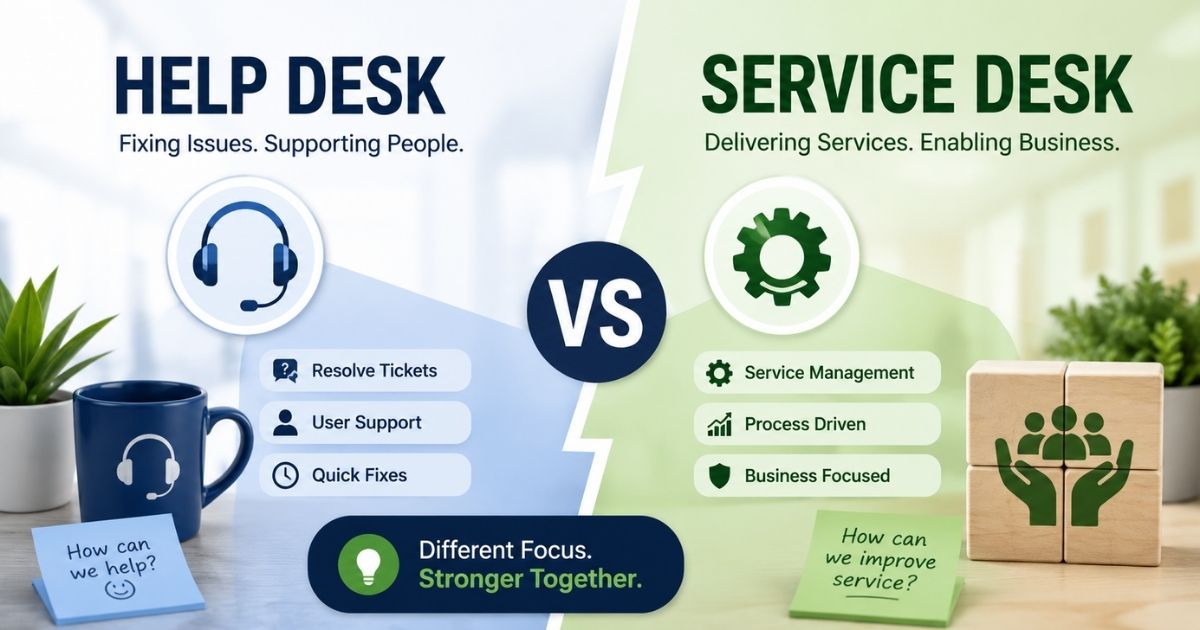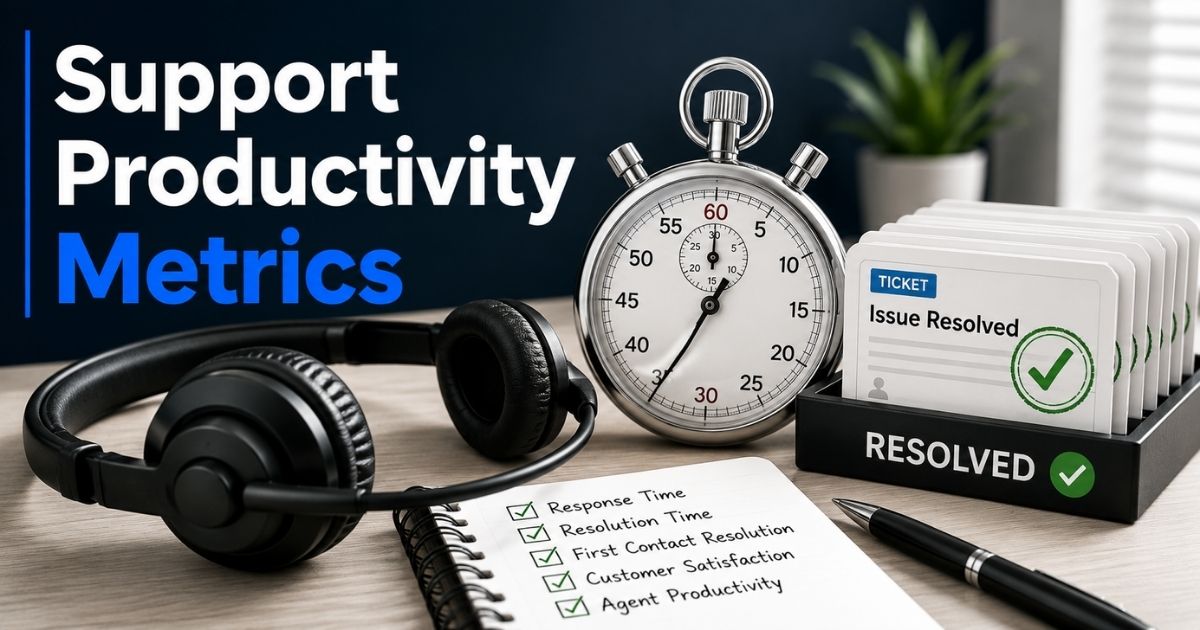
People expect fast and accurate answers from support teams. But many help desk managers are unsure which helpdesk KPIs actually matter. Without the right help desk metrics, it becomes hard to measure performance or improve service quality.
Help desk metrics and KPIs are measurable indicators that show how your team handles tickets and resolves customer issues. Metrics like first response time, customer satisfaction score, and cost per ticket directly impact support performance and customer experience.
This guide covers essential service desk KPIs to track, explains the difference between help desk metrics and KPIs, and shares practical helpdesk KPI examples that align with business goals and improve customer satisfaction, complementing broader frameworks for customer support metrics, KPIs, and best practices.
What Are Helpdesk KPIs
Helpdesk KPIs are key performance indicators that measure how well a help desk or service desk handles customer issues and service requests. These help desk metrics track support performance, response time, ticket volume, and service quality. Service desk KPIs give desk managers a clear view of support operations, agent productivity, and resource allocation. Teams use desk metrics and KPIs to align service delivery with business objectives and customer service expectations.
Common examples include first contact resolution rate, average resolution time, customer satisfaction score, and net promoter score NPS. These service desk metrics show how efficiently service desk agents resolve tickets and improve customer satisfaction. Metrics like cost per ticket and agent utilization rate also help control support costs.
With the right desk reporting and custom dashboards, teams can make data-driven decisions, improve service management, and optimize support processes, especially when they rely on a modern ticketing system to organize and track requests.
Four Categories Of Helpdesk KPIs
Organizing helpdesk KPIs into logical groups makes them easier to understand and implement. Service desk metrics fall into four distinct categories based on what they measure and how they affect your support operations.
Productivity KPIs
Productivity metrics measure the relationship between workload and your team's knowing how to process service requests at a consistent pace. These help desk metrics assess throughput and identify pressure points in your ticket queue.
Ticket volume shows how many requests enter the service desk during a defined period. This fundamental metric reveals demand placed on support teams. High ticket volume may signal a surge in customer issues. Low volume suggests stability in your IT environment.
Quality and Customer Impact KPIs
Quality metrics review desk performance from the user's viewpoint. They focus on consistency and reliability of the support experience. These key performance indicators help you understand how well your technical support team resolves customer issues and whether service delivery meets customer expectations.
Customer satisfaction score captures feedback right after a service request gets resolved. This metric measures how well your help desk meets user needs, and a dedicated CSAT score guide for support teams can help you design surveys and benchmarks effectively.
Agent Performance KPIs
Performance metrics look at how quickly your support team handles work. These desk metrics and kpis help you understand response speed and contact resolution patterns.
First response time measures the elapsed period before the first reply reaches the user. Fast first response sets a positive tone for the entire support experience.
First contact resolution rate shows the percentage of tickets resolved without follow-ups or escalations. A high FCR is beneficial because it saves customers time and gets problems fixed quickly. The average first contact resolution rate is 74%.
Financial Impact KPIs
Financial metrics show the economic effect of running your service desk. These helpdesk kpis calculate the cost of handling demand and support budget decisions tied to staffing and desk tools.
Cost per ticket represents the average cost required to resolve a single request. You calculate this by dividing total customer support costs by issues resolved in a given period. Reducing this over time improves efficiency.
Return on investment compares the benefits of support initiatives or desk software with their total investment cost. This metric helps justify process improvements and technology purchases to stakeholders, including investing in helpdesk ticketing software to centralize support.
By and large, these four categories provide a complete framework to measure desk service. Each category addresses different aspects of support performance, from operational efficiency to customer loyalty to business operations effect.
Essential Productivity KPIs to Track
Productivity helpdesk KPIs reveal whether your support team keeps pace with incoming requests or struggles under mounting pressure. These service desk metrics show you exactly where bottlenecks form and help you allocate resources before problems escalate.
Ticket Volume by Channel
Breaking down ticket volume by channel gives you a clear picture of how customers prefer to reach your support team. Email, phone, live chat, and social media each attract different types of requests.
The calculation is straightforward. Take the number of channel-specific tickets and divide by total tickets, then multiply by 100. To name just one example, if your help desk received 500 tickets in a month with 300 via email and 200 through live chat, email represents 60% of your volume. This percentage tells you where to focus resources.
Understanding these patterns helps you optimize each channel's efficiency. You can direct customers to the most appropriate support options for their needs and adapt your strategy as priorities shift. Email dominates your ticket volume? That's where your team needs the strongest coverage.
Ticket Backlog Trends
Your ticket backlog represents unresolved support tickets accumulating at any given time. This metric provides a snapshot of your team's current workload and reveals potential bottlenecks before they spiral out of control.
Predicted backlogs take this further by making use of historical information to forecast future volumes. Your team starts a week with 20 unresolved tickets and anticipates an additional 15 based on past trends? The total predicted backlog reaches 35 tickets. This proactive approach allows you to adjust workflows and prevent service disruptions, especially when you use ticket automation software to route and prioritize work.
Software companies maintain a 30-day unresolved backlog averaging around 50 tickets. Backlogs grow when new tickets arrive faster than your team resolves existing ones. High customer volume, resource constraints, inefficient workflows, and unexpected spikes all contribute to this accumulation. A high backlog guides to longer wait times and increases pressure on your support team, which affects customer satisfaction negatively.
Tickets Opened vs Resolved Ratio
This helpdesk KPI compares new support tickets created against tickets successfully resolved within the same timeframe. The metric shows whether your team keeps up with requests or falls behind.
To calculate it, divide resolved tickets by opened tickets and multiply by 100. A monthly analysis where your help desk received 200 support tickets and resolved 180 would achieve a 90% open versus resolved percentage. This indicates your team handled most incoming requests effectively.
The ratio reveals critical trends. Do tickets resolved consistently exceed tickets opened? You're reducing backlog. Opened surpasses resolved? Your queue grows. Tracking this over time helps you anticipate when additional resources become necessary and refine how you manage support tickets efficiently in your helpdesk.
Agent Utilization Rate
Agent utilization rate measures the percentage of time service desk agents spend on support related activities compared to their total available work time. An agent spends six hours handling tickets during an eight hour shift? The utilization rate equals 75%, illustrating how a well-run help desk improves support behind the scenes by balancing workloads.
The industry average hovers around 47.8% to 48%. Anything above 75% signals overtasked agents and relates with poor service level agreements performance, high abandon rates, and longer average speed to answer. Utilization rates between 60% and 70% guide high agent turnover because you're pushing people too hard.
The calculation factors in contacts handled and average handle time. An agent handling 700 contacts monthly at a 6.5 minute average produces a 48% utilization rate. By the same token, 500 contacts at 15 minutes pushes utilization to 79%, well into the danger zone. High utilization might maximize short-term productivity, but long-term costs from recruiting and training replacement staff cancel out those temporary gains.
Quality and Customer-Focused KPIs
Customer perception determines whether your help desk succeeds or fails. These quality-focused helpdesk KPIs measure what actually matters to the people you support.
Customer Satisfaction Score (CSAT)
Customer satisfaction score gages how happy consumers are with a purchase or interaction. This helpdesk KPI uses a simple 5 or 10-point Likert scale to measure customer expectations, attitudes, and behaviors. Scores of 5 indicate satisfied customers on a 5-point scale, while 1 means dissatisfied. The same logic applies to 10-point scales where 9 or 10 represent top satisfaction, and it is closely tied to cutting average resolution time with proven methods.
The calculation is straightforward. Count satisfied responses (typically 4s and 5s on a 5-point scale), divide by total responses, and multiply by 100. Your CSAT score hits 67% if you receive 37 satisfied responses from 55 total surveys. Many industries think over scores between 75% and 85% as good, while anything above 90% is exemplary. Your support team does something right if your CSAT increases over time.
Net Promoter Score (NPS)
Net promoter score measures customer loyalty rather than immediate satisfaction. NPS asks how likely customers are to recommend your services to friends or family on a 0-10 scale. Responses fall into three categories: Promoters (9-10), Passives (7-8), and Detractors (0-6). Calculate NPS by subtracting the percentage of Detractors from Promoters, then feed those insights into your broader helpdesk implementation strategy for support teams.
Your NPS equals +30 if 50% are Promoters, 30% Passives, and 20% Detractors. Data shows the average NPS is +32, with a median of +44. Scores above 0 are good, above 20 is favorable, over 50 is excellent, and anything above 80 represents world-class performance. CSAT measures happiness with specific interactions while NPS reveals your customer's desire to represent your brand. Many companies choose to measure NPS quarterly rather than after individual interactions.
Service Level Agreement Compliance
Service level agreements define response and resolution targets that build trust with customers. Meeting SLA commitments demonstrates reliability and strengthens customer service expectations. Only 38% of MSPs track SLA compliance consistently. High-performing service desk managers are more likely to monitor this metric among net promoter score. Examples include responding to high-priority tickets within 30 minutes or resolving standard issues within 24 hours, which aligns with best practices in a dedicated service level agreement helpdesk guide.
Customer Effort Score (CES)
Customer effort score measures how much effort customers expend to get issues resolved. This metric matters because 94% of customers with low-effort interactions intend to repurchase compared with just 4% experiencing high-effort interactions. Low-effort interactions cost 37% less than high-effort ones. Calculate CES by dividing total ratings by survey responses, or subtract negative response percentages from positive ones. CES captures customer perception rather than operational benchmarks, which sets it apart from average handle time and also connects closely to why SLAs matter for service success.
Agent Performance and Efficiency KPIs
Individual agent metrics reveal performance patterns that directly affect customer satisfaction. These helpdesk KPIs show how your support team handles each customer interaction from original contact through final resolution efficiently.
First Response Time
First response time measures how quickly a customer receives the first reply after submitting a support ticket. This excludes automated responses and tracks actual agent participation. The best companies respond to customer tickets within two minutes. A fast first response sets a positive tone for the entire support experience. It shows customers their time is valued, especially when they use customer support software to improve response time.
Calculate your average FRT by taking total response times from a channel and dividing by the number of service requests received. Customer expectations vary by channel. 42% of customers complaining on social media expect responses within 60 minutes or less. 50% of email respondents expect replies within 24 hours. The average FRT measure in any industry for live chat is one minute and 36 seconds, yielding 92% customer satisfaction, and real-world teams have achieved this by improving response time with EasyDesk.
First Contact Resolution Rate
First contact resolution rate measures the percentage of tickets resolved without follow-ups or escalations. This helpdesk KPI directly affects both customer satisfaction and support costs. The call center industry measure average for FCR hovers around 70%. Many claim the measure sits between 65% and 75% in a variety of industries.
Calculate FCR by dividing issues resolved on first contact by total interactions, then multiply by 100. Customer satisfaction increases by 1% when FCR improves by 1%, and employee satisfaction jumps by 2.5%. You reduce operating costs by 1% for every 1% FCR improvement. High first contact resolution rates indicate well-trained agents and troubleshooting processes that work.
Average Handle Time
Average handle time tracks the average duration of customer support interactions. The formula has total talk time, total hold time, and follow-up work divided by total calls. A good average handle time is around six minutes. Industry measures vary: retail runs 3-4 minutes, banking 4-6 minutes, and technical support 8-10 minutes.
Speed must be balanced with quality here. A healthy AHT strikes equilibrium between efficiency and thorough service. Rushing through calls to achieve lower AHT shouldn't compromise addressing customer concerns, so pair it with strategies for reducing average resolution time without hurting quality.
Escalation Rate
Escalation rate reveals the percentage of support tickets moved to higher-tier support. Calculate it by dividing escalated tickets by total tickets, then multiply by 100. The industry baseline sits at 15-20% for mature service desks. A low escalation rate means frontline agents can resolve most issues on their own. High rates point to frontline agents lacking necessary knowledge or training that's insufficient.
Time to Resolution
Time to resolution measures the average time between when a customer interaction starts and when it's marked resolved. This metric provides a handy shorthand for overall customer experience. Research shows being more responsive and resolving issues relates to improved customer satisfaction and loyalty. An acceptable average time to resolution for customer service teams in any industry is around 17 hours.
Difference Between Help Desk Metrics And KPIs
Help desk metrics and KPIs both measure support performance, but they serve different roles. Metrics track daily service desk activities, while key performance indicators focus on business objectives, service quality, and overall help desk performance.
| Aspect | Help Desk Metrics | Helpdesk KPIs |
|---|---|---|
| Purpose | Track daily support process and service desk activities | Measure progress toward business goals and business objectives |
| Focus | Operational data like ticket volume, response time, and number of tickets | Strategic outcomes like customer satisfaction, customer loyalty, and service quality |
| Scope | Covers all service desk metrics and desk metrics | Select key metrics that impact support performance and service delivery |
| Examples | Average resolution time, time spent per support ticket, ticket backlog | Customer satisfaction score, net promoter score NPS, and first contact resolution rate |
| Usage | Helps desk managers monitor support operations and desk performance | Helps teams improve customer satisfaction and make data-driven decisions |
| Impact | Supports process improvements and resource allocation | Drives customer retention rate, user satisfaction, and business operations success |
How to Choose and Implement the Right KPIs
Selecting the right helpdesk KPIs requires strategic thinking rather than tracking every available metric. Your choices determine whether desk performance improves or stagnates under data overload.
Line Up KPIs With Business Objectives
Work with business stakeholders to identify which support outcomes directly affect their goals. Sales teams prioritize CRM uptime and mobile device support, while finance focuses on ERP system reliability. Defining KPIs is about matching business objectives to internal processes. So, choose KPIs that line up with overall business goals and customer needs rather than generic industry metrics, and embed them in smarter helpdesk setups for smoother support.
Establish Realistic Standards
Set clear standards for each help desk metric using industry norms, historical data, or internal performance trends. Gather at least 3-6 months of historical data before setting targets. Standards help you avoid setting KPIs that are either too conservative or overly aggressive. Understanding your operational reality matters more than copying competitor standards, especially when configuring an SLA management system to track commitments.
Create Visual Dashboards for Monitoring
Build reporting dashboards with up-to-the-minute information to track where your support team excels and where improvements are needed. Visualizing business KPIs helps you measure performance and achieve success. Identify your intended audience before dashboard design. Interactive charts and graphs allow quick review and analysis, particularly when your platform offers robust EasyDesk features for smarter, secure customer support.
Balance Speed With Quality Outcomes
Establish clear, consistent metrics for both speed and quality. Track these side by side on dashboards. Response time may improve but customer satisfaction could dip if you've leaned too far toward efficiency. Metrics tell a story when you read them constantly.
How To Track Helpdesk KPIs Easily With EasyDesk
EasyDesk makes it simple to track helpdesk KPIs across your support operations. It centralizes help desk metrics, service desk KPIs, and desk reporting into one platform. Your support team can monitor response time, ticket volume, and tickets resolved without switching tools. Custom dashboards highlight key metrics like customer satisfaction score, first contact resolution rate, and average resolution time, all powered by a secure and efficient EasyDesk customer support platform.
EasyDesk helps desk managers turn data into action. With real-time reporting tools, you can create custom dashboards, prioritize metrics, and improve service desk performance. Automated reports reduce time spent on manual tracking and support better resource allocation. This helps your customer support team improve customer satisfaction, control cost per ticket, and align service delivery with business goals by relying on ticketing software built for better customer support and following helpdesk setup best practices for stronger customer service.
FAQs
How Do Helpdesk KPIs Connect With Customer Retention Rate And Long-Term Customer Loyalty?
Helpdesk KPIs like customer satisfaction score, net promoter score NPS, and customer effort score directly influence customer loyalty. Strong service desk performance reduces customer concerns and improves retention rate over time.
Can Too Many Help Desk Metrics Reduce Support Performance Instead Of Improving It?
Yes, tracking too many desk metrics can create noise and slow data-driven decisions. Support teams should prioritize key metrics that align with business goals and avoid cluttered dashboards.
Is It Possible To Align Helpdesk KPIs With IT Service Management Frameworks Like ITIL?
Yes, helpdesk KPIs can align with IT service management practices by mapping service level agreements, response time, and service delivery metrics to IT services workflows. This improves consistency across support operations.
How Do Self-Service Portals Impact Helpdesk KPIs Like Ticket Volume And Cost Per Ticket?
Self-service portals reduce ticket volume by enabling users to resolve common customer issues independently. This lowers cost per ticket, improves agent productivity, and supports better resource allocation.
Do Helpdesk KPIs Differ For Technical Support Teams Compared To General Customer Support Teams?
Yes, technical support teams focus more on resolution time, escalation rate, and complex contact resolution. General customer support teams prioritize customer satisfaction, response time, and overall service quality.