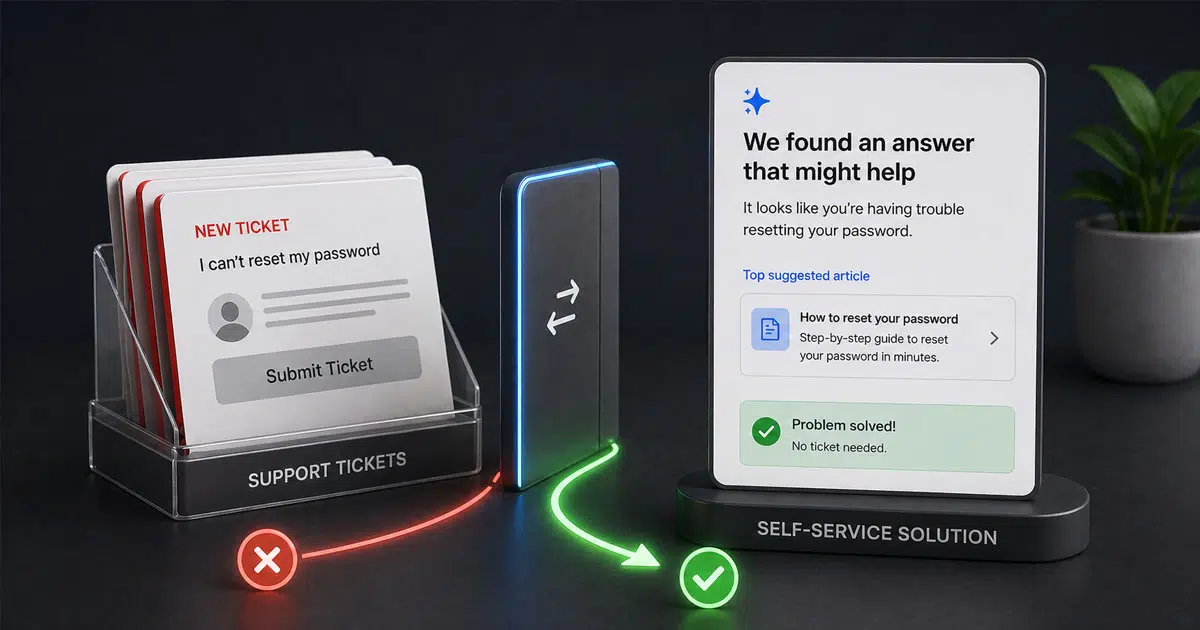
Customers expect fast answers. They do not want to wait in long support queues or open tickets for simple questions. That is where ticket deflection changes the game. It helps users find answers on their own, without contacting support.
Ticket deflection reduces workload for support teams while improving customer satisfaction. Fewer tickets mean faster response times and better efficiency. It also allows businesses to scale support without increasing costs.
A strong ticket deflection strategy combines knowledge bases, AI chatbots, and smart self-service tools. When done right, it creates a smooth and friction-free customer experience.
What Is Ticket Deflection
Ticket deflection refers to reducing support tickets by helping customers find answers without contacting a support agent. It uses self-service tools like a knowledge base, FAQ page, and self-service portal. Customers get immediate access to up-to-date information and resolve issues on their own. Ticket deflection describes a smarter way to manage incoming tickets and lower ticket volume while improving customer experience.
AI-powered ticket deflection adds more value. AI-powered assistants and conversational AI use natural language understanding to guide users to the right answer. An AI agent can handle routine requests like password resets or software access requests. This reduces support requests, improves first contact resolution, and supports the customer support team with fewer tickets.
A successful deflection strategy helps support teams focus on complex issues that need human intervention. It improves customer satisfaction, lowers support costs, and boosts satisfaction scores. Many companies calculate ticket deflection rate as a direct measure of efficiency. Better ticket deflection means higher deflection rates, faster ticket resolutions, and a stronger customer support experience.
How Ticket Deflection Works In Modern Customer Support
Ticket deflection now plays a central role in customer support. Most companies aim to reduce ticket volume without hurting customer experience. Smart self-service customer support strategies and AI-powered tools help users find answers fast. Support teams handle fewer tickets and focus on complex issues.
Self-Service Tools Drive Deflection
Self-service tools sit at the core of ticket deflection. A strong knowledge base software setup, FAQ page, and self-service portal give users immediate access to answers. Customers find accurate solutions without the need to submit tickets. This reduces incoming tickets and lowers support volume.
Recent data shows that over 60% of customers prefer self-service for simple issues. A well-structured knowledge base article can resolve routine requests like password reset or software access requests. This improves first contact resolution and reduces pressure on the customer support team.
AI-Powered Systems Improve Accuracy
AI-powered ticket deflection adds speed and precision. Conversational AI and natural language understanding help users find the right answer quickly. An ai agent can understand intent and provide relevant self-service content in real time.
Studies show AI can deflect up to 40% of support requests in high-volume environments. AI-powered assistants reduce the need for human agent involvement. They handle routine requests while support staff focus on complex issues that need human intervention.
Smart Routing Reduces Ticket Load
Modern systems use smart routing to manage support requests. Before users submit tickets, systems guide them to helpful content. This process helps in deflecting support tickets early in the journey.
This approach improves deflection rates and reduces unnecessary ticket resolutions. It also lowers support costs and improves satisfaction scores. Customers get faster contact resolution, and support teams manage fewer tickets with better efficiency.
Data Tracking Measures Deflection Success
Teams track ticket deflection rate to measure success. It shows how many tickets were avoided through self-service deflection. This direct measure helps businesses calculate ticket deflection and refine their deflection strategy.
Most companies monitor metrics like first contact resolution rates and satisfaction scores. Higher deflection rates often lead to fewer tickets and better customer satisfaction. Data also helps identify gaps in self-service resources and training gaps in support systems.
Human Support Handles Complex Issues
Ticket deflection does not remove human support. It filters routine requests so the customer support team can focus on real challenges. Complex issues still need agent intervention and full conversation context.
This balance improves the overall support experience. Support agents handle meaningful work instead of repetitive tasks. Customers receive better help for serious customer issues, which drives satisfaction scores rise and improves long-term customer experience.
Key Benefits Of Ticket Deflection For Businesses
Ticket deflection gives businesses a clear advantage in modern customer support. It reduces support tickets and improves customer experience at the same time. Companies handle fewer tickets while customers find answers faster. Strong deflection strategy drives efficiency, lowers costs, and boosts satisfaction scores.
Lower Support Costs
Ticket deflection helps reduce support costs in a measurable way. Each support ticket handled by a human agent can cost $5 to $15, based on industry data. Self-service tools and the broader benefits of using a ticketing system cut that cost close to zero for routine requests. This creates a strong financial impact.
Self-service deflection reduces incoming tickets and support volume. Fewer tickets mean less pressure on support staff and smaller team expansion needs. Most companies report up to 30% cost reduction with effective ticket deflection. It also helps the service desk operate with better efficiency.
Faster Issue Resolution
Customers expect quick answers. Ticket deflection gives immediate access to solutions through a knowledge base or self-service portal. Users find answers without waiting for a support agent. This improves first contact resolution and overall support experience.
AI-powered ticket deflection speeds up responses even more. Conversational AI and AI-powered assistants guide users to the right answer. Studies show response time improves by over 50% with self-service tools, especially when teams focus on cutting average resolution time fast. Faster ticket resolutions lead to better satisfaction scores and improved customer experience.
Reduced Ticket Volume
Ticket deflection directly reduces ticket volume. It prevents unnecessary support requests before users submit tickets. Choosing smarter processes in the manual vs automated ticketing approach ensures self-service resources and FAQ pages help deflecting tickets early in the journey.
Many companies report that 20% to 40% of customer support tickets can be deflected. This leads to fewer tickets and lower support workload. Support teams focus on complex issues instead of routine requests like password reset or software access requests.
Improved Customer Satisfaction
Customers prefer quick and easy solutions. Ticket deflection improves customer satisfaction by helping users find accurate answers without delay. Immediate access to up-to-date information builds trust and confidence.
Reports show that 70% of customers expect self-service options. When customers find answers fast, satisfaction scores rise, which is clear when you track core customer satisfaction metrics for support teams. Better ticket deflection leads to smoother contact resolution and stronger relationships with the customer support team.
Better Focus For Support Teams
Ticket deflection allows support teams to focus on high-value tasks. Routine requests no longer take time from support agents. Human support becomes more effective and meaningful.
Support staff handle complex issues that require full conversation context and human intervention. This improves first contact resolution rates and reduces training gaps. A balanced deflection strategy ensures better use of human agent skills while maintaining high-quality customer support.
Ticket Deflection Strategies Every Business Should Use
Ticket deflection works best when supported by the right mix of strategies. Businesses use self-service tools, AI-powered systems, and smart workflows to reduce support tickets. Each approach helps customers find answers faster and lowers support volume. A strong deflection strategy improves customer experience and reduces support costs.
Knowledge Base And FAQ Pages
A knowledge base is one of the most effective ticket deflection tools. It gives users immediate access to up-to-date information. Customers find answers through a clear knowledge base article or FAQ page without submitting support tickets.
Research shows that over 65% of users try self-service first before contacting support. Well-structured self-service content helps resolve issues like password reset or basic customer issues. This reduces incoming tickets and improves first contact resolution rates.
AI-Powered Chatbots And Assistants
AI-powered ticket deflection uses conversational AI to guide users in real time. AI-powered assistants understand intent through natural language understanding. They provide accurate answers and suggest helpful resources.
Reports show AI can deflect up to 40% of support requests. An AI agent can handle routine requests without human intervention using dedicated ticket automation software. This reduces ticket volume and improves satisfaction scores while keeping support experience smooth and efficient.
Self-Service Portals And Help Centers
A self-service portal centralizes all support resources. Users can access knowledge base articles, community forums, and support guides in one place. This helps customers find answers quickly without raising support requests.
Data shows that companies with strong self-service portals see up to 30% fewer tickets. Self-service deflection and automated email-to-ticket workflows reduce dependency on support staff and improve customer satisfaction. It also ensures users find accurate solutions with minimal effort.
Smart Ticket Routing And Suggestions
Smart systems guide users before they submit tickets. When users try to create support tickets, ticket automation workflows suggest relevant self-service resources. This helps in deflecting support tickets early.
This method improves deflection rates and reduces unnecessary ticket resolutions. Businesses see a drop in support volume by up to 25% with smart routing. It also improves contact resolution and ensures customers get the right answer faster.
Community Forums And Peer Support
Community forums allow users to help each other. Customers share solutions and experiences related to common customer issues. This creates a growing library of self-service content.
Studies show that peer-to-peer support can deflect up to 20% of support tickets. Community forums reduce pressure on the customer support team. They also improve customer experience by helping users find answers from real-world cases without agent intervention.
How To Measure Ticket Deflection Rate And Success
Ticket deflection needs clear measurement to prove its value. Businesses must track how many support tickets get avoided through self-service. Strong metrics and modern ticketing software best practices show if the deflection strategy works. Data helps improve customer experience and reduce support volume.
Ticket Deflection Rate Formula
Ticket deflection rate is a direct measure of success. It shows how many tickets were avoided compared to total support requests. Most teams calculate ticket deflection using this formula: deflected tickets divided by total incoming tickets.
Industry benchmarks show average deflection rates between 15% and 35%. High-performing teams reach up to 50% with strong self-service tools. This metric helps understand how effective ticket deflection works across customer support operations.
Track Support Volume Trends
Support volume gives a clear signal of deflection success. A drop in incoming tickets shows that customers find answers without submitting support tickets. This means self-service deflection works as expected.
Teams often track weekly and monthly ticket volume trends. Reports show that companies using AI-powered ticket deflection reduce support volume by 20% to 40%. Fewer tickets help support teams focus on complex issues and improve efficiency.
Measure First Contact Resolution
First contact resolution shows how often customer issues get solved in one interaction. High first contact resolution rates mean users find accurate answers quickly. This connects directly with effective ticket deflection.
Studies show that companies with strong self-service resources and well-designed workflow automation in customer support improve first contact resolution rates by up to 30%. Better resolution reduces repeat support requests and improves satisfaction scores. It also strengthens the overall support experience.
Analyze Customer Satisfaction Scores
Customer satisfaction reflects how well the support system performs. Satisfaction scores rise when users find answers fast through self-service tools. Quick solutions improve trust and customer experience.
Reports suggest that 73% of customers prefer fast resolution over channel choice. Better ticket deflection leads to higher satisfaction scores and better contact resolution. It also shows that the customer support team meets user expectations.
Evaluate Self-Service Usage Data
Self-service usage data reveals how customers interact with support resources. Metrics include knowledge base visits, FAQ page views, and chatbot interactions. High usage shows strong engagement with self-service content.
Data shows that over 60% of customers use self-service portals before contacting support. Businesses use this data to refine self-service tools and improve deflection rates. It also helps identify gaps in knowledge base articles and training gaps in support systems.
Best Practices To Improve Ticket Deflection Performance
Ticket deflection needs the right approach to deliver results. Many companies use self-service tools but fail to get strong deflection rates. Clear strategy, quality content, and AI-powered support make a big difference. Smart execution improves customer experience and reduces support tickets.
Build A Strong Knowledge Base
A knowledge base is the foundation of effective ticket deflection. It must offer up-to-date information and clear answers to common customer issues. Each knowledge base article should focus on solving real problems like password reset or software access requests.
Research shows that 67% of customers prefer self-service over human support. A well-structured knowledge base helps users find answers quickly. This reduces incoming tickets and improves first contact resolution rates across the customer support team.
Use AI-Powered Assistants
AI-powered ticket deflection improves accuracy and speed. Conversational AI uses natural language understanding to guide users to the right answer. AI-powered assistants provide instant help without human intervention.
Reports show AI can deflect up to 40% of support requests. An AI agent handles routine requests and reduces support volume. This helps support teams focus on complex issues and improves satisfaction scores across customer support operations.
Optimize Self-Service Experience
Self-service tools must be easy to use. A clean self-service portal and simple navigation help customers find accurate answers. Poor design creates friction and leads to more support requests.
Data shows that 70% of customers expect companies to offer self-service options. Better self-service content improves ticket deflection and reduces ticket volume. It also ensures users get immediate access to the information they need.
Guide Users Before Ticket Creation
Smart systems can reduce support tickets before they are created. When users try to submit tickets, automated ticket creation and streamlined ticket automation show relevant self-service resources. This approach helps in deflecting tickets early.
Companies using guided support flows see up to 25% fewer tickets. It improves deflection rates and reduces unnecessary ticket resolutions. Customers find answers faster, which improves contact resolution and overall support experience.
Track Data And Improve Continuously
Data helps refine a deflection strategy. Teams must calculate ticket deflection rate and track support volume trends, often using insights from automated ticket management software. Metrics like satisfaction scores and first contact resolution show real performance.
Top companies review deflection data regularly and update self-service resources. This helps fix training gaps and improve knowledge base quality. Continuous improvement leads to better ticket deflection and stronger customer satisfaction.
Common Challenges In Ticket Deflection And How To Solve Them
Ticket deflection delivers strong results, but many teams face real challenges. Poor content, weak tools, and low adoption reduce deflection rates. Clear fixes can improve performance fast. A focused approach helps reduce support tickets and improve customer experience.
Low Quality Self-Service Content
Low-quality content is a major blocker. A weak knowledge base or outdated FAQ page fails to help users find answers. Customers still submit tickets because they do not trust the information.
Studies show that 91% of customers use a knowledge base only if it is relevant and up to date. Clear, accurate knowledge base articles improve self-service deflection. Regular updates and real customer issue mapping help resolve issues faster and reduce incoming tickets.
Poor Search And Navigation
Users struggle when search results are not relevant. A weak self-service portal makes it hard to find accurate answers. This leads to more support requests and higher ticket volume.
Reports show that 43% of users go straight to support when they cannot find answers quickly. Better search with natural language understanding improves results. AI-powered tools guide users to the right answer and improve ticket deflection performance.
Low Customer Adoption
Many customers ignore self-service tools. They prefer direct human support even for routine requests. This limits the impact of ticket deflection strategies.
Data shows that over 60% of users will try self-service if it is easy to use and visible. Clear prompts, smart suggestions, and AI-powered assistants increase adoption. Strong onboarding helps customers find answers without needing a support agent.
Complex Issues Need Human Support
Not every problem fits self-service. Complex issues require human intervention and full conversation context. Poor handling of this balance can hurt customer satisfaction.
A good deflection strategy routes complex cases to a human agent at the right time. This improves first contact resolution and reduces frustration. Support teams focus on resolving customer issues that need deeper expertise.
Lack Of Data And Measurement
Many teams fail to track performance. Without data, it is hard to calculate ticket deflection or improve deflection rates. This creates gaps in strategy and execution.
Companies that track metrics like ticket deflection rate and satisfaction scores see better results. Data helps identify training gaps and improve self-service resources. Regular analysis leads to fewer tickets, lower support costs, and a stronger support experience.
Tools And Technologies Behind Effective Ticket Deflection
Ticket deflection depends on the right mix of tools and technologies. Modern customer support uses AI-powered systems, self-service platforms, and smart automation such as EasyDesk helpdesk ticketing software. Each tool helps reduce support tickets and improve customer experience. The right setup drives better deflection rates and lower support costs.
Knowledge Base Platforms
A knowledge base is the core of self-service deflection. It stores knowledge base articles that help users find answers without contacting a support agent. A strong system offers up-to-date information and easy navigation.
Research shows that 67% of customers prefer self-service over human support for simple issues. A well-managed knowledge base reduces incoming tickets and improves first contact resolution. It also supports the customer support team with fewer repetitive support requests.
AI-Powered Chatbots
AI-powered chatbots play a key role in ticket deflection. They use natural language understanding to guide users to the right answer. Conversational AI enables real-time responses without human intervention.
Studies show AI-powered ticket deflection can reduce support volume by up to 40%. An AI agent and structured support ticket management in EasyDesk handle routine requests like password reset and basic customer issues. This improves satisfaction scores and reduces the need for a human agent.
Self-Service Portals
A self-service portal brings all support resources into one place. Users get immediate access to FAQ pages, community forums, and help guides. This helps customers find accurate answers quickly.
Companies with strong self-service portals report up to 30% fewer customer support tickets. Self-service tools and the #1 ticketing software system improve customer experience and reduce support costs. They also help drive deflection by guiding users before they submit tickets.
Smart Ticketing Systems
Smart ticketing systems help in deflecting support tickets before they reach support teams. They suggest relevant self-service content during ticket creation. This reduces unnecessary ticket resolutions.
Data shows that businesses using smart routing and the best ticket management system reduce ticket volume by up to 25%. These systems improve contact resolution and help support staff manage fewer tickets. They also enhance the overall support experience with better efficiency.
Analytics And Reporting Tools
Analytics tools help measure ticket deflection success. They track ticket deflection rate, support volume, and satisfaction scores, especially when paired with rich EasyDesk customer support features. This data acts as a direct measure of performance.
Companies that use analytics improve deflection rates faster. Insights help identify training gaps and improve self-service resources. Regular tracking ensures better ticket deflection and stronger customer support outcomes.
How EasyDesk Improves Ticket Deflection With Smart Automation
EasyDesk improves ticket deflection by combining smart automation with self-service tools. It helps customers find answers before they submit tickets. Features like knowledge base, AI-powered assistants, and guided workflows within the broader EasyDesk customer support platform reduce support tickets and improve customer experience.
EasyDesk uses AI-powered ticket deflection to handle routine requests. An AI agent understands queries through natural language understanding and shows the right answer instantly. This reduces support volume and helps deflect tickets early, supporting the goals of ticketing software built for better support. Studies show AI can reduce support requests by up to 40% and improve response time significantly.
The platform also supports self-service deflection through a strong self-service portal and up-to-date knowledge base. Customers get immediate access to solutions without human intervention. Businesses using self-service see up to 43% fewer tickets, which lowers support costs and improves satisfaction scores.
FAQs
Is Ticket Deflection Only About Reducing Support Tickets?
Yes, but not only that. Ticket deflection also improves customer experience and helps customers find answers faster. It reduces support volume while improving satisfaction scores and first contact resolution across customer support teams.
Can Small Teams Use Ticket Deflection Effectively?
Yes, small support teams can use self-service tools and AI-powered assistants to deflect support tickets. Even a simple knowledge base and FAQ page can reduce incoming tickets and lower support costs significantly.
What Role Does AI Play In Ticket Deflection?
AI-powered ticket deflection uses conversational AI and natural language understanding to guide users. An AI agent can handle routine requests and provide the right answer instantly, which reduces support requests and improves ticket deflection rate. AI systems now deflect up to 45%+ of queries in many setups.
How Does Ticket Deflection Impact Customer Satisfaction?
No, it does not reduce quality. Effective ticket deflection improves customer satisfaction by offering immediate access to solutions. Customers prefer self-service, with up to 84% trying to resolve issues on their own before contacting support.
What Makes A Ticket Deflection Strategy Successful?
No, tools alone are not enough. A successful deflection strategy needs strong self-service content, up-to-date information, and smart automation. Combining a knowledge base, a self-service portal, and AI-powered assistants helps drive deflection and improve overall support experience.