Customers expect support teams to deliver fast and consistent service across multiple channels. Many businesses assume that offering more channels automatically improves the customer experience, but that is not always true. The real difference between omnichannel vs multichannel lies in how those channels work together. Omnichannel support connects customer data across every interaction, while multichannel support often manages each channel separately.
The same distinction applies to omnichannel marketing and multichannel marketing, where connected experiences create better customer journeys. Understanding omnichannel vs multichannel helps support teams reduce repeated conversations, improve response quality, and deliver a seamless experience regardless of how customers choose to reach the business, making it easier to unlock the full benefits of omnichannel support for customer experience.
What is Multichannel Support
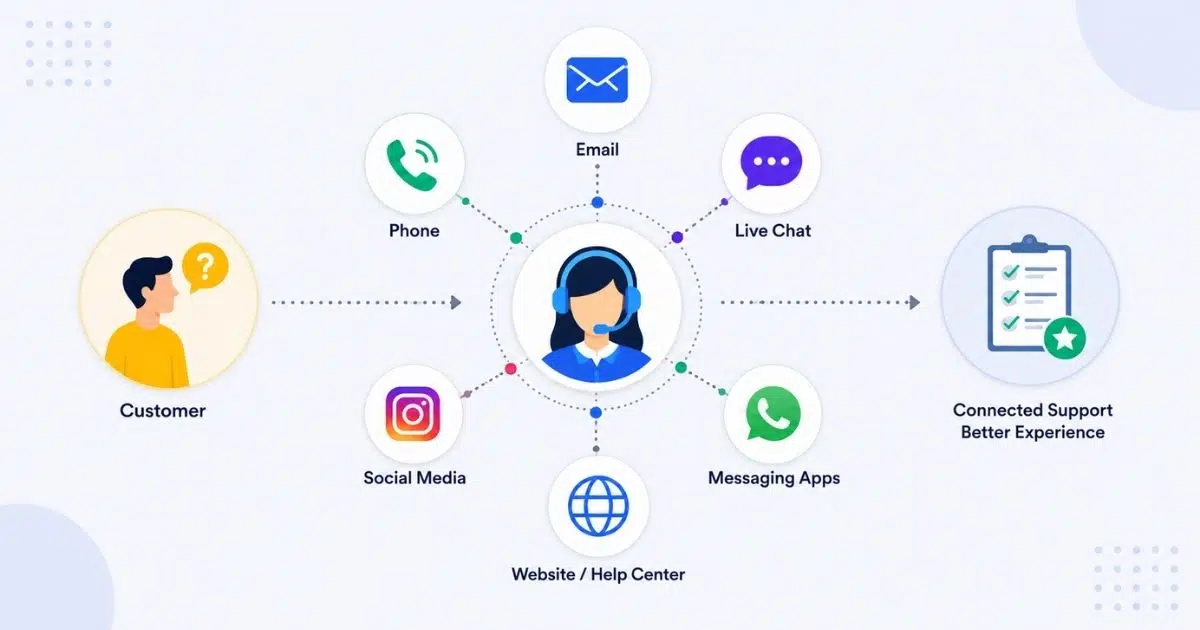
Multichannel support is a customer service approach that allows businesses to assist customers through multiple channels, including email, phone, live chat, social media, messaging apps, and physical stores. Every channel gives customers another way to reach the business, making support more accessible.
Unlike omnichannel support, each channel often operates independently. A multichannel marketing strategy follows a similar approach, where multichannel marketing focuses on expanding customer reach instead of connecting every interaction. As a result, the customer journey may feel disconnected, leading to a less consistent customer experience.
What is Omnichannel Support

Multichannel support is a customer service approach that allows businesses to assist customers through multiple channels, including email, phone, live chat, social media, messaging apps, and physical stores. Every channel gives customers another way to reach the business, making support more accessible.
Unlike omnichannel support, each channel often operates independently. A multichannel marketing strategy follows a similar approach, where multichannel marketing focuses on expanding customer reach instead of connecting every interaction. As a result, the customer journey may feel disconnected, leading to a less consistent customer experience.
Omnichannel vs Multichannel: Key Differences
Choosing between omnichannel and multichannel support affects how customers interact with your business across every touchpoint. Understanding the key differences helps you deliver better customer experiences, improve operational efficiency, and build stronger long-term customer relationships.
Feature | Omnichannel Support | Multichannel Support |
|---|---|---|
Customer Experience | Seamless and connected | Separate across channels |
Channel Integration | All channels work together | Channels operate independently |
Customer Data | Unified customer data across every channel | Customer data is stored separately |
Personalization | High, based on shared customer history | Limited to individual channels |
Communication | Consistent across touchpoints | May vary between channels |
Customer Journey | Continuous from start to finish | Often interrupted when switching channels |
Business Focus | Customer centric experience | Expanding marketing channels |
Customer Experience
The biggest difference between omnichannel vs multichannel is the customer experience. An omnichannel approach creates one connected experience regardless of how customers interact with your business. Whether they contact support through live chat, email, social media, or visit an in store location, every interaction feels like part of the same conversation.
A multichannel approach focuses on offering multiple marketing channels without fully connecting them. Customers may need to repeat information when switching channels, making the experience less convenient. Businesses that adopt customer centric omnichannel marketing strategies often achieve higher customer retention because they provide a smoother and more consistent experience throughout the full customer journey.
Channel Integration
Omnichannel support connects every communication channel into a single ecosystem. All channels share customer data, allowing support agents to view previous conversations, purchase history, and customer preferences from one place. An omnichannel marketing platform helps teams deliver faster and more personalized support.
A multichannel approach treats each communication channel as a separate system. Although customers have more ways to contact the business, those channels do not always exchange information. As a result, teams spend more time switching between systems, and customers often receive inconsistent support across different channels, which underscores the need for a structured omnichannel communication guide for support teams.
Customer Data Management
Customer data management is another major difference between omnichannel vs multichannel. Omnichannel support creates unified customer data by combining every interaction into one complete customer profile. This gives support teams the context they need to resolve issues faster and personalize every conversation.
In a multichannel environment, customer information is usually stored across separate platforms. Support agents may need to search multiple systems before helping a customer, increasing response times and reducing efficiency. Even a senior content marketing manager can see the value of centralized customer insights, as unified data helps improve customer lifetime value and supports better business decisions across every department.
Personalization
Personalization is much stronger in an omnichannel environment because every interaction is connected. Support agents can access previous conversations, purchase history, and customer preferences without asking customers to repeat information. This allows businesses to provide faster and more relevant support across every touchpoint.
A multichannel approach offers personalization within individual channels, but the experience often changes when customers move to another platform. Without shared customer context, recommendations and support become less consistent. Connected customer insights help businesses build trust and strengthen long-term relationships.
Communication Consistency
Omnichannel support keeps communication consistent across every customer touchpoint. Since channels share the same customer information, customers receive accurate updates and consistent responses whether they contact the business through live chat, email, social media, or phone.
A multichannel approach can create inconsistent communication because different teams or systems often manage different channels. Customers may receive different answers depending on where they reach out. Consistent communication improves customer confidence and reduces unnecessary follow-up conversations.
Customer Journey
Omnichannel support is designed around the full customer journey instead of individual interactions. Customers can start a conversation on one channel and continue it on another without losing context. The experience remains connected from the first inquiry to post-purchase support.
A multichannel strategy focuses on providing several communication options rather than connecting them. Customers may begin on one channel but need to restart the conversation after switching to another. That extra effort can increase frustration and reduce overall satisfaction throughout the customer journey.
Business Goals And Strategy
The business objective is another important difference between omnichannel vs multichannel. Omnichannel businesses focus on creating a customer-centric experience that connects sales, marketing, and customer support. This strategy improves operational efficiency, increases customer loyalty, and contributes to higher customer retention over time.
A multichannel approach primarily aims to expand customer reach by adding more communication and marketing channels. While this increases accessibility, disconnected systems can make it difficult to deliver a seamless experience. Businesses that invest in connected customer experiences often improve customer lifetime value because every interaction supports stronger, long-term relationships.
Benefits Of Omnichannel Customer Service

Omnichannel customer service helps businesses deliver faster, more consistent, and more personalized support. Instead of treating every communication channel separately, it connects customer conversations, giving support teams the context they need to resolve issues efficiently and build stronger customer relationships.
Connected Customer Conversations
Customers rarely use just one communication channel. They may start with live chat, continue through email, and follow up on social media or phone. Omnichannel customer service connects every interaction into one continuous conversation, allowing agents to pick up where the previous discussion ended.
This eliminates repeated explanations and creates a smoother support experience. Customers spend less time repeating information, while support teams resolve issues more quickly with complete conversation history available from the first response.
Complete Customer Context
Support quality improves when agents have access to complete customer information. An omnichannel platform combines previous conversations, purchase history, support tickets, customer preferences, and account details into one centralized profile.
With complete customer context, agents can understand problems faster and provide more relevant solutions. They no longer need to switch between multiple systems or ask customers for information that has already been shared. Better context also helps teams deliver more personalized support throughout the customer journey.
Higher CSAT And NPS
Fast and consistent service has a direct impact on customer satisfaction. When customers receive the same level of support across every communication channel, they are more likely to trust the business and return in the future.
A connected support experience often leads to higher Customer Satisfaction (CSAT) and Net Promoter Score (NPS). Customers appreciate shorter resolution times, personalized interactions, and seamless communication. Those positive experiences encourage repeat business and increase the likelihood of customer recommendations.
Improved Agent Productivity
Disconnected support tools slow agents down. Searching multiple systems for customer information wastes valuable time and reduces the number of requests agents can handle each day.
Omnichannel customer service improves productivity by bringing conversations, customer data, and workflows into one platform. Agents spend less time switching between tools and more time helping customers. Better visibility also allows managers to balance workloads, monitor performance, and improve team efficiency without adding unnecessary complexity.
Stronger Customer Loyalty
Customer loyalty is built through consistent positive experiences rather than one successful interaction. Omnichannel customer service helps businesses deliver reliable support every time customers reach out, regardless of the communication channel they choose.
When customers know their history is recognized and their issues are handled efficiently, they develop greater confidence in the brand. Stronger relationships increase repeat purchases, improve customer retention, and raise customer lifetime value. Over time, businesses that invest in connected customer experiences build long-term loyalty while reducing the cost of acquiring new customers.
Omnichannel vs Multichannel: Real-World Examples

Real businesses show the difference between omnichannel vs multichannel better than theory alone. While both approaches help brands reach customers through different channels, the customer experience depends on how those channels work together. The following examples show how connected systems improve engagement, while multiple independent channels often create fragmented experiences.
Starbucks: Connected Omnichannel Experience
Starbucks is one of the strongest examples of omnichannel support and customer engagement. Its mobile app connects Rewards, digital payments, gift cards, and in-store purchases into one customer profile. Customers can place an order through the mobile app, earn rewards, reload gift cards, and pick up their drinks without losing account information or purchase history.
Rather than treating every touchpoint separately, omnichannel marketing connects every interaction into one seamless experience. Starbucks also uses customer insights to personalize marketing campaigns and meet changing customer expectations, making it a leading example of how ecommerce brands and retailers build loyalty through connected experiences.
Nike: Unified Customer Journey
Nike has built a sophisticated omnichannel strategy by connecting its website, Nike App, Nike Membership, and physical stores. Customers can browse products, reserve items, receive personalized recommendations, and access exclusive member benefits using one account across every touchpoint.
Unlike businesses that operate through different channels independently, Nike removes data silos by keeping customer information synchronized. Omnichannel marketing integrates digital marketing, retail experiences, and membership benefits to create one continuous journey. The result is a more personalized shopping experience that encourages repeat purchases and stronger customer relationships.
Macy's: Traditional Multichannel Strategy
Macy's represents a more traditional multichannel retail model where customers can shop through its website, physical stores, email, catalogs, and customer service. Every channel helps the company reach customers, but interactions may not always remain connected as customers move between touchpoints.
This approach reflects the difference between omnichannel vs multichannel. A multichannel strategy expands customer access across different channels, while omnichannel support focuses on connecting those channels into one experience. Businesses that rely on multiple independent channels often face data silos and inconsistent customer journeys, making it harder to deliver the seamless service modern customers expect.
What Multichannel Gaps Cost Your Support Team

Small gaps between support channels quickly become bigger operational problems. When every particular channel operates independently, teams lose valuable context, customers repeat themselves, and service quality declines. Modern customers expect fast, connected support across multiple touchpoints, making integrated service more important than ever.
Repeated Customer Conversations
Customers often contact support through different channels when they need faster answers. If every particular channel stores information separately, agents cannot see previous conversations.
As a result, customers repeat the same issue several times. Poor cross-channel orchestration creates frustration and weakens customer loyalty because every interaction feels like a new conversation.
Slower Response And Resolution Times
Support agents work more slowly when customer information is scattered across different systems. They spend valuable time searching emails, tickets, and chat histories before solving a problem.
Without unified data, response times increase and issue resolution takes longer. A connected customer experience allows agents to access the right information immediately and serve customers more efficiently.
Disconnected Customer Data
Customer information becomes fragmented when every channel operates independently. Purchase history, previous tickets, and communication records remain in separate systems instead of one central location.
Weak data infrastructure makes it difficult to build unified customer profiles. Support teams lose important context, making personalized service much harder to deliver across multiple touchpoints.
Lower Agent Productivity
Disconnected tools force support agents to switch between several platforms throughout the day. Valuable working time is spent searching for information instead of helping customers.
Unified customer profiles eliminate unnecessary manual work and simplify daily tasks. Better visibility allows agents to resolve more conversations with greater accuracy while improving overall team productivity.
Inconsistent Customer Experience
Customers expect the same quality of support regardless of the channel they choose. When communication is disconnected, answers, policies, and recommendations can differ between channels.
Businesses struggle to deliver consistent customer experiences because every channel works in isolation. Strong cross-channel orchestration helps organizations create cohesive customer experiences that build trust and strengthen long-term customer relationships.
Higher Support Operating Costs
Operational costs increase when teams spend extra time handling repeated requests and searching for missing customer information. Inefficient workflows also require more resources to manage growing support volumes.
Investing in unified data and connected systems helps businesses reduce unnecessary work while improving service quality. Better support operations increase customer loyalty, strengthen lifetime value, and allow the marketing team to align customer service with broader marketing strategies.
Signs You’ve Outgrown Multichannel Support
Multichannel support may work during the early stages of growth, but disconnected systems eventually slow your team down. When customers use different preferred channels, they expect the same experience every time. If channel integration is missing, service becomes inconsistent and inefficient, revealing the limitations of even a well-designed multi-channel customer support strategy.
An omnichannel approach solves those problems by connecting interactions through centralized data, helping even a small marketing team deliver better support and more effective targeted messaging.
- Customers Repeat Information: Customers must explain the same issue whenever they switch from one channel to another because conversation history is not shared.
- Support Channels Work Separately: Every channel operates independently, making it difficult to provide consistent service across customers' preferred channels, even when you invest in sophisticated multi-channel customer support software.
- Customer Data Is Scattered: Without centralized data, agents spend more time searching for information than solving customer issues.
- Marketing And Support Are Disconnected: Email, social media, and direct mail campaigns are planned separately, reducing the effectiveness of targeted messaging.
- Reports Show Partial Insights: Performance is measured by one channel instead of giving a complete view of the customer journey, making it harder to benefit from robust conversation management software and holistic reporting.
- Customer Expectations Keep Rising: Modern customers expect fast, connected support. Moving to an omnichannel approach helps businesses deliver a more consistent experience across every touchpoint.
What to Look for in an Omnichannel Support Tool

The right omnichannel support tool should do more than combine communication channels. It should connect customer conversations, simplify team workflows, and give agents the context they need to deliver personalized service. Whether you support a growing customer base or manage enterprise operations, choosing the right platform, such as a secure, efficient EasyDesk customer support platform, helps create consistent experiences across digital channels.
Unified Inbox
A unified inbox brings messages from email, live chat, social media, messaging apps, and other digital channels into one workspace. Instead of switching between multiple platforms, agents manage every conversation from a single screen, similar to how dedicated multichannel helpdesk software centralizes support workflows.
This reduces missed messages, improves response times, and helps teams maintain consistent messaging. Many retail brands use unified inboxes to simplify support while serving customers across separate channels.
Cross-Channel Conversation History
Customers often move between different channels before an issue is resolved. Your support tool should preserve every interaction so agents always understand the complete conversation, much like modern conversation management software does for growing support teams.
Access to conversation history prevents customers from repeating information and allows agents to continue discussions without interruption. Real world examples from leading ecommerce businesses show that connected conversations improve customer satisfaction and reduce handling time.
Customer Profile And Context
Every support agent should have immediate access to customer information before responding. A complete customer profile should include previous conversations, purchase history, support tickets, and preferences in one place, supported by robust EasyDesk customer support features such as centralized ticket management and real-time data.
Access to real time data allows agents to deliver personalized service instead of generic responses. Whether a customer speaks with a sales rep or a support agent, everyone works from the same information, creating a more connected experience.
Automation And AI Capabilities
Automation helps support teams manage repetitive work while improving response speed. Look for features such as automatic ticket routing, AI-powered responses, workflow automation, and intelligent conversation assignments provided by modern automated workflow software for support.
Automation also improves multichannel campaigns by ensuring customer requests reach the right department without delays. Faster support reduces acquisition costs because satisfied customers are more likely to return instead of switching to competitors, which is exactly what dedicated ticket automation software is designed to achieve.
Third-Party Integrations
An effective omnichannel platform should integrate with the tools your business already uses. CRM systems, ecommerce platforms, payment gateways, marketing software, and collaboration tools should all exchange information automatically when connected through a modern help desk platform for support teams.
Strong integrations eliminate separate channels of customer data and keep every department aligned. Whether you operate as an omnichannel retailer or a service-based business, connected systems such as multi channel support software for customer service improve efficiency and create a smoother customer experience.
Reporting And Performance Analytics
Reporting tools help businesses measure support quality and identify areas for improvement. Look for dashboards that track response times, resolution times, customer satisfaction, agent performance, and channel performance, which are core capabilities of modern automated ticket management software.
Detailed analytics show how customers interact across individual channels while also providing a complete business view. Better reporting helps teams make informed decisions, optimize support operations, and evaluate options such as the best multichannel helpdesk software platforms to deliver more consistent messaging as the customer base continues to grow.
How EasyDesk Makes the Switch to Omnichannel Easy
Moving from multichannel to omnichannel support does not have to be complicated. EasyDesk helps teams manage customer conversations from email, live chat, and social media in one place, reducing the need to switch between separate tools, and its live chat support for real-time conversations makes it easier to engage customers instantly.
Shared conversation history, smart ticket routing, workflow automation, SLA tracking, and a centralized knowledge base help agents respond faster with better context, while streamlined support ticket management keeps ownership and priorities clear. EasyDesk also uses AI features such as smart triage and conversation summaries to improve efficiency, further bridging the gap between manual vs automated ticketing approaches for modern support teams.
As your support team grows, the platform provides a structured way to deliver more consistent customer experiences without adding unnecessary complexity, especially when paired with thoughtful ticket automation workflows for support.
Frequently Asked Questions
Can A Business Use Both Omnichannel And Multichannel Support?
Yes. Many businesses start with a multichannel setup and gradually adopt omnichannel capabilities. During the transition, some channels may remain independent while others become connected. The goal is to unify customer data and conversations over time without disrupting daily support operations.
How Long Does It Take To Switch To Omnichannel Support?
The timeline depends on your existing tools, data quality, and business size. Organizations with integrated CRM and support systems can transition more quickly, while businesses using disconnected platforms may need additional planning, data migration, and workflow updates before fully adopting an omnichannel model.
Which Industries Benefit Most From Omnichannel Support?
Omnichannel support benefits almost every industry, especially ecommerce, SaaS, retail, healthcare, financial services, and telecommunications. Any business that serves customers across multiple communication channels can improve response quality, customer satisfaction, and operational efficiency through a connected support experience.
What Is The Biggest Challenge When Moving To Omnichannel Support?
The biggest challenge is connecting customer data across existing systems. Many organizations store customer information in separate tools, making it difficult to create a complete customer profile. Successful implementation requires system integration, clean data, and well-defined support workflows.
How Can You Measure The Success Of An Omnichannel Strategy?
Success should be measured using both operational and customer-focused metrics. Common KPIs include first response time, average resolution time, first contact resolution, customer satisfaction (CSAT), Net Promoter Score (NPS), customer retention, and channel utilization. Tracking these metrics over time helps businesses evaluate whether their omnichannel strategy is improving both service quality and overall efficiency.